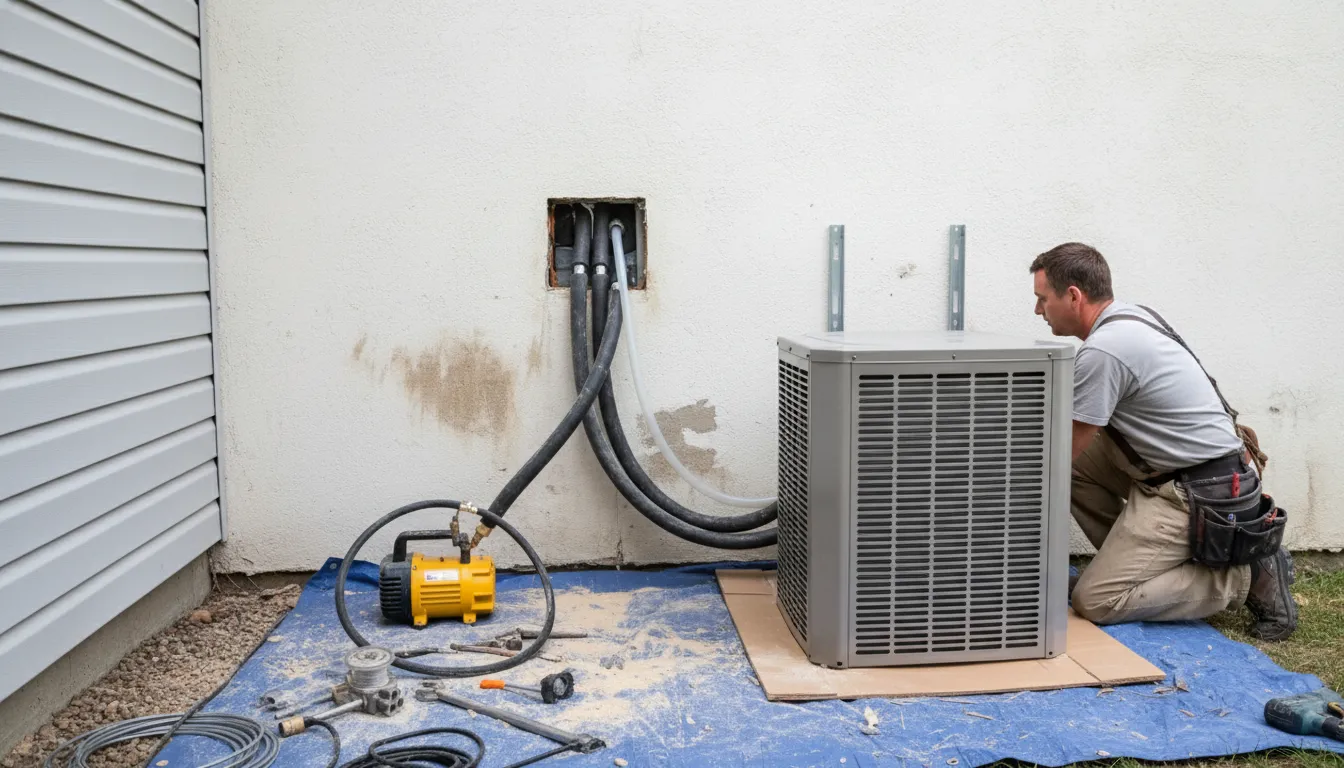
Find the Best Heat Pump Installation & Replacement Contractors for Your Business
No obligation • Fast responses • Nationwide coverage

Why you can trust HVAC Firms
HVAC Firms is a leading United States resource for evaluating HVAC service providers. Our team researches companies, checks credentials, and reviews customer feedback to present clear, unbiased information. Listings and rankings are based on merit, and companies cannot pay to change our editorial content.
Search providers near you
Best Heat Pump Installation & Replacement Contractors in North Carolina Ranked
Upgrading to a heat pump is a smart decision for North Carolina homeowners seeking year-round comfort, lower energy bills, and a reduced carbon footprint. These efficient systems provide both heating and cooling from a single unit, making them an excellent choice for the state's varied climate. This guide provides clear, actionable information on heat pump types, costs, and the substantial financial incentives available in North Carolina to help you make an informed decision and connect with qualified local professionals.
McClintock Heating and Cooling
3032 Eaton Avenue Suite 103, Indian Trail, NC 28079
McClintock Heating and Cooling is a locally owned and fully licensed HVAC company serving Charlotte, NC, and surrounding areas. They offer a range of heating and cooling services including repair and installation of air conditioners, furnaces, heat pumps, and indoor air quality solutions. The company also provides plumbing and electrical services, expanding their support for home and commercial comfort needs. With over 24 years of experience, McClintock Heating and Cooling focuses on tailored solutions that improve energy efficiency and system performance.
Panther Heating and Cooling
722 Corporate Blvd Suite 105, Rock Hill, SC 29730
Panther Heating and Cooling is an HVAC company based in Charlotte, NC, offering a full range of heating and cooling services including installation, repair, and maintenance of furnaces, air conditioners, heat pumps, and mini-split systems. They also provide indoor air quality solutions and smart thermostat installations. The company serves Charlotte and surrounding areas such as Rock Hill, Tega Cay, Fort Mill, Indian Land, York, Clover, Matthews, and Waxhaw. Panther Heating and Cooling emphasizes skilled, certified technicians and offers 24/7 emergency HVAC services to address urgent needs promptly.
City Air Experts Heating and Cooling
411 Foster Ave, Charlotte, NC 28203
City Air Experts Heating and Cooling is a Charlotte, NC-based company providing residential and commercial HVAC services. They offer installation, repair, and maintenance for air conditioning, furnaces, heat pumps, mini splits, and general HVAC systems. The company is a certified Trane Comfort Specialist and employs NATE-certified technicians, ensuring skilled service. Established in 2009, City Air Experts provides 24/7 emergency HVAC services to respond to urgent needs any time of day or night.
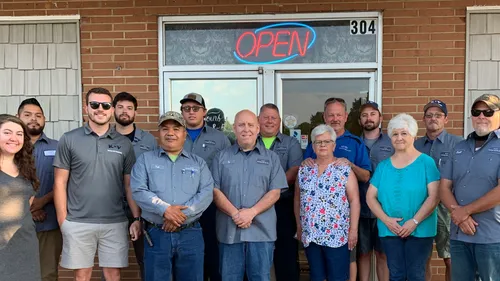
K & V Heating & Air Conditioning
304 NC-67, East Bend, NC 27018
K & V Heating & Air Conditioning has been serving Winston Salem, NC, and the surrounding East Bend area for over 20 years. This family- and veteran-owned company offers a full range of HVAC services including installation, repair, and maintenance of air conditioners, furnaces, and heat pumps. They are certified dealers for Trane®, Coleman®, Bosch®, and Amana® equipment and provide custom metal duct fabrication with insulation options. With over 30 years of industry experience, K & V Heating & Air Conditioning also offers indoor air quality products such as humidifiers and air purifiers. Their services include 24-hour emergency support and yearly preventative maintenance plans to maintain system efficiency.
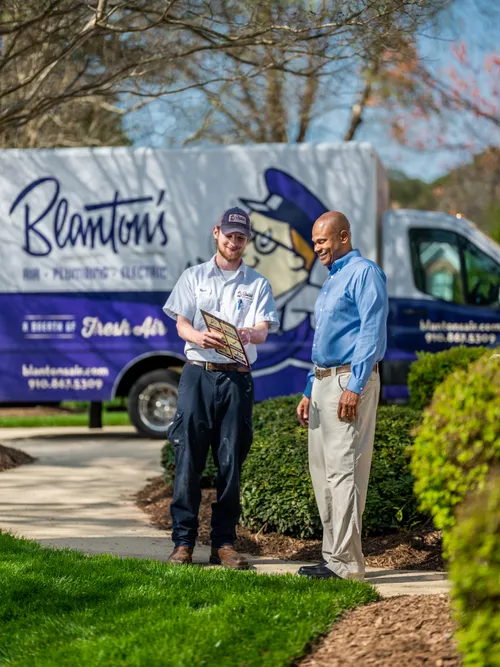
Blanton's Air, Plumbing & Electric
2000 Citation Dr Ste 100, Garner, NC 27529
Blanton's Air, Plumbing & Electric has been serving Raleigh, NC, and the surrounding Triangle area since 1951. They provide a wide range of home services including HVAC repair and installation for air conditioners, furnaces, heat pumps, and boilers. With over 75 years of experience, they offer comprehensive maintenance and emergency services to ensure home comfort and safety year-round. Their team is available 24/7, including after-hours support through an AI representative and live customer care, prioritizing urgent needs and flexible scheduling.
Why Choose a Heat Pump for Your North Carolina Home?
Heat pumps are uniquely suited to North Carolina's climate, which features hot, humid summers and generally mild winters. Unlike traditional furnaces that generate heat, a heat pump transfers heat, moving it indoors during winter and outdoors during summer. This process is significantly more energy-efficient. For every unit of electricity consumed, a high-efficiency heat pump can move two to three units of heat, leading to substantial savings on your utility bills, especially if you're replacing an older electric resistance (strip) heating system.
Beyond efficiency, modern heat pumps offer superior comfort with more consistent temperatures and better humidity control during the cooling season. They also represent a cleaner heating option, as they run on electricity and can be paired with renewable energy sources, helping to lower your household's environmental impact.
Types of Heat Pump Systems
Understanding the different types of heat pumps is the first step in selecting the right system for your home's layout and needs.
Central Ducted Heat Pumps
This is the most common type, ideal for homes with existing ductwork for central air conditioning. A central heat pump replaces both your outdoor air conditioner and indoor furnace or air handler, utilizing the same ducts to distribute conditioned air. It's a seamless upgrade for many North Carolina homes and is eligible for most state and utility rebates.
Ductless Mini-Split Heat Pumps
Mini-splits are a versatile solution for homes without ducts, for room additions, or for enhancing comfort in specific areas like sunrooms or garages. They consist of an outdoor compressor unit connected to one or more indoor air handlers mounted on walls or ceilings. This "zoned" approach allows for individual temperature control in different rooms, improving efficiency and comfort. They are a popular choice for older homes or targeted comfort solutions.
Geothermal (Ground-Source) Heat Pumps
Geothermal systems are the most efficient type, leveraging the stable temperature of the earth to heat and cool your home. While they have the highest upfront installation cost due to the required ground loop (a series of pipes buried in your yard), they offer the lowest operating costs and longest equipment lifespan. They are an excellent long-term investment, particularly for new construction or properties with adequate land.
Understanding Heat Pump Efficiency Ratings
When comparing models, two key metrics indicate efficiency: SEER (Seasonal Energy Efficiency Ratio) and HSPF (Heating Seasonal Performance Factor).
- SEER measures cooling efficiency. The higher the number, the more efficient the unit is at cooling.
- HSPF measures heating efficiency. A higher HSPF indicates better heating performance.
To qualify for important rebates in North Carolina, your system must meet specific efficiency thresholds. For example, Duke Energy's rebate program requires a heat pump with a rating of at least 16.8 SEER and 9.0 HSPF (or their updated SEER2/HSPF2 equivalents). Always look for the ENERGY STAR® label, as this certification is a baseline requirement for most federal and state financial incentives.
Financial Incentives and Rebates in North Carolina
A significant advantage of installing a heat pump in North Carolina right now is the unprecedented availability of financial incentives that can dramatically reduce your net cost.
Energy Saver NC State Rebates
The state's flagship program, Energy Saver NC, offers substantial point-of-sale rebates for qualifying heat pump installations. The rebate amount is tiered based on household income, with the highest incentives targeted at low- and moderate-income residents. Rebates can be as high as $8,000 for an ENERGY STAR certified heat pump 1 2 3. This program also includes rebates for supporting upgrades like heat pump water heaters and necessary electrical panel work.
Federal Tax Credits
The federal Residential Clean Energy Tax Credit provides a tax credit worth 30% of the total installation cost, up to a maximum of $2,000 per year 4 5 6. This credit applies to the purchase and installation of qualified heat pumps and can be combined with state rebates for even greater savings.
Utility-Specific Rebates
Many North Carolina utilities offer their own incentives. A prominent example is Duke Energy, which provides a $1,000 rebate for replacing an electric strip heat system with a qualifying high-efficiency heat pump 7 8. Always check with your local electric cooperative or municipal utility for available programs.
Crucial Requirement: To receive the Energy Saver NC rebate and most utility incentives, your installation must be performed by a registered contractor. DIY installations do not qualify.
Find the perfect heat pump installation & replacement contractors for your needs
Get personalized recommendations and expert advice
Heat Pump Cost Overview in North Carolina
The total investment for a heat pump system varies based on type, capacity, efficiency, and home-specific installation factors. Here is a general cost range for North Carolina:
- Central Ducted Heat Pump: $4,500 - $10,000+ 9
- Ductless Mini-Split System: $2,000 - $15,000+ (cost increases with the number of indoor zones)
- Geothermal Heat Pump System: $10,000 - $50,000+ 10
Remember, these are pre-incentive costs. By strategically combining the Energy Saver NC rebate, federal tax credit, and utility rebates, your final out-of-pocket expense can be significantly lower.
The Installation Process: What to Expect
A professional installation is critical for performance, efficiency, and rebate eligibility. The process typically involves:
- Initial Consultation: A certified technician will assess your home's size, insulation, existing ductwork, and electrical service to recommend the properly sized system.
- System Selection: You'll review options that fit your home, comfort goals, and budget, focusing on models that qualify for available incentives.
- Rebate Pre-Qualification: Your contractor should help you navigate the pre-approval or application process for state and utility rebates.
- Professional Installation: This includes removing old equipment, installing the new outdoor and indoor units, connecting refrigerant lines and electrical wiring, and integrating with your thermostat and duct system (if applicable).
- Testing & Commissioning: The technician will test the system, check refrigerant charge, ensure airflow is correct, and verify all components are working efficiently.
- Rebate Fulfillment: Your contractor will often handle the final rebate paperwork, with the incentive applied as a discount at checkout or via direct reimbursement.
Maximizing Your Investment
To get the most from your new heat pump:
- Schedule Regular Maintenance: Bi-annual maintenance (spring and fall) ensures peak efficiency, prevents breakdowns, and extends the system's life.
- Upgrade Your Thermostat: A programmable or smart thermostat can optimize your system's operation for savings and comfort.
- Address Home Envelope Issues: Sealing air leaks and adding insulation in your attic and walls helps your heat pump work less to maintain comfort, lowering bills further.
- Keep Records: Save all invoices, model numbers, and rebate documentation for warranty service and future reference.
Frequently asked questions
Sources
Footnotes
-
Energy Efficiency Rebates | NC DEQ - https://www.deq.nc.gov/energy-climate/state-energy-office/energy-saver-north-carolina/energy-efficiency-rebates ↩
-
Energy Saver North Carolina | NC DEQ - https://www.deq.nc.gov/energy-climate/state-energy-office/energy-saver-north-carolina ↩
-
North Carolina Department of Environmental Quality Launches State ... - https://www.deq.nc.gov/news/press-releases/2025/01/16/north-carolina-department-environmental-quality-launches-state-home-energy-rebate-program-energy ↩
-
Home Upgrades | Department of Energy - https://www.energy.gov/save/home-upgrades ↩
-
Inflation Reduction Act | Tax Credits, Rebates, Greensboro - https://suttonbros.com/inflation-reduction-act/ ↩
-
Heat Pump Tax Credit | Federal Incentives for Energy Savings - https://www.carrier.com/residential/en/us/products/heat-pumps/heat-pump-tax-credits/ ↩
-
Rebate for HVAC Replacement - Duke Energy - https://www.duke-energy.com/Home/Products/Home-Energy-Improvement/HVAC-Replacement?jur=FL01 ↩
-
Breaking Down North Carolina Energy Efficiency Rebates - https://caseyserviceshvac.com/blog/breaking-down-north-carolina-energy-efficiency-rebates/ ↩
-
How Much Does an HVAC Cost to Replace in North Carolina? - https://lmwilson.com/blog/how-much-does-an-hvac-cost-to-replace-in-north-carolina/ ↩
-
Heat Pump Replacement Cost: A Complete Guide for Wake Forest/ ... - https://caseyserviceshvac.com/blog/heat-pump-replacement-cost-a-complete-guide-for-wake-forest-raleigh-homeowners/ ↩