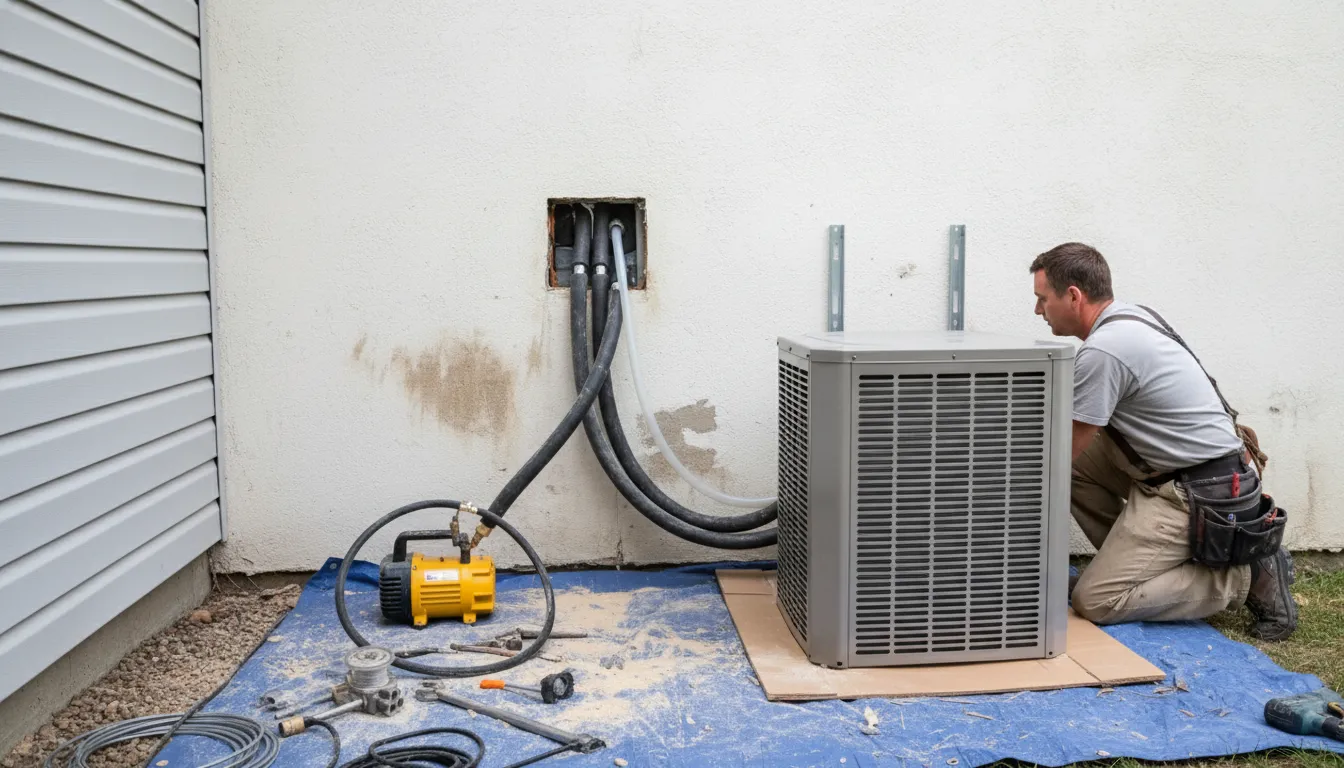
Find the Best Heat Pump Installation & Replacement Contractors for Your Business
No obligation • Fast responses • Nationwide coverage

Why you can trust HVAC Firms
HVAC Firms is a leading United States resource for evaluating HVAC service providers. Our team researches companies, checks credentials, and reviews customer feedback to present clear, unbiased information. Listings and rankings are based on merit, and companies cannot pay to change our editorial content.
Search providers near you
Top Heat Pump Installation & Replacement Contractors in Louisville, Kentucky Ranked
A heat pump is a versatile, all-in-one system that provides both heating and cooling for your Louisville home by moving heat rather than generating it. This technology is especially valuable in our variable climate, offering efficient year-round comfort and significant energy savings compared to traditional systems. This guide will help you understand your options, from air-source to geothermal units, and how to connect with qualified local professionals for a seamless installation or replacement project.
Cool Dog HVAC (HEATING & COOLING)
4223 Produce Rd, Louisville, KY 40218
Cool Dog HVAC (HEATING & COOLING) is a family and veteran-owned HVAC company serving Louisville, KY. They provide a range of heating and cooling services including installation, repair, and maintenance for air conditioners, furnaces, heat pumps, and thermostats. The company also offers ductwork design and installation, using local metal fabricators for parts. Cool Dog HVAC supports various brands, with a focus on Ruud, and provides warranties on new equipment installs. Their team emphasizes customer comfort and safety, with a commitment to ongoing training and technology updates.
Ricks Repair Heating & Cooling
9587 IN-64, Georgetown, IN 47122
Ricks Repair Heating & Cooling is a family-owned HVAC company serving Louisville, KY, and nearby Indiana areas including Jeffersonville, Sellersburg, and Floyds Knobs. With 20 years of experience, they provide heating and cooling services such as repairs, maintenance, and new installations for furnaces, air conditioners, heat pumps, and complete HVAC systems. Their technicians are trained with current industry knowledge and equipped to handle all makes and models, offering thorough service calls with fully stocked trucks. The company is licensed and accredited by the Better Business Bureau, emphasizing honest work and fair pricing.
Energy Control Heating & Air
251 Terry Blvd, Louisville, KY 40229
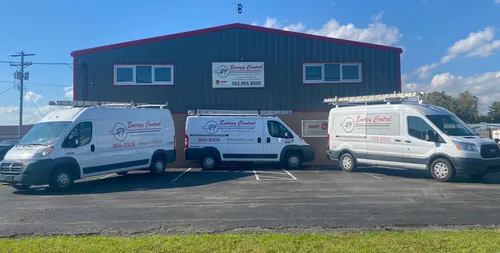
Energy Control Heating & Air is a family-owned HVAC company serving Louisville, KY, since 1987. They provide heating and cooling installation, repair, and maintenance services, including ductless mini-split systems and indoor air quality solutions. As a certified Trane Comfort Specialist, they offer premium HVAC products backed by extended warranties. Their team focuses on honest assessments and transparent pricing to meet each home's specific needs.
Comfort Technologies
Louisville, KY
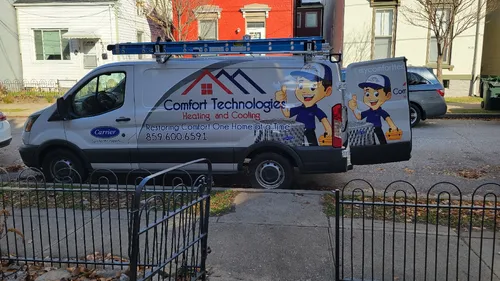
Comfort Technologies is an HVAC company serving Louisville, KY, and the surrounding communities, including Lexington. They provide installation, repair, and maintenance services for air conditioners, furnaces, heat pumps, geothermal systems, and ductless split systems. As a licensed Carrier dealer, they offer a range of indoor comfort products such as programmable thermostats, humidifiers, and air cleaners. Comfort Technologies specializes in HVAC tune-ups and emergency repairs, with 24/7 availability to assist customers. They emphasize customizing solutions to fit unique needs and have experience installing many systems in the area.
Dauenhauer Plumbing Heating Air & Electric
815 Taylorsville Rd, Shelbyville, KY 40065
Dauenhauer Plumbing Heating Air & Electric is a home services provider based in Louisville, KY, offering plumbing, HVAC, and electrical services. With over 65 years of experience serving Kentucky homeowners, they provide a wide range of services including air conditioning repair and installation, furnace and heat pump services, indoor air quality solutions, and plumbing repairs. Their capabilities include hydro jetting and video camera inspections for drain and sewer issues. The company also offers 24/7 emergency services to address urgent plumbing, heating, and air conditioning needs.
Why Choose a Heat Pump for Your Louisville Home?
Louisville's distinct seasons-hot, humid summers and chilly winters-make an efficient, dual-purpose system like a heat pump an ideal choice. Unlike a furnace that creates heat, a heat pump simply transfers it, making it incredibly efficient for both warming and cooling your living space1. Modern models are designed to perform effectively even during our colder snaps, providing consistent comfort while reducing your overall energy consumption. For homeowners looking to upgrade an old air conditioner and furnace or seeking a more efficient solution, a heat pump installation can be a smart long-term investment.
Types of Heat Pump Systems
Understanding the different types of heat pumps is the first step in selecting the right one for your home's layout and your budget.
Air-Source Heat Pumps (ASHP)
The most common and affordable type, air-source heat pumps transfer heat between your home and the outside air. They typically come as split systems with an outdoor unit and an indoor air handler, often integrating with existing ductwork. This makes them a straightforward replacement for many traditional central air systems.
Ductless Mini-Split Heat Pumps
If your home lacks ductwork or you want to add climate control to a specific area like a sunroom or garage, a ductless mini-split is an excellent solution. These systems consist of an outdoor compressor connected to one or more quiet, wall-mounted indoor units. They offer "zoning" capabilities, allowing you to control temperatures in individual rooms for maximum efficiency and comfort 2.
Geothermal Heat Pumps
Also known as ground-source heat pumps, these are the most efficient option available. They exchange heat with the stable temperature of the earth through a series of underground pipes (loops). While they offer the lowest operating costs and are exceptionally durable, the installation is more invasive and complex, leading to a significantly higher upfront cost3.
Key Features and Efficiency Ratings
When comparing heat pump models, you'll encounter specific ratings that indicate performance and potential savings.
- SEER2 and HSPF2: These are the latest efficiency standards. SEER2 (Seasonal Energy Efficiency Ratio) measures cooling efficiency, while HSPF2 (Heating Seasonal Performance Factor) measures heating efficiency. As of 2023, the new minimum standard is around 15 SEER2 and 7.5 HSPF2. Aiming for a unit with 18-20 SEER2 will provide greater energy savings over its lifespan.
- Compressor Staging: This affects comfort and efficiency.
- Single-Stage: Operates at 100% capacity when on. Simpler but less efficient.
- Two-Stage: Operates at a lower capacity (e.g., 70%) most of the time, ramping up to full power only on the hottest or coldest days. This improves efficiency, humidity control, and temperature consistency.
- Variable-Speed: The most advanced option, it adjusts its output in small increments to precisely match your home's heating or cooling demand. This provides superior comfort, excellent humidity removal, and the highest efficiency, making it a great match for Louisville's fluctuating weather4 5.
Understanding Heat Pump Costs in Louisville
The total cost for a heat pump installation or replacement in Louisville varies widely based on system type, size, efficiency, and the specifics of your home. Always view pricing as an investment where higher efficiency models cost more upfront but save substantially on monthly utility bills.
Here's a general breakdown of what homeowners might expect 6 7 8:
- Basic Air-Source System Replacement: $5,000 - $7,500. This typically covers a standard-efficiency, properly sized unit replacing an existing system with minimal ductwork modifications.
- Mid-Range / Advanced System: $7,500 - $10,000. This range includes higher-efficiency models (higher SEER2/HSPF2), two-stage compressors, or more complex installations like a multi-zone ductless mini-split system.
- High-End / Complex Installation: $10,000 - $15,000+. This tier encompasses top-tier variable-speed air-source heat pumps, extensive ductless systems, or the installation of a geothermal heat pump system, which involves significant excavation for the ground loop.
What Influences the Final Price?
Several key factors will determine where your project falls within these ranges:
- Home Size & Unit Capacity: A professional will perform a "Manual J" load calculation to determine the correct size (in BTUs) for your home. An oversized or undersized unit will perform poorly.
- Existing Ductwork: The condition, design, and size of your current ducts may need assessment and modification to work optimally with a new heat pump.
- Labor & Installation Complexity: Accessibility, electrical upgrades, and the experience of the installing contractor affect labor costs.
- Rebates & Incentives: Federal tax credits and potential local utility rebates can significantly reduce your net cost. A qualified local installer can provide the latest information on available savings 9.
Find the perfect heat pump installation & replacement contractors for your needs
Get personalized recommendations and expert advice
The Professional Installation Process
A successful heat pump installation is more than just swapping units. It's a detailed process that ensures optimal performance and longevity.
- Initial Consultation & Load Calculation: A reputable professional will start with a thorough home assessment. This should always include a Manual J calculation to scientifically determine your home's exact heating and cooling needs-never rely on rule-of-thumb sizing.
- System Design & Quote: Based on the assessment, the contractor will recommend a properly sized system type and model, explain its features, and provide a detailed, written quote outlining all costs, equipment, and labor.
- Preparation & Installation: The old system is safely removed. The team will then install the new outdoor and indoor units, connect refrigerant lines and electrical components, and make any necessary adjustments to ductwork or electrical service.
- Testing & Commissioning: Once installed, the system is charged with refrigerant, started, and meticulously tested. The technician will verify airflow, check all modes of operation (heating and cooling), and ensure the thermostat is correctly calibrated. They should also walk you through basic operation and maintenance.
Choosing a Local Louisville Professional
Your installer's expertise is as critical as the equipment itself. Look for a licensed, insured contractor with specific experience in heat pump installations. Seek out companies with strong local reputations, like those noted for their service in the area10 11 12. Always obtain multiple detailed quotes to compare not just price, but also the proposed equipment, scope of work, warranties, and the company's professionalism. A trustworthy pro will be happy to answer all your questions, provide references, and clearly explain the benefits of their recommended system.
Maintaining Your New Heat Pump
To protect your investment and maintain peak efficiency, regular maintenance is essential. This includes simple homeowner tasks like keeping the outdoor unit clear of debris, leaves, and snow, and changing the indoor air filter regularly. You should also schedule a professional tune-up at least once a year. A technician will clean coils, check refrigerant levels, inspect electrical connections, and ensure all components are operating correctly, helping to prevent costly repairs and extend the system's life.
Frequently asked questions
Sources
Footnotes
-
Which AC System is Best For Your Louisville, KY Home? - https://ocmech.com/blog/which-ac-system-is-best-for-your-louisville-ky-home ↩
-
Heat Pump Cost Explained: What to Expect for Your Home Upgrade - https://www.leokobco.com/post/heat-pump-cost-explained ↩
-
Louisville Heat Pump Systems: Expert Installation & Service - https://www.allegiancehvac.com/heat-pump-systems-louisville-ky/ ↩
-
Heat Pumps - Louisville - Robbins Heating & Air Conditioning - https://www.robbinshvac.com/products/heat-pumps/ ↩
-
Heat Pump Price Guides - https://heatpumppriceguides.com/ ↩
-
Cost of a Heat Pump Installation in 2025 - https://www.cabshvac.com/heat-pump-installation-cost/ ↩
-
2026 Heat Pump Cost Guide: Purchase, Installation & Repair - https://www.carrier.com/residential/en/us/products/heat-pumps/how-much-does-a-heat-pump-cost/ ↩
-
HVAC Replacement Cost in Kentucky | ComfortMaster Heating & Air - https://comfortmasterheating.com/how-much-does-it-cost-to-replace-an-hvac-system-in-kentucky/ ↩
-
Preparing for HVAC Installation: 2025 Guide for Louisville and ... - https://projecthvac.com/2025/08/02/preparing-for-hvac-installation-louisville-southern-indiana/ ↩
-
2025 Cost to Replace HVAC in Louisville & Southern Indiana - HVAC Service and Repair - https://projecthvac.com/2025/06/11/cost-to-replace-hvac-louisville-southern-indiana-2025/ ↩
-
Heat Pump Installation | Louisville, KY - Absolute Services - https://absoluteservices.net/hvac/heat-pump-installation/ ↩
-
Heat Pump Installation Louisville KY | Chapman HVAC - https://chapmanengineering.net/heat-pump-installation/ ↩