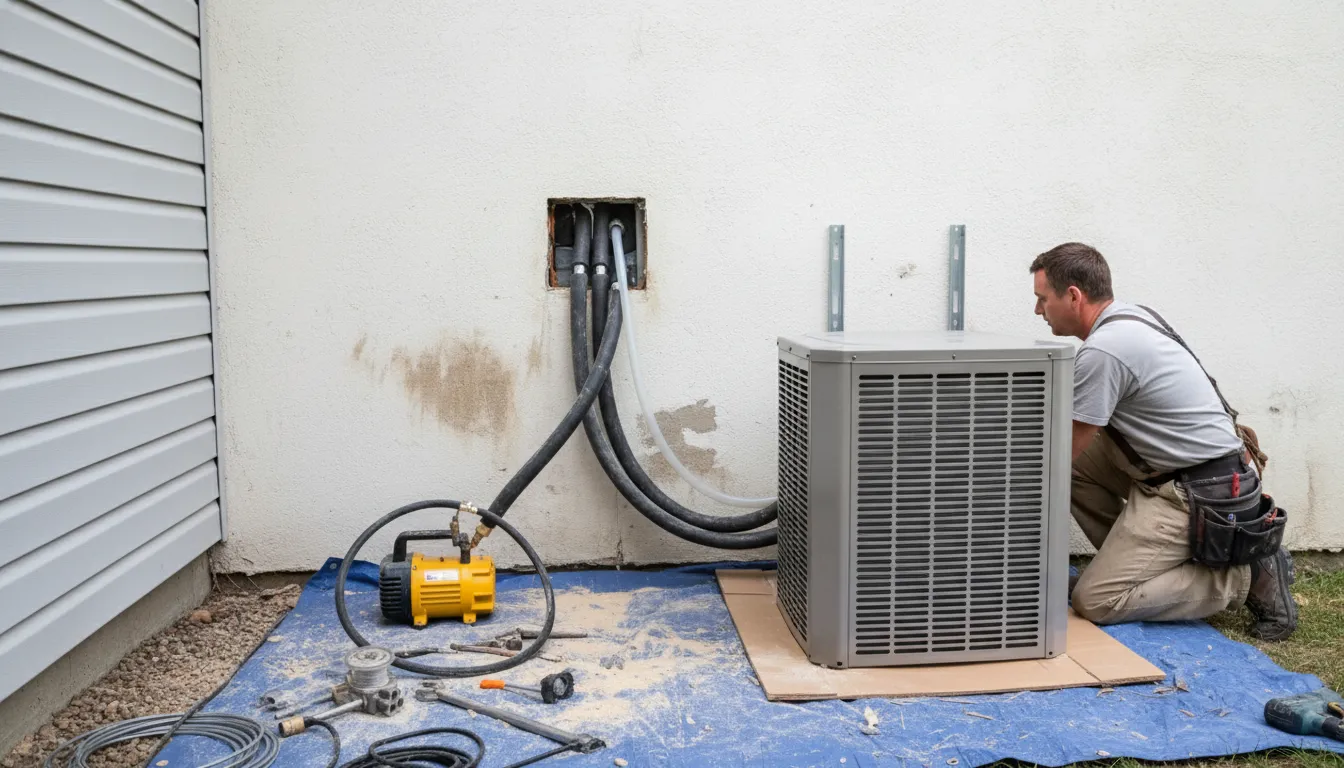
Find the Best Heat Pump Installation & Replacement Contractors for Your Business
No obligation • Fast responses • Nationwide coverage

Why you can trust HVAC Firms
HVAC Firms is a leading United States resource for evaluating HVAC service providers. Our team researches companies, checks credentials, and reviews customer feedback to present clear, unbiased information. Listings and rankings are based on merit, and companies cannot pay to change our editorial content.
Search providers near you
Top Heat Pump Installation & Replacement Contractors in Mesa, Arizona Ranked
Upgrading your home's heating and cooling system to a modern heat pump is a smart investment for Mesa residents, offering year-round comfort and significant energy savings. This technology is particularly well-suited to our desert climate, providing efficient cooling during our scorching summers and reliable, cost-effective heating in the milder winters. This guide will help you understand your options, from ducted central systems to ductless mini-splits, and the key factors like sizing, efficiency ratings, and costs, so you can make an informed decision when selecting a local provider for your project.
AZ Home Services Group of Queen Creek
23010 S 208th St, Queen Creek, AZ 85142
AZ Home Services Group of Queen Creek is a full-service HVAC and plumbing company serving the Queen Creek, AZ area. They provide air conditioning repair and installation, furnace and heat pump installation, mini-split systems, thermostat installation, and HVAC tune-ups. The company works with major brands like Goodman, Carrier, Trane, and Rheem, offering tailored HVAC solutions based on home size and insulation. They also handle plumbing services including leak detection, water softener installation, and water heater replacement. AZ Home Services Group offers 24/7 emergency AC repair to address urgent cooling needs in the hot Arizona climate.
Reliance Heating and Air Conditioning
302 W Lone Cactus Dr, Phoenix, AZ 85027
Reliance Heating and Air Conditioning is a family-owned HVAC company serving Phoenix, AZ, and the surrounding areas. They offer a range of services including air conditioning, furnace, and heat pump repair and installation, as well as HVAC tune-ups and thermostat installation. As a Trane Comfort Specialist, they provide expertise with Trane systems known for reliability and quality. With over 40 years of experience as a third-generation family business, Reliance Heating and Air Conditioning emphasizes treating customers' homes with care and professionalism.

Island Breeze Air Conditioning & Heating LLC
809 E Fairmount Ave, Phoenix, AZ 85014
Island Breeze Air Conditioning & Heating LLC is a firefighter-owned HVAC company serving Phoenix, AZ, and surrounding areas including Gilbert, Mesa, Peoria, and Surprise. They provide residential and light commercial services such as air conditioning, furnace, heat pump, and ductless HVAC installation, repair, and maintenance. Their NATE-certified technicians focus on energy-efficient solutions and indoor air quality improvements. The company emphasizes integrity, accountability, and continuous improvement in their work. Island Breeze also offers after-hours service to address urgent HVAC needs.

HVAC Near Me
947 W Redwood Dr, Chandler, AZ 85248
HVAC Near Me is an HVAC repair and installation company serving Phoenix, AZ, and the surrounding metro area. They offer a wide range of services including air conditioner, heat pump, furnace, and ductless system repair and installation, as well as thermostat installation and duct cleaning. The company provides 24/7 same-day and emergency HVAC services and works with most major air conditioner brands. Their technicians are licensed, bonded, insured, and receive ongoing training to maintain service quality. HVAC Near Me serves numerous cities across the Phoenix valley, ensuring comprehensive coverage for residential and commercial customers.

Savage Air Conditioning
2315 W Fairmont Dr, Tempe, AZ 85282
Savage Air Conditioning is a family-owned HVAC company serving Phoenix, AZ, with over 30 years of experience since 1988. They provide installation, repair, and maintenance services for air conditioning, furnaces, heat pumps, and ductless mini splits for both residential and commercial clients. The company also offers indoor air quality solutions to improve home environments and has maintenance plans to help prolong system lifespan and efficiency.
Understanding Heat Pump Technology for Arizona Homes
A heat pump is an all-in-one HVAC system that moves heat rather than generating it. In the summer, it acts like a standard air conditioner, extracting heat from inside your home and releasing it outdoors. In the winter, the process reverses, pulling ambient heat from the outside air (even cool air contains heat energy) and transferring it indoors. This method of heat transfer is far more energy-efficient than traditional furnaces that burn fuel to create heat, making heat pumps a cornerstone of modern, efficient home comfort.
For Mesa homeowners, the primary appeal is exceptional cooling efficiency. Given our long, intense cooling season, even a modest improvement in efficiency can translate to substantial savings on monthly utility bills. Modern systems are designed to perform reliably in our high temperatures, making a heat pump installation or replacement a practical upgrade for both new builds and existing homes looking to replace an aging AC and furnace combo.
Types of Heat Pump Systems: Ducted vs. Ductless
Choosing the right type of system is your first major decision. The best choice depends on your home's existing infrastructure and your comfort goals.
Ducted (Central) Heat Pumps
This is the most common whole-home solution, especially for replacements. A ducted system uses a single outdoor unit connected to an indoor air handler that distributes conditioned air through a network of ducts in your walls, ceilings, or floors.
- Best For: Homes with existing, functional ductwork. It provides consistent, whole-house temperature control.
- Replacement Scenario: Often, a new heat pump can directly replace an old central air conditioner and furnace, utilizing the same ductwork and electrical connections, which can streamline the installation process.
- Considerations: The condition of your existing ducts is critical. Leaky or poorly insulated ducts can undermine the efficiency of even the best system. A professional assessment is essential to determine if duct sealing, repair, or full replacement is needed.
Ductless Mini-Split Heat Pumps
These systems consist of one or more compact indoor air-handling units mounted on walls or ceilings, connected by a small conduit to an outdoor condenser. They do not require ductwork.
- Best For: Homes without existing ducts (like older homes with swamp coolers), room additions, sunrooms, garages, or for creating independent "zones" with different temperature settings 1 2.
- Advantages: Installation is typically less invasive and can be faster than a ducted system. They offer superior zoning capabilities, allowing you to cool or heat only the rooms you're using, which can lead to additional energy savings.
- Configuration: You can install a single-zone system (one outdoor unit to one indoor head) or a multi-zone system (one outdoor unit connected to multiple indoor heads) 3.
Geothermal (Ground-Source) Heat Pumps
While the most efficient type of heat pump by exchanging heat with the ground, these systems have a very high upfront cost due to the extensive ground-loop installation required. They are less common for standard residential replacements in Mesa but can be a viable option for new construction on suitable lots where long-term savings are a priority.
Key Factors for Your Mesa Heat Pump Project
Sizing is Everything
An improperly sized system is a leading cause of discomfort, high bills, and premature failure. A unit that's too large will "short cycle"-turning on and off rapidly-failing to dehumidify your home properly and wearing out components. One that's too small will run constantly, struggling to keep up on the hottest days. A qualified technician will perform a Manual J load calculation, which considers your home's square footage, insulation, window types, ceiling height, and local climate to determine the precise capacity (measured in tons) needed.
Efficiency Ratings: SEER and HSPF
Understanding these ratings is key to comparing systems and predicting operating costs.
- SEER (Seasonal Energy Efficiency Ratio): Measures cooling efficiency. The higher the SEER, the more efficient the cooling. Arizona state code requires new central systems to have a minimum SEER of 15, but high-performance models can reach SEER 20+. Investing in a higher SEER unit is especially valuable in Mesa.
- HSPF (Heating Seasonal Performance Factor): Measures heating efficiency. A higher HSPF indicates more efficient heating performance. Look for units with an HSPF of 9 or higher for the best winter efficiency 4.
- ENERGY STAR® Certification: Systems that meet strict efficiency guidelines set by the EPA earn this label. Choosing an ENERGY STAR certified heat pump often qualifies you for various rebates and incentives.
Find the perfect heat pump installation & replacement contractors for your needs
Get personalized recommendations and expert advice
The Role of Ductwork
If you're considering a ducted system, your ductwork is part of the overall system health. Old, torn, or poorly sealed ducts can leak 20-30% of your conditioned air into attics or crawl spaces. Before installing a new, efficient heat pump, have your ducts inspected. In some cases, repairing or replacing outdated ductwork, though an added cost, is necessary to unlock the full performance and savings of your new system.
Understanding Costs and Incentives
Heat pump installation costs in Mesa vary widely based on system type, size, brand, and the complexity of the installation.
- Average Ducted System Replacement: For a full replacement of a standard-capacity, mid-efficiency central heat pump system, homeowners can expect a typical range of $10,000 to $15,000+, which generally includes the outdoor condenser, indoor air handler, labor, and basic setup 5 6 7.
- Ductless Mini-Split System: A single-zone mini-split installation typically costs between $5,000 and $8,000. Each additional indoor zone (head) may add $3,000 to $4,500 to the project 8.
- New Ductwork Installation: If your home needs all-new ducts installed for a central system, this can add a significant $6,000 to $10,000+ to the total project cost 9 10.
- High-End & Geothermal Systems: Larger homes, ultra-high-efficiency models, or geothermal installations can push total costs to $20,000 or more 11 12.
Financial Incentives: These costs can be offset by available incentives. Always check for:
- Federal Tax Credits: The Inflation Reduction Act offers tax credits for qualified high-efficiency heat pump installations.
- Utility Rebates: Local utilities like SRP and APS often offer rebates for upgrading to energy-efficient heat pumps. Your installer should be familiar with current programs 13 14.
The Professional Installation Process
A proper installation is as important as the equipment you choose. A reputable provider will follow a thorough process:
- In-Home Consultation & Load Calculation: A technician assesses your home, discusses your needs, and performs the essential load calculation.
- System Design & Proposal: They present options, detailed quotes, and explain efficiency ratings, warranties, and estimated operating costs.
- Site Preparation & Installation: The old equipment is safely removed. The new outdoor and indoor units are placed, all electrical and refrigerant lines are connected, and the system is charged.
- Ductwork Evaluation/Modification: If applicable, ducts are inspected, sealed, or modified.
- System Startup & Testing: The installer starts the system, tests all functions, measures airflow and refrigerant charge, and ensures it operates at peak efficiency.
- Customer Education: They walk you through basic operation, maintenance, and your new thermostat.
Frequently asked questions
Sources
Footnotes
-
Top 10 Home Heating Systems for Arizona Homes - https://www.parkerandsons.com/blog/top-10-home-heating-systems-for-arizona-homes ↩
-
Understanding 2025 Heat Pump Installation Prices - Armor Air - https://www.armorair.com/blog/heat-pump-installation-cost/ ↩
-
Most Energy Efficient HVAC Systems 2025: Complete Guide & ... - https://solartechonline.com/blog/most-energy-efficient-hvac-systems-2025/ ↩
-
Heat Pump Price Guides - Heat Pump Prices and Replacement Costs - https://heatpumppriceguides.com/ ↩
-
Heat Pump Installation and Replacement in Mesa - https://rustysairaz.com/heating/heat-pump-install/ ↩
-
Average Cost of AC Replacement in Mesa, AZ | Semper Fi Heating ... - https://www.semperfiheatingcooling.com/blog/what-is-the-average-cost-of-ac-replacement-in-mesa-az/ ↩
-
Heat Pump Installation Prices in Arizona: What to Expect - https://www.markdanielsac.com/heat-pump-installation-prices-arizona-what-to-expect/ ↩
-
2026 Heat Pump Cost Guide: Purchase, Installation & Repair - https://www.carrier.com/residential/en/us/products/heat-pumps/how-much-does-a-heat-pump-cost/ ↩
-
Heat Pump Guide: Cost, Rebates, and Efficiency Explained - https://www.sumzeroenergysystems.com/blog/heat-pump-guide-cost-rebates-efficiency-explained ↩
-
Heat Pump Installation in Mesa AZ - Comfort Experts - https://azcomfortexperts.com/heating/heat-pump-installation-mesa-az/ ↩
-
Heat Pump Cost: Purchase, Installation, and Operation - Palmetto - https://palmetto.com/home-electrification/heat-pump-cost ↩
-
The Average Cost of HVAC Replacement (Heating & AC) - https://howardair.com/blog/average-cost-to-replace-heating-and-air-conditioning/ ↩
-
New HVAC System Cost in Phoenix, Arizona | Wolfgangs - https://wolfgangscooling.com/air-conditioning-ac/the-true-cost-of-a-new-hvac-system-in-arizona/ ↩
-
Arizona HVAC Guide: Choosing the Right System for Your ... - https://comfortairsolutionsaz.com/choosing-the-right-hvac-system-for-arizona/ ↩