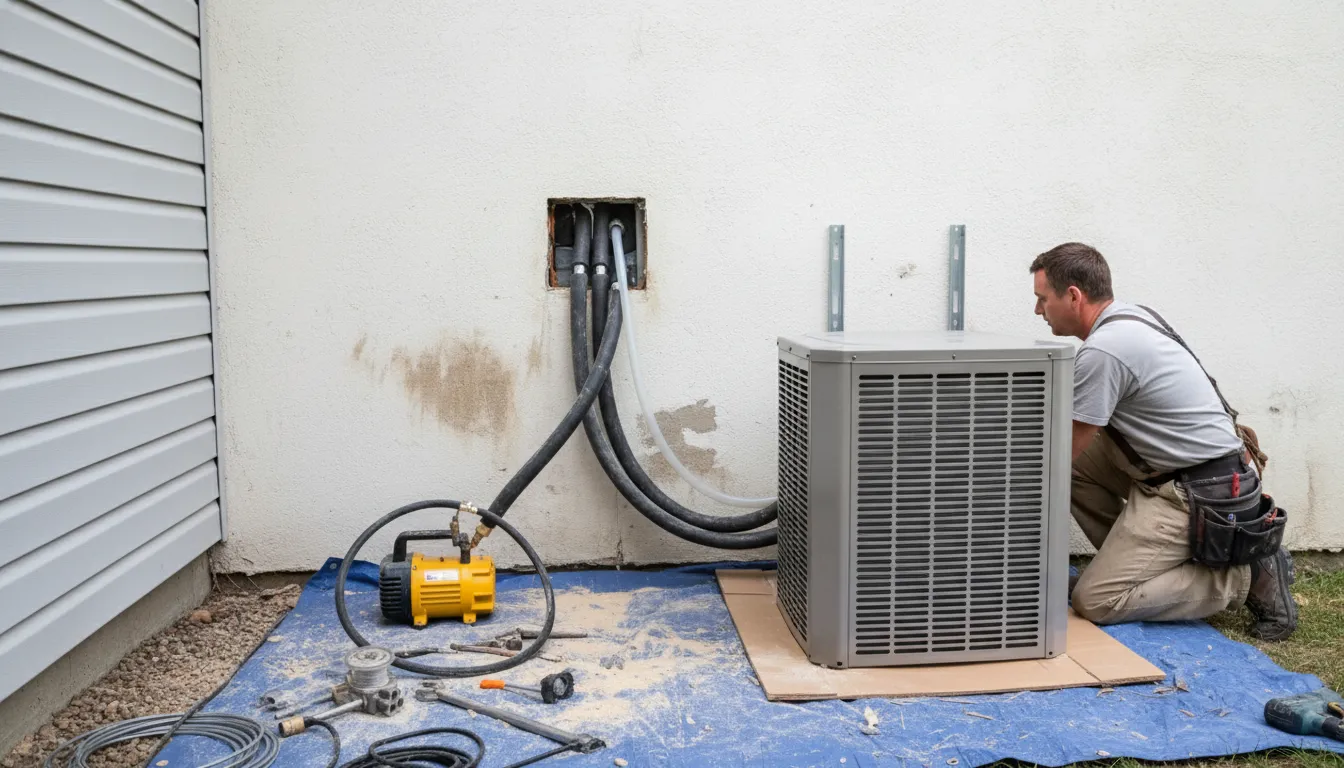
Find the Best Heat Pump Installation & Replacement Contractors for Your Business
No obligation • Fast responses • Nationwide coverage

Why you can trust HVAC Firms
HVAC Firms is a leading United States resource for evaluating HVAC service providers. Our team researches companies, checks credentials, and reviews customer feedback to present clear, unbiased information. Listings and rankings are based on merit, and companies cannot pay to change our editorial content.
Search providers near you
Top Heat Pump Installation & Replacement Contractors in Goodyear, Arizona Ranked
Considering a new heat pump for your Goodyear home? You're looking at a smart investment for year-round comfort. A modern heat pump system provides both efficient cooling during our scorching summers and effective heating for our mild winters, all from one unit. This guide will help you understand your options, from system types and efficiency ratings to local costs, so you can make an informed decision and connect with qualified professionals for your project.

Island Breeze Air Conditioning & Heating LLC
809 E Fairmount Ave, Phoenix, AZ 85014
Island Breeze Air Conditioning & Heating LLC is a firefighter-owned HVAC company serving Phoenix, AZ, and surrounding areas including Gilbert, Mesa, Peoria, and Surprise. They provide residential and light commercial services such as air conditioning, furnace, heat pump, and ductless HVAC installation, repair, and maintenance. Their NATE-certified technicians focus on energy-efficient solutions and indoor air quality improvements. The company emphasizes integrity, accountability, and continuous improvement in their work. Island Breeze also offers after-hours service to address urgent HVAC needs.

Savage Air Conditioning
2315 W Fairmont Dr, Tempe, AZ 85282
Savage Air Conditioning is a family-owned HVAC company serving Phoenix, AZ, with over 30 years of experience since 1988. They provide installation, repair, and maintenance services for air conditioning, furnaces, heat pumps, and ductless mini splits for both residential and commercial clients. The company also offers indoor air quality solutions to improve home environments and has maintenance plans to help prolong system lifespan and efficiency.
WISE Cooling & Heating
Phoenix, AZ
WISE Cooling & Heating is a family-owned HVAC company serving Phoenix, AZ, and surrounding areas. Founded in 1999 in Cave Creek, they provide installation, repair, and maintenance services for air conditioning, furnace, and heat pump systems. Their technicians are experienced with all major HVAC brands and offer services including HVAC tune-ups and thermostat installations. With over 27 years in business, WISE Cooling & Heating brings extensive knowledge to residential and commercial HVAC needs.
One Hour Heating & Air Conditioning
9831 S 51st St Suite D133, Phoenix, AZ 85044
One Hour Heating & Air Conditioning provides comprehensive HVAC services in Phoenix, AZ, including air conditioning, heating, heat pump, and mini split installation and repair. They also offer duct cleaning, thermostat installation, indoor air quality services, and HVAC tune-ups. Known for their punctuality and customer-focused approach, they serve the Phoenix metropolitan area and the West Valley with a range of capabilities such as emergency HVAC repairs and duct inspections. The company guarantees satisfaction with every job and offers 24/7 emergency service to address unexpected HVAC issues promptly.

Compass Air
7741 E Gray Rd # 13, Scottsdale, AZ 85260
Compass Air is a full-service heating, ventilation, and air conditioning (HVAC) company based in Scottsdale, AZ. They provide installation and repair services for air conditioners, furnaces, and heat pumps, focusing on high-efficiency systems. Serving the East Valley area, Compass Air offers specialized knowledge and skilled technicians to maintain comfort throughout the year.
Why a Heat Pump is Ideal for Goodyear's Climate
Goodyear's climate presents a unique set of challenges and opportunities for home comfort systems. The extreme summer heat demands a cooling system with exceptional efficiency and durability, while the mild winters are perfectly suited for heat pump technology. Unlike traditional furnaces that generate heat, a heat pump simply moves existing heat from one place to another-pulling it from your home in the summer and extracting it from the outdoor air to warm your home in the winter. This process is inherently more energy-efficient for heating in a climate like ours, where temperatures rarely dip low enough to severely impact a heat pump's ability to operate.
The primary advantage here is dual functionality. By installing a single heat pump system, you address both your air conditioning and heating needs, which can simplify maintenance and potentially reduce equipment footprint. For new construction or homeowners looking to replace an aging AC and furnace simultaneously, a heat pump is a compelling, all-in-one solution. Its efficiency in heating mode during our cooler months can lead to lower utility bills compared to running a standard electric furnace or resistance heating.
Understanding Heat Pump Types and Technologies
Not all heat pumps are created equal. The right choice for your home depends on your existing ductwork, budget, and specific comfort goals. Here are the main types available to Goodyear residents.
Air-Source Heat Pumps: This is the most common type installed in our area. It uses an outdoor unit with a coil and fan to exchange heat with the outside air. Modern air-source models are highly effective in Arizona's climate, providing robust cooling and sufficient heating for our winter conditions. They are typically connected to your home's existing ductwork.
Ductless Mini-Split Heat Pumps: These systems are an excellent option for homes without existing ducts, for room additions, or for creating "zones" with independent temperature control. A mini-split consists of an outdoor compressor/condenser and one or more indoor air-handling units mounted on walls or ceilings. They are incredibly efficient and allow you to cool or heat only the rooms you're using, which can lead to significant energy savings.
Variable-Speed and Two-Stage Heat Pumps: Moving beyond basic single-stage models, these advanced air-source heat pumps offer superior comfort and efficiency. A variable-speed inverter-driven compressor can adjust its output in small increments to match the exact cooling or heating demand of your home. This results in more consistent temperatures, better humidity removal in summer, quieter operation, and reduced energy consumption. Two-stage units offer a high and a low setting, providing a middle ground between single-stage and variable-speed models.
Geothermal (Ground-Source) Heat Pumps: This is the most efficient heat pump technology available. Instead of exchanging heat with the outside air, it uses a loop system buried in the ground to exchange heat with the earth's more stable temperatures. While geothermal systems offer the lowest operating costs and are exceptionally durable, they come with a significantly higher upfront installation cost due to the required ground loop excavation 1.
Decoding Efficiency: SEER2, HSPF, and What Matters in Arizona
Efficiency ratings are critical, especially in a hot climate where your cooling system is your primary utility expense. The key metric for cooling efficiency is the SEER2 (Seasonal Energy Efficiency Ratio 2). This updated rating provides a more realistic measure of real-world performance. The higher the SEER2 number, the more efficient the unit.
For Goodyear, investing in a high-efficiency unit is strongly recommended. While standard units start around 14-16 SEER2, opting for a system with a SEER2 rating of 18 or higher will provide much better performance during extreme heat, leading to lower electric bills and more reliable operation 2. Top-tier variable-speed models can reach SEER2 ratings of 20+.
For heating efficiency, look at the HSPF2 (Heating Seasonal Performance Factor 2). A higher HSPF2 indicates better heating efficiency. While our heating season is shorter, a good HSPF2 rating ensures your system heats your home economically during our cooler nights and winter months.
Find the perfect heat pump installation & replacement contractors for your needs
Get personalized recommendations and expert advice
Key Considerations for Your Goodyear Home Installation
Several local factors should guide your heat pump selection and installation plan:
- Sizing is Paramount: An improperly sized unit is a recipe for problems. An oversized unit will short-cycle (turn on and off frequently), failing to dehumidify your home properly and wearing out components faster. An undersized unit will struggle to keep up on the hottest days. A reputable contractor will perform a Manual J load calculation, which considers your home's square footage, insulation, window types, and orientation to determine the precise capacity needed (measured in tons).
- Desert Durability: Goodyear's environment is harsh on HVAC equipment. Dust storms, high temperatures, and dry air can take a toll. Look for units with features like corrosion-resistant coils (often coated with materials like Blue Fin™ or other protective finishes) and sturdy cabinet construction. Regular maintenance, including keeping the outdoor unit clean of dust and debris, is essential for longevity 3 4.
- Ductwork Evaluation: If you're opting for a ducted system, your existing ducts must be inspected. Leaky, poorly insulated, or undersized ducts can sabotage the performance of even the most efficient new heat pump. Sealing and insulating ductwork in attics or crawl spaces is often a necessary companion project to ensure you get the full benefit of your investment.
- Permits and Professionalism: Always ensure your installer is licensed, bonded, and insured to work in Goodyear. A proper installation will require a permit from the city, which ensures the work meets local building and safety codes. This protects you as a homeowner and is often required for warranty validation.
Understanding Heat Pump Costs in Goodyear
Investment in a heat pump system in Goodyear varies widely based on the type, efficiency, size of your home, and complexity of the installation. The following price ranges are estimates for typical residential installations (3-5 ton systems) and can help you set a budget 5 6 7.
- Standard Efficiency (14-16 SEER2): $6,500 - $11,500. This is the entry point for a basic, reliable ducted system replacement.
- Mid-Range Efficiency (15-17 SEER2): $10,000 - $13,000. Offers a good balance of upfront cost and operating savings.
- High-Efficiency / Variable-Speed (18+ SEER2): $12,000 - $18,000+. Recommended for Arizona, these systems provide the best comfort, humidity control, and long-term energy savings.
- Ductless Mini-Split System: Cost varies greatly by the number of indoor "heads" (zones). A single-zone system may start around a few thousand dollars, while multi-zone whole-home solutions can range from $10,000 to $20,000+ 8.
- Geothermal System: $16,000 - $55,000+. The high cost is due to ground loop excavation, but federal tax credits and ultra-low operating costs can improve the long-term value proposition.
Crucial Note: These are general ranges. The only way to get an accurate price for your specific home is to obtain detailed, written quotes from several licensed local HVAC contractors. A thorough quote should include the exact model numbers, proposed system size (tonnage), labor warranty, a breakdown of all costs, and a plan for any necessary ancillary work like duct modification or electrical upgrades 9 10 11.
Frequently asked questions
Sources
Footnotes
-
Top 10 Home Heating Systems for Arizona Homes - https://www.parkerandsons.com/blog/top-10-home-heating-systems-for-arizona-homes ↩
-
Heat Pump Replacement in Phoenix, AZ - Trusted Service - https://www.aztrademasters.com/heat-pump/heat-pump-replacement-phoenix-az ↩
-
Heat Pump Installation Prices in Arizona: What to Expect - https://www.markdanielsac.com/heat-pump-installation-prices-arizona-what-to-expect/ ↩
-
Heat Pump Installation in Goodyear & Greater Phoenix, AZ - https://aqualityhvac.org/heating/heat-pump-installation/ ↩
-
Energy-Efficient HVAC Systems for Arizona Homes - https://forbesrefrigeration.com/blog/hvac-systems-for-arizona-homes/ ↩
-
AC Replacement Cost in Arizona: What to Expect in 2025 - https://azhomeservices.group/ac-replacement-cost-in-arizona-what-to-expect-in-2025/ ↩
-
New HVAC System Cost in Phoenix, Arizona | Wolfgangs - https://wolfgangscooling.com/air-conditioning-ac/the-true-cost-of-a-new-hvac-system-in-arizona/ ↩
-
Heat Pump Price Guides - https://heatpumppriceguides.com/ ↩
-
How Much Does a Heat Pump Cost in Phoenix, AZ? | Angi - https://www.angi.com/articles/how-much-does-heat-pump-cost/az/phoenix ↩
-
How Much Does Heat Pump Installation Cost? - https://www.rivervalleyac.com/how-much-does-heat-pump-installation-cost/ ↩
-
How Much Does It Cost to Replace an AC Unit in Arizona? - https://azcomfortexperts.com/blog/ac-replacement-cost-arizona/ ↩