Find the Best Geothermal Heat Pump Contractors for Your Business
No obligation • Fast responses • Nationwide coverage

Why you can trust HVAC Firms
HVAC Firms is a leading United States resource for evaluating HVAC service providers. Our team researches companies, checks credentials, and reviews customer feedback to present clear, unbiased information. Listings and rankings are based on merit, and companies cannot pay to change our editorial content.
Search providers near you
Top Geothermal Heat Pump Contractors in Waukesha, Wisconsin Ranked
Geothermal heat pumps, also known as ground-source heat pumps, are a highly efficient technology for heating and cooling your home by leveraging the earth's stable underground temperature. This matters for Waukesha residents because it can dramatically reduce energy bills and environmental impact compared to traditional furnaces and air conditioners. This guide explains how these systems work, what installation involves, and how you can find qualified local professionals to assess your property for a geothermal solution.

How Geothermal Systems Work in Waukesha's Climate
The core principle behind a geothermal heating and cooling system is remarkably simple: it moves heat rather than creating it. Even during Wisconsin's cold winters, the soil just a few feet below the surface maintains a nearly constant temperature of approximately 50 to 55 degrees Fahrenheit 1. This stable earth temperature acts as a reliable heat source in winter and a heat sink in summer.
Here's the basic process:
- Heat Exchange: A fluid (typically water mixed with an environmentally safe antifreeze) circulates through a loop of pipes buried underground, called the ground loop. In winter, this fluid absorbs the earth's warmth.
- Heat Concentration: The warmed fluid is pumped to an indoor heat pump unit. The heat pump uses a refrigeration cycle to concentrate this low-grade heat into higher-temperature heat suitable for warming your home.
- Heat Distribution: The concentrated heat is then distributed throughout your home via your existing ductwork or a hydronic (water-based) system.
- Summer Reversal: In cooling mode, the process reverses. The system extracts heat from your indoor air and transfers it into the cooler ground loop fluid, which then dissipates the heat into the earth 2.
This method of transferring heat is vastly more efficient than generating it through combustion or electrical resistance, leading to the significant energy savings these systems are known for.
Types of Ground Loop Systems
The buried pipe loop is the heart of the system, and its configuration depends on your property's characteristics. The three main types are:
Vertical Closed Loops This is the most common installation type for homes in Waukesha, especially those with smaller or typical urban/suburban lots. Contractors use a drilling rig to bore holes 150 to 400 feet deep. U-shaped pipes are inserted into each borehole, which are then backfilled with a special grout. The tops of the loops are connected in a trench below the frost line to form a closed circuit. Vertical loops minimize surface disruption and are ideal where space is limited 3.
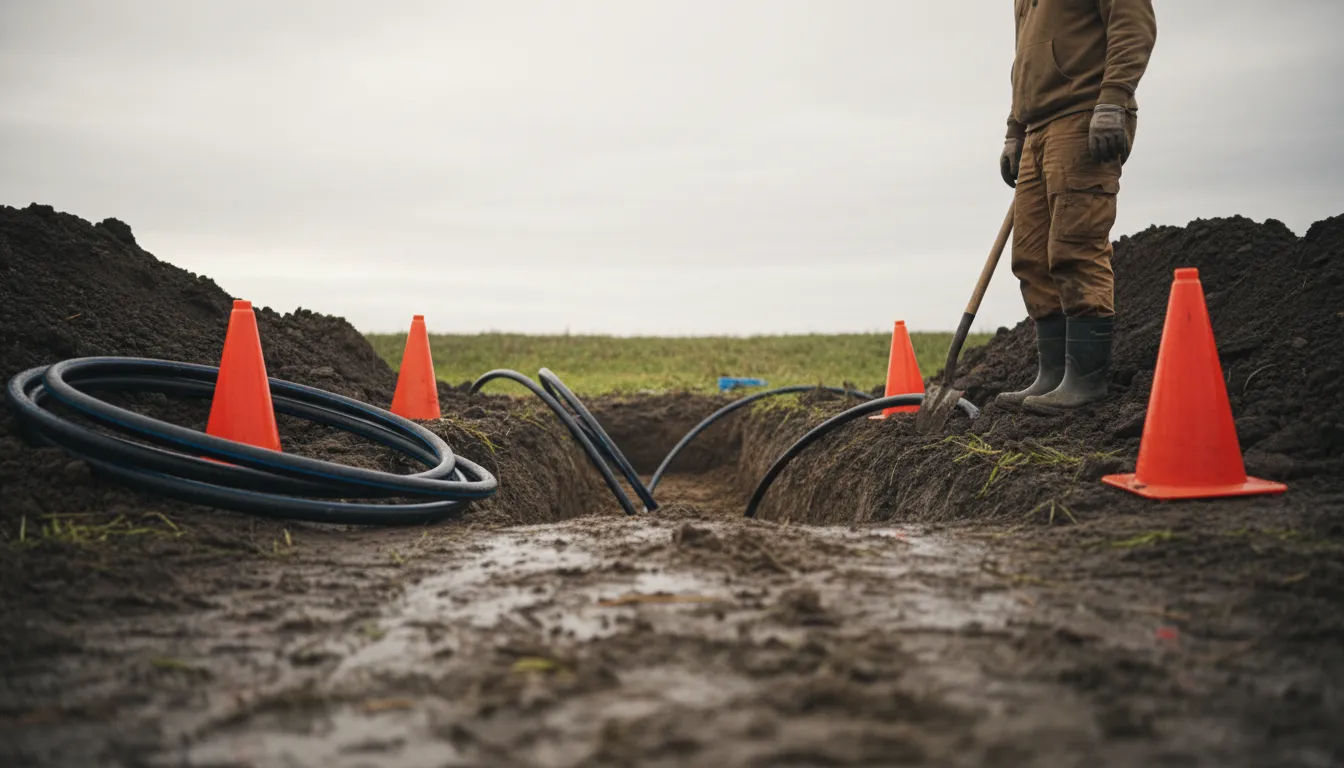
Horizontal Closed Loops For properties with more available land, a horizontal loop can be a cost-effective option. Trenches are dug 4 to 8 feet deep, and pipes are laid in a series of parallel trenches or coiled in "slinky" formations to fit more pipe in less trench length 4. This method requires a significant amount of open land, typically between a quarter to three-quarters of an acre, making it better suited for new construction or rural properties.
Pond/Lake Loops If you have a suitably sized and deep pond or lake on your property, this can be an excellent low-cost loop option. Coils of pipe are submerged at a depth where water temperatures remain stable. The water acts as an excellent heat exchange medium. This system requires specific site conditions, including adequate water volume, depth, and quality 5 6.
The Installation Process: What to Expect
Installing a geothermal system is a significant project that requires professional expertise. Here's a step-by-step overview of what a typical installation in Waukesha entails:
- Site Assessment & Design: A qualified installer will conduct a thorough evaluation of your property. This includes assessing soil composition (which affects heat transfer), available land area, and your home's heating and cooling loads. This data is used to design a properly sized loop field and select the correct indoor heat pump unit 7.
- Loop Field Installation: This is the major excavation or drilling phase.
- For vertical systems, a drilling rig will create the necessary boreholes. The drilling process is relatively quick but requires specialized equipment.
- For horizontal systems, a backhoe will dig the long trenches. This process disturbs a larger surface area but is often less expensive for suitable lots.
- Indoor Unit Installation: The geothermal heat pump unit, which is about the size of a traditional furnace, is installed in your basement, utility room, or garage. It is connected to the ground loop piping and to your home's existing ductwork or radiant heating system.
- System Charging & Startup: The closed-loop piping is filled with the heat transfer fluid and purged of air. The entire system is then pressurized, tested for leaks, and started up. The contractor will calibrate the system and ensure it is operating at peak efficiency 8.
Find the perfect geothermal heat pump contractors for your needs
Get personalized recommendations and expert advice
Energy Savings and Financial Incentives
The primary motivation for most homeowners is the dramatic reduction in energy costs. Geothermal heat pumps are the most energy-efficient heating and cooling technology available, often achieving efficiencies of 400-600% 9. For Waukesha residents, this can translate to savings of 50% to 70% on heating, cooling, and even hot water bills compared to conventional systems 10 11.
While the upfront cost for a geothermal system is higher than a standard furnace and air conditioner, it's crucial to view it as a long-term investment. The massive monthly utility savings offset the initial premium over time. Furthermore, significant financial incentives improve the payback period:
- Federal Tax Credit: The federal government offers a substantial tax credit for the installation of qualified geothermal heat pump systems 12.
- State & Local Incentives: Wisconsin's Focus on Energy program provides rebates and resources for homeowners who install geothermal systems, helping to reduce the net installed cost.
- Increased Home Value: Studies have shown that geothermal installations can increase property value, as future buyers recognize the benefit of low energy bills.
Longevity and Environmental Benefits
A well-installed geothermal system is renowned for its durability. The underground loop piping is often guaranteed for 50 years and can last for generations 13. The indoor heat pump unit typically lasts 20-25 years, significantly longer than the 15-year average lifespan of a conventional air conditioner or furnace.
Environmentally, ground-source heat pumps have a minimal footprint. They use electricity only to move heat, not to create it, which drastically reduces fossil fuel consumption and associated greenhouse gas emissions. For homeowners looking to reduce their carbon footprint while gaining energy independence from volatile fuel prices, geothermal is a leading solution.
Finding the Right Professional in Waukesha
Success with geothermal technology hinges on proper design and installation. When searching for providers, look for contractors with specific experience in geothermal systems. They should be certified by organizations like the International Ground Source Heat Pump Association (IGSHPA) and be familiar with local soil conditions and drilling regulations in Southeastern Wisconsin. A reputable professional will always start with a detailed load calculation and site survey, not a quick quote.
Frequently asked questions
Sources
Footnotes
-
Heat exchange drilling (geothermal systems) - Wisconsin DNR - https://dnr.wisconsin.gov/topic/Wells/Geothermal.html ↩
-
Geothermal Heat Pumps | WBDG - https://www.wbdg.org/resources/geothermal-heat-pumps ↩
-
Geothermal Systems for Home and Commercial Buildings - https://www.davejonesllc.com/heating-and-cooling-madison-wi/geothermal/ ↩
-
How Does A Geothermal Heat Pump Work? Complete 2025 Guide - https://solartechonline.com/blog/how-does-geothermal-heat-pump-work/ ↩
-
Geothermal Heat Pumps - Department of Energy - https://www.energy.gov/energysaver/geothermal-heat-pumps ↩
-
All You Need to Know About Home Geothermal Heating & ... - https://dandelionenergy.com/all-you-need-to-know-about-home-geothermal-heating-cooling ↩
-
Geothermal Heat Pump Installation: What To Expect For Your Property - https://jomory.com/geothermal-heat-pump-installation-what-to-expect-for-your-property/ ↩
-
How Geothermal Heat Pumps Work - https://www.youtube.com/watch?v=XxlTnBukweI&t=37 ↩
-
5 Things You Should Know about Geothermal Heat Pumps - https://www.energy.gov/cmei/articles/5-things-you-should-know-about-geothermal-heat-pumps ↩
-
Geothermal - https://www.ecec.com/energy-efficiency/renewable-energy/geothermal ↩
-
Geothermal Heat Pumps | Focus on Energy - https://focusonenergy.com/residential/geothermal ↩
-
Guide to Geothermal Heat Pumps - https://www.energy.gov/sites/prod/files/guide_to_geothermal_heat_pumps.pdf ↩
-
Geothermal Heating, Cooling, and Hot Water Systems - https://igshpa.org/wp-content/uploads/Homeowners-Guide-to-Geothermal.pdf ↩