
Find the Best Geothermal Heat Pump Contractors for Your Business
No obligation • Fast responses • Nationwide coverage

Why you can trust HVAC Firms
HVAC Firms is a leading United States resource for evaluating HVAC service providers. Our team researches companies, checks credentials, and reviews customer feedback to present clear, unbiased information. Listings and rankings are based on merit, and companies cannot pay to change our editorial content.
Search providers near you
Top Geothermal Heat Pump Contractors in Cranston, Rhode Island Ranked
A geothermal heat pump, also known as a ground-source heat pump, is a highly efficient system that uses the earth's stable underground temperature to heat and cool your home. For Cranston residents, this technology offers a reliable, renewable way to manage indoor comfort while dramatically reducing energy bills. This guide explains how these systems work, what installation involves, and how you can find qualified local professionals to assess your property for this long-term investment.
How a Geothermal System Works
Unlike traditional air-source heat pumps or furnaces that battle Rhode Island's variable outdoor air temperatures, a geothermal system taps into the consistent thermal energy stored just below the surface. A few feet underground, the earth maintains a nearly constant temperature of 50-60°F year-round. A geothermal, or ground-source, heating and cooling system leverages this stability through a simple, elegant process.
The core of the system is a network of buried pipes called a ground loop. A water-based solution circulates through these sealed loops, absorbing heat from the ground in the winter when the soil is warmer than the outside air. This warmed fluid is brought to an indoor heat pump unit, which concentrates the thermal energy and distributes warm air through your home's ductwork or radiant floor system 1. In the summer, the process reverses: the system extracts heat from your home and transfers it into the cooler ground, providing efficient air conditioning 2 3. This heat exchange process is what makes geothermal technology so remarkably efficient, often reducing energy consumption for heating and cooling by up to 60% compared to conventional systems.
Types of Ground Loop Systems for Cranston Properties
The design of the ground loop is critical and depends entirely on your property's characteristics. There are three primary configurations, each with its own advantages.
- Horizontal Ground Loops: This is often the most cost-effective option if you have sufficient land. Contractors excavate trenches about six feet deep across a large area of your yard and lay pipes in a series of parallel runs or slinky coils. This approach requires a sizable, clear plot of land but involves less specialized drilling equipment.
- Vertical Ground Loops: For homes in Cranston with smaller lots, vertical loops are the standard solution. Contractors drill boreholes 150 to 400 feet deep and insert U-shaped loop pipes into each hole. While the drilling cost is higher, this method minimizes landscape disruption and is ideal for properties with limited space or rocky soil 4 5.
- Pond/Lake Loops: If you have access to a sufficient body of water, this can be a very efficient option. Coils of pipe are submerged at the bottom of the pond or lake, where the water temperature remains stable. This method typically has lower installation costs since it avoids extensive trenching or drilling, but it is entirely dependent on water access and quality 6.
A professional installer will conduct a detailed site assessment to determine the best loop type for your home, considering soil composition, rock content, available space, and local geology.
The Geothermal Installation Process
Installing a geothermal heating and cooling system is a significant project that transforms your home's energy infrastructure. Understanding the steps can help you prepare.
- Comprehensive Site Evaluation: A qualified installer will visit your property to assess soil conditions, lot size, landscaping, and your home's existing heating/cooling distribution system (ductwork or hydronic). This evaluation determines the optimal loop type and size for maximum efficiency.
- Loop Field Installation: This is the major exterior work. For a horizontal system, excavation equipment will dig the necessary trenches. For a vertical system, a drilling rig will create the boreholes. High-density polyethylene pipe is then placed and connected into a continuous loop, which is pressure-tested before being filled with the heat-transfer fluid.
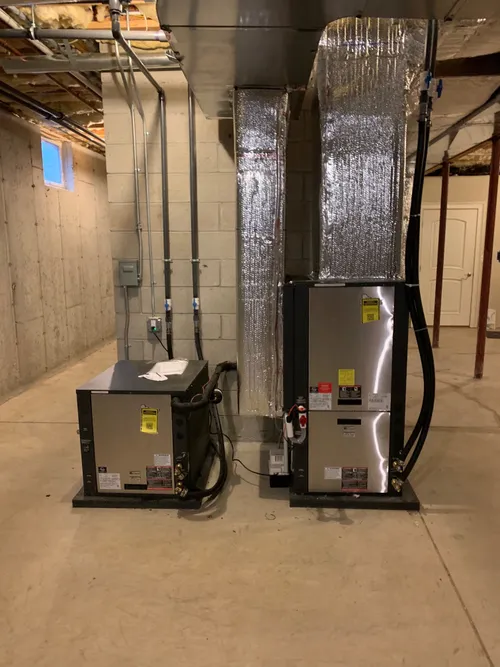
- Heat Pump Unit Installation: Indoors, the geothermal heat pump unit-which is typically about the size of a small furnace-is installed. It is connected to the ground loop on one side and to your home's ductwork or water heating system on the other. This unit houses the compressor and heat exchanger that make the energy transfer possible.
- System Startup and Restoration: Once all connections are made, the system is charged, purged of air, and started. The contractor will calibrate it for optimal performance. Finally, the outdoor work area is backfilled, compacted, and the landscaping is restored as closely as possible to its original condition.
Find the perfect geothermal heat pump contractors for your needs
Get personalized recommendations and expert advice
Key Considerations for Cranston Homeowners
Before committing to a geothermal system, several local factors are worth careful consideration.
- Property Suitability: The most important factor is your land. Do you have the space for a horizontal trench field, or will your lot require vertical drilling? A professional assessment is non-negotiable. Rhode Island's geology is generally suitable for geothermal systems, but soil thermal conductivity will affect the required loop length.
- Upfront Cost vs. Long-Term Savings: The initial investment for a geothermal heat pump system is higher than for a conventional HVAC system, primarily due to the ground loop installation. However, the dramatic reduction in monthly energy bills-often 30% to 70% for heating and cooling-means the system often pays for itself in 5 to 10 years through utility savings 7 8 9. After the payback period, you enjoy decades of significantly lower operating costs.
- Financial Incentives: The federal government offers a tax credit for the installation of qualified geothermal heat pump systems, which can substantially offset the upfront cost. It's crucial to check the current status of this credit and explore any additional state or local incentives offered through Rhode Island's Office of Energy Resources 10 11.
- Comfort and Reliability: Beyond savings, homeowners appreciate the consistent comfort. Geothermal systems provide even heating without cold drafts and dehumidify more effectively in cooling mode. They are also exceptionally quiet, with no noisy outdoor condenser unit, and have fewer mechanical components exposed to the weather, leading to long lifespans, often 20+ years for the indoor unit and 50+ years for the underground loops.
Benefits of Choosing Geothermal in Cranston
Investing in a ground-source heat pump offers a compelling array of benefits that align with both economic and environmental goals.
- Exceptional Energy Efficiency: By exchanging heat with the relatively constant ground temperature instead of the extreme outdoor air, geothermal systems work much less hard, achieving efficiencies 300-600% higher than the best conventional systems 12 13. This directly translates to the substantial savings on your National Grid bill.
- Reduced Environmental Impact: Geothermal systems use electricity not to create heat, but to move it. When paired with Rhode Island's growing renewable energy grid, your home's heating and cooling can have a very low carbon footprint. The system itself uses no combustion and emits no carbon monoxide or greenhouse gases on-site.
- All-in-One Solution: A single geothermal system can provide space heating, air conditioning, and can even be equipped to supply a significant portion of your home's domestic hot water at high efficiency, consolidating multiple home systems into one.
- Low Maintenance and Longevity: With the major components protected indoors or underground, geothermal systems are not subject to the wear and tear of outdoor units. This results in fewer repairs, lower maintenance costs, and a much longer operational life, making it a durable, set-and-forget solution for home comfort 14.
Frequently asked questions
Sources
Footnotes
-
How a Geothermal Heat Pump Works | This Old House - https://www.youtube.com/watch?v=d5Tbsx3R2T8 ↩
-
Ground-Source Heat Pumps | Rhode Island Office of Energy Resources - https://energy.ri.gov/heating-cooling/renewables/ground-source-heat-pumps-geothermal ↩
-
Geothermal (Ground Source) Heat Pumps - NY.gov - https://cleanheat.ny.gov/geothermal-heat-pumps/ ↩
-
Geothermal Installation Steps Explained - https://ultrageothermal.com/geothermal-installation-steps-explained/ ↩
-
Complete Guide To Geothermal Heat Pump Installation - https://coolwithbowman.com/geothermal-heat-pump-installation/ ↩
-
Geothermal Heat Pump Installation: What To Expect For Your ... - https://jomory.com/geothermal-heat-pump-installation-what-to-expect-for-your-property/ ↩
-
How Does A Geothermal Heat Pump Work? Complete 2025 Guide - https://solartechonline.com/blog/how-does-geothermal-heat-pump-work/ ↩
-
Geothermal Heat Pumps - Department of Energy - https://www.energy.gov/energysaver/geothermal-heat-pumps ↩
-
Geothermal Heat Pumps: Installation by Beacon Mechanical - https://beaconmechanicalservice.com/geothermal-heat-pump/ ↩
-
Geothermal Heating and Cooling - Open Energy Information - https://openei.org/wiki/GeoBridge/Heating_and_Cooling ↩
-
Guide to Geothermal Heat Pumps - https://www.energy.gov/sites/prod/files/guide_to_geothermal_heat_pumps.pdf ↩
-
5 Things You Should Know about Geothermal Heat Pumps - https://www.energy.gov/cmei/articles/5-things-you-should-know-about-geothermal-heat-pumps ↩
-
Clean Energy 101: Geothermal Heat Pumps - RMI - https://rmi.org/clean-energy-101-geothermal-heat-pumps/ ↩
-
Geothermal Heating, Cooling, and Hot Water Systems - https://igshpa.org/wp-content/uploads/Homeowners-Guide-to-Geothermal.pdf ↩