Find the Best Geothermal Heat Pump Contractors for Your Business
No obligation • Fast responses • Nationwide coverage

Why you can trust HVAC Firms
HVAC Firms is a leading United States resource for evaluating HVAC service providers. Our team researches companies, checks credentials, and reviews customer feedback to present clear, unbiased information. Listings and rankings are based on merit, and companies cannot pay to change our editorial content.
Search providers near you
Top Geothermal Heat Pump Contractors in Albuquerque, New Mexico Ranked
Geothermal heat pumps, also known as ground-source heat pumps, are a highly efficient method for heating and cooling your home by leveraging the stable temperatures found underground. For Albuquerque residents, this technology offers a powerful way to reduce energy bills and environmental impact by tapping into the consistent thermal energy of the earth. This guide explains how geothermal systems work, what installation entails, and how you can find qualified local experts to assess your property for this sustainable upgrade.
How Geothermal Systems Work in the Albuquerque Climate
At the heart of a geothermal system is a simple principle: while air temperatures in Albuquerque can swing from freezing winter nights to scorching summer days, the temperature of the earth just 30 feet below the surface remains remarkably stable, typically between 50-60°F year-round. A geothermal heat pump uses this constant temperature as a renewable energy source.
The process involves a closed-loop system of pipes, called a ground loop, buried in your yard. A water-based solution circulates through these pipes, absorbing the earth's warmth in the winter. This warmed fluid is brought back to an indoor heat pump unit, which concentrates the thermal energy and distributes it as warm air through your home's ductwork. In the summer, the system reverses: it extracts heat from your home and transfers it into the cooler ground, providing air conditioning 1 2. This efficient heat exchange is why ground-source heat pumps can be 300-600% efficient, far surpassing the best gas furnaces or standard air-source heat pumps.
Types of Ground Loop Systems
The buried loop is the critical, property-specific component of a geothermal installation. The right type for your Albuquerque home depends on your land availability, soil composition, and budget.
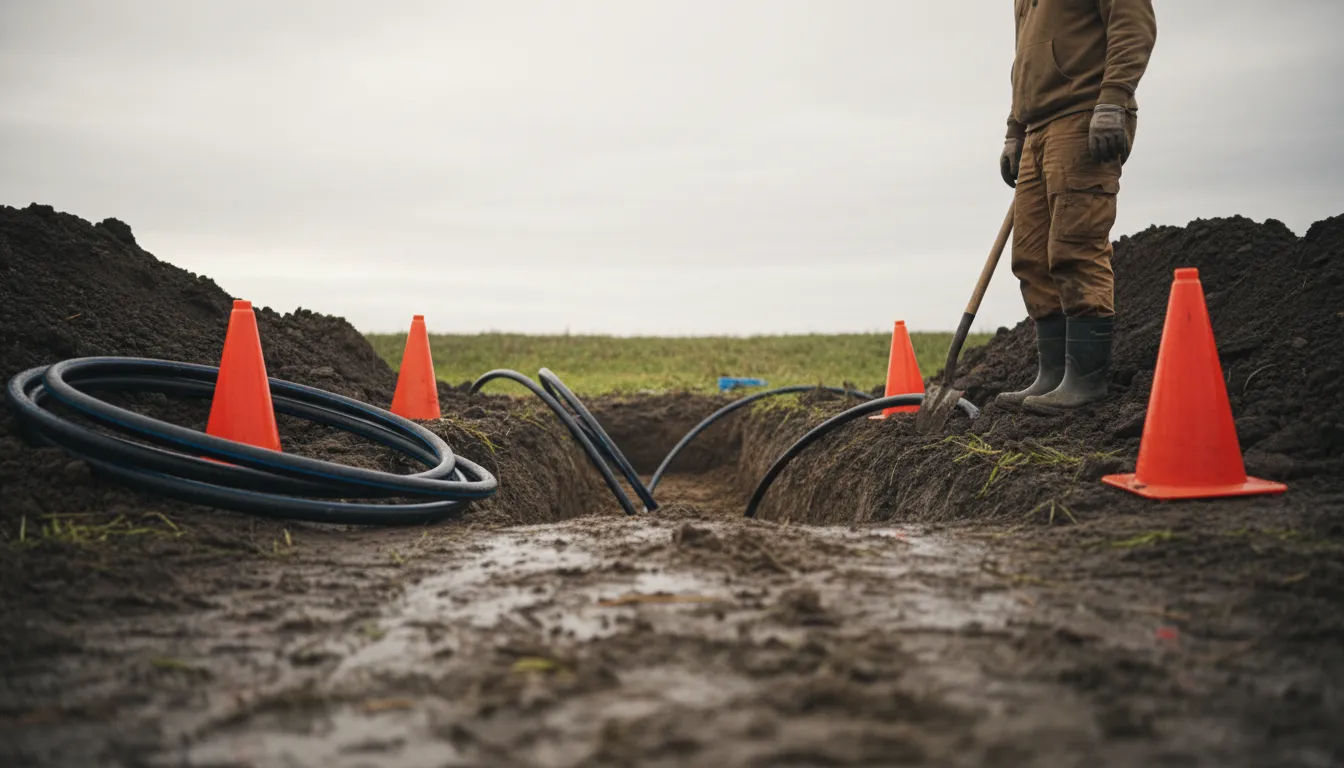
Horizontal Closed Loops This is often the most cost-effective option if space allows. Contractors dig trenches four to six feet deep and lay pipes in a series of parallel loops. A significant amount of clear, flat land is required-typically about 400 to 600 feet of trench per ton of system capacity 3. This makes horizontal loops a popular choice for properties with ample yard space.
Vertical Closed Loops For homes with smaller lots, which is common in many Albuquerque neighborhoods, vertical loops are the ideal solution. Contractors use drilling rigs to bore holes 100 to 400 feet deep. U-shaped pipes are inserted into each borehole, which are then grouted for efficient heat transfer. While the drilling makes vertical loops more expensive upfront, they often deliver superior performance and require minimal surface area, sometimes just the footprint of the drilling rig itself 4.
Pond or Lake Loops If your property has a suitable, large body of water, this can be the most economical loop option. Coils of pipe are submerged at the bottom of the pond or lake, utilizing the water as a heat exchange medium. This method avoids the need for extensive trenching or drilling.
The Geothermal Installation Process: What to Expect
Installing a geothermal heating and cooling system is a significant project that requires careful planning and professional execution. Understanding the steps can help you prepare.
-
Site Assessment and Design: A qualified installer will first evaluate your property. This includes a survey of your land, an analysis of soil and rock composition (which affects heat transfer), and locating underground utilities. They will also perform a detailed heating and cooling load calculation for your home to properly size the system. This stage determines the optimal loop type and configuration.
-
Ground Loop Installation: This is the major excavation phase. For a horizontal system, a backhoe will dig the necessary trenches. For a vertical system, a drilling rig will be brought in to create the boreholes. The high-density polyethylene pipes are then placed, connected into a continuous loop, and pressure-tested to ensure there are no leaks.
-
Indoor Unit Installation: The geothermal heat pump unit, which is about the size of a traditional furnace, is installed inside your home, typically in a basement, utility room, or garage. Your installer will connect it to your existing ductwork or install new ducts if needed. The refrigerant and electrical lines are connected, and the system is filled with its heat-transfer fluid 5.
-
Connection and Commissioning: The indoor unit is connected to the buried ground loop. The entire system is charged, started, and meticulously tested to verify its performance and efficiency. Your installer will also walk you through the system's controls and basic maintenance.
Find the perfect geothermal heat pump contractors for your needs
Get personalized recommendations and expert advice
Key Factors Influencing Your System Design
Several local factors will guide the design and cost of your geothermal installation in Albuquerque:
- Land Availability: The size and layout of your yard is the primary determinant for loop type. Vertical loops solve space constraints but at a higher initial cost 6 7.
- Soil and Rock Conditions: Albuquerque's soil composition varies. Sandy soil transfers heat differently than clay or rock. A professional assessment will determine the required loop length for optimal efficiency 8 9.
- Existing HVAC Infrastructure: The condition of your home's ductwork, electrical service, and the location for the indoor unit all play a role in the project's scope and cost.
Costs, Savings, and Incentives for Albuquerque Homes
The investment in a geothermal heat pump system is substantial but pays dividends over time through dramatically lower operating costs.
Upfront Costs: For a typical single-family home in Albuquerque, a complete geothermal system installation typically ranges from $20,000 to $40,000. This wide range accounts for system size, loop type (vertical being more expensive than horizontal), and site-specific challenges 10.
Long-Term Savings: The primary financial benefit comes from drastically reduced energy bills. By moving heat rather than creating it through combustion, geothermal heat pumps can reduce heating and cooling energy use by 25% to 65% compared to conventional systems 11 12. With Albuquerque's climate, where both heating and cooling are needed, these savings are realized year-round. Many homeowners see a payback on their investment through utility savings in 5 to 10 years 13.
New Mexico Incentives and Rebates: State and local incentives can significantly reduce the net cost:
- NM HEAR (Home Energy Assistance and Repair) Program: Offers rebates for qualifying energy-efficient upgrades, which can include geothermal systems.
- Utility Programs: Check with PNM and Xcel Energy for specific rebates or special electric rate programs designed for efficient technologies like heat pumps.
- Federal Tax Credits: The federal Residential Clean Energy Credit can provide a tax credit for a significant percentage of the installation cost, including both the heat pump unit and ground loop.
Maintenance and Lifespan
One of the most compelling advantages of geothermal technology is its durability. The indoor heat pump unit typically lasts 15-20 years, similar to a high-quality conventional HVAC system. The buried ground loop, however, is renowned for its longevity, with a lifespan often exceeding 50 years with virtually no maintenance 14. Annual maintenance is simple, usually involving checking the air filter, coolant levels, and electrical components, much like a standard HVAC system.
Frequently asked questions
Sources
Footnotes
-
How a Geothermal Heat Pump Works | This Old House - https://www.youtube.com/watch?v=d5Tbsx3R2T8 ↩
-
Research on Ground Source Heat Pump Design - https://docs.lib.purdue.edu/cgi/viewcontent.cgi?article=2047&context=iracc ↩
-
Everything You Need to Know About Geothermal Heat Pumps - https://www.familyhandyman.com/article/everything-you-need-to-know-about-geothermal-heat-pumps/ ↩
-
Geothermal heating & cooling, heat pumps, heat exchange ... - https://aztechgeo.com/residential-geothermal/how-it-works/ ↩
-
All You Need to Know About Home Geothermal Heating & Cooling - Dandelion Energy - https://dandelionenergy.com/all-you-need-to-know-about-home-geothermal-heating-cooling ↩
-
Geothermal Heat Pumps | WBDG - https://www.wbdg.org/resources/geothermal-heat-pumps ↩
-
How Does A Geothermal Heat Pump Work? Complete 2025 Guide - https://solartechonline.com/blog/how-does-geothermal-heat-pump-work/ ↩
-
Geothermal Heat Pump Installation: What To Expect For Your ... - https://jomory.com/geothermal-heat-pump-installation-what-to-expect-for-your-property/ ↩
-
Geothermal energy in New Mexico - https://geoinfo.nmt.edu/publications/periodicals/earthmatters/6/n2/em_v6_n2.pdf ↩
-
Geothermal Heat Pump Guide: Installation Costs, Types And Benefits - https://modernize.com/hvac/heating-repair-installation/heat-pump/geothermal ↩
-
5 Things You Should Know about Geothermal Heat Pumps - https://www.energy.gov/cmei/articles/5-things-you-should-know-about-geothermal-heat-pumps ↩
-
Heating and Cooling: Electric Heat Pumps - 350 New Mexico - https://350newmexico.org/heating-and-cooling-heat-pumps/ ↩
-
Geothermal Heat Pumps - Department of Energy - https://www.energy.gov/energysaver/geothermal-heat-pumps ↩
-
Geothermal Heat Pumps, Explained - Bosch Home Comfort - https://www.bosch-homecomfort.com/us/en/residential/connect/blog/geothermal-heat-pumps-go-green-save-green/ ↩