
Find the Best Geothermal Heat Pump Contractors for Your Business
No obligation • Fast responses • Nationwide coverage

Why you can trust HVAC Firms
HVAC Firms is a leading United States resource for evaluating HVAC service providers. Our team researches companies, checks credentials, and reviews customer feedback to present clear, unbiased information. Listings and rankings are based on merit, and companies cannot pay to change our editorial content.
Search providers near you
Top Geothermal Heat Pump Contractors in Gaithersburg, Maryland Ranked
A geothermal heat pump, also known as a ground-source heat pump, is a highly efficient system for heating and cooling your home by leveraging the earth's stable underground temperature. For homeowners in Gaithersburg, this technology offers a path to dramatically lower energy bills and reduce environmental impact. This guide explains how these systems work, what installation entails, and how you can connect with qualified local professionals to explore this long-term investment for your property.
Grove Heating & Cooling
2142 Priest Bridge Court #6, Crofton, MD 21114
Grove Heating & Cooling is an HVAC company serving Washington, DC, and nearby areas including Bowie, Crofton, and Annapolis. They provide a range of services such as furnace repair, air conditioner repair, heat pump repair, HVAC installation, and indoor air quality solutions. The company also offers geothermal heat pump installation and HVAC tune-ups. Grove Heating & Cooling is equipped to handle heat pump repairs at any time, including day or night service. They aim to support customers with reliable heating, cooling, and ventilation needs.

EverCool, Inc.
7516 Fullerton Rd J, Springfield, VA 22153
EverCool, Inc. is a family-owned HVAC company serving Washington, DC, and the surrounding Northern Virginia area since 2003. They provide a range of heating and cooling services including air conditioning and furnace repair, installation of mini splits and geothermal heat pumps, thermostat installation, and indoor air quality solutions. EverCool is a Carrier factory-authorized dealer with NATE-certified technicians, offering 24-hour emergency HVAC services to ensure year-round comfort. Their team handles all brands and focuses on proper system sizing and maintenance to enhance efficiency and system lifespan.

United Air Temp
500 Redland Ct # 107, Owings Mills, MD 21117
United Air Temp is a home comfort service provider based in Baltimore, MD, offering heating, cooling, plumbing, and whole-home generator services. The company serves Baltimore homeowners with air conditioning, furnace, heat pump, boiler, mini split, geothermal heat pump, and HVAC installation, repair, and maintenance. They provide 24/7 emergency repairs to address urgent heating and cooling issues. Established in 1931, United Air Temp has over 90 years of experience in the industry, supporting homeowners with licensed and insured technicians to ensure efficient and safe operation of home systems.

United Air Temp
11900 Parklawn Dr #110, Rockville, MD 20852
United Air Temp provides heating, cooling, plumbing, and whole-home generator services in Washington, DC. The company offers installation, repair, and maintenance for air conditioners, furnaces, heat pumps, boilers, mini splits, and geothermal heat pumps. They also specialize in whole-home generator installation to keep essential systems running during power outages. With over 90 years of experience since 1931, United Air Temp serves the local community with licensed and insured technicians. They provide 24/7 emergency repair services for heating and cooling systems.

United Air Temp
601 7th St Suite #301, Laurel, MD 20707
United Air Temp is an HVAC, plumbing, and whole-home generator service provider based in Baltimore, MD. Serving the Baltimore area, they offer a wide range of heating and cooling services including air conditioning, furnace, heat pump, boiler, geothermal heat pump, and mini split installation and repair. The company also provides water heater services and whole-home generator installation to help maintain home comfort and safety. Established in 1931, United Air Temp has over 90 years of experience in the industry. They offer 24/7 emergency repair services for heating and cooling systems to address urgent needs promptly.
How Geothermal Heating and Cooling Works
The core principle behind a geothermal system is simple yet powerful: it uses the earth as a thermal battery. While air temperatures in Gaithersburg swing from hot, humid summers to cold winters, the ground just a few feet below the surface maintains a remarkably constant temperature of approximately 55°F year-round. A geothermal heat pump capitalizes on this stability to provide both heating and air conditioning.
The process centers on a closed loop of pipes, called the ground loop, buried in your yard. A water-based solution circulates through these pipes, exchanging heat with the surrounding earth.
- In Winter: The fluid in the loop absorbs the earth's natural heat (even at 55°F, it's warmer than the winter air) and carries it to the heat pump unit inside your home. The heat pump concentrates this low-grade heat and distributes warm air through your ductwork 1 2.
- In Summer: The system reverses. The heat pump extracts excess heat and humidity from your indoor air and transfers it into the fluid in the loop. The fluid then travels underground, where the cooler earth absorbs and dissipates the heat, effectively using the ground as a heat sink.
This method of heat exchange is far more efficient than traditional air-source systems that must work harder as outdoor air temperatures become extreme. Many systems can also be equipped with a desuperheater, which captures excess heat to provide a significant portion of your home's domestic hot water at no extra cost 3 4.
Types of Ground Loop Systems for Gaithersburg Homes
The design of the underground loop field is tailored to your specific property. The three main configurations are:
Horizontal Closed Loop This is often the most cost-effective option if space allows. Pipes are laid in trenches that are typically 4 to 8 feet deep 5. This approach requires a larger, clear area of land, making it a common choice for properties with ample yard space.
Vertical Closed Loop For homes in Gaithersburg with smaller lots, a vertical loop is the standard solution. Contractors drill boreholes 150 to 400 feet deep and insert U-shaped loop pipes. This method minimizes landscape disturbance and is effective in most soil and rock types found in the area.
Open Loop System Less common, an open loop system uses groundwater from a well as the direct heat exchange fluid. After passing through the heat pump, the water is returned to a second well or a suitable discharge point. This system requires an abundant, high-quality water source and compliance with local codes.
A professional installer will conduct a detailed site assessment of your land, soil composition, and home's heating and cooling needs to recommend the optimal loop type for efficiency and cost 6.
The Installation Process: What to Expect
Installing a geothermal system is a significant project that requires professional expertise. Understanding the steps can help you prepare.
- Site Assessment and Design: A certified installer will evaluate your property, perform a heat load calculation for your home, and locate all underground utilities. Soil testing helps determine thermal conductivity and the best loop design.
- Loop Field Installation: For a horizontal system, this involves trenching. For a vertical system, a drilling rig creates the boreholes. The high-density polyethylene pipes are then placed and connected into a continuous loop.
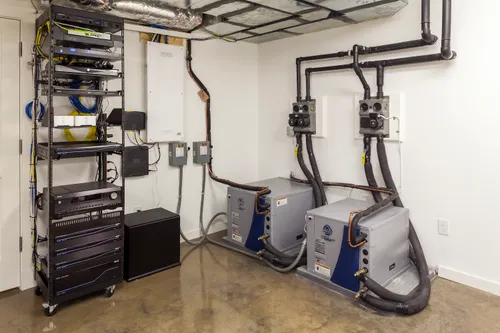
- Indoor Unit and Connection: The geothermal heat pump unit, which is typically about the size of a small refrigerator, is installed in your basement, utility room, or garage. It is connected to your existing ductwork or a new air distribution system, as well as to your home's electrical panel and thermostat 7.
- System Charging and Startup: The loop is filled and pressurized with the heat transfer fluid. The entire system is tested, balanced, and started up, with the technician ensuring everything operates at peak efficiency.
Find the perfect geothermal heat pump contractors for your needs
Get personalized recommendations and expert advice
Costs, Savings, and Long-Term Value
The upfront investment for a complete geothermal heating and cooling system is higher than that for a conventional furnace and air conditioner. In the Gaithersburg area, total installed costs typically range from $20,000 to $40,000 or more, depending on your home's size, the loop type, and site conditions 8 9.
However, the long-term financial benefits are substantial. By leveraging the earth's consistent temperature, geothermal heat pumps are exceptionally efficient. Homeowners often see a reduction of 40% to 70% or more in their heating and cooling energy costs 10 11 12. These savings can allow the system to pay for itself over time through lower utility bills.
Additional value comes from:
- Extended Lifespan: The durable underground loop often comes with warranties of 25 to 50 years and can last for generations. The indoor heat pump unit typically lasts 20 years or more, significantly longer than the 15-year average of many traditional air conditioners 13.
- Increased Comfort: These systems provide consistent, even heating and cooling without the drafts and temperature swings common with fossil fuel systems.
- Quiet Operation & Low Maintenance: With no noisy outdoor condenser unit, operation is very quiet. The systems have fewer mechanical components exposed to the weather, which generally means less maintenance.
- Environmental Benefits: Geothermal systems use renewable thermal energy from the ground, drastically reducing your home's carbon footprint associated with heating and cooling.
Is a Geothermal System Right for Your Home?
A ground-source heat pump is an excellent long-term investment for many Gaithersburg residents. It is particularly well-suited for homeowners who:
- Plan to stay in their home long enough to realize the long-term savings.
- Are building a new home or replacing an aging, inefficient HVAC system.
- Have the property space (or depth) suitable for a loop field.
- Prioritize energy independence, environmental sustainability, and home comfort.
The key to a successful project is working with an experienced, certified geothermal contractor who can provide an accurate assessment and quality installation. Proper design and installation are critical to achieving the promised efficiency and savings.
Frequently asked questions
Sources
Footnotes
-
Understanding Geothermal Heating & Cooling Systems - https://www.tchvac.net/news/geothermal-heating-and-cooling-explained ↩
-
Geothermal (Ground Source) Heat Pumps - NY.gov - https://cleanheat.ny.gov/geothermal-heat-pumps/ ↩
-
All You Need to Know About Home Geothermal Heating & Cooling - https://dandelionenergy.com/all-you-need-to-know-about-home-geothermal-heating-cooling ↩
-
How Geothermal Heat Pumps Work - https://www.youtube.com/watch?v=XxlTnBukweI&t=37 ↩
-
Geothermal Heating Systems - https://earthrivergeothermal.com/geothermal-heating-systems/ ↩
-
Geothermal Heat Pump Installation: What To Expect For Your Property - https://jomory.com/geothermal-heat-pump-installation-what-to-expect-for-your-property/ ↩
-
Geothermal Heat Pumps - Department of Energy - https://www.energy.gov/energysaver/geothermal-heat-pumps ↩
-
5 Things You Should Know about Geothermal Heat Pumps - https://www.energy.gov/cmei/articles/5-things-you-should-know-about-geothermal-heat-pumps ↩
-
Geothermal Heat Pump Guide: Installation Costs, Types And Benefits - https://modernize.com/hvac/heating-repair-installation/heat-pump/geothermal ↩
-
Geothermal Heating & Cooling - https://energy.maryland.gov/pages/info/renewable/geothermal.aspx ↩
-
How Does a Geothermal System Work? - ClimateMaster - https://www.climatemaster.com/homeowner/side-links/how-it-works ↩
-
How a Geothermal Heat Pump Works for Maryland Homeowners - https://www.griffithenergyservices.com/geothermal-heat-pump-works-maryland-homeowners/ ↩
-
Guide to Geothermal Heat Pumps - https://www.energy.gov/sites/prod/files/guide_to_geothermal_heat_pumps.pdf ↩