Find the Best Geothermal Heat Pump Contractors for Your Business
No obligation • Fast responses • Nationwide coverage

Why you can trust HVAC Firms
HVAC Firms is a leading United States resource for evaluating HVAC service providers. Our team researches companies, checks credentials, and reviews customer feedback to present clear, unbiased information. Listings and rankings are based on merit, and companies cannot pay to change our editorial content.
Search providers near you
Top Geothermal Heat Pump Contractors in Bowie, Maryland Ranked
A geothermal heat pump, or ground-source heat pump, is a highly efficient system that uses the earth's stable underground temperature to heat and cool your home. This technology matters because it can dramatically reduce your energy bills and environmental footprint, offering a sustainable and quiet alternative to traditional HVAC systems. For Bowie residents, finding a qualified local installer is key to leveraging Maryland's unique geology and available incentives for a successful, long-term home comfort solution.
Grove Heating & Cooling
2142 Priest Bridge Court #6, Crofton, MD 21114
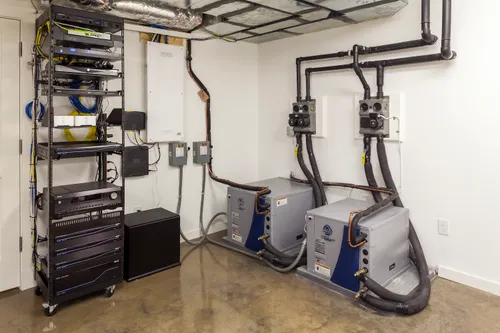
Grove Heating & Cooling is an HVAC company serving Washington, DC, and nearby areas including Bowie, Crofton, and Annapolis. They provide a range of services such as furnace repair, air conditioner repair, heat pump repair, HVAC installation, and indoor air quality solutions. The company also offers geothermal heat pump installation and HVAC tune-ups. Grove Heating & Cooling is equipped to handle heat pump repairs at any time, including day or night service. They aim to support customers with reliable heating, cooling, and ventilation needs.

EverCool, Inc.
7516 Fullerton Rd J, Springfield, VA 22153
EverCool, Inc. is a family-owned HVAC company serving Washington, DC, and the surrounding Northern Virginia area since 2003. They provide a range of heating and cooling services including air conditioning and furnace repair, installation of mini splits and geothermal heat pumps, thermostat installation, and indoor air quality solutions. EverCool is a Carrier factory-authorized dealer with NATE-certified technicians, offering 24-hour emergency HVAC services to ensure year-round comfort. Their team handles all brands and focuses on proper system sizing and maintenance to enhance efficiency and system lifespan.
United Air Temp
11900 Parklawn Dr #110, Rockville, MD 20852
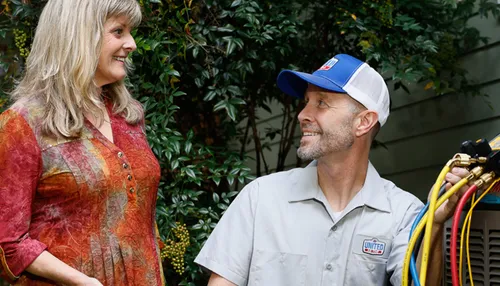
United Air Temp provides heating, cooling, plumbing, and whole-home generator services in Washington, DC. The company offers installation, repair, and maintenance for air conditioners, furnaces, heat pumps, boilers, mini splits, and geothermal heat pumps. They also specialize in whole-home generator installation to keep essential systems running during power outages. With over 90 years of experience since 1931, United Air Temp serves the local community with licensed and insured technicians. They provide 24/7 emergency repair services for heating and cooling systems.
United Air Temp
601 7th St Suite #301, Laurel, MD 20707
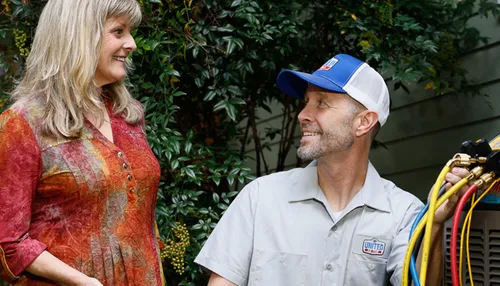
United Air Temp is an HVAC, plumbing, and whole-home generator service provider based in Baltimore, MD. Serving the Baltimore area, they offer a wide range of heating and cooling services including air conditioning, furnace, heat pump, boiler, geothermal heat pump, and mini split installation and repair. The company also provides water heater services and whole-home generator installation to help maintain home comfort and safety. Established in 1931, United Air Temp has over 90 years of experience in the industry. They offer 24/7 emergency repair services for heating and cooling systems to address urgent needs promptly.
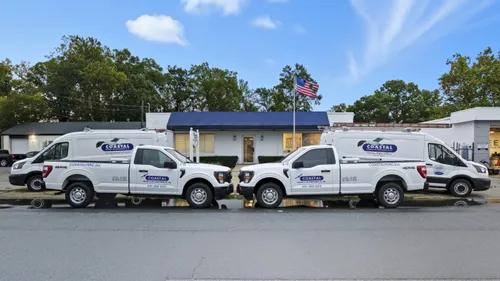
Coastal Co., Inc.
25 Hudson St, Annapolis, MD 21401
Coastal Co., Inc. is an HVAC company serving Washington, DC, specializing in heating and air conditioning installation, repair, and maintenance. Their services include furnace and air conditioning repair, geothermal heat pump installation, and indoor air quality improvement. The company focuses on helping customers select efficient HVAC systems tailored to their property needs. Coastal Co., Inc. is known for qualified geothermal heat pump installations, offering an eco-friendly heating and cooling option that significantly reduces energy usage. They provide service agreements to help maintain system efficiency and longevity.
How Geothermal Systems Work in Bowie
Geothermal heating and cooling systems operate on a simple principle of heat exchange with the ground. In Bowie, the earth maintains a relatively constant temperature of around 50-60°F just a few feet below the surface, year-round. A geothermal system capitalizes on this stable thermal resource.
During the winter, a fluid (typically water mixed with antifreeze) circulates through a loop of pipes buried in your yard. This fluid absorbs heat from the warmer earth and carries it into your home. The geothermal heat pump unit inside then concentrates this heat and distributes it through your existing ductwork or radiant floor system. In the summer, the process reverses: the system extracts heat from your home and transfers it into the cooler ground, effectively providing air conditioning. This method of moving heat, rather than generating it through combustion, is what leads to exceptional efficiency. Some systems can also include a desuperheater to provide supplemental hot water for your household year-round 1.
Types of Ground Loop Systems
The heart of a geothermal system is the ground loop. The type of loop installed depends heavily on your property's characteristics, such as lot size, soil composition, and landscaping. The two primary closed-loop systems used in Bowie are horizontal and vertical.
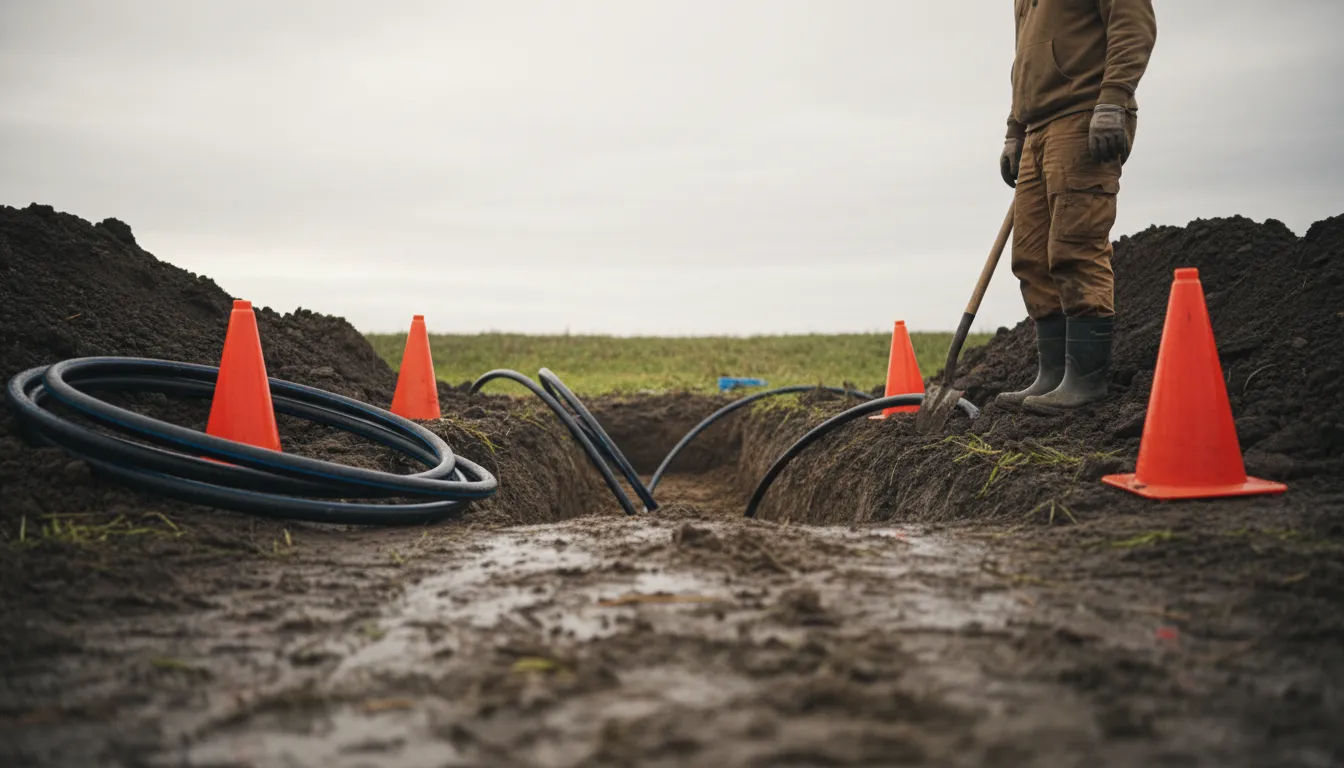
Horizontal Closed Loops This is often the most cost-effective installation method if you have sufficient land. Contractors dig trenches four to six feet deep across your yard, laying pipes in a series of parallel loops. A typical horizontal system for an average home requires 1,500 to 2,500 square feet of land per ton of capacity 2 3. While this method involves significant yard disruption initially, the soil tends to recover quickly, and restoration is a standard part of the process.
Vertical Closed Loops For homes in Bowie with smaller lots or established landscaping, vertical loops are the ideal solution. Installers use a drilling rig to bore holes 150 to 400 feet deep. U-shaped pipe loops are then inserted into each borehole. This method minimizes surface disruption, as the drilling footprint is small, but it requires specialized equipment and can take longer to complete. Vertical loops are also less affected by seasonal surface temperature fluctuations.
The Installation Process: What to Expect
Installing a geothermal heat pump is a significant project that transforms your home's energy infrastructure. Understanding the steps can help Bowie homeowners prepare.
- Site Assessment and Design: A qualified installer will first evaluate your property. They assess soil conditions, available space, your home's heating and cooling load, and the best location for the loop field and indoor unit. This planning phase is critical for system efficiency and longevity.
- Loop Installation: This is the major excavation phase. For a horizontal system, a backhoe will dig the trench network. For a vertical system, a drill rig will be brought in. The high-density polyethylene pipes are then laid or lowered into place, connected into a continuous loop, and pressure-tested 4.
- Indoor Unit Installation: The geothermal heat pump unit, which is about the size of a traditional furnace, is installed inside your home-typically in a basement, utility room, or garage. It is connected to the ground loop and to your home's ductwork or hydronic distribution system.
- System Startup and Yard Restoration: Once the mechanical connections are complete, the system is charged with fluid, purged of air, and started. The contractor will then backfill the trenches or boreholes and begin restoring your yard to its original condition, a process that may take a full growing season to fully settle.
Find the perfect geothermal heat pump contractors for your needs
Get personalized recommendations and expert advice
Benefits for Bowie Homeowners
Choosing a geothermal system in Bowie offers a compelling array of advantages that go beyond simple temperature control.
- Substantial Energy Savings: Geothermal heat pumps are incredibly efficient, often achieving 300% to over 400% efficiency. This means they move three to four units of heat for every one unit of electricity used to run them 5. For homeowners, this can translate to a reduction of up to 65% in heating and cooling costs compared to conventional systems 6.
- Long-Term Reliability and Low Maintenance: The underground loop system is incredibly durable, with a lifespan often exceeding 50 years 7 8. The indoor heat pump unit typically lasts 20 years or more, which is longer than the average air conditioner or furnace. With few moving parts exposed to the elements, maintenance is generally minimal.
- Environmental Sustainability: By using the renewable thermal energy of the earth, geothermal systems drastically reduce your home's reliance on fossil fuels and lower its carbon footprint. They also operate very quietly, with no noisy outdoor condenser unit.
- Financial Incentives: The upfront cost is offset by significant financial incentives. The federal residential energy efficiency tax credit currently covers 26% of the total installed cost, including the ground loop 9 10. Maryland may also offer additional rebates or incentives through programs like the Maryland Energy Administration (MEA) 11 12.
Trenching vs. Drilling: Key Considerations
The choice between horizontal (trenching) and vertical (drilling) loop installation has important implications for your property and budget.
Trenching (Horizontal)
- Best For: Properties with ample, clear yard space.
- Pros: Generally lower installation cost due to simpler equipment and faster process (often completed in a few days) 13 14.
- Cons: Requires a larger area and causes more initial surface disruption to your landscaping.
Drilling (Vertical)
- Best For: Smaller lots, properties with mature trees or extensive landscaping, or sites with rocky soil near the surface.
- Pros: Minimal surface footprint, allowing installation with little impact on existing yards. Performance can be very consistent due to deeper, more stable ground temperatures.
- Cons: Higher installation cost due to the specialized drilling equipment and longer time required. The drilling process itself is more technically complex.
A reputable local installer will guide you through these options, helping you select the most effective and practical loop configuration for your specific Bowie property.
Frequently asked questions
Sources
Footnotes
-
Energy 101: Geothermal | University of Maryland Extension - https://extension.umd.edu/resource/energy-101-geothermal ↩
-
Geothermal Heat Pumps - Department of Energy - https://www.energy.gov/energysaver/geothermal-heat-pumps ↩
-
Geothermal Heating & Cooling System Information - https://earthrivergeothermal.com/geothermal-heating-cooling-system-information/ ↩
-
How Does A Geothermal Heat Pump Work? Complete 2025 Guide - https://solartechonline.com/blog/how-does-geothermal-heat-pump-work/ ↩
-
Geothermal Heat Pumps | WBDG - https://www.wbdg.org/resources/geothermal-heat-pumps ↩
-
Understanding Geothermal Heating & Cooling Systems - https://www.tchvac.net/news/geothermal-heating-and-cooling-explained ↩
-
How a Geothermal Heat Pump Works for Maryland Homeowners - https://www.griffithenergyservices.com/geothermal-heat-pump-works-maryland-homeowners/ ↩
-
Guide to Geothermal Heat Pumps - https://www.energy.gov/sites/prod/files/guide_to_geothermal_heat_pumps.pdf ↩
-
5 Things You Should Know about Geothermal Heat Pumps - https://www.energy.gov/cmei/articles/5-things-you-should-know-about-geothermal-heat-pumps ↩
-
Geothermal Heat Pumps: How They Work and Benefits for Your ... - https://www.rbiva.com/resources/geothermal-heat-pumps-how-they-work-and-benefits/ ↩
-
Geothermal Heating & Cooling - https://energy.maryland.gov/pages/info/renewable/geothermal.aspx ↩
-
⋆ The Geothermal Heating and Cooling System - https://earthrivergeothermal.com/the-geothermal-heating-and-cooling-system/ ↩
-
Geothermal Heat Pump Installation: What To Expect For Your ... - https://jomory.com/geothermal-heat-pump-installation-what-to-expect-for-your-property/ ↩
-
Geothermal Installation Steps Explained - https://ultrageothermal.com/geothermal-installation-steps-explained/ ↩