
Find the Best Geothermal Heat Pump Contractors for Your Business
No obligation • Fast responses • Nationwide coverage

Why you can trust HVAC Firms
HVAC Firms is a leading United States resource for evaluating HVAC service providers. Our team researches companies, checks credentials, and reviews customer feedback to present clear, unbiased information. Listings and rankings are based on merit, and companies cannot pay to change our editorial content.
Search providers near you
Top Geothermal Heat Pump Contractors in South Bend, Indiana Ranked
A geothermal heat pump, or ground-source heat pump, is a highly efficient heating and cooling system that leverages the stable temperature of the earth beneath your property. Unlike conventional systems that battle the fluctuating outdoor air, a geothermal system exchanges heat with the consistent ground temperature, providing exceptional comfort and significant energy savings. For South Bend residents, this technology offers a powerful way to reduce utility bills and environmental impact. This guide explains how these systems work, what installation entails, and how you can find qualified local professionals to assess your home's potential.
How Geothermal Systems Work in South Bend
The core principle behind a geothermal heat pump is simple yet brilliant. Just a few feet below the surface, the earth in Indiana maintains a nearly constant temperature of around 50°F year-round 1. A geothermal system uses this stable thermal mass as a heat source in the winter and a heat sink in the summer.
Here's the basic process:
- Heat Exchange: A loop of durable, high-density polyethylene pipe is buried in the ground. A water-based fluid circulates through this loop.
- Winter Heating: In heating mode, the fluid absorbs the earth's warmth (even in a South Bend winter) and carries it to the heat pump unit inside your home. The unit concentrates this low-grade heat and distributes warm air through your ducts.
- Summer Cooling: In cooling mode, the system reverses. It extracts heat from your home's air, transfers it to the circulating fluid, and deposits it into the cooler ground.
This process is incredibly efficient because moving heat is far less energy-intensive than generating it through combustion or electric resistance. Ground-source heat pumps can achieve efficiencies of 400-600%, meaning they deliver 4 to 6 units of heat for every unit of electricity used to run them.
Types of Ground-Source Loop Systems
The buried pipe system, known as the "ground loop," is the heart of the installation. The right type for your South Bend home depends on your lot size, soil conditions, and budget. The three main configurations are:
Closed-Loop Systems (Most Common) These systems continuously circulate the same fluid through a sealed loop. They are the standard choice for residential properties.
- Horizontal Closed-Loop: Pipes are laid in trenches dug 6 to 10 feet deep. This method requires a larger amount of available land but typically involves lower excavation costs than drilling 2.
- Vertical Closed-Loop: Pipes are installed in boreholes drilled 150 to 500 feet deep. This is ideal for homes with smaller yards, as it uses minimal surface area. While drilling costs are higher, vertical loops are less susceptible to surface temperature fluctuations and are often used where soil is shallow or rocky 3 4.
Open-Loop System This system uses groundwater from a well as the heat exchange fluid. After passing through the heat pump, the water is discharged back into a well, pond, or stream, depending on local codes. While potentially very efficient, open-loop systems are less common for residential use in South Bend due to specific water availability requirements and environmental regulations.
The Installation Process: What to Expect
Installing a geothermal heating and cooling system is a significant project that requires professional expertise. Understanding the steps can help you prepare.
- Site Evaluation and Design: A certified installer will assess your property, considering soil composition, lot layout, and existing ductwork. They will design a system tailored to your home's heating and cooling loads and determine the optimal loop type and size.
- Loop Field Installation: This is the major excavation phase. For a horizontal system, trenches are dug. For a vertical system, a drilling rig creates the boreholes. The HDPE pipe is then laid or inserted and the trenches are backfilled, or the boreholes are grouted 5.
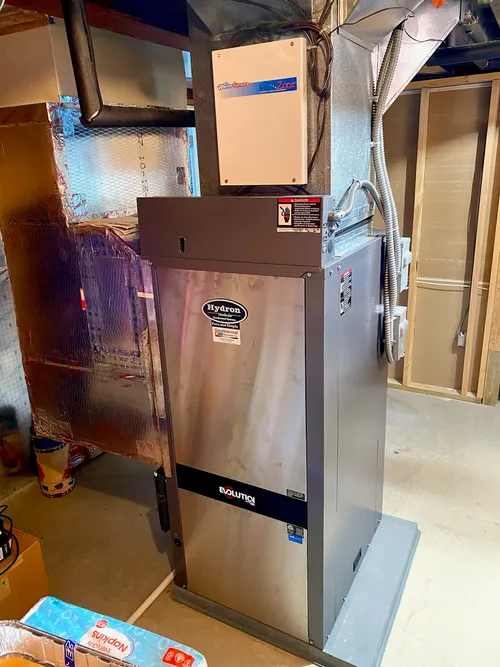
- Indoor Unit Installation: The geothermal heat pump unit-which is typically about the size of a small refrigerator-is installed in your basement, utility closet, or garage. It is connected to your home's existing ductwork or to a new duct system.
- Connection and Commissioning: The underground loops are connected to the indoor unit. The system is filled with fluid, purged of air, and connected to your electrical panel. Finally, the contractor will start the system, test its operation, and ensure it meets performance specifications 6.
Find the perfect geothermal heat pump contractors for your needs
Get personalized recommendations and expert advice
Comparing Trenching vs. Drilling for Your Loop
The choice between a horizontal (trenched) or vertical (drilled) loop is a key cost and logistics decision.
- Trenching (Horizontal Loops): This method generally has a lower upfront equipment cost. The primary requirement is sufficient open land. After backfilling, surface disruption is minimal, and the area can typically be landscaped over again 7.
- Drilling (Vertical Loops): Drilling is the solution for smaller urban or suburban lots in South Bend. It causes less surface disturbance to your yard but involves the higher cost of mobilizing a drilling rig. The deep boreholes provide excellent performance with a small footprint 8.
A reputable installer will clearly explain the pros and cons of each option for your specific property.
Cost, Savings, and Incentives in South Bend
The investment in a geothermal system is substantial but is offset by dramatic operating savings and available financial incentives.
Upfront Installation Cost For a typical South Bend home, a complete geothermal heat pump system installation can range from $20,000 to $40,000 or more. The final price depends heavily on the loop type (vertical loops are more expensive), the size of your home, and the complexity of connecting to your existing HVAC infrastructure.
Long-Term Energy Savings This is where geothermal shines. Homeowners often see their heating and cooling bills reduced by 50% to 70% compared to systems using fuel oil, propane, or standard electric resistance heat 9 10. These savings can amount to hundreds, if not thousands, of dollars annually, leading to a typical payback period of 5 to 10 years on the initial investment 11 12.
Federal Tax Credit A powerful incentive is the Federal Residential Energy Clean Energy Credit. This allows you to claim 30% of the total installation cost as a credit on your federal income taxes, significantly reducing the net cost of your system. This credit is currently in effect through 2034 13.
Why Geothermal is a Smart Choice for South Bend Homeowners
Choosing a ground-source heat pump is an investment in long-term comfort, savings, and sustainability. The technology offers unparalleled efficiency by using the earth's free, stable thermal energy. For South Bend residents, this translates to:
- Substantially Lower Utility Bills: Protection from volatile fossil fuel prices.
- Reduced Carbon Footprint: A clean, electric system that can be paired with renewable energy.
- Quiet, Reliable Operation: No noisy outdoor condenser units.
- Long System Life: The underground loops are warrantied for 50+ years, and the indoor heat pump unit often lasts 20-25 years 14.
- Increased Home Value: An efficient, modern HVAC system is an attractive feature for future buyers.
By leveraging the consistent ground temperature beneath Indiana, a geothermal system provides a dependable and efficient solution for year-round climate control.
Frequently asked questions
Sources
Footnotes
-
5 Things You Should Know about Geothermal Heat Pumps - https://www.energy.gov/cmei/articles/5-things-you-should-know-about-geothermal-heat-pumps ↩
-
Geothermal heat pumps: The ultimate guide to ground-source ... - https://termo-plus.com/blog/geothermal-ultimate-guide-to-ground-source-heat-pumps/ ↩
-
Hydrologic Impacts Group - Purdue University - https://www.agry.purdue.edu/hydrology/projects/Geothermal/Geothermal.asp ↩
-
All You Need to Know About Home Geothermal Heating & ... - https://dandelionenergy.com/all-you-need-to-know-about-home-geothermal-heating-cooling ↩
-
Geothermal Heat Pumps | WBDG - https://www.wbdg.org/resources/geothermal-heat-pumps ↩
-
How It Works: Geothermal Heat Pump 101 - GeoComfort Blog - https://geocomfort.com/blog/how-it-works-geothermal-heat-pump-101 ↩
-
Geothermal Heat Pump Guide: Installation Costs, Types And Benefits - https://modernize.com/hvac/heating-repair-installation/heat-pump/geothermal ↩
-
Geothermal heat pump systems: Status review and comparison with other heating options - https://www.sciencedirect.com/science/article/pii/S0306261912000542 ↩
-
How Does a Geothermal System Work? - ClimateMaster - https://www.climatemaster.com/homeowner/side-links/how-it-works ↩
-
Geothermal Heat Pumps - Department of Energy - https://www.energy.gov/energysaver/geothermal-heat-pumps ↩
-
Heat Pumps & Geothermals - South Central Indiana REMC - https://www.sciremc.com/save-energy-money/heat-pumps-geothermals/ ↩
-
Geothermal Heat Pump Guide: Installation Costs, Types And Benefits - https://modernize.com/hvac/heating-repair-installation/heat-pump/geothermal ↩
-
Your Step-by-Step Guide to Installing a Geothermal System in Indiana Before the 2025 Tax Credit Deadline - https://absolutecomfort.org/install-geothermal-system-indiana-2025-guide/ ↩
-
Geothermal Heat Pumps - EnergySmart CNY - https://www.energysmartcny.org/heat-pumps/geothermal/ ↩