Find the Best Geothermal Heat Pump Contractors for Your Business
No obligation • Fast responses • Nationwide coverage

Why you can trust HVAC Firms
HVAC Firms is a leading United States resource for evaluating HVAC service providers. Our team researches companies, checks credentials, and reviews customer feedback to present clear, unbiased information. Listings and rankings are based on merit, and companies cannot pay to change our editorial content.
Search providers near you
Top Geothermal Heat Pump Contractors in Fort Wayne, Indiana Ranked
Geothermal heat pumps, also known as ground-source heat pumps, are a highly efficient method for heating and cooling your Fort Wayne home by leveraging the stable temperatures found underground. This technology matters because it can dramatically reduce your energy bills and environmental footprint while providing reliable comfort year-round. If you're considering this upgrade, you can use this guide to understand the process and find qualified local experts to assess your property and handle the specialized installation.
Northeast Mechanical Services, Inc.
3620 Metro Park Dr N, Fort Wayne, IN 46818
Northeast Mechanical Services, Inc. is an HVAC and plumbing contractor based in Fort Wayne, IN. They provide a wide range of services including installation and repair of air conditioning, furnaces, heat pumps, boilers, mini splits, geothermal heat pumps, and indoor air quality systems. The company also offers generator installation and maintenance, ensuring reliable power solutions for homes and businesses. Northeast Mechanical Services emphasizes honest recommendations and fair pricing, serving Fort Wayne and nearby communities such as New Haven, Auburn, and Huntington. Their expertise includes energy consultations and eco-friendly geothermal HVAC systems.
Blazing Heat HVAC LLC
Fort Wayne, IN
Blazing Heat HVAC LLC is a heating and cooling company serving Fort Wayne, IN, and nearby communities. They provide a wide range of HVAC services including installation, repair, diagnostics, maintenance, tune-ups, indoor air quality solutions, commercial refrigeration, boiler services, and geothermal system support. With over 36 years of combined experience, their certified technicians focus on energy efficiency, system longevity, and indoor comfort for both residential and commercial customers. They also offer emergency repair services to minimize downtime and maintain reliable system operation.
Masters Heating & Cooling
3512 Cavalier Dr, Fort Wayne, IN 46808
Masters Heating & Cooling is a heating, cooling, and plumbing service provider located in Fort Wayne, IN. They serve customers across Indiana, Michigan, and Ohio, offering installation, repair, replacement, and maintenance for air conditioners, furnaces, boilers, heat pumps, packaged units, ductless mini-splits, and geothermal systems. With over 40 years of experience since 1980, their certified technicians handle a wide range of HVAC and plumbing needs, including plumbing system repairs and water heater services.
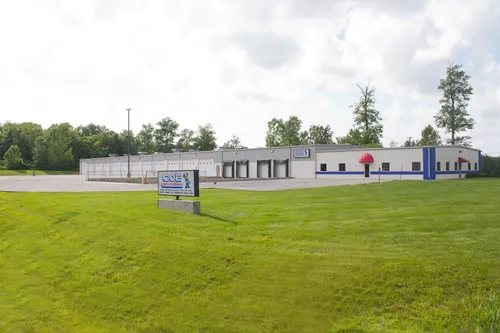
Coe Heating & Air Conditioning
9410 Airport Dr, Fort Wayne, IN 46809
Coe Heating & Air Conditioning is a family-owned HVAC company serving Fort Wayne, IN, and nearby communities since 1962. They offer installation, repair, and maintenance services for heating and cooling systems, including air conditioners, furnaces, heat pumps, boilers, geothermal systems, and ductless split systems. As an American Standard dealer, they provide a range of indoor comfort products such as programmable thermostats, humidifiers, air cleaners, and zoning systems. Their services cover both residential and commercial HVAC equipment, with capabilities including system tune-ups and indoor air quality solutions.
Ro-Mech Mechanical INC
228 E Collins Rd Suite D, Fort Wayne, IN 46825
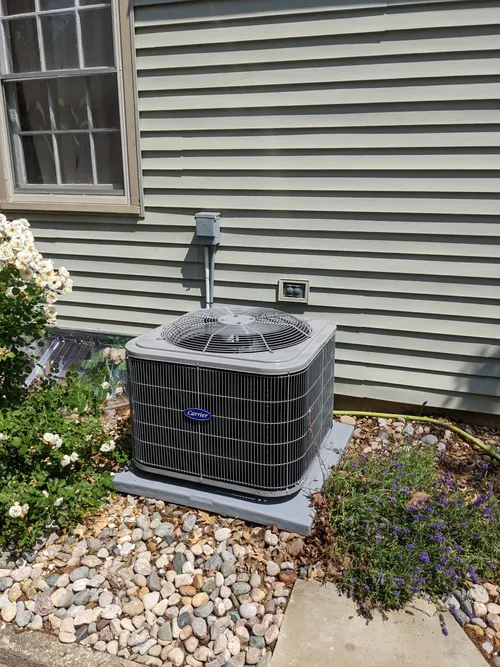
Ro-Mech Mechanical INC is an HVAC contractor serving Fort Wayne, IN, and nearby communities. They provide installation, repair, and maintenance services for air conditioners, furnaces, heat pumps, boilers, mini split systems, and geothermal heat pumps. As an American Standard dealer, they offer a range of indoor comfort equipment including programmable thermostats, humidifiers, air cleaners, and zoning products. Ro-Mech Mechanical INC is staffed by licensed contractors experienced in servicing all brands and offers service agreements to maintain system performance.
How Geothermal Systems Work in Fort Wayne
Unlike traditional air-source systems that battle Fort Wayne's hot summers and cold winters, a geothermal heating and cooling system uses the earth's near-constant temperature as its exchange medium. Just a few feet below the surface, the ground maintains a relatively stable temperature of around 55°F year-round 1. A geothermal system uses a network of buried pipes, called a ground loop, filled with a water-based solution to exchange heat with this stable earth.
During the winter, the fluid circulating through the underground loops absorbs the earth's stored thermal energy. This warm fluid is brought to an indoor geothermal heat pump unit, which concentrates the heat and distributes it throughout your home via your existing ductwork or radiant floor system. In the summer, the process simply reverses: the system extracts heat from your home's air, transfers it to the fluid in the loop, and disperses it into the cooler ground, effectively providing air conditioning. This elegant exchange with the ground, rather than the outside air, is the key to the system's remarkable efficiency.
Types of Ground Loop Systems
The design of the underground loop field is critical and depends entirely on your Fort Wayne property's characteristics. There are three primary configurations, each with its own advantages.
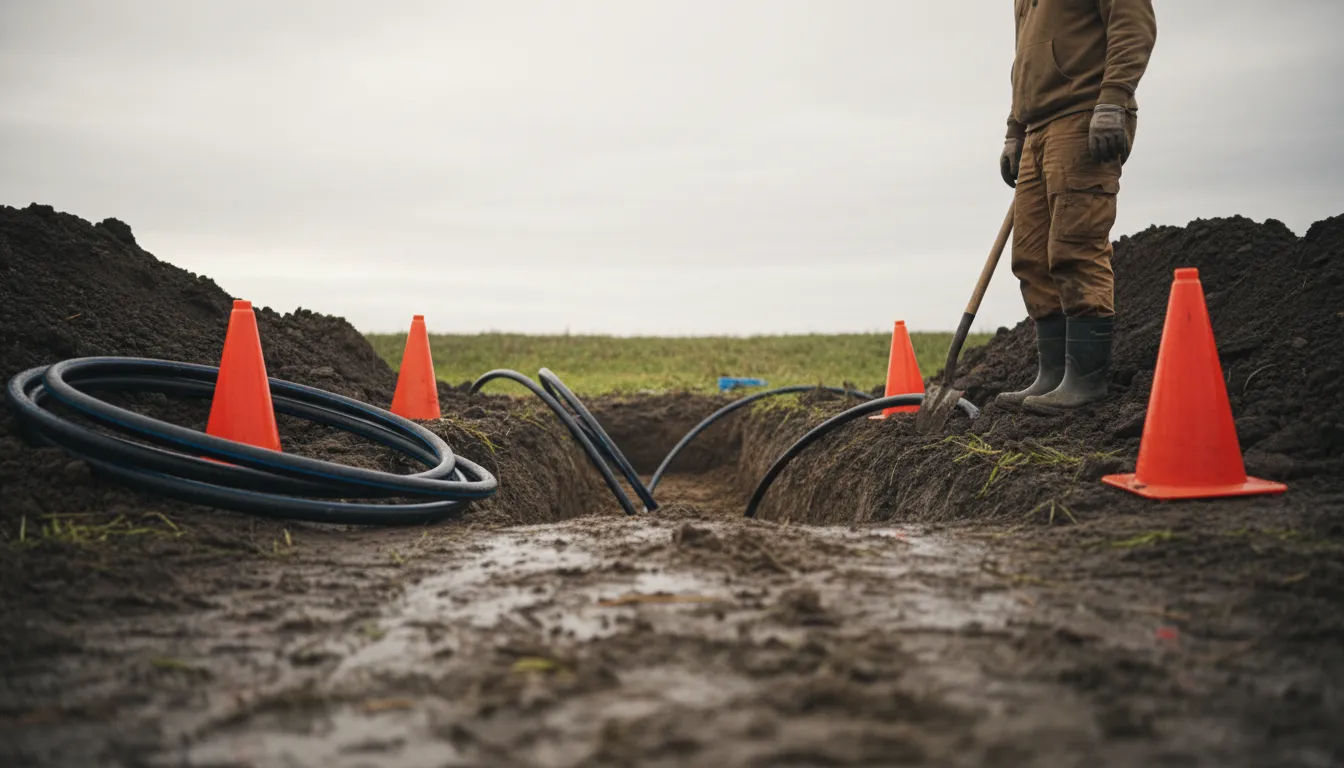
Horizontal Closed Loops: This is often the most cost-effective option if space allows. Contractors dig trenches approximately six feet deep and lay pipes in a series of parallel loops. This method requires a significant amount of land area but typically involves lower excavation costs than drilling.
Vertical Closed Loops: For homes in Fort Wayne with smaller lots, vertical loops are the ideal solution. Contractors use a drilling rig to bore holes 150 to 450 feet deep 2. U-shaped pipe loops are inserted into each borehole, which are then grouted. While the drilling equipment cost is higher, this system minimizes landscape disturbance and is highly effective 2.
Pond/Lake Loops: If you have a sufficient body of water on your property, this can be the most economical loop option. Coils of pipe are submerged at a depth that ensures they won't freeze. The water conducts heat exceptionally well, making this a very efficient setup 3.
The Geothermal Installation Process: What to Expect
Installing a ground-source heat pump is a significant project that requires careful planning and skilled execution. Here's a step-by-step overview of what a professional installation in Fort Wayne entails.
- Site Assessment & Design: A qualified installer will first evaluate your property. They assess soil composition, available land, the location of utility lines, and your home's heating and cooling loads to design the most effective and efficient loop system for your needs.
- Loop Installation: This is the major excavation phase. For a horizontal system, trenches are dug. For a vertical system, a drilling rig creates the necessary boreholes. The polyethylene pipes are then laid in the trenches or inserted into the boreholes.
- Piping & Connection: The pipes are connected into a continuous, pressurized loop and filled with the heat-transfer fluid. The loop is tested for leaks before the trenches are backfilled or the boreholes are grouted.
- Heat Pump Setup: Inside your home, typically in the basement or a utility closet, the geothermal heat pump unit is installed. It is connected to the ground loop on one side and to your home's ductwork or hydronic distribution system on the other 4.
- System Startup & Commissioning: The installer fills the system, purges it of air, and starts it up. They will test and balance the entire system to ensure it operates at peak efficiency and provide you with instructions on its use and maintenance.
Find the perfect geothermal heat pump contractors for your needs
Get personalized recommendations and expert advice
Comparing Installation: Trenching vs. Drilling
The choice between horizontal (trenching) and vertical (drilling) loops is a major cost and logistics decision.
- Trenching for Horizontal Loops: This method generally uses less expensive equipment and can have a lower upfront cost per foot of pipe installed. However, it requires a large, clear area of your yard and results in significant surface disturbance that will need to be landscaped afterward 5 6.
- Drilling for Vertical Loops: Drilling requires specialized equipment and is more expensive per foot. Its primary advantage is its minimal footprint; it's perfect for smaller, landscaped, or wooded lots in Fort Wayne, as the boreholes are only about six inches in diameter and the rig can often access the site without major disruption.
The Financials: Costs, Savings, and Incentives
The decision to install a geothermal system is a long-term investment in your home's efficiency and comfort.
Upfront Costs: It's true that the initial installation cost for a geothermal heat pump system is higher than that of a conventional high-efficiency furnace and air conditioner. This premium is due to the cost of the ground loop excavation and installation.
Operational Savings: Where the system shines is in its operating costs. By using the earth's free thermal energy, geothermal systems can reduce your heating and cooling energy consumption by up to 70% compared to conventional systems 7 8 9. For a Fort Wayne homeowner, this can translate into dramatically lower monthly utility bills year-round.
Long-Term Value & Incentives: The financial picture is made even more attractive by the system's durability and available incentives. The indoor heat pump unit typically lasts 20-25 years, while the underground loop system often comes with warranties of 50 years or more and can last generations 10 11. Furthermore, the federal government offers a Residential Clean Energy Tax Credit for qualified geothermal heat pump installations, which can directly offset a significant percentage of the installation cost 10. Many homeowners find that the combination of massive utility savings and tax incentives allows them to recoup their initial investment within 5 to 10 years.
Key Benefits for Fort Wayne Homeowners
Choosing a geothermal system offers a suite of advantages beyond just savings.
- Exceptional Efficiency & Consistency: Because the ground temperature is stable, the system doesn't have to work as hard as an air-source heat pump during extreme weather, maintaining high efficiency and consistent comfort whether it's 95°F or 5°F outside.
- Quiet Operation: With no loud outdoor condenser unit, the system is remarkably quiet. The only mechanical components are inside your home, and they operate at a low hum 12.
- Durability & Low Maintenance: The sheltered, indoor location of the main components and the rugged construction of the underground loops lead to a long system life with relatively minimal maintenance required.
- Environmental Stewardship: By drastically reducing fossil fuel consumption or electricity drawn from the grid, a geothermal system significantly lowers your household's carbon footprint, making it one of the cleanest heating and cooling options available 13.
Frequently asked questions
Sources
Footnotes
-
How Geothermal Heat Pumps Work - https://www.youtube.com/watch?v=XxlTnBukweI&t=37 ↩
-
Ground source heat pumps: horizontal collectors Vs. vertical boreholes - https://www.mesh-energy.com/insights/ground-source-heat-pumps-horizontal-collectors-vs-vertical-boreholes ↩ ↩2
-
How Does a Geothermal System Work? - ClimateMaster - https://www.climatemaster.com/homeowner/side-links/how-it-works ↩
-
Geothermal Heat Pump Installation: What To Expect For Your Property - https://jomory.com/geothermal-heat-pump-installation-what-to-expect-for-your-property/ ↩
-
Hydrologic Impacts Group - Purdue University - https://www.agry.purdue.edu/hydrology/projects/Geothermal/Geothermal.asp ↩
-
Geothermal Installation Steps Explained - https://ultrageothermal.com/geothermal-installation-steps-explained/ ↩
-
Your Step-by-Step Guide to Installing a Geothermal System in Indiana Before the 2025 Tax Credit Deadline - https://absolutecomfort.org/install-geothermal-system-indiana-2025-guide/ ↩
-
Geothermal Cooling: Here's How It Works - Hartman Brothers - https://hartmanbrothers.com/blog/geothermal-cooling ↩
-
Geothermal Energy: How Does 'Free' Sound? - Hartman Brothers - https://hartmanbrothers.com/blog/geothermal-energy ↩
-
Geothermal Heat Pumps - Department of Energy - https://www.energy.gov/energysaver/geothermal-heat-pumps ↩ ↩2
-
Geothermal Heating, Cooling, and Hot Water Systems - https://igshpa.org/wp-content/uploads/Homeowners-Guide-to-Geothermal.pdf ↩
-
How It Works: Geothermal Heat Pump 101 - GeoComfort Blog - https://geocomfort.com/blog/how-it-works-geothermal-heat-pump-101 ↩
-
5 Things You Should Know about Geothermal Heat Pumps - https://www.energy.gov/cmei/articles/5-things-you-should-know-about-geothermal-heat-pumps ↩