Find the Best Geothermal Heat Pump Contractors for Your Business
No obligation • Fast responses • Nationwide coverage

Why you can trust HVAC Firms
HVAC Firms is a leading United States resource for evaluating HVAC service providers. Our team researches companies, checks credentials, and reviews customer feedback to present clear, unbiased information. Listings and rankings are based on merit, and companies cannot pay to change our editorial content.
Search providers near you
Top Geothermal Heat Pump Contractors in Anderson, Indiana Ranked
A geothermal heat pump, also known as a ground-source heat pump, is a highly efficient heating and cooling system that leverages the Earth's stable underground temperature. For homeowners in Anderson, this technology offers a reliable way to manage indoor climate while significantly reducing energy consumption and utility bills. This guide explains how these systems work, the installation process, and how you can find qualified local experts to assess your property for a potential geothermal installation.
King of Comfort Heating & Cooling
7009 E 56th St, Indianapolis, IN 46226
King of Comfort Heating & Cooling is an HVAC company based in Indianapolis, IN, offering a wide range of heating and cooling services. Their team provides installation, repair, and maintenance for air conditioners, furnaces, heat pumps, boilers, mini splits, geothermal heat pumps, and thermostats. They emphasize comprehensive service and staying current with industry developments to meet diverse HVAC needs. The company also offers 24/7 emergency repair services to ensure reliable heating and cooling during extreme weather conditions. Their technicians handle everything from routine tune-ups to complex repairs, including cracked heat exchangers and faulty thermostats.
Williams Comfort Air - Heating Cooling Plumbing Electrical
711 E 65th St Suite 101, Indianapolis, IN 46220
Williams Comfort Air - Heating Cooling Plumbing Electrical is a full-service HVAC and plumbing contractor based in Indianapolis, IN. They provide repair and installation services for heating systems including furnaces, boilers, heat pumps, and ductless mini splits, as well as air conditioning systems. The company is a Carrier Factory Authorized Dealer and employs NATE-certified technicians trained specifically for Carrier equipment installation and repair. They offer 24/7 emergency repair services to address urgent heating and cooling needs any time of day or night. Plumbing repair services are also available, handled by licensed and insured professionals.

Hoosier Indoor Air
6080 N Railroad St, McCordsville, IN 46055
Hoosier Indoor Air is an HVAC company based in McCordsville, serving homeowners in Indianapolis, IN, and nearby communities such as Geist, Fishers, and Pendleton. They provide heating and cooling repair, maintenance, and installation services, including air conditioning, furnaces, heat pumps, boilers, mini splits, geothermal heat pumps, and indoor air quality systems. As a Bryant Factory Authorized Dealer, they install high-efficiency heating and cooling products and offer specialized services like HVAC zoning systems to improve home comfort. Hoosier Indoor Air has a long history of focusing on skilled technical work and customer care, emphasizing problem-solving with patience and integrity.
Williams Comfort Air - Heating Cooling Plumbing Electrical
1033 3rd Ave SW Suite 205, Carmel, IN 46032
Williams Comfort Air - Heating Cooling Plumbing Electrical is a full-service HVAC and plumbing company serving Indianapolis, IN. They provide a wide range of services including installation, repair, and maintenance for air conditioners, furnaces, heat pumps, boilers, mini-splits, geothermal heat pumps, and duct cleaning. The company is a Carrier Factory Authorized Dealer and offers 24/7 emergency HVAC service to address urgent heating and cooling needs. With over 55 years of experience, Williams Comfort Air emphasizes clear communication, transparent pricing, and comprehensive home comfort solutions.
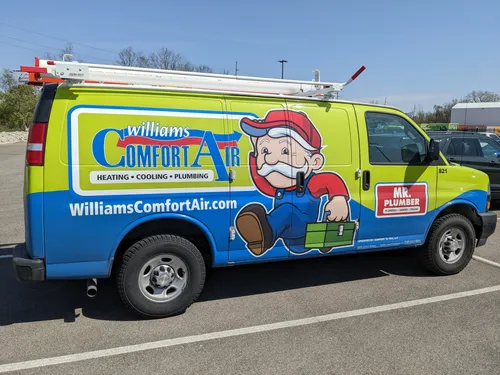
Williams Comfort Air - Heating Cooling Plumbing Electrical
10640 E 59th St, Indianapolis, IN 46236
Williams Comfort Air - Heating Cooling Plumbing Electrical is a full-service HVAC and plumbing company serving Indianapolis, IN. They offer a wide range of services including installation, repair, and maintenance of air conditioners, furnaces, heat pumps, boilers, mini splits, and geothermal heat pumps. The company also provides duct cleaning and indoor air quality services. Their team includes NATE-certified HVAC contractors and licensed plumbers who perform careful diagnostics and repairs. Williams Comfort Air has been serving the community since 1966 and offers 24/7 emergency HVAC service to address urgent heating and cooling needs.
How Geothermal Systems Work: Tapping into the Earth's Constant Temperature
The core principle behind a geothermal system is remarkably simple: it uses the ground as a giant, renewable battery for thermal energy. Just a few feet below the surface, the Earth maintains a nearly constant temperature of around 55°F year-round, regardless of the weather above ground. A geothermal heat pump capitalizes on this stability.
The system circulates a water-based fluid through a continuous loop of high-density polyethylene pipe buried in your yard. In the winter, this fluid absorbs the Earth's gentle warmth. The warm fluid is pumped to an indoor unit, where a heat pump concentrates the thermal energy and distributes warm air throughout your home via your ductwork 1. In the summer, the process reverses: the system extracts heat from your home and transfers it into the cooler ground loop, effectively providing air conditioning 2 3. This heat exchange process is what makes ground-source heat pumps so efficient, as they move existing heat rather than generating it through combustion.
Types of Ground Loop Systems for Anderson Properties
The buried pipe network, called the ground loop, is the heart of the installation. The right type for your Anderson home depends on your land, soil conditions, and budget. There are four primary configurations:
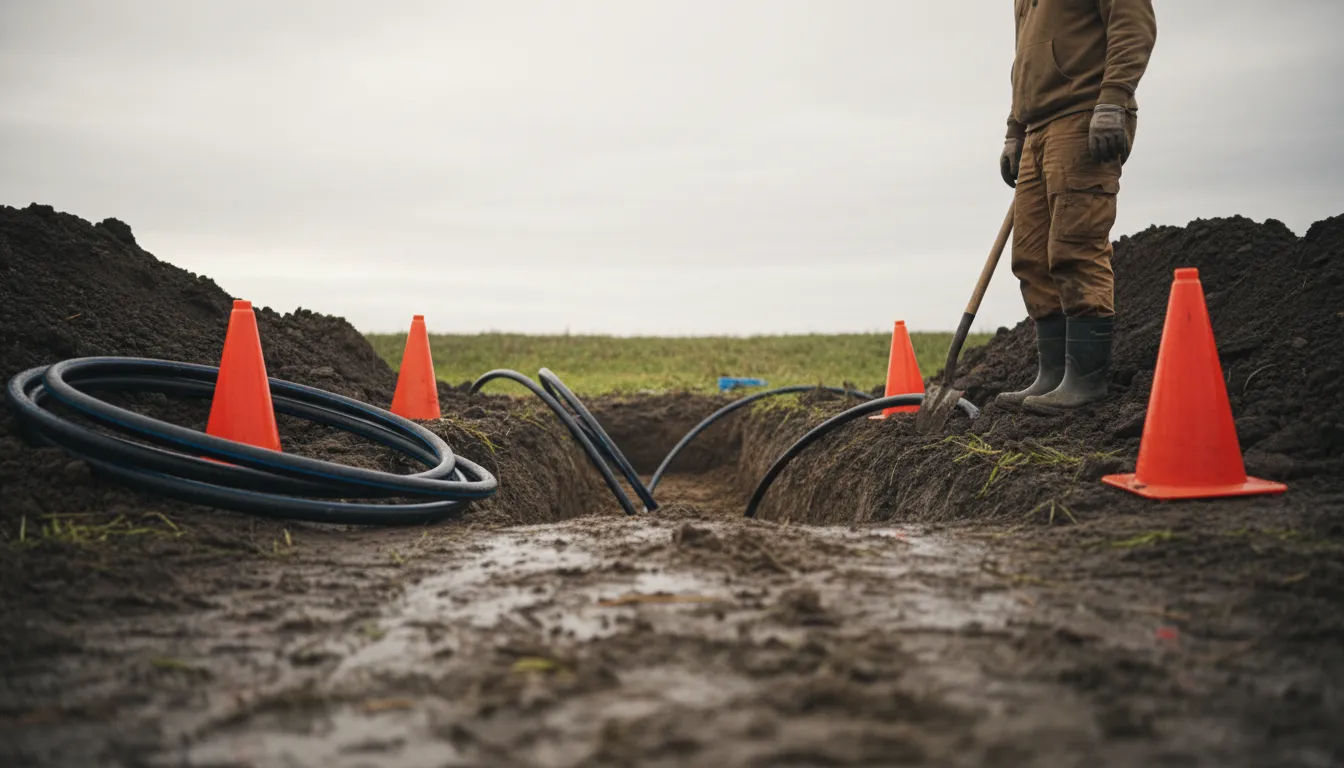
- Horizontal Closed Loop: This is often the most cost-effective option if you have sufficient space. Trenches are dug 4 to 6 feet deep in an open area, and pipes are laid in long, parallel runs or coiled slinky patterns. This design requires a larger plot of land, typically between 1/4 to 3/4 of an acre 4.
- Vertical Closed Loop: Ideal for homes with smaller yards, this system uses deep boreholes drilled 60 to 140 meters into the ground. U-shaped loops of pipe are inserted into each borehole. While the drilling process is more complex and costly upfront, it requires the least amount of surface land 5 6.
- Pond/Lake Loop: If you have a suitably sized and deep pond on your property, this can be the most efficient and least expensive loop to install. Coils of pipe are submerged at the bottom of the water body, which acts as a superb heat exchanger.
- Open Loop System: This system uses groundwater from a well as the direct heat exchange fluid. After passing through the heat pump, the water is discharged back into a second well or a suitable surface body. Its efficiency is high, but it depends entirely on having an adequate supply of clean water and complying with local regulations.
The Geothermal Installation Process: From Assessment to Comfort
Installing a residential geothermal system is a significant project that requires careful planning and professional expertise. The process typically follows these key stages:
- Site Assessment and Design: A qualified installer will evaluate your property, considering soil composition, land availability, and your home's heating and cooling loads. This assessment determines the optimal loop type and size for maximum efficiency.
- Loop Installation: For a horizontal system, this involves excavation with a backhoe to create the trenches. For a vertical system, a drilling rig is used to create the boreholes. The durable HDPE pipes are then placed, connected, and pressure-tested before the trenches are backfilled.
- Indoor Unit Installation: The geothermal heat pump unit is installed inside your home, typically in a basement, utility room, or garage. It is connected to the ground loops and integrated with your existing ductwork or hydronic distribution system.
- System Commissioning: Once everything is connected, the installer will charge the system, power it up, and perform thorough testing and balancing. This ensures all components are working in harmony for optimal performance and efficiency 7.
Find the perfect geothermal heat pump contractors for your needs
Get personalized recommendations and expert advice
Understanding Costs and Financial Incentives
The upfront investment for a complete geothermal heating and cooling system in Anderson is higher than for a conventional system, typically ranging from $20,000 to $40,000 for an average home 8. This cost includes the ground loop installation, the heat pump unit, and any necessary modifications to your home's ductwork or electrical service.
However, this investment is offset by substantial long-term savings and powerful financial incentives:
- Energy Savings: By moving heat instead of creating it, geothermal heat pumps are exceptionally efficient. Homeowners can see reductions of up to 65% on their heating and cooling bills compared to standard electric resistance heating or older HVAC systems 9 10.
- Federal Tax Credit: The Inflation Reduction Act provides a tax credit for 30% of the total installed cost of a qualifying geothermal system, with no upper limit. This credit is available through 2032, making now an excellent time to consider an installation 11 12.
- Local Rebates: It's always worth checking with your local utility company, as they may offer additional rebates or special rates for customers who install high-efficiency geothermal systems.
Is a Geothermal System Right for Your Home?
A ground-source heat pump is a fantastic long-term solution for many, but not all, properties. It's an ideal choice if you:
- Plan to stay in your current home for many years to maximize the return on investment through energy savings.
- Have the available land for a horizontal loop or the budget for vertical drilling.
- Are building a new home or replacing an aging, inefficient HVAC system.
- Prioritize comfort, quiet operation, and reducing your carbon footprint.
The most critical step is to consult with a local Anderson installer who specializes in geothermal technology. They can provide a detailed site evaluation, accurate cost estimate, and savings projection tailored to your specific home.
Maintenance and Longevity
One of the major advantages of a geothermal system is its durability and low maintenance needs. The indoor heat pump unit requires about the same level of care as a standard furnace-primarily regular filter changes and periodic check-ups by a technician. The buried ground loop is designed to last for generations, often carrying warranties of 50 years or more on the piping itself. With proper care, the entire system can provide reliable, efficient comfort for 20-25 years or more.
Frequently asked questions
Sources
Footnotes
-
Consider A Geothermal Heat Pump | JL Anderson HVAC | IN - https://jlanderson.net/3-reasons-to-consider-a-geothermal-heat-pump/ ↩
-
Geothermal Heating & Cooling | City of Ann Arbor - A2gov.org - https://www.a2gov.org/sustainability-innovations-home/sustainability-me/for-families-individuals/geothermal-heating-cooling/ ↩
-
How Geothermal Heat Pumps Work - https://www.youtube.com/watch?v=XxlTnBukweI&t=37 ↩
-
How Does A Geothermal Heat Pump Work? Complete 2025 Guide - https://solartechonline.com/blog/how-does-geothermal-heat-pump-work/ ↩
-
Geothermal Heat Pumps - Department of Energy - https://www.energy.gov/energysaver/geothermal-heat-pumps ↩
-
Geothermal heat pumps: The ultimate guide to ground-source ... - https://termo-plus.com/blog/geothermal-ultimate-guide-to-ground-source-heat-pumps/ ↩
-
Research Conference Proceedings - https://igshpa.org/wp-content/uploads/2017-IGSHPA-Research-Track-Proceedings-1.pdf ↩
-
Geothermal Heat Pump Guide: Installation Costs, Types And Benefits - https://modernize.com/hvac/heating-repair-installation/heat-pump/geothermal ↩
-
All You Need to Know About Home Geothermal Heating & ... - https://dandelionenergy.com/all-you-need-to-know-about-home-geothermal-heating-cooling ↩
-
Everything You Need to Know About Geothermal Heat Pumps - https://www.familyhandyman.com/article/everything-you-need-to-know-about-geothermal-heat-pumps/ ↩
-
Your Step-by-Step Guide to Installing a Geothermal System in Indiana Before the 2025 Tax Credit Deadline - https://absolutecomfort.org/install-geothermal-system-indiana-2025-guide/ ↩
-
Geothermal Heat Pumps: How They Work and Benefits for Your ... - https://www.rbiva.com/resources/geothermal-heat-pumps-how-they-work-and-benefits/ ↩