Find the Best Geothermal Heat Pump Contractors for Your Business
No obligation • Fast responses • Nationwide coverage

Why you can trust HVAC Firms
HVAC Firms is a leading United States resource for evaluating HVAC service providers. Our team researches companies, checks credentials, and reviews customer feedback to present clear, unbiased information. Listings and rankings are based on merit, and companies cannot pay to change our editorial content.
Search providers near you
Top Geothermal Heat Pump Contractors in North Miami, Florida Ranked
A geothermal heat pump, often called a ground-source heat pump, is a highly efficient system for heating and cooling your home by exchanging heat with the earth. In North Miami, this technology leverages the area's consistently warm ground temperature to provide year-round comfort with dramatically lower energy use. This guide explains how these systems work, the installation process, and how you can find qualified local professionals to evaluate your property.
Cool Breeze Air Conditioning
13120 SW 130th Terrace, Miami, FL 33186
Cool Breeze Air Conditioning is an HVAC company based in Miami, FL, serving Central and South Florida. They specialize in the installation, repair, and maintenance of air conditioning, furnaces, heat pumps, boilers, mini splits, and geothermal heat pumps. The company handles projects ranging from small residential units to large commercial chillers. Founded in 1987, Cool Breeze has decades of experience and operates with a team of certified professionals and a large fleet of service vehicles. They offer round-the-clock service to meet customer needs at any time.
Miami Heat Pump -Geothermal Heat Pump
1052 NW 21st St, Miami, FL 33127
Miami Heat Pump - Geothermal Heat Pump is a geothermal heat pump contractor based in Miami, FL. They specialize in designing and manufacturing highly efficient geothermal heat pump units for residential and commercial use. With over 40 years of experience, their products are made in the USA, Energy Star compliant, and AHRI certified. Their units include features such as two-stage options for increased efficiency and quiet package designs to reduce noise levels. The company offers a wide range of customizable geothermal heat pumps that support heating, cooling, radiant floor systems, and domestic hot water heating.
How Geothermal Systems Work in South Florida
The core principle of a geothermal system is simple: it uses the earth as a heat source in winter and a heat sink in summer. Unlike traditional air conditioners and furnaces that battle the extreme outdoor air temperatures, a ground-source heat pump connects to a loop of pipes buried in the ground, where temperatures remain a stable 72-75°F year-round.
Summer Cooling: When your home needs cooling, the system absorbs heat from your indoor air. Instead of releasing this heat into the hot outdoor air like a standard AC, the geothermal unit transfers it into the fluid circulating in the underground loop. The cooler earth absorbs this heat, and the chilled fluid returns to cool your home.
Winter Heating: In the rare cooler periods, the process reverses. The system extracts the abundant heat energy stored in the 72°F ground, concentrates it via the heat pump, and circulates warm air throughout your home.
This "heat exchange" process is what makes geothermal technology so efficient. Because it moves existing heat rather than creating it through combustion or intense electrical resistance, a geothermal heat pump can deliver three to five times more heating and cooling energy than the electrical energy it consumes.
Types of Ground Loop Systems
The underground portion of the system, called the ground loop, is the critical component that enables heat exchange. The right type for your North Miami property depends on your lot size, soil conditions, and budget.
Closed-Loop Systems: This is the most common installation type. A mixture of water and antifreeze circulates continuously through a sealed, high-density polyethylene pipe loop buried in the ground. There are two primary configurations:
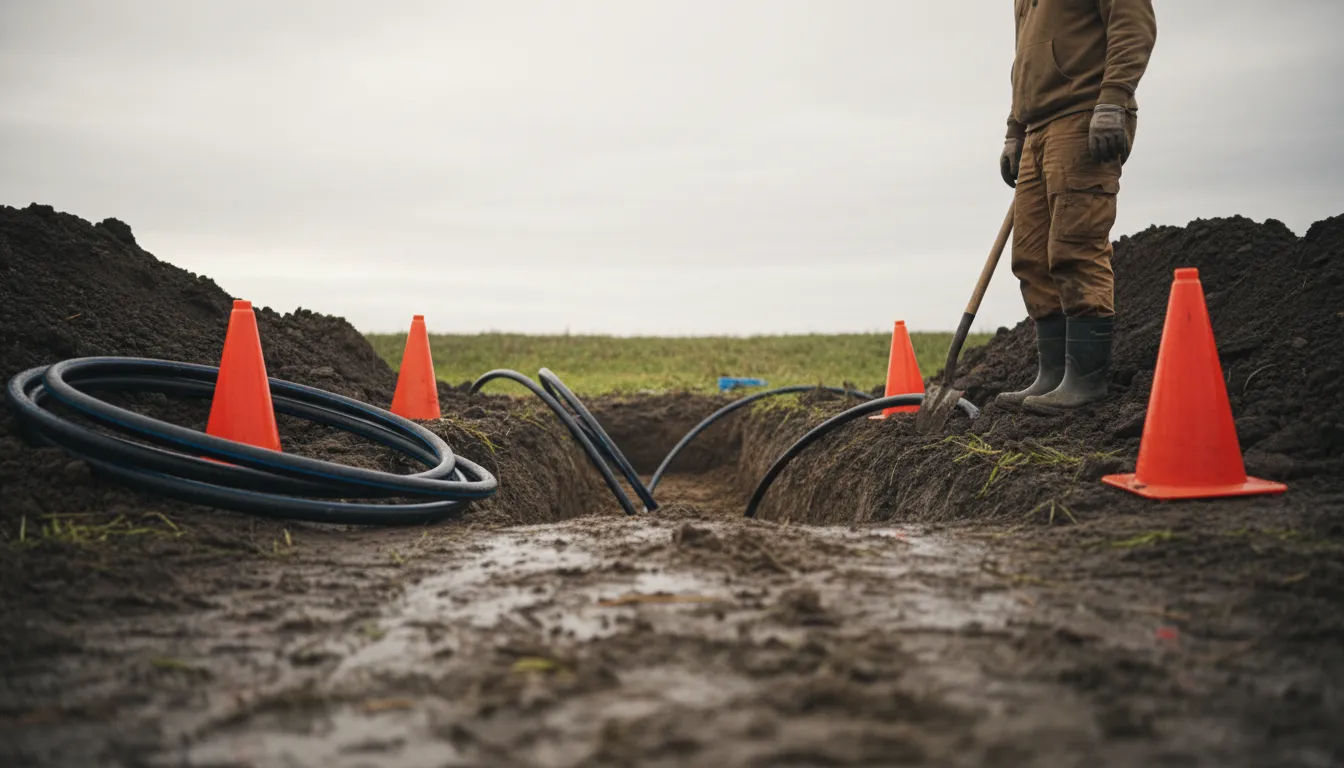
- Horizontal Loops: Ideal for properties with ample yard space. Contractors dig trenches 4 to 6 feet deep and lay pipes in a series of parallel lines or slinky coils. This method typically has a lower excavation cost than drilling 1.
- Vertical Loops: The best solution for smaller residential lots common in North Miami. Contractors drill boreholes 200 to 400 feet deep and insert U-shaped pipe loops into each hole. Vertical loops require less land area and are often less susceptible to ground temperature fluctuations, but drilling costs can be higher 2 3 4.
Open-Loop Systems: This system uses groundwater from a well as the direct heat exchange fluid. It pumps water from the aquifer, runs it through the heat pump, and then discharges it. While potentially very efficient, open-loop systems are less common due to local regulations concerning water use and discharge, and they require a sufficient, consistent water supply.
Pond/Lake Loops: If your property has access to a sufficient body of water, a coil of pipe can be submerged at the bottom. The water acts as the heat exchange medium. This can be a cost-effective option if the site conditions are suitable 5.
The Geothermal Installation Process: What to Expect
Installing a geothermal heating and cooling system is a significant project that requires careful planning and expert execution. Here's a step-by-step overview of what a professional installation entails.
1. Initial Site Assessment and Load Calculation A qualified installer will first conduct a thorough evaluation of your property and home. This includes a detailed heat load calculation to determine your home's precise heating and cooling requirements. They will also assess your yard's size, soil composition, and rock content to recommend the optimal loop type and design 6.
2. Loop Field Installation This is the most distinctive phase of the project. For a vertical loop system, a drilling rig will bore the necessary number of deep holes. For a horizontal system, a backhoe will dig the required trenches. The polyethylene pipe is then laid in the trenches or inserted into the boreholes. The trenches are backfilled, or the boreholes are grouted with a special material to ensure good thermal conductivity and protect groundwater.
3. Indoor Unit and Connection Inside your home, typically in a garage, basement, or utility closet, the geothermal heat pump unit is installed. This cabinet contains the compressor, heat exchanger, and controls. The ground loop pipes are connected to this unit. The system is then connected to your home's existing ductwork or to a new air distribution system 7.
4. System Charging, Testing, and Startup The loop and unit are pressurized and tested for leaks. The system is charged with refrigerant, and all electrical connections are finalized. The contractor will then start the system, calibrate the thermostat, and balance the airflow to ensure optimal performance and comfort throughout your home 8 9.
Find the perfect geothermal heat pump contractors for your needs
Get personalized recommendations and expert advice
Benefits for North Miami Homeowners
Choosing a geothermal system offers compelling advantages, particularly in the South Florida climate.
Substantial Energy Savings: By leveraging the earth's constant temperature, geothermal heat pumps operate with exceptional efficiency. Homeowners can typically see a 30% to 70% reduction in energy use for heating and cooling compared to conventional systems, leading to significantly lower monthly utility bills 10 11 12.
Long-Term Value and Durability: While the upfront investment is higher than a standard HVAC system, the operational savings provide an attractive return on investment, often paying back the premium in 5 to 10 years. Furthermore, the durable underground piping often carries warranties of 25 to 50 years, and the indoor heat pump unit typically lasts 20 years or more, far exceeding the lifespan of traditional outdoor AC condensers.
Environmental Stewardship: Geothermal systems have a very low carbon footprint. They use renewable thermal energy from the ground and eliminate on-site fossil fuel combustion. They also use non-ozone-depleting refrigerants and, because they are so efficient, reduce the demand on the local power grid.
Quiet Operation and Comfort: With no loud outdoor condenser fan battling the heat, geothermal systems run very quietly. They also provide exceptionally consistent temperatures and better humidity control than forced-air systems, enhancing indoor comfort 13 14.
Potential Financial Incentives: To encourage energy efficiency, federal tax credits are often available for the installation of qualified geothermal heat pump systems. A knowledgeable local installer can provide details on current incentive programs that can help offset the initial cost 15.
Key Considerations Before You Install
Upfront Cost: The installation of the ground loop is labor and equipment-intensive, making the total system cost higher than a traditional air-source system. It's important to view this as a long-term investment in your home's efficiency and comfort 16.
Property Suitability: Not every lot is ideal for every type of loop. A vertical system may be necessary for smaller urban lots, while a horizontal system requires adequate, unobstructed land. A professional site survey is essential.
Choosing the Right Contractor: This is the most critical step. Installation quality directly impacts system performance and longevity. Look for experienced, certified professionals who specialize in geothermal technology, conduct proper load calculations, and have a portfolio of successful local installations 17.
Frequently asked questions
Sources
Footnotes
-
Geothermal Heat Pumps Guide: Installation, Benefits, Cost - https://www.miamihp.com/welcome-to-our-comprehensive-guide-on-geothermal-heat-pumps/ ↩
-
Geothermal Heat Pump Installation: What To Expect For Your ... - https://jomory.com/geothermal-heat-pump-installation-what-to-expect-for-your-property/ ↩
-
Geothermal Heat Pumps - Department of Energy - https://www.energy.gov/energysaver/geothermal-heat-pumps ↩
-
Exploring Geothermal Systems: Advantages and Considerations - https://dilandroandrews.com/understanding-geothermal-systems/ ↩
-
Geothermal Installation Options & Solutions - Miami Heat Pumps - https://www.miamiheatpumps.com/geothermal_installation_options_solutions.html ↩
-
Geothermal Heating and Cooling - Greener Solutions Air Conditioning - https://www.greenersolutionsair.com/geothermal ↩
-
Geothermal Heat Pumps - EnergySmart CNY - https://www.energysmartcny.org/heat-pumps/geothermal/ ↩
-
The Geothermal Process - https://www.cogeothermal.com/services/our-process/ ↩
-
Geothermal Heating & Cooling - Adams Electric Cooperative - https://adamselectric.coop/community/energy-efficiency-for-all/geothermal/ ↩
-
Geothermal Energy in Florida | Efficient Heating & Cooling - https://tonykellyinc.com/what-is-geothermal-energy-in-florida/ ↩
-
How Does A Geothermal Heat Pump Work? Complete 2025 Guide - https://solartechonline.com/blog/how-does-geothermal-heat-pump-work/ ↩
-
Top Benefits of Geothermal Heating and Cooling in Florida Homes - https://tricountyair.com/blog/geothermal-heating-cooling-florida/ ↩
-
Guide to Geothermal Heat Pumps - https://www.energy.gov/sites/prod/files/guide_to_geothermal_heat_pumps.pdf ↩
-
Geothermal Heat Pumps | Panama City, FL - https://ridgeac.com/geothermal/ ↩
-
5 Things You Should Know about Geothermal Heat Pumps - https://www.energy.gov/cmei/articles/5-things-you-should-know-about-geothermal-heat-pumps ↩
-
Geothermal Heat Pump Guide: Installation Costs, Types And Benefits - https://modernize.com/hvac/heating-repair-installation/heat-pump/geothermal ↩
-
Frequently Asked Questions - https://igshpa.org/frequently-asked-questions/ ↩