Find the Best Geothermal Heat Pump Contractors for Your Business
No obligation • Fast responses • Nationwide coverage

Why you can trust HVAC Firms
HVAC Firms is a leading United States resource for evaluating HVAC service providers. Our team researches companies, checks credentials, and reviews customer feedback to present clear, unbiased information. Listings and rankings are based on merit, and companies cannot pay to change our editorial content.
Search providers near you
Top Geothermal Heat Pump Contractors in Miramar, Florida Ranked
A geothermal heat pump, also known as a ground-source heat pump, is one of the most energy-efficient systems available for home heating and cooling. It works by exchanging heat with the earth, which maintains a stable temperature year-round. In Miramar, this technology is particularly effective due to Florida's favorable ground conditions. This guide explains how these systems work, what installation involves, and how you can find qualified local specialists to evaluate your property for this sustainable comfort solution.
Cool Breeze Air Conditioning
13120 SW 130th Terrace, Miami, FL 33186
Cool Breeze Air Conditioning is an HVAC company based in Miami, FL, serving Central and South Florida. They specialize in the installation, repair, and maintenance of air conditioning, furnaces, heat pumps, boilers, mini splits, and geothermal heat pumps. The company handles projects ranging from small residential units to large commercial chillers. Founded in 1987, Cool Breeze has decades of experience and operates with a team of certified professionals and a large fleet of service vehicles. They offer round-the-clock service to meet customer needs at any time.
Miami Heat Pump -Geothermal Heat Pump
1052 NW 21st St, Miami, FL 33127
Miami Heat Pump - Geothermal Heat Pump is a geothermal heat pump contractor based in Miami, FL. They specialize in designing and manufacturing highly efficient geothermal heat pump units for residential and commercial use. With over 40 years of experience, their products are made in the USA, Energy Star compliant, and AHRI certified. Their units include features such as two-stage options for increased efficiency and quiet package designs to reduce noise levels. The company offers a wide range of customizable geothermal heat pumps that support heating, cooling, radiant floor systems, and domestic hot water heating.
Why Geothermal is a Smart Choice for Miramar Homes
Florida's unique geology provides an ideal environment for ground-source heat exchange systems. Unlike northern states where the ground freezes, the earth and groundwater in Miramar remain at a remarkably consistent temperature of approximately 76°F (about 24°C) throughout the year. This stable thermal resource acts as a reliable heat source in the winter and an efficient heat sink in the summer, allowing geothermal systems to operate with exceptional efficiency 1.
The core principle is heat transfer. A fluid, typically water or an antifreeze solution, circulates through a network of pipes buried underground, known as a ground loop. In the cooling season, the system extracts heat from your home and transfers it into the cooler ground. During the rare cooler periods, the process reverses, drawing the earth's natural warmth into your home 2 3. This process can reduce energy consumption for heating and cooling by up to 70% compared to conventional air-conditioning and furnace systems 2.
How a Geothermal Heating and Cooling System Works
Understanding the mechanics can help you appreciate the long-term value. The system has two main components: the underground loop field and the indoor heat pump unit.
- The Ground Loop: This is the system's connection to the earth's thermal energy. Pipes are buried in your yard, either vertically in deep boreholes or horizontally in trenches, forming a closed circuit. In an open-loop configuration, which is common and effective in Florida, water is drawn from a well, cycled through the heat pump, and then returned to a second well or a safe discharge point.
- The Indoor Heat Pump: This unit, often installed in a garage or utility room, functions like a sophisticated refrigerator. It contains a compressor and a heat exchanger. The fluid from the ground loop enters the heat pump, where its temperature is either concentrated (for heating) or dissipated (for cooling). The conditioned air is then distributed throughout your home via your existing ductwork 4.
Because the system moves heat rather than generating it by burning fuel, it delivers significant savings. Homeowners in Miramar can expect to save between 30% and 70% on their annual heating and cooling bills 5.
Types of Ground Loop Systems for South Florida Properties
The right loop configuration depends on your property's size, soil composition, and layout. Local installers will conduct a detailed site assessment to recommend the best option.
- Vertical Closed Loops: Ideal for homes with smaller yards, this method involves drilling boreholes 150 to 250 feet deep for each ton of system capacity. U-shaped pipes are inserted into these holes and sealed with a special grout. While drilling costs can be higher, this system requires minimal surface area 6.
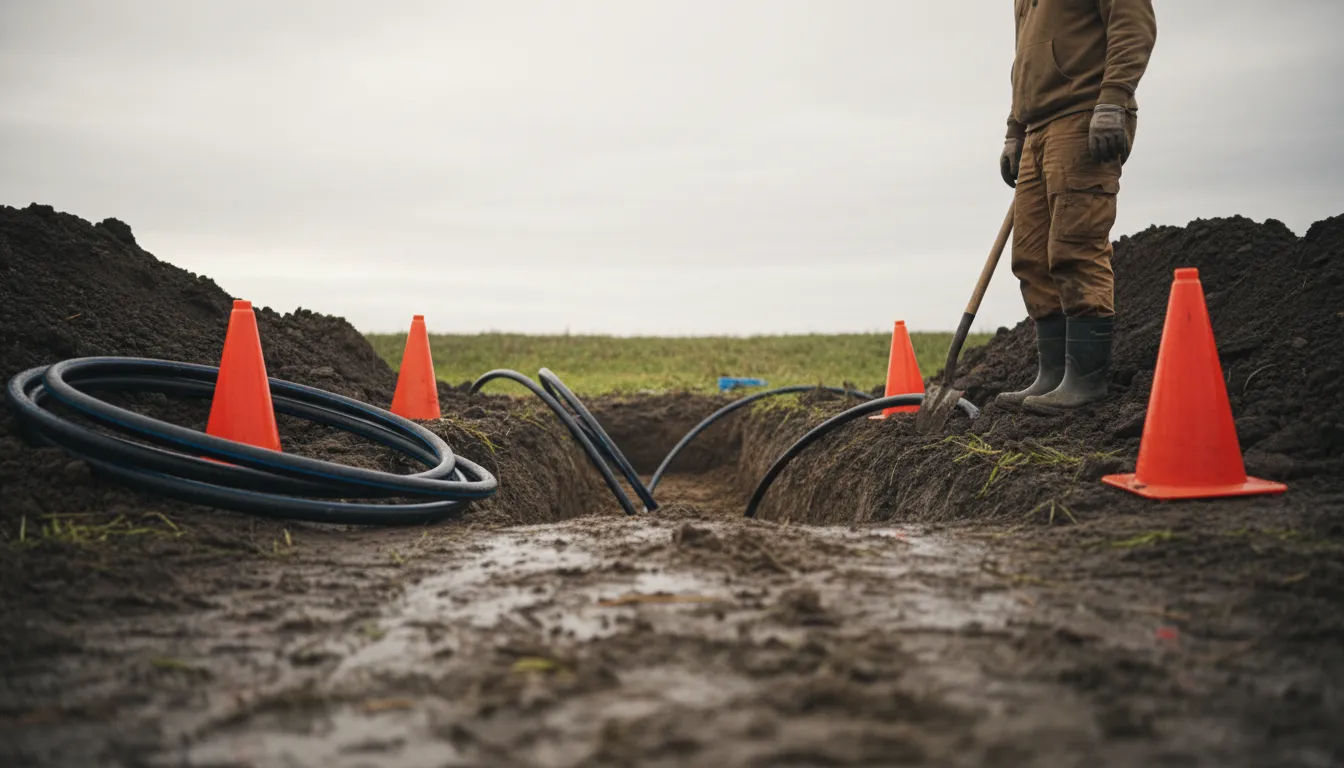
- Horizontal Closed Loops: If you have ample, clear land, this can be a cost-effective choice. Excavators dig trenches 4 to 8 feet deep and 6 to 10 feet apart. Coiled or straight pipes are laid in these trenches before they are backfilled. This method requires more land but often less specialized drilling equipment 7.
- Open Loop Systems (Well Water Systems): This is frequently the preferred and most efficient method in Florida due to the abundant, warm groundwater. The system uses water from a supply well, passes it through the heat pump for heat exchange, and then discharges it to a second "return" well, a pond, or another approved location. It typically offers high efficiency and can have lower installation costs than vertical closed loops, provided adequate water quality and flow are available 8.
Find the perfect geothermal heat pump contractors for your needs
Get personalized recommendations and expert advice
The Geothermal Installation Process: What to Expect
Installing a geothermal HVAC system is a significant project that requires professional expertise. Here's a general overview of the steps involved.
- Consultation and Site Evaluation: A certified technician will assess your home's heating and cooling loads, inspect your existing ductwork, and evaluate your property. They will test soil conditions, check for underground utilities, and determine the best loop type and size for your needs 9.
- Loop Field Installation: This is the major outdoor phase.
- For vertical loops, a drilling rig will create the necessary boreholes.
- For horizontal loops, a backhoe or trencher will excavate the field.
- For open loops, a well driller will create the supply and return wells. Pipes are then placed, connected into a manifold, and pressure-tested. The trenches or boreholes are carefully backfilled and sealed.
- Indoor Unit Installation: The geothermal heat pump unit is installed inside your home, typically where your old furnace or air handler was located. It is connected to the ground loop pipes entering your home and to your existing ductwork and electrical system 10.
- System Startup and Testing: The installer will charge the system, power it up, and test all components for proper operation. They will ensure the heating, cooling, and thermostat controls are working correctly and explain the system's basic maintenance to you.
Costs, Savings, and Incentives for Miramar Residents
The upfront investment for a geothermal system is higher than for a standard air-conditioning system, primarily due to the ground loop installation. However, the operational savings are substantial.
- Energy Savings: By leveraging the earth's constant temperature, these systems slash energy use. The U.S. Department of Energy notes that geothermal heat pumps can reduce energy use by 30-70% compared to conventional systems 11 12. For a Miramar home, this often translates to savings exceeding 50% on monthly utility bills, especially during peak cooling seasons 13.
- Long-Term Value: While the initial cost is higher, the significantly lower monthly bills mean the system can pay for itself over time. Furthermore, the underground piping has a lifespan of 50+ years, and the indoor heat pump unit often lasts 20 years or more, much longer than traditional outdoor AC condensers.
- Financial Incentives: To encourage adoption of clean energy, the federal government offers a tax credit for qualifying geothermal heat pump installations. It's crucial to consult with your installer and a tax professional about the current credit amount and eligibility requirements at the time of your purchase 14.
Benefits Beyond Energy Bills
The advantages of a ground-source heat pump extend far beyond cost savings.
- Quiet Operation: With no loud outdoor condenser unit, the system runs very quietly. The majority of the mechanical components are indoors.
- Improved Comfort: These systems provide exceptionally consistent temperatures and better humidity control than many conventional systems.
- Safety and Cleanliness: There is no combustion of fossil fuels inside your home, eliminating risks associated with carbon monoxide and gas leaks.
- Durability and Low Maintenance: Protected from outdoor weather, the indoor components experience less wear and tear. The ground loop is virtually maintenance-free.
Frequently asked questions
Sources
Footnotes
-
How Geothermal Heat Pumps Work - https://www.youtube.com/watch?v=XxlTnBukweI&t=37 ↩
-
How Does GeoThermal Air Conditioning Work in Florida? - https://symbiontservice.com/services/geothermal-air-conditioning/how-does-geothermal-ac-work/ ↩ ↩2
-
How Geothermal Heating and Cooling Systems Work | Belle Air - https://www.belleairservices.com/how-geothermal-heating-and-cooling-systems-work/ ↩
-
How Does a Heat Pump Work? BC Homeowners Guide | Vernon AC - https://vernonairconditioning.com/blog/how-does-a-heat-pump-work/ ↩
-
Geothermal Heating, Cooling, and Hot Water Systems - https://igshpa.org/wp-content/uploads/Homeowners-Guide-to-Geothermal.pdf ↩
-
Geothermal Heat Pumps, Explained - Bosch Home Comfort - https://www.bosch-homecomfort.com/us/en/residential/connect/blog/geothermal-heat-pumps-go-green-save-green/ ↩
-
Geothermal Heat Pump Installation: What To Expect For Your ... - https://jomory.com/geothermal-heat-pump-installation-what-to-expect-for-your-property/ ↩
-
Geothermal Heating And Cooling Works In Florida. Here's How - https://symbiontservice.com/2011/06/07/geothermal-heating-and-cooling-works-in-florida-heres-how/ ↩
-
How Does A Geothermal Heat Pump Work? Complete 2025 Guide - https://solartechonline.com/blog/how-does-geothermal-heat-pump-work/ ↩
-
All You Need to Know About Home Geothermal Heating & Cooling - Dandelion Energy - https://dandelionenergy.com/all-you-need-to-know-about-home-geothermal-heating-cooling ↩
-
5 Things You Should Know about Geothermal Heat Pumps - https://www.energy.gov/cmei/articles/5-things-you-should-know-about-geothermal-heat-pumps ↩
-
Guide to Geothermal Heat Pumps - https://www.energy.gov/sites/prod/files/guide_to_geothermal_heat_pumps.pdf ↩
-
Geothermal Energy in Florida | Efficient Heating & Cooling - https://tonykellyinc.com/what-is-geothermal-energy-in-florida/ ↩
-
Geothermal Heat Pump Cost | Geothermal Heat Pump Installation Cost - https://www.carrier.com/residential/en/ca/products/geothermal-heat-pumps/cost-buying-geothermal-heat-pump/ ↩