Find the Best Geothermal Heat Pump Contractors for Your Business
No obligation • Fast responses • Nationwide coverage

Why you can trust HVAC Firms
HVAC Firms is a leading United States resource for evaluating HVAC service providers. Our team researches companies, checks credentials, and reviews customer feedback to present clear, unbiased information. Listings and rankings are based on merit, and companies cannot pay to change our editorial content.
Search providers near you
Top Geothermal Heat Pump Contractors in Largo, Florida Ranked
A geothermal heat pump, or ground-source heat pump, is a highly efficient system for heating, cooling, and providing hot water for your home. It works by exchanging heat with the stable temperature of the earth beneath your property, offering a sustainable alternative to traditional air conditioners and furnaces. For Largo residents, this technology leverages the area's consistent underground climate to deliver significant energy savings and reliable comfort year-round. This guide explains how these systems work, what installation involves, and how you can find qualified local specialists to assess your property.
Total Air Solutions
6625 Anderson Rd, Tampa, FL 33634
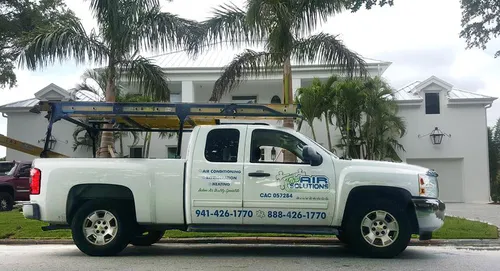
Total Air Solutions is an HVAC company serving Tampa, FL, and the surrounding Gulf Coast communities. Since 2003, they have provided heating, cooling, and indoor air quality services for residential, commercial, and industrial clients. Their offerings include installation, repair, and maintenance of air conditioners, furnaces, heat pumps, boilers, ductless mini-splits, and geothermal heat pumps. The company is equipped to handle advanced HVAC technologies such as smart thermostats and geothermal systems. Total Air Solutions also offers 24/7 emergency service to address urgent HVAC needs.
Boyette Air, Inc.
Tampa, FL
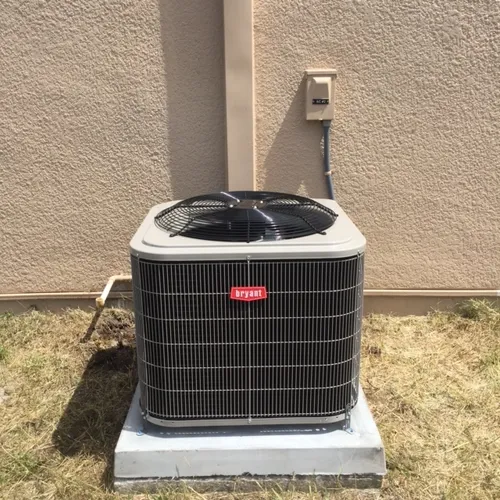
Boyette Air, Inc. is an HVAC company based in Tampa, FL, serving both residential and commercial clients. They offer a range of services including air conditioning repair, furnace installation, geothermal heat pump work, and commercial HVAC installation. The company handles projects of varying sizes, from quick repairs to extensive heating system installations, with licensed professionals managing the work.
How Geothermal Systems Work in Largo's Climate
The core principle of a geothermal system is heat exchange. Unlike conventional systems that battle Florida's hot outdoor air, a ground-source heat pump uses the earth's near-constant temperature as a thermal resource. Just a few feet below the surface, the ground in Largo maintains a stable temperature of approximately 70°F year-round 1 2. This provides a perfect, steady source for efficient heating and cooling.
During the sweltering summer, the system acts as a highly efficient cooler. Heat from your home's air is absorbed by a water-based fluid circulating in underground pipes. This warmed fluid is pumped back outside, where it releases the heat into the cooler earth 3. In the milder winter, the process reverses. The fluid absorbs the gentle warmth from the 70°F earth and carries it into the heat pump, which concentrates it to provide comfortable heating for your home 4. This elegant exchange of thermal energy with the ground is what makes geothermal technology so efficient and effective.
Types of Ground Loop Systems
The underground pipe network, called the ground loop, is the critical component that facilitates heat exchange with the earth. The right type for your Largo home depends primarily on your property's size and soil conditions. There are three main configurations.
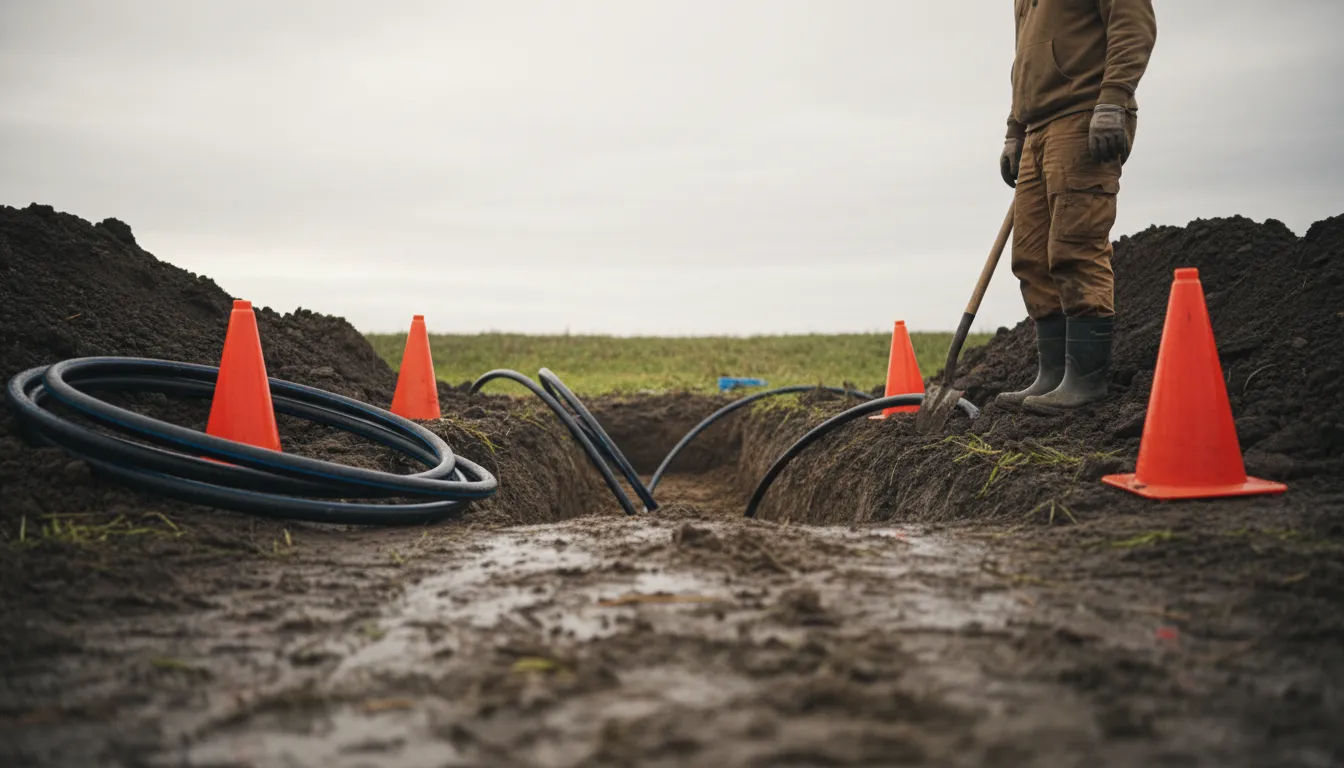
Horizontal Ground Loops are the most common choice for properties with ample yard space. Pipes are laid in trenches that are typically 5 to 8 feet deep, spread across a large area. This approach requires a significant amount of land, often at least half an acre, to accommodate the necessary pipe length. The installation involves trenching, which disturbs a larger surface area but is generally less expensive and can be completed in 1-3 days.
Vertical Ground Loops are the ideal solution for most existing homes in Largo with smaller or landscaped yards. Instead of trenches, contractors use a drilling rig to create boreholes 150 to 400 feet deep 5. U-shaped pipes are then inserted into these holes. While the drilling process is more specialized and can take 3-5 days, it minimizes surface disruption and is excellent for rocky soil. This makes vertical loops a practical choice for retrofitting a geothermal system onto an established property.
Pond/Lake Loops can be the most cost-effective option if a suitable body of water is available on your property. Coils of pipe are submerged at an adequate depth where water temperatures remain stable. However, due to the typical suburban landscape of Largo, this closed-loop system is less commonly applicable for most homeowners compared to horizontal or vertical configurations 6 7.
Find the perfect geothermal heat pump contractors for your needs
Get personalized recommendations and expert advice
The Installation Process: What to Expect
Installing a geothermal heating and cooling system is a significant project that requires careful planning and expert execution. The process begins with a thorough site evaluation by a qualified installer. They will assess your soil composition, lot size, existing landscaping, and home's heating/cooling load to design the most effective and efficient loop system for your needs.
The physical installation centers on the ground loop. For a horizontal system, this means excavating long trenches across the yard. For a vertical system, it involves drilling the deep boreholes. This phase is often easiest during new home construction or major renovation when the landscape is already accessible 8. Once the pipes are placed and connected into a continuous loop, they are pressure-tested and backfilled. The indoor unit, which resembles a traditional furnace, is then installed and connected to the loop and your home's ductwork. The final step is a comprehensive system startup and testing procedure to ensure everything operates at peak efficiency.
Costs, Savings, and Long-Term Value
The upfront investment for a geothermal heat pump system is higher than for a conventional HVAC system. In Largo, total installed costs typically range from $12,000 to over $40,000. This wide range depends heavily on the loop type (vertical drilling is more expensive than horizontal trenching), the size of your home, and the system's capacity. It's important to view this cost through the lens of long-term ownership.
The primary financial benefit comes from dramatically lower operating costs. Homeowners can expect to save between 30% and 65% on their annual energy bills for heating, cooling, and hot water compared to standard systems 9 10 11. These substantial savings mean the system often pays for itself through reduced utility bills over a period of 4 to 15 years, after which you enjoy decades of significantly lower energy costs 12 11 13. Furthermore, geothermal systems are known for their durability, with ground loops often warrantied for 50 years and indoor components lasting 20 years or more, adding to the long-term value.
Environmental Benefits and Incentives
Choosing a geothermal system is one of the most impactful decisions a homeowner can make for reducing their environmental footprint. By using the renewable thermal energy stored in the earth, these systems eliminate the on-site burning of fossil fuels for heating. They also use electricity far more efficiently than standard air-source heat pumps or air conditioners, especially during Florida's hottest days. This translates to a major reduction in household greenhouse gas emissions.
To encourage the adoption of this clean technology, financial incentives are often available. These can include federal tax credits, which can offset a significant percentage of the installation cost. It's essential to consult with a local geothermal provider who stays current on all available federal, state, and even local utility rebates and incentive programs that can improve the overall affordability of your project.
Finding the Right Local Specialist
Success with a geothermal system hinges on proper design and installation. When looking for a provider in the Largo area, seek out companies with specific experience in ground-source heat pumps, not just general HVAC. Ask for references from past geothermal projects and verify certifications from organizations like the International Ground Source Heat Pump Association (IGSHPA). A reputable contractor will perform a detailed Manual J load calculation for your home and provide a transparent, written proposal outlining the loop design, equipment specifications, projected efficiency, and a complete breakdown of costs.
Frequently asked questions
Sources
Footnotes
-
Geothermal Energy in Florida | Efficient Heating & Cooling - https://tonykellyinc.com/what-is-geothermal-energy-in-florida/ ↩
-
How Geothermal Heat Pumps Work - https://www.youtube.com/watch?v=XxlTnBukweI&t=37 ↩
-
Ground Source Heat Pumps (GSHP) - https://www.mnpower.com/ProgramsRebates/GroundSourceHeatPumps ↩
-
Geothermal heating and cooling systems are a viable alternative to traditional HVAC - https://www.architectmagazine.com/technology/geothermal-heating-and-cooling-systems-are-a-viable-alternative-to-traditional-hvac_o ↩
-
Geothermal Heating And Cooling Works In Florida. Here's How - https://symbiontservice.com/2011/06/07/geothermal-heating-and-cooling-works-in-florida-heres-how/ ↩
-
Geothermal Heat Pump Installation: What To Expect For Your ... - https://jomory.com/geothermal-heat-pump-installation-what-to-expect-for-your-property/ ↩
-
Geothermal Heat Pumps - Department of Energy - https://www.energy.gov/energysaver/geothermal-heat-pumps ↩
-
Geothermal heat pumps: The ultimate guide to ground-source heat ... - https://termo-plus.com/blog/geothermal-ultimate-guide-to-ground-source-heat-pumps/ ↩
-
Geothermal Heating, Cooling, and Hot Water Systems - https://igshpa.org/wp-content/uploads/Homeowners-Guide-to-Geothermal.pdf ↩
-
How Does A Geothermal Heat Pump Work? Complete 2025 Guide - https://solartechonline.com/blog/how-does-geothermal-heat-pump-work/ ↩
-
5 Things You Should Know about Geothermal Heat Pumps - https://www.energy.gov/cmei/articles/5-things-you-should-know-about-geothermal-heat-pumps ↩ ↩2
-
Everything You Need to Know About Geothermal Heat Pumps - https://www.familyhandyman.com/article/everything-you-need-to-know-about-geothermal-heat-pumps/ ↩
-
Geothermal Heat Pump Guide: Installation Costs, Types And Benefits - https://modernize.com/hvac/heating-repair-installation/heat-pump/geothermal ↩