Find the Best Geothermal Heat Pump Contractors for Your Business
No obligation • Fast responses • Nationwide coverage

Why you can trust HVAC Firms
HVAC Firms is a leading United States resource for evaluating HVAC service providers. Our team researches companies, checks credentials, and reviews customer feedback to present clear, unbiased information. Listings and rankings are based on merit, and companies cannot pay to change our editorial content.
Search providers near you
Top Geothermal Heat Pump Contractors in Doral, Florida Ranked
For homeowners in Doral seeking year-round comfort with remarkable efficiency, geothermal heat pumps offer a powerful solution. Also known as ground-source heat pumps or geoexchange systems, these units leverage the Earth's stable underground temperature to provide both heating and cooling for your home. This technology is particularly effective in Florida, offering a way to drastically reduce energy consumption while enjoying quiet, eco-friendly climate control. The following guide explains how these systems work, their benefits for Doral residents, and what to consider when exploring this advanced HVAC option.
Cool Breeze Air Conditioning
13120 SW 130th Terrace, Miami, FL 33186
Cool Breeze Air Conditioning is an HVAC company based in Miami, FL, serving Central and South Florida. They specialize in the installation, repair, and maintenance of air conditioning, furnaces, heat pumps, boilers, mini splits, and geothermal heat pumps. The company handles projects ranging from small residential units to large commercial chillers. Founded in 1987, Cool Breeze has decades of experience and operates with a team of certified professionals and a large fleet of service vehicles. They offer round-the-clock service to meet customer needs at any time.
Miami Heat Pump -Geothermal Heat Pump
1052 NW 21st St, Miami, FL 33127
Miami Heat Pump - Geothermal Heat Pump is a geothermal heat pump contractor based in Miami, FL. They specialize in designing and manufacturing highly efficient geothermal heat pump units for residential and commercial use. With over 40 years of experience, their products are made in the USA, Energy Star compliant, and AHRI certified. Their units include features such as two-stage options for increased efficiency and quiet package designs to reduce noise levels. The company offers a wide range of customizable geothermal heat pumps that support heating, cooling, radiant floor systems, and domestic hot water heating.
How Geothermal Systems Work in South Florida
At its core, a geothermal heating and cooling system is a heat pump that uses the ground or a water source as its heat exchanger, rather than the outside air. The principle is simple: just a few feet below the surface, the Earth maintains a nearly constant temperature year-round. In Doral, that temperature is a remarkably efficient 76°F. This provides a perfect "heat source" in the winter and a "heat sink" in the summer.
The system has three main components:
- The Ground Loop: This is a network of high-density polyethylene pipes buried in the ground or submerged in a water source. A water-based solution circulates through this closed loop.
- The Heat Pump Unit: This indoor unit, which looks similar to a traditional air handler, contains a compressor, a heat exchanger, and a fan.
- The Ductwork: This distributes the conditioned air throughout your home, just like a standard forced-air system.
In the cooling mode, the system works by absorbing heat from your home's air. This heat is transferred to the fluid in the ground loop, which then carries it into the cooler earth where it is dissipated 1 2. In the heating mode, the process reverses. The fluid in the loop absorbs the abundant heat from the 76°F ground and carries it to the heat pump, which concentrates it and delivers warm air to your home 3. This process of moving heat, rather than creating it through combustion, is what leads to exceptional efficiency.
Types of Ground Loops for Doral Properties
The configuration of the underground piping system, or ground loop, is determined by your property's characteristics-specifically available land, soil conditions, and the presence of a pond or well. There are three primary types of loops used in residential geothermal installations.
Vertical Loops This is often the most practical choice for homes in developed areas like Doral, where yard space may be limited. Contractors use a drilling rig to bore holes typically 150 to 400 feet deep. U-shaped loop pipes are inserted into each borehole, which are then grouted for optimal thermal conductivity. While the drilling process is more specialized, the surface disruption is minimal, confined to the small borehole sites, and this design offers excellent performance in most soil types.
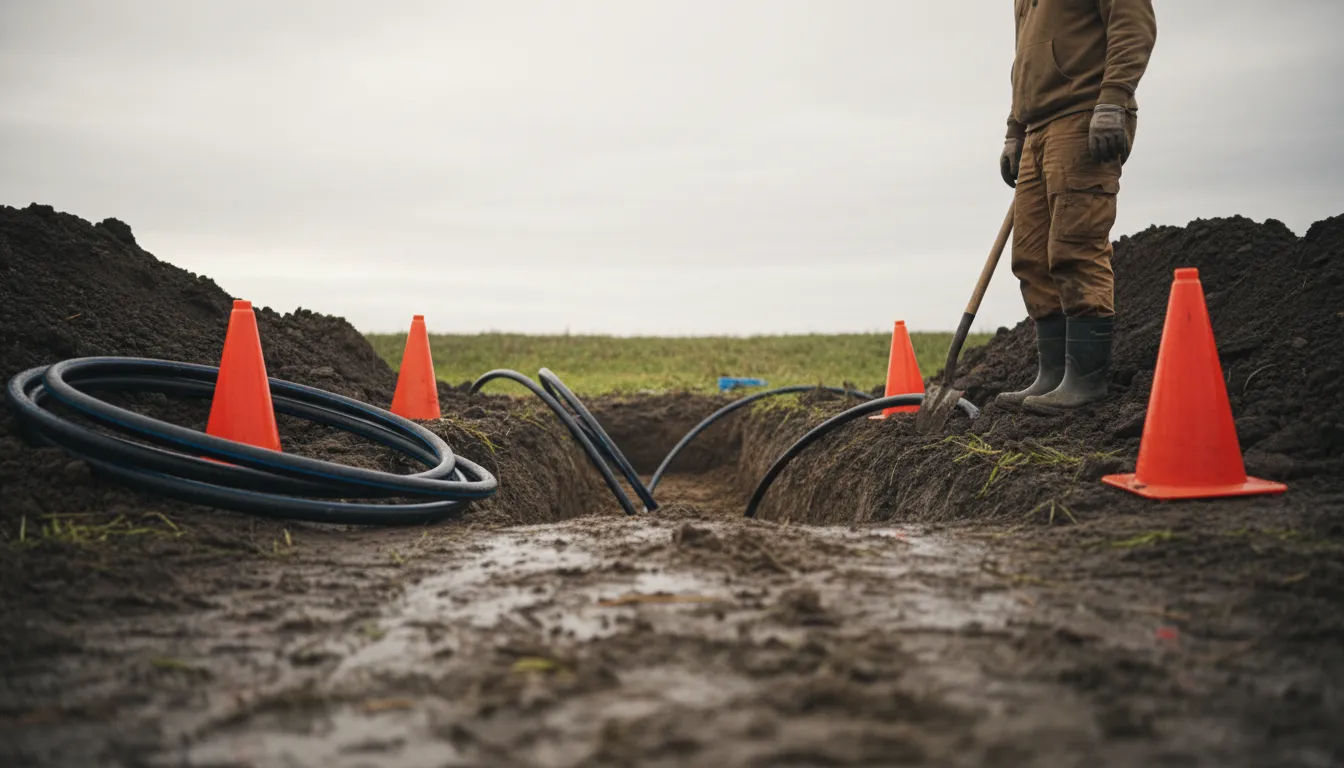
Horizontal Loops If you have ample yard space, a horizontal loop system can be a cost-effective option. Contractors use trenching machines to excavate long trenches, usually four to six feet deep, and lay coils of piping horizontally 4 5. This method generally requires more land area than a vertical system but can have lower installation costs since trenching is less expensive than deep drilling. It's ideal for new construction where the land is readily accessible.
Pond/Lake Loops For properties with a suitable pond, lake, or other substantial water body, this can be the most economical loop option. Coils of piping are simply submerged and anchored at the bottom of the water source 6. The water provides excellent heat transfer. However, this option is entirely dependent on having an adequate, accessible body of water that meets depth and quality requirements.
Find the perfect geothermal heat pump contractors for your needs
Get personalized recommendations and expert advice
The Installation Process: What to Expect
Installing a geothermal system is a significant project that requires experienced professionals. Understanding the steps can help you prepare.
- Site Evaluation and Design: A qualified installer will first assess your property to determine the best loop type. They'll consider soil composition, lot size, local geology, and your home's heating and cooling loads to design a properly sized system.
- Loop Field Installation: This is the major outdoor work. For a vertical system, a drilling rig will create the boreholes. For a horizontal system, a backhoe will dig the trenches. The polyethylene pipe is then placed, connected into a continuous loop, and pressure-tested to ensure there are no leaks before the holes or trenches are backfilled 7 8.
- Indoor Unit Installation: The geothermal heat pump unit is installed inside your home, typically in a basement, utility room, or garage. It connects to your existing ductwork. If you don't have ducts, ductless options are available, though less common for whole-home systems.
- Connection and Commissioning: The ground loop is connected to the heat pump, and the system is filled with fluid. The installer will then start up the system, check all electrical and refrigerant connections, and calibrate the controls to ensure optimal performance 9.
Benefits of Choosing Geothermal in Doral
The advantages of switching to a ground-source heat pump in South Florida are substantial and multifaceted.
- Exceptional Energy Savings: This is the most compelling benefit. By leveraging the Earth's stable temperature, geothermal heat pumps can achieve efficiencies 300-600% higher than traditional systems 10. For Doral homeowners, this can translate to a reduction in energy bills for heating and cooling by up to 65% 10.
- Lower Operating Costs: While the upfront investment is higher, the dramatically reduced monthly energy costs mean the system often pays for itself over time through utility savings. The consistent efficiency also protects you from fluctuating energy prices.
- Longevity and Reliability: The components of a geothermal system are built to last. The indoor heat pump unit often has a lifespan of 20-25 years, while the underground piping, protected from the elements, frequently carries warranties of 50 years and can last for generations 11.
- Quiet and Discreet Operation: With no loud outdoor condenser unit (like a traditional AC has), geothermal systems operate very quietly. The only mechanical components are inside your home, eliminating outdoor noise pollution.
- Environmental Friendliness: These systems use electricity to move heat, not to create it by burning fossil fuels. This drastically reduces your home's carbon footprint. They also use non-ozone-depleting refrigerants and have no on-site emissions 12.
- Year-Round Comfort: Geothermal systems provide exceptionally even heating and cooling. They also excel at dehumidification in the humid Florida summer, improving indoor air quality and comfort.
Financial Considerations and Incentives
The primary hurdle for most homeowners is the initial installation cost. A full geothermal system for a typical 2,000-square-foot home in Doral can range from $20,000 to $40,000 or more, with the ground loop accounting for a significant portion of that cost 13 14. However, it's critical to view this as a long-term investment.
- Utility Savings: The dramatic reduction in monthly bills (often hundreds of dollars per month in peak seasons) creates a steady return on investment.
- Federal Tax Credit: The federal government offers a significant tax credit for qualifying geothermal heat pump installations, which can offset a substantial percentage of the installed cost 15. It's essential to consult with your installer and a tax professional about current incentives.
- Increased Home Value: Studies have shown that homes with geothermal systems often have higher resale values, as buyers recognize the benefit of low utility costs.
- Low Maintenance: With fewer mechanical parts exposed to the weather and long-lasting components, maintenance costs over the life of the system are typically lower than for conventional HVAC systems.
Is a Geothermal System Right for Your Home?
Geothermal heat pumps are an excellent choice for many, but not all, properties in Doral. They are ideally suited for:
- Homes with sufficient yard space for a horizontal loop or where vertical drilling is feasible.
- Homeowners who plan to stay in their home long enough to realize the long-term savings.
- Those interested in maximizing energy efficiency and reducing their environmental impact.
- New construction projects, where the loop field can be integrated into the site plan from the beginning.
The key to a successful project is working with a certified, experienced geothermal contractor who can provide a detailed assessment, an accurate quote, and a clear explanation of the expected savings and payback period for your specific situation.
Frequently asked questions
Sources
Footnotes
-
How Does GeoThermal Air Conditioning Work in Florida? - https://symbiontservice.com/services/geothermal-air-conditioning/how-does-geothermal-ac-work/ ↩
-
FPL Northwest FL | Ways to Save | Geothermal Heat Pump - https://www.fpl.com/northwest/save/programs/heating-and-cooling/geothermal-heat-pump.html ↩
-
Geothermal Energy in Florida | Efficient Heating & Cooling - https://tonykellyinc.com/what-is-geothermal-energy-in-florida/ ↩
-
Geothermal Heat Pumps, Explained - Bosch Home Comfort - https://www.bosch-homecomfort.com/us/en/residential/connect/blog/geothermal-heat-pumps-go-green-save-green/ ↩
-
Exploring Geothermal Systems: Advantages and Considerations - https://dilandroandrews.com/understanding-geothermal-systems/ ↩
-
Geothermal Heating And Cooling Works In Florida. Here's How - https://symbiontservice.com/2011/06/07/geothermal-heating-and-cooling-works-in-florida-heres-how ↩
-
Geothermal Heat Pump Installation: What To Expect For Your Property - https://jomory.com/geothermal-heat-pump-installation-what-to-expect-for-your-property/ ↩
-
How a Geothermal Heat Pump Works | This Old House - https://www.youtube.com/watch?v=d5Tbsx3R2T8 ↩
-
Geothermal Heat Pump | DSO Electric Cooperative - https://dsoelectric.com/geothermal-heat-pump ↩
-
5 Things You Should Know about Geothermal Heat Pumps - https://www.energy.gov/cmei/articles/5-things-you-should-know-about-geothermal-heat-pumps ↩ ↩2
-
Geothermal Heat Pumps - EnergySmart CNY - https://www.energysmartcny.org/heat-pumps/geothermal/ ↩
-
Geothermal Heat Pumps - Department of Energy - https://www.energy.gov/energysaver/geothermal-heat-pumps ↩
-
How Do Geothermal Systems Work for Residential Homes? - https://www.davisheat.com/blog/how-do-geothermal-systems-work-for-residential-homes/ ↩
-
Geothermal Heat Pump Guide: Installation Costs, Types And Benefits - https://modernize.com/hvac/heating-repair-installation/heat-pump/geothermal ↩
-
Guide to Geothermal Heat Pumps - https://www.energy.gov/sites/prod/files/guide_to_geothermal_heat_pumps.pdf ↩