Find the Best Geothermal Heat Pump Contractors for Your Business
No obligation • Fast responses • Nationwide coverage

Why you can trust HVAC Firms
HVAC Firms is a leading United States resource for evaluating HVAC service providers. Our team researches companies, checks credentials, and reviews customer feedback to present clear, unbiased information. Listings and rankings are based on merit, and companies cannot pay to change our editorial content.
Search providers near you
Top Geothermal Heat Pump Contractors in Cutler Bay, Florida Ranked
A geothermal heat pump, often called a ground-source heat pump or earth-coupled system, is one of the most efficient ways to heat and cool your Cutler Bay home. By leveraging the stable temperature of the earth just below the surface, these systems provide exceptional comfort and dramatic energy savings, especially in Florida's climate. This guide explains how geothermal heating and cooling works, what to expect from local installation, and how you can find qualified specialists in the Cutler Bay area to explore this sustainable home upgrade.
Cool Breeze Air Conditioning
13120 SW 130th Terrace, Miami, FL 33186
Cool Breeze Air Conditioning is an HVAC company based in Miami, FL, serving Central and South Florida. They specialize in the installation, repair, and maintenance of air conditioning, furnaces, heat pumps, boilers, mini splits, and geothermal heat pumps. The company handles projects ranging from small residential units to large commercial chillers. Founded in 1987, Cool Breeze has decades of experience and operates with a team of certified professionals and a large fleet of service vehicles. They offer round-the-clock service to meet customer needs at any time.
Miami Heat Pump -Geothermal Heat Pump
1052 NW 21st St, Miami, FL 33127
Miami Heat Pump - Geothermal Heat Pump is a geothermal heat pump contractor based in Miami, FL. They specialize in designing and manufacturing highly efficient geothermal heat pump units for residential and commercial use. With over 40 years of experience, their products are made in the USA, Energy Star compliant, and AHRI certified. Their units include features such as two-stage options for increased efficiency and quiet package designs to reduce noise levels. The company offers a wide range of customizable geothermal heat pumps that support heating, cooling, radiant floor systems, and domestic hot water heating.
How Geothermal Systems Work in South Florida
At its core, a geothermal HVAC system uses a network of underground pipes, called a ground loop, to exchange heat with the earth. In Cutler Bay, the ground temperature a few feet below the surface remains a remarkably stable 72-75°F year-round. This consistency is the key to the system's efficiency.
During the hot Florida summer, the system acts as a highly efficient air conditioner. The heat pump inside your home extracts warmth and humidity from your indoor air. Instead of releasing this heat into the hot outside air like a traditional AC unit, a geothermal system transfers it into the cooler fluid circulating in the underground loops, which then dissipates the heat into the earth 1 2. This process uses the ground as a massive, free heat sink.
In the winter, the process simply reverses. The fluid in the loops absorbs the mild warmth from the earth (even 75°F is warmer than many winter days). The heat pump then concentrates this low-grade heat and distributes warm air throughout your home 3. This elegant, closed-loop process provides both heating and cooling from a single, quiet unit.
Types of Ground Loops for Cutler Bay Properties
The design of the underground loop field is a critical part of any geothermal installation. The right type depends on your property's soil conditions, available land, and local geology. Here are the common configurations used in our area:
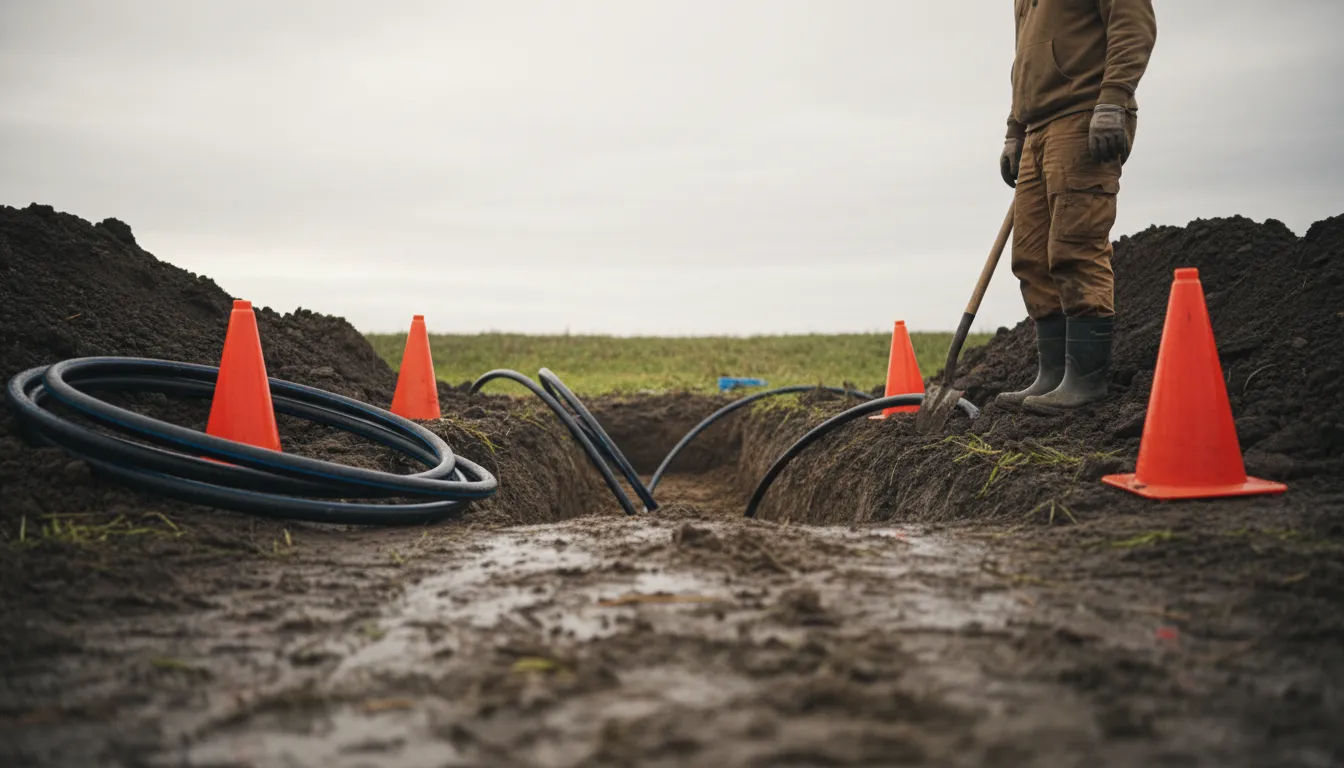
Horizontal Closed Loops: This is often the most cost-effective option if you have sufficient yard space. Trenches are dug about 3 to 6 feet deep, and pipes are laid in a series of parallel runs or coiled slinky patterns 4 5. This method requires a larger, open area but typically involves lower excavation costs than deep drilling.
Vertical Closed Loops: For homes in Cutler Bay with smaller lots, which is common in many neighborhoods, vertical loops are the standard solution. A drilling rig bores holes 150 to 400 feet deep 6 7. U-shaped pipe loops are inserted into each borehole, which are then grouted. This vertical approach requires minimal surface area, making it ideal for retrofitting existing homes or properties with limited landscaping space 8.
Pond or Lake Loops: If you have a suitable, perennial body of water on your property, a submerged loop can be an excellent option. Coils of pipe are anchored at the bottom of the pond or lake. This can be a very efficient and lower-cost installation method, but it is less common in Cutler Bay due to specific site requirements 9.
Local geothermal contractors will assess your property to recommend the optimal loop type, considering factors like soil composition (which affects heat transfer), lot size, and local zoning regulations.
The Installation Process: What to Expect
Installing a geothermal heating and cooling system is a significant project that involves both indoor and outdoor work. Understanding the steps can help you prepare.
- Site Evaluation and Design: A certified installer will first conduct a thorough assessment of your property, home size, and existing ductwork. They will perform a Manual J load calculation to determine your exact heating and cooling needs and design the loop field accordingly.
- Loop Field Installation: For a horizontal system, this involves trenching equipment to dig the necessary network of trenches. For a vertical system, a well-drilling rig will be brought in to create the boreholes. This is the most visually disruptive phase of the project but is usually completed within a few days.
- Indoor Unit Installation: The geothermal heat pump unit-which is typically about the size of a small refrigerator-is installed in your garage, utility room, or basement. It connects to the underground loop and to your home's existing ductwork or hydronic distribution system.
- Connection and Commissioning: The loop is pressure-tested, purged, and filled with a water-based fluid. The indoor unit is connected to the electrical system and thermostat. Finally, the entire system is started, tested, and balanced to ensure optimal performance.
A major advantage for coastal Cutler Bay homes is that the most complex component-the heat pump unit-is located safely indoors, protected from salt spray, humidity, and storms that can wear on traditional outdoor AC condensers.
Find the perfect geothermal heat pump contractors for your needs
Get personalized recommendations and expert advice
Benefits for Cutler Bay Homeowners
Choosing a geothermal system offers a compelling list of advantages that are particularly pronounced in Florida's climate.
- Extreme Energy Savings: This is the most significant benefit. Geothermal heat pumps can reduce your energy consumption for heating and cooling by up to 70% compared to conventional systems 10. For a typical Florida home focused on cooling, this can translate to savings of over $1,000 or more per year on utility bills. The high efficiency comes from moving heat rather than creating it by burning fuel.
- Superior Comfort: These systems provide consistent, even heating and cooling without the blasts of hot or cold air associated with traditional systems. They also excel at dehumidification during our humid summers, enhancing indoor air quality and comfort.
- Remarkable Longevity and Quiet Operation: The indoor heat pump unit has a lifespan of 20 to 25 years, roughly double that of a standard outdoor AC condenser 11. The underground polyethylene loop piping is incredibly durable and often comes with warranties of 50 years or more 11. Furthermore, with no loud outdoor fan unit, geothermal systems operate very quietly.
- Environmental Sustainability: By using the renewable thermal energy of the earth and electricity (which is increasingly from renewable sources), geothermal systems have a very low carbon footprint. They use no fossil fuels on-site and emit no greenhouse gases at your home.
- Reliability and Low Maintenance: With fewer mechanical parts exposed to the elements and a stable heat source, geothermal systems are known for their reliability. Routine maintenance is simple, similar to a traditional forced-air system.
Understanding Costs and Return on Investment
The upfront cost of a geothermal system is higher than that of a standard air-source heat pump or AC unit. This is primarily due to the cost of excavating or drilling to install the ground loop. However, this initial investment is offset by dramatically lower operating costs.
In Cutler Bay's cooling-dominant climate, homeowners can expect savings of 40-50% on cooling costs and even higher percentages on the minimal heating needed, leading to the 50-70% overall savings mentioned earlier 12 13. The payback period-the time it takes for energy savings to equal the initial investment-varies but is often in the range of 5-10 years. When you factor in the system's exceptional longevity, the lifetime savings are substantial.
It's also important to investigate available incentives. Federal tax credits for geothermal heat pumps are currently available, which can significantly reduce the net installed cost. Your local installer should be up-to-date on all applicable federal, state, and utility rebates.
Finding the Right Local Specialist
A properly designed and installed geothermal system is a long-term investment. Success depends heavily on working with an experienced, certified contractor. Look for companies with specific credentials from organizations like the International Ground Source Heat Pump Association (IGSHPA). They should have a portfolio of local installations and be able to provide detailed site evaluations, not just equipment quotes. Ask about their drilling or excavation partners, as this is a specialized trade. A reputable provider will focus on designing a system correctly sized for your home to ensure efficiency, comfort, and durability for decades to come.
Frequently asked questions
Sources
Footnotes
-
How Geothermal Heating and Cooling Systems Work | Belle Air - https://www.belleairservices.com/how-geothermal-heating-and-cooling-systems-work/ ↩
-
How a Geothermal Heat Pump Works | This Old House - https://www.youtube.com/watch?v=d5Tbsx3R2T8 ↩
-
How Do Geothermal Systems Work for Residential Homes? - https://www.davisheat.com/blog/how-do-geothermal-systems-work-for-residential-homes/ ↩
-
Geothermal heating & cooling, heat pumps, heat exchange ... - https://aztechgeo.com/residential-geothermal/how-it-works/ ↩
-
Geothermal Heating And Cooling Works In Florida. Here's How - https://symbiontservice.com/2011/06/07/geothermal-heating-and-cooling-works-in-florida-heres-how/ ↩
-
All You Need to Know About Home Geothermal Heating & ... - https://dandelionenergy.com/all-you-need-to-know-about-home-geothermal-heating-cooling ↩
-
How Geothermal Heating and Cooling Works: A Beginner's Guide - https://www.atlanticrefrigeration.com/blog/geothermal-service/how-geothermal-heating-and-cooling-works-a-beginners-guide/ ↩
-
Geothermal Heat Pumps | Geothermal HVAC - https://www.carrier.com/us/en/residential/geothermal-heat-pumps/ ↩
-
4 Types of Geothermal HVAC Systems - https://berkeleyheating.com/article/types-geothermal-hvac-systems ↩
-
Geothermal Energy in Florida | Efficient Heating & Cooling - https://tonykellyinc.com/what-is-geothermal-energy-in-florida/ ↩
-
Guide to Geothermal Heat Pumps - https://www.energy.gov/sites/prod/files/guide_to_geothermal_heat_pumps.pdf ↩ ↩2
-
Exploring Geothermal Air Conditioning: Benefits in Florida - https://www.mdicustomhomebuilders.com/blog-mdi-custom-homes/14cvxi4mfdlktao2n61f1d4sqcalts ↩
-
How Does A Geothermal Heat Pump Work? Complete 2025 Guide - https://solartechonline.com/blog/how-does-geothermal-heat-pump-work/ ↩