Find the Best Geothermal Heat Pump Contractors for Your Business
No obligation • Fast responses • Nationwide coverage

Why you can trust HVAC Firms
HVAC Firms is a leading United States resource for evaluating HVAC service providers. Our team researches companies, checks credentials, and reviews customer feedback to present clear, unbiased information. Listings and rankings are based on merit, and companies cannot pay to change our editorial content.
Search providers near you
Top Geothermal Heat Pump Contractors in Stamford, Connecticut Ranked
A geothermal heat pump, or ground-source heat pump, is a highly efficient heating and cooling system that leverages the stable temperatures of the earth. For Stamford homeowners, this technology offers a path to significant energy savings and reduced environmental impact, especially when replacing older oil or propane systems. This guide explains how these systems work, what installation entails, and how you can find qualified local professionals to assess your property for a geothermal solution.
Energywise Inc
2231 5th Ave Suite 26, Ronkonkoma, NY 11779
Energywise Inc is an HVAC company based in New York, NY, specializing in heating and cooling solutions. They offer installation, repair, and maintenance services for a variety of systems including heat pumps, central air conditioning, ductless mini splits, geothermal systems, and traditional furnaces. Their factory-trained technicians provide expert guidance and personalized recommendations to optimize home comfort and energy efficiency. Energywise Inc emphasizes energy-efficient products and sustainable solutions to reduce environmental impact while maintaining reliable system performance. The company has decades of experience and provides 24/7 emergency repair services to address urgent heating or cooling issues promptly.
Geothermal Works, Inc.
New York, NY
Geothermal Works, Inc. is a geothermal heat pump contractor based in New York, NY. They specialize in installing efficient geothermal heating and cooling systems that transfer heat energy between the ground and buildings. This technology helps reduce energy use and environmental impact. The company shares extensive knowledge about geothermal systems and supports clients through the installation process.
American Well & Pump
21 Prince St, Farmingdale, NY 11735
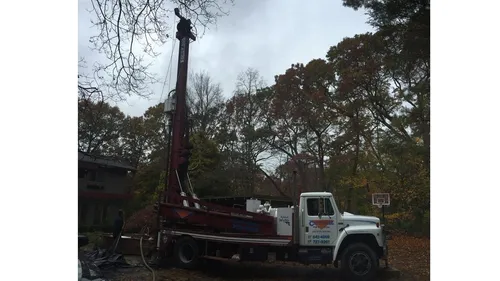
American Well & Pump is a geothermal heat pump contractor based in New York, NY, specializing in residential and commercial geothermal drilling services. They serve Nassau and Suffolk Long Island, offering a full range of geothermal drilling options including open and closed loop systems, standing column, horizontal trenching, and pump installations. The company has been operating since 1989 and uses heavy-duty equipment such as Schramm drill rigs and pump hoists to meet safety and quality standards.
How Geothermal Systems Work
Unlike traditional air-source heat pumps or furnaces that battle Connecticut's variable outdoor air temperatures, a geothermal system taps into the consistent thermal energy stored just below the earth's surface. A few feet underground, the temperature remains a relatively constant 50-55°F year-round. A geothermal, or ground-source, system uses this stable resource as its exchange medium instead of the outside air.
The process centers on a closed loop of high-density polyethylene pipe buried in your yard, which circulates a water-based antifreeze solution. During the winter, this fluid absorbs the earth's gentle heat and carries it to a heat pump unit inside your home. The heat pump concentrates this low-grade thermal energy and distributes warm air through your existing ductwork 1. In the summer, the cycle simply reverses: the system extracts heat from your indoor air and transfers it into the cooler ground loop, effectively providing air conditioning 2. This elegant exchange with the ground is what makes geothermal technology exceptionally efficient.
Types of Ground Loops for Stamford Properties
The buried pipe system, known as the ground loop, can be configured in several ways. The right choice for your Stamford home depends heavily on your lot size, soil composition, and local geology.
- Vertical Closed Loop: This is the most common installation type in Connecticut and is particularly well-suited for Stamford's typically smaller residential lots 3. A drilling rig bores holes 150 to 400 feet deep, and U-shaped pipes are inserted into each borehole. The holes are then sealed with a special grout to ensure good thermal conductivity. While drilling adds to the upfront cost, it minimizes the required surface area 4 5.
- Horizontal Closed Loop: This configuration requires trenches to be dug about four to six feet deep, spanning a significant area of your property. It generally has a lower installation cost than vertical systems if space is ample. However, the substantial land requirement makes it less feasible for many properties in denser neighborhoods.
- Pond/Lake Loop: If you have access to a sufficiently large, deep body of water (typically at least half an acre in surface area and 10-12 feet deep), a coiled loop can be submerged at the bottom. This can be a very cost-effective loop option, but it requires the right water source to be viable 6.
- Open Loop System: This system uses groundwater from a well or a surface water source directly. The water is pumped through the heat pump and then discharged back into a second well, a recharge basin, or the original body of water. While potentially efficient, open loops are less common due to water availability concerns, water quality issues, and more complex permitting.
The Geothermal Installation Process
Installing a residential geothermal system is a significant project that requires careful planning and expert execution. Here's a step-by-step overview of what you can expect:
- Site Assessment and Design: A qualified installer will evaluate your property. They will assess soil conditions, rock content, available space, and the location of underground utilities. This information is used to design the most effective and efficient loop field and system size for your home's heating and cooling loads.
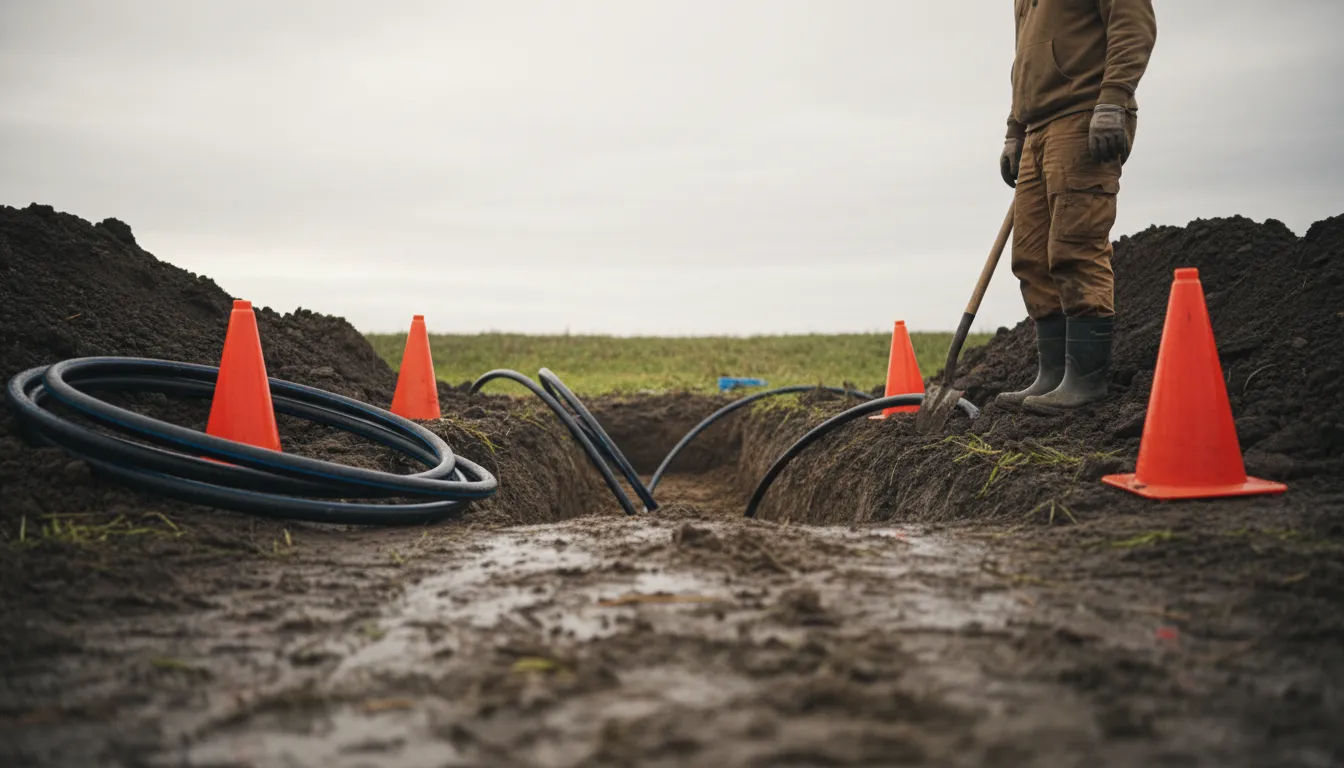
- Loop Installation: For a vertical system, a drilling rig will arrive to create the boreholes. For a horizontal system, a trencher will dig the necessary channels. The durable HDPE pipe is then laid or inserted into the trenches or boreholes.
- Connecting the Loop: All the pipe runs are connected into a continuous loop manifold, which is then routed into your home, usually entering through the basement or a utility room.
- Heat Pump Installation: The indoor heat pump unit is installed and connected to the ground loop manifold and to your home's electrical system and ductwork. This unit is typically about the size of a traditional furnace.
- Grouting and Restoration: For vertical boreholes, a thermally enhanced grout is pumped in to seal the hole around the pipes, which is crucial for proper heat transfer and to protect groundwater. The site is then backfilled and restored as closely as possible to its original condition 7.
Find the perfect geothermal heat pump contractors for your needs
Get personalized recommendations and expert advice
Key Considerations for Stamford Homeowners
Before moving forward with a geothermal project, several local factors are important to consider:
- Space and Lot Size: The vertical closed-loop system is often the only practical option for standard city lots in Stamford. Your installer will determine if there is adequate space for the drilling equipment and the required number of boreholes, which are typically spaced 15-20 feet apart.
- Utility Lines and Permits: A critical step before any digging or drilling is to have all underground utilities marked (call 811). Additionally, your installer will need to secure the necessary local permits for drilling and excavation, which are standard for any ground-source heat pump project in Stamford 8.
- Existing Heating System: Geothermal systems provide the greatest financial benefit when replacing expensive-to-operate systems like oil or propane furnaces or baseboard heat. The savings compared to a modern natural gas furnace are still significant but may extend the payback period slightly.
Understanding Costs, Savings, and Payback
The decision to install a geothermal heat pump involves weighing a higher initial investment against long-term operational savings.
- Installation Cost: For a typical Stamford single-family home, a complete geothermal heating and cooling system installation generally ranges from $20,000 to $40,000 or more 9 10. The wide range depends on the loop type (vertical is more expensive), system size, property characteristics, and the complexity of integrating with your existing ductwork.
- Energy Savings: This is where geothermal shines. Homeowners typically see a 30% to 70% reduction in their heating and cooling energy bills 11 12. The exact savings depend on what fuel you are replacing; switching from oil or propane yields the most dramatic reduction in monthly costs.
- Payback Period: The time it takes for your energy savings to equal the initial investment can vary widely, from 4 to 15 years. Factors influencing payback include your local utility rates, the system you're replacing, the installation cost, and available incentives. Federal tax credits, which can cover a substantial percentage of the installation cost, significantly improve the economics and shorten the payback timeline.
Maximizing Efficiency and Incentives
To get the most from your geothermal investment, ensure your home is well-insulated and sealed to reduce the overall heating and cooling load. Also, explore all available financial incentives. The federal Residential Clean Energy Credit offers a significant tax credit for qualified geothermal heat pump property. It's essential to discuss current federal, state, and even local utility rebates with your installer, as these can dramatically reduce your net project cost and improve your return on investment.
Frequently asked questions
Sources
Footnotes
-
How a Geothermal Heat Pump Works | This Old House - https://www.youtube.com/watch?v=d5Tbsx3R2T8 ↩
-
Clean Energy 101: Geothermal Heat Pumps - RMI - https://rmi.org/clean-energy-101-geothermal-heat-pumps/ ↩
-
PROS AND CONS OF GEOTHERMAL SYSTEMS - CGA.ct.gov - https://www.cga.ct.gov/2008/rpt/2008-R-0543.htm ↩
-
Geothermal Heat Pumps, Explained - Bosch Home Comfort - https://www.bosch-homecomfort.com/us/en/residential/connect/blog/geothermal-heat-pumps-go-green-save-green/ ↩
-
Ground-Source Heat Pumps - Energize CT - https://www.energizect.com/sites/default/files/documents/ECT_21_GSHP_GUIDE_FIN_011222.pdf ↩
-
Geothermal heating & cooling, heat pumps, heat exchange ... - https://aztechgeo.com/residential-geothermal/how-it-works/ ↩
-
All You Need to Know About Home Geothermal Heating & ... - https://dandelionenergy.com/all-you-need-to-know-about-home-geothermal-heating-cooling ↩
-
Geothermal heat pumps: The ultimate guide to ground-source ... - https://termo-plus.com/blog/geothermal-ultimate-guide-to-ground-source-heat-pumps/ ↩
-
Geothermal Heat Pumps - EnergySmart CNY - https://www.energysmartcny.org/heat-pumps/geothermal/ ↩
-
Geothermal Heat Pump Guide: Installation Costs, Types And Benefits - https://modernize.com/hvac/heating-repair-installation/heat-pump/geothermal ↩
-
Geothermal Heating, Cooling, and Hot Water Systems - https://igshpa.org/wp-content/uploads/Homeowners-Guide-to-Geothermal.pdf ↩
-
Everything You Need to Know About Geothermal Heat Pumps - https://www.familyhandyman.com/article/everything-you-need-to-know-about-geothermal-heat-pumps/ ↩