Find the Best Mini-Split Installers for Your Business
No obligation • Fast responses • Nationwide coverage

Why you can trust HVAC Firms
HVAC Firms is a leading United States resource for evaluating HVAC service providers. Our team researches companies, checks credentials, and reviews customer feedback to present clear, unbiased information. Listings and rankings are based on merit, and companies cannot pay to change our editorial content.
Search providers near you
Best Mini-Split Installers in Virginia Ranked
Ductless mini-split systems offer an efficient heating and cooling solution for Virginia homes, particularly those without existing ductwork. A professional installation is critical to ensure the system operates at peak efficiency, maintains its warranty, and qualifies for significant financial incentives. This guide explains the key considerations for Virginia homeowners, from licensing and costs to available tax credits and rebates, helping you connect with qualified local professionals for your project.
Smiley's Heating & Cooling
3500 Virginia Beach Blvd Ste 110, Virginia Beach, VA 23452
Smiley's Heating & Cooling is an HVAC company based in Virginia Beach, VA, serving both residential and commercial customers. They offer a wide range of services including air conditioning repair and installation, furnace and heat pump repair, ductless mini-split installation, indoor air quality testing, and HVAC maintenance plans. Their certified technicians provide expert repairs and installations, backed by a 10-year labor warranty on select new installs. Smiley's also offers emergency HVAC repair services and covers areas including Virginia Beach and Norfolk.
Absolute Comfort Heating and Cooling
524 Central Dr #101, Virginia Beach, VA 23454
Absolute Comfort Heating and Cooling is a family-owned HVAC company serving Virginia Beach, VA, and nearby areas since 2003. They provide a wide range of services including air conditioning, heat pump, furnace, and boiler repair and installation, as well as indoor air quality solutions and ductless system services. Their NATE-certified technicians handle both residential and light commercial HVAC needs, offering expertise in system diagnostics, maintenance, and installations. The company also offers 24/7 emergency service for urgent HVAC issues.
Conner Services Inc
1359 Virginia Beach Blvd, Virginia Beach, VA 23454
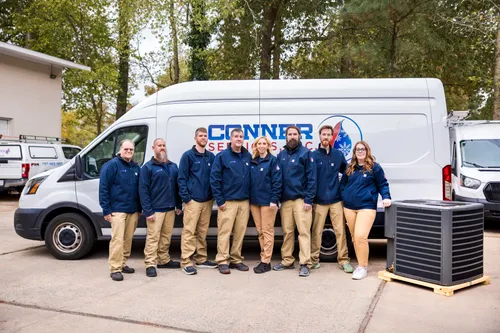
Conner Services Inc provides a wide range of heating, ventilation, and air conditioning services in Virginia Beach, VA. Their skilled technicians handle HVAC installation, repair, and maintenance for systems including furnaces, heat pumps, mini-splits, geothermal units, and ductwork. They also offer indoor air quality solutions such as filtration and UV lights, as well as smart home HVAC accessories. The company emphasizes energy-efficient options and comprehensive seasonal tune-ups to maintain system performance. Conner Services Inc holds multiple professional licenses and offers a one-year labor warranty on all services.

Aire Serv of Southside
4740 W Norfolk Rd, Portsmouth, VA 23703
Aire Serv of Southside is an HVAC company serving Virginia Beach, VA, and nearby areas including Chesapeake, Norfolk, and Portsmouth. They provide a range of heating and cooling services such as air conditioner repair and installation, furnace and heat pump maintenance, boiler services, and indoor air quality improvements. The company offers specialized capabilities like ductless mini split AC system installation and comprehensive HVAC tune-ups to enhance system efficiency. Aire Serv of Southside is locally owned and operated and is affiliated with a national network, providing access to extensive resources and continuing education. They also offer 24/7 availability for heating and air conditioning repairs to ensure customer comfort year-round.
Mid Atlantic Mechanical and Repair, LLC
Richmond, VA
Mid Atlantic Mechanical and Repair, LLC is an HVAC company serving Richmond, VA, and surrounding areas. They provide repair, installation, and maintenance services for air conditioning, heating, heat pumps, ductless mini-splits, and indoor air quality systems for both residential and commercial customers. The company is EPA certified, holds a master HVAC license, and operates as a Class-A contractor. Their technicians have extensive experience working with electric, oil, and gas HVAC systems. Financing options are available to assist with repair and installation costs.
Understanding Ductless Mini-Split Systems
A ductless mini-split system consists of an outdoor compressor/condenser unit connected to one or more indoor air-handling units via a small conduit that houses refrigerant lines, power cables, and a condensate drain. This design eliminates the need for extensive ductwork, making it an ideal choice for room additions, older homes, or spaces where extending central HVAC is impractical. In Virginia's climate, which features humid summers and cold winters, modern heat pump mini-splits provide efficient year-round comfort.
Virginia Licensing and Regulatory Requirements
Hiring a properly licensed contractor is not just a recommendation-it's a necessity for a successful and compliant installation.
State HVAC License: In Virginia, anyone performing HVAC work on systems over 25 PSIG must hold a valid license from the Department of Professional and Occupational Regulation (DPOR) 1. Contractors must carry either a Journeyman or Master-level license with an "HVA" designation 1 2. This licensing ensures the professional has passed required exams and meets state standards for knowledge and experience.
EPA Certification: Federal law requires that any technician who handles refrigerant, a key part of mini-split installation, must be certified by the Environmental Protection Agency (EPA) under Section 608. This certification ensures proper handling to prevent environmental harm and system damage.
Local Permits: Many Virginia counties and cities require a permit for installing a new HVAC system like a mini-split 3. Your licensed contractor will typically pull this permit on your behalf. The permitting process ensures the installation is inspected for compliance with local building, electrical, and mechanical codes, which is crucial for safety and can be a requirement for warranty validation 3.
The Professional Installation Process
A proper installation by a qualified technician involves several meticulous steps that directly impact system performance and longevity.
- Site Assessment and Load Calculation: A professional will first perform a Manual J load calculation to determine the correct heating and cooling capacity (in BTUs) needed for your specific space, avoiding an inefficient, oversized, or undersized system.
- Indoor Unit Placement: The installer will determine optimal locations for the indoor air handlers, considering factors like airflow distribution, condensation drainage, aesthetics, and maintaining proper clearance from walls and ceilings.
- Mounting and Drilling: The indoor units are securely mounted, and a small hole (typically 3 inches) is drilled through the exterior wall to run the conduit from each indoor unit to the outdoor location.
- Line Set and Electrical Run: The pre-charged refrigerant lines (line sets), condensate drain hose, and communication/power cables are run through the conduit and carefully connected. This may involve running new electrical circuits from your home's panel to the outdoor unit location.
- Outdoor Unit Placement: The condenser is placed on a stable, level pad (often concrete or composite) with adequate clearance (usually 1-2 feet) on all sides for airflow and service access.
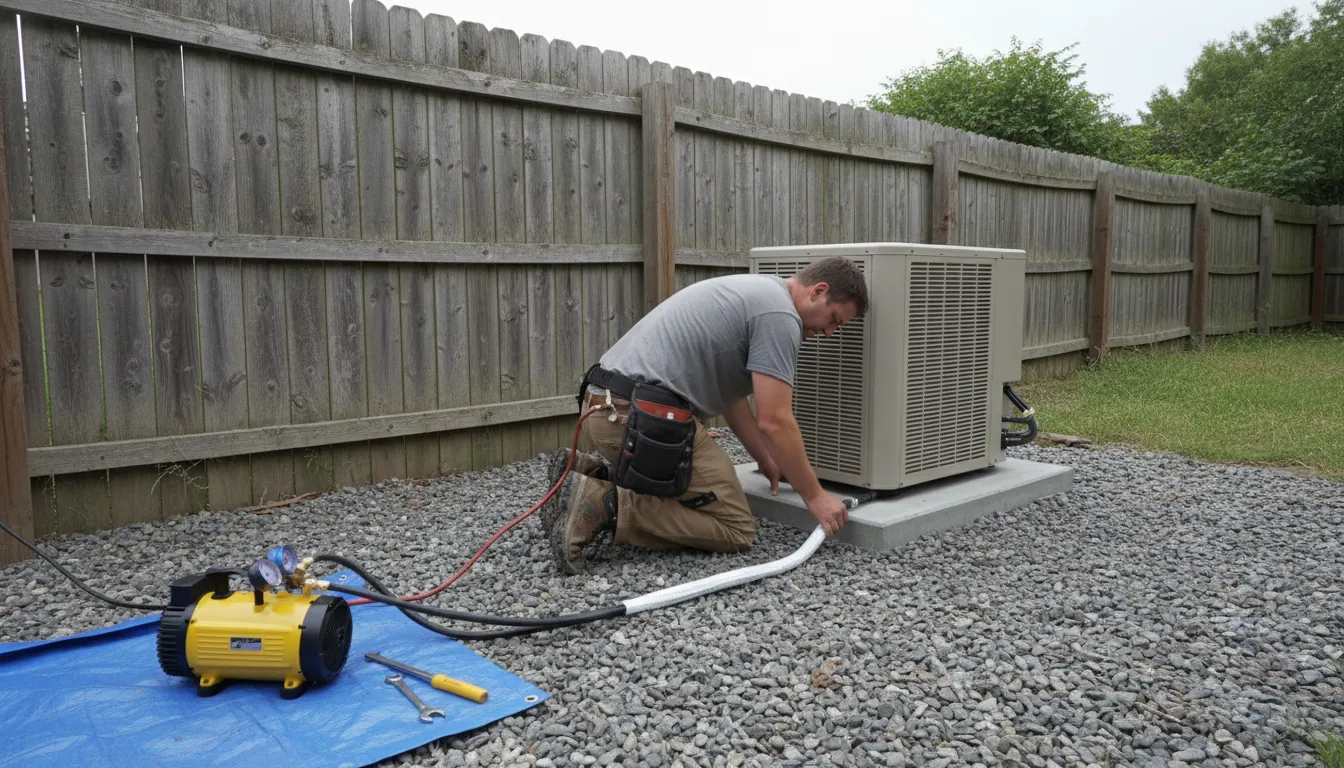
- Making Connections and Vacuuming: The technician connects the refrigerant lines at both ends. A critical step is then using a high-quality vacuum pump to remove all moisture and non-condensable gases from the refrigerant lines before releasing the refrigerant charge. This step is essential for efficiency and compressor life.
- System Testing and Commissioning: Finally, the system is powered on and tested in both heating and cooling modes. The technician will check refrigerant pressures, electrical readings, airflow, temperature differentials, and thermostat operation to ensure everything is working correctly.
Cost Factors for Mini-Split Installation in Virginia
The total installed cost for a ductless system in Virginia can vary widely, typically ranging from $2,000 to over $10,5004. Understanding the components of this cost helps in budgeting and comparing quotes.
- Equipment Cost: The mini-split units themselves range from $700 to $4,000 for a single-zone system, with higher-efficiency models (with better SEER2 ratings) commanding a premium 5 6.
- Number of Zones: A single-zone system (one outdoor unit, one indoor head) is the most affordable. Multi-zone systems (one outdoor unit supporting 2-5 indoor heads) increase the equipment and labor cost but provide whole-home or multi-room comfort.
- Labor and Complexity: Labor is a significant portion of the cost. Complexity increases-and so does labor time-with factors like multi-story installations, long refrigerant line set runs, difficult wall materials (brick, stone), or the need to navigate finished attics or crawl spaces.
- Electrical Work: Most mini-splits require a dedicated 220-volt circuit. If your electrical panel is full or outdated, adding a new circuit or upgrading the panel can add $1,000 to $3,000 to the project cost.
- Additional Features: Options like Wi-Fi-enabled controls, advanced air filtration systems, or ceiling cassette indoor units will add to the overall price.
Find the perfect mini-split installers for your needs
Get personalized recommendations and expert advice
Financial Incentives: Tax Credits and Rebates
Virginia homeowners have access to valuable financial incentives that can substantially reduce the net cost of a qualifying high-efficiency mini-split installation.
Federal Tax Credit (IRA Section 25C): This is a direct credit against your federal income tax liability. You can claim 30% of the total project cost (including both equipment and labor), up to a maximum of $2,000 per year, for installing a qualifying heat pump mini-split 7 8 9. To qualify, the system must meet specific efficiency tiers:
- Cold Climate Heat Pump: ≥ 16 SEER2, ≥ 9.5 HSPF2
- Standard Heat Pump: ≥ 16 SEER2, ≥ 12 EER2, ≥ 9 HSPF2
Virginia State Rebates (Coming Soon): The Virginia Department of Energy (Virginia Energy) is administering new Home Energy Rebate programs funded by the Inflation Reduction Act. These are expected to launch in 2025. The programs will include:
- Home Efficiency Rebates: For comprehensive upgrades.
- Home Electrification and Appliance Rebates (HEAR): Targeted at low- and middle-income households, this program may offer point-of-sale rebates for heat pumps, potentially covering a significant portion of costs for eligible homeowners 10 11.
Utility-Specific Programs: Many local utility companies in Virginia, such as Dominion Energy and Appalachian Power, offer their own rebates for installing high-efficiency heat pumps. These can often be "stacked" with the federal tax credit and future state rebates 12. It's essential to check with your specific electricity provider for current offers.
How to Secure Incentives and Protect Your Warranty
Navigating incentives and warranties requires careful documentation and professional partnership.
- Verify System Eligibility: Before purchase, ensure the specific make and model of the mini-split system you are considering meets the federal efficiency requirements (SEER2, EER2, HSPF2). Your contractor should provide the Air-Conditioning, Heating, and Refrigeration Institute (AHRI) certificate of product performance for your records.
- Work with a Licensed Pro: Most manufacturers require professional installation by a licensed HVAC contractor to validate the equipment warranty. Furthermore, the IRS may require that qualifying installations be "completed in accordance with applicable manufacturer and industry standards," which implies professional work 13 14.
- Keep Detailed Records: Save all documentation, including:
- The contractor's DPOR license number and EPA certification.
- Itemized invoices clearly showing equipment and labor costs.
- The AHRI certificate and equipment model/serial numbers.
- Proof of local permit closure (final inspection sign-off).
- Claiming the Tax Credit: File IRS Form 5695 with your annual federal tax return. You will need the information from your records to complete the form.
Choosing the Right Virginia Contractor
Selecting an experienced installer is the most important decision you'll make. Look for a contractor who:
- Holds a valid Virginia DPOR HVAC license and EPA certification.
- Has specific, verifiable experience installing ductless mini-split systems.
- Provides a detailed, written estimate that breaks down equipment, labor, and any ancillary costs (permits, electrical).
- Is willing to explain the process, discuss efficiency ratings, and help you understand incentive eligibility.
- Has positive reviews and references from past mini-split installation projects.
Frequently asked questions
Sources
Footnotes
-
Virginia HVAC License: How to Become a certified Contractor - Jobber - https://www.getjobber.com/academy/hvac-license/virginia/ ↩ ↩2
-
Virginia HVAC License 2025 | Requirements & Exams - https://www.lumberfi.com/wiki/virginia-hvac-license-requirements ↩
-
Do Mini Splits Need Permits? Installation Requirements Guide - https://www.greecomfort.com/news-and-events/do-mini-splits-need-permits/ ↩ ↩2
-
Ductless mini-split installation: Cool 2025 Guide - Southern Air - https://www.southern-air.com/blog/ductless-mini-split-installation ↩
-
How Much Does it Cost to Install a Ductless Mini Split? | VA - https://arlingtonheating.com/how-much-does-it-cost-to-install-a-ductless-mini-split/ ↩
-
Mini-Split Cost Breakdown & Incentives - The Furnace Outlet - https://thefurnaceoutlet.com/blogs/hvac-tips/mini-split-cost-breakdown ↩
-
An Overview of the 2024 HVAC Tax Credits and Rebates in Virginia - https://newriverheatingandair.com/blog/an-overview-of-the-2024-hvac-tax-credits-and-rebates-in-virginia ↩
-
2024 HVAC Rebates For Virginia Residents - https://albemarleheating.net/blog/2024-hvac-rebates-virginia/ ↩
-
Save Big with 2025 Heat Pump Tax Credits - https://nelsonsheatingandcooling.com/save-big-with-2025-heat-pump-tax-credits/ ↩
-
Inflation Reduction Act Rebates and Tax Credits - Virginia Energy - https://energy.virginia.gov/energy-efficiency/Available-Tax-Credits.shtml ↩
-
Home Energy Rebates Frequently Asked Questions - https://www.energy.virginia.gov/energy-efficiency/HomeEnergyRebatesFrequentlyAskedQuestions.shtml ↩
-
Virginia Heat Pump Incentives, Tax Credits, and Rebates (2024) - https://www.energysage.com/heat-pumps/heat-pump-incentives/virginia-heat-pump-incentives-2024-guide/ ↩
-
Ductless Mini Split Installation Guide: What Every Homeowner ... - https://www.aceanda.com/blog/ductless-mini-split-installation-guide-what-every-homeowner-should-know/ ↩
-
Energy Efficiency and Tax Credits: Do Ductless Mini-Splits Qualify? - https://thefurnaceoutlet.com/blogs/hvac-tips/energy-efficiency-and-tax-credits-do-ductless-mini-splits-qualify ↩