Find the Best Mini-Split Installers for Your Business
No obligation • Fast responses • Nationwide coverage

Why you can trust HVAC Firms
HVAC Firms is a leading United States resource for evaluating HVAC service providers. Our team researches companies, checks credentials, and reviews customer feedback to present clear, unbiased information. Listings and rankings are based on merit, and companies cannot pay to change our editorial content.
Search providers near you
Top Mini-Split Installers in Murfreesboro, Tennessee Ranked
A ductless mini-split system is a versatile and efficient solution for heating and cooling specific areas of your home without the need for extensive ductwork. This technology is particularly valuable in Murfreesboro, where it can solve comfort problems in home additions, sunrooms, or older houses lacking central air. Understanding your options for ductless HVAC installation helps you make an informed decision to improve your home's comfort and energy efficiency. The following guide provides a detailed look at the process, costs, and considerations for installing a mini-split system in the Murfreesboro area.

Affordable Heating & Cooling
5510 E Division St Suite 134, Mt. Juliet, TN 37122
Affordable Heating & Cooling serves Nashville, TN, providing air conditioning and heating system repairs and installations for both residential and commercial properties. With over 20 years of experience, the company offers services including AC repair, furnace repair, and mini split installation. They have NATE-certified technicians and a service truck equipped with the latest tools and frequently-needed parts. Affordable Heating & Cooling is available 24/7 for heating and cooling emergencies, ensuring prompt response at any time.

PrimeTime Heat & Air
228 Wellington Way, Smyrna, TN 37167
PrimeTime Heat & Air is a locally owned HVAC company serving Nashville, TN, and surrounding areas. They provide a full range of heating and cooling services including repair, installation, and maintenance for air conditioners, furnaces, heat pumps, ductless systems, and indoor air quality solutions. The company is EPA certified, licensed, bonded, and insured, ensuring professional and compliant service. With expertise in ductwork, zoning systems, and air purification technologies like UV lights and air scrubbers, they address various comfort and air quality needs. PrimeTime Heat & Air emphasizes building lasting customer relationships and offers flexible appointment availability to meet client needs.

C & M Heating & Cooling
106 Beasley Dr, Franklin, TN 37064
C & M Heating & Cooling is an HVAC company serving Nashville, TN, and the surrounding Middle Tennessee area. They provide a range of services including air conditioning, furnace, heat pump, and mini split installation and repair, as well as HVAC tune-ups, duct cleaning, and thermostat installation. Established in 1976, C & M Heating & Cooling has over four decades of experience in the industry. Their team is known for thorough diagnostics and repairs, including parts replacement and system maintenance, with a focus on honest communication and customer care.
Premier Heating & Air
78 Fesslers Ln, Nashville, TN 37210
Premier Heating & Air is an HVAC company based in Nashville, TN, offering a range of services including air conditioning, heating, heat pump, and mini split installation and repair. They also provide duct cleaning, indoor air quality solutions, and home performance evaluations. The company serves both residential and commercial clients, with capabilities such as installing ductless systems, central air conditioners, and modular rooftop heat pump systems. With over 20 years in business, Premier Heating & Air employs EPA-certified technicians and maintains an A+ rating with the Better Business Bureau.
Center Air Solutions LLC
5959 Foothills Dr, Murfreesboro, TN 37129
Center Air Solutions LLC is an HVAC company based in Nashville, TN, offering a variety of heating and cooling services. Their work includes air conditioning and furnace repair, installation of new HVAC units and ductwork, mini split installation, and preventative maintenance. The company has over 15 years of experience in the industry and provides 24/7 availability for service calls.
What is a Ductless Mini-Split System?
A ductless mini-split system consists of two main components: a quiet outdoor condenser unit and one or more sleek indoor air-handling units. Refrigerant lines, power cables, and a condensate drain line connect the two through a small, inconspicuous hole in your wall. Unlike traditional central HVAC, which pushes air through a network of ducts, a ductless system delivers conditioned air directly into the room from the indoor unit. This design eliminates the energy losses associated with ductwork, which can account for more than 30% of energy consumption for space conditioning, especially if the ducts are in an unconditioned space like an attic 1 2.
The core appeal of a ductless air conditioner installation is its ability to provide zoned comfort. Each indoor unit operates independently, allowing you to set different temperatures for different rooms. This means you can cool a frequently used living room without wasting energy on an empty guest bedroom, leading to significant savings on utility bills.
Common Applications in Murfreesboro Homes
Ductless technology is not a one-size-fits-all solution, but it is an ideal fit for many common scenarios in local homes.
- Room Additions and Finished Spaces: If you've converted a garage, finished a basement, or built a sunroom, extending existing ductwork can be prohibitively expensive and disruptive. A mini-split installation provides a dedicated, efficient climate control solution for these new spaces without touching your main system.
- Targeting Problem Areas: Does your master bedroom stay too warm in summer? Is your home office over the garage always chilly? A single-zone ductless system can solve these spot comfort issues, supplementing your central HVAC where it falls short 3.
- Whole-Home Comfort in Ductless Houses: Many older homes in Murfreesboro were built without any ductwork. Installing a multi-zone ductless mini-split system can provide comprehensive, efficient heating and cooling throughout the entire home, often serving as a complete replacement for window units and inefficient space heaters 4.
- Improving Efficiency in Specific Zones: For families with different schedules, zoning allows you to condition only the occupied parts of the house. This targeted operation is a hallmark of energy-efficient ductless HVAC installation.
Understanding Zoning: Single vs. Multi-Zone Systems
The "split" in mini-split refers to the separation of the compressor/condenser (outside) from the air handlers (inside). Your first major decision is how many zones you need.
- Single-Zone Systems: This configuration links one indoor unit to one outdoor condenser. It's perfect for conditioning a single room, such as a bedroom, home office, or workshop. It's typically the most straightforward and budget-friendly option for a focused application.
- Multi-Zone Systems: A single outdoor condenser can be connected to multiple indoor units (commonly 2, 3, 4, or more). This allows you to control the temperature in several rooms independently from one central outdoor unit. Multi-zone installations are ideal for whole-home comfort or for conditioning an entire floor or wing of a house. They offer great flexibility, as you can mix and match different types of indoor units (e.g., a wall unit in one room and a ceiling cassette in another) to suit each space 5 6.
Choosing and Placing Your Indoor Units
The indoor unit is the visible component inside your home, so its type and placement are crucial for both performance and aesthetics.
- Wall-Mounted Units: This is the most common and cost-effective style. They are mounted high on a wall, typically about 6 feet from the floor, to allow for optimal air distribution across the room. Professional installers will ensure it's placed on an interior wall away from direct sunlight and heat sources for maximum efficiency 7 8.
- Ceiling Cassette Units: These are installed flush with the ceiling, with only a decorative grille visible. They distribute air in four directions for very even coverage and are a popular, discreet choice for finished basements, main living areas, or commercial spaces. Installation is more complex and generally more expensive than wall-mounted units.
- Floor-Mounted Units: These are installed low on a wall, similar to a traditional radiator. They are an excellent solution for rooms with high ceilings, vaulted spaces, or rooms where wall space is limited, such as those with extensive glass or shelving.
A key part of the professional installation process is the technician's "Manual J" load calculation. This determines the precise British Thermal Unit (BTU) capacity needed for each room, ensuring the indoor unit is neither undersized (struggling to keep up) nor oversized (leading to short cycling and poor humidity control).
Outdoor Unit Placement and Requirements
The outdoor condenser unit requires careful consideration for longevity and performance.
- Location: It should be placed on a stable, level surface-usually a concrete pad or specially rated mounting brackets for side-of-house installations. The location should have good airflow and be accessible for future maintenance. While many units are designed to withstand the elements, placing them in a spot with some protection from the worst direct afternoon sun and driving rain can enhance longevity 9.
- Clearances: Critical for efficiency, the unit must have adequate clearance on all sides as specified by the manufacturer (often 12-24 inches). This allows for proper air intake and exhaust. It should also be positioned away from windows, patios, or decks where the operational noise or exhaust air could be a nuisance.
Find the perfect mini-split installers for your needs
Get personalized recommendations and expert advice
The Professional Installation Process Explained
A proper ductless mini-split installation is a technical job that ensures system efficiency, reliability, and warranty validity. Here's what a professional installation typically entails 10:
- Consultation and Planning: A technician assesses your home, performs load calculations, and determines the optimal locations for indoor and outdoor units.
- Preparing the Indoor Location: A mounting bracket is securely anchored to the wall studs or ceiling joists.
- Drilling the Line Set Hole: A small hole (about 3 inches) is drilled through the exterior wall to connect the indoor and outdoor units.
- Running the Line Set: The refrigerant tubing (pre-charged or field-charged), condensate drain line, and electrical communication cables are run from the outdoor unit location through the wall to the indoor unit. This is often housed in a slim, decorative conduit.
- Mounting the Units: The indoor unit is hung on its bracket. The outdoor unit is placed on its pad or brackets.
- Making Electrical Connections: A dedicated electrical circuit is run from your home's panel to the outdoor unit. This is a critical safety step that often requires a licensed electrician.
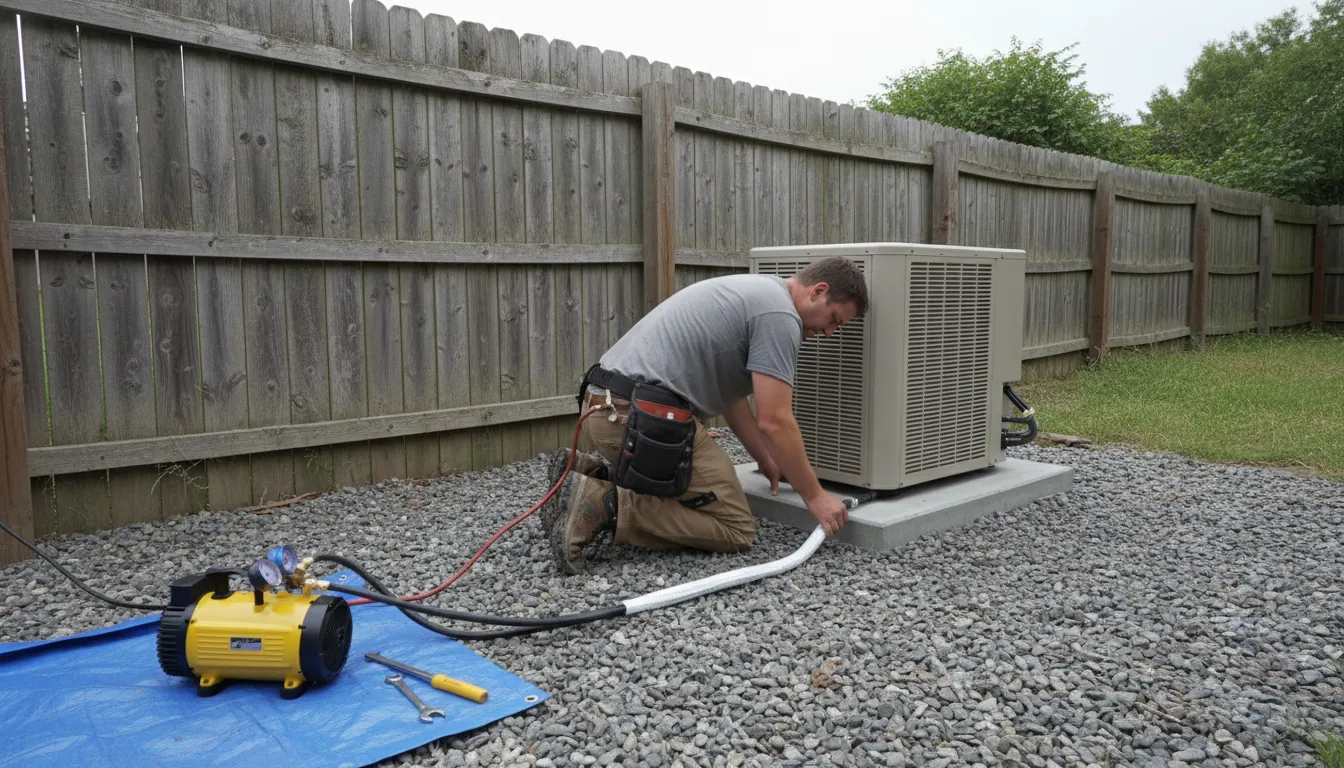
- Sealing and Evacuation: The refrigerant lines are connected. A vacuum pump is then used to remove all air and moisture from the refrigerant circuit-a non-negotiable step to prevent contamination and ensure efficiency.
- System Charging and Testing: The system is charged with refrigerant, powered on, and put through a series of tests. The technician will calibrate the system, check for leaks, verify drainage, and show you how to use the remote controls.
Cost Factors for Mini-Split Installation in Murfreesboro
The total cost of a ductless system installation varies widely based on the project's scope and complexity. Here is a general breakdown of cost ranges for the Murfreesboro area 11 12 13:
- Single-Zone System: $2,000 - $8,000
- Dual-Zone System: $5,000 - $9,000
- Multi-Zone System (3+ zones): $5,800 - $11,000+
These ranges encompass the complete installed cost. Key factors that influence the final price include:
- Equipment: The brand, efficiency rating (SEER/HSPF), and capacity (BTUs) of the units. Higher-efficiency models cost more upfront but save on long-term operating costs.
- Labor: This is often the most significant portion of the cost, covering the expertise, time, and specialized tools required for a proper installation.
- Number of Zones: Adding more indoor units increases both equipment and labor costs.
- Indoor Unit Type: Ceiling cassettes are typically more expensive to install than standard wall-mounted units.
- Electrical Work: If a new dedicated circuit or sub-panel is required, this will add to the cost ($500 - $2,000).
- Site-Specific Challenges: Difficult routing for linesets (e.g., in a two-story home), the need for extensive concrete work for the pad, or special permits can add to the project total.
While DIY kits exist, a professional installation is strongly recommended. It ensures the system is correctly sized, charged, and sealed, which is essential for performance, efficiency, and maintaining the manufacturer's warranty 14. Furthermore, professional installation may be required to qualify for local utility rebates or federal tax credits for energy-efficient home improvements.
Frequently asked questions
Sources
Footnotes
-
Ductless Mini Split Installation Costs in 2026 - Carrier - https://www.carrier.com/residential/en/us/products/ductless-mini-splits/ductless-mini-split-installation-cost/ ↩
-
Ductless mini-split installation: Cool 2025 Guide - Southern Air - https://www.southern-air.com/blog/ductless-mini-split-installation ↩
-
Middle Tennessee Ductless Mini-Split System Experts - https://airstreamteam.com/air-conditioning/ductless-mini-split-systems/ ↩
-
Ductless mini split installation cost in MA | Save on energy bills - https://www.sumzeroenergysystems.com/blog/how-much-does-a-ductless-mini-split-installation-cost ↩
-
Ductless HVAC in Murfreesboro | Mini Split Installation - https://www.acplusonline.com/ductless-hvac-system/ ↩
-
Ductless Mini Split - How Ductless HVAC Systems Work - Trane - https://www.trane.com/residential/en/buyers-guide/hvac-basics/how-does-a-ductless-system-work/ ↩
-
Best Mini Split AC Installation Location - Carrier - https://www.carrier.com/residential/en/us/products/ductless-mini-splits/install-ductless-ac/best-mini-split-placement/ ↩
-
How Much Does a Mini-Split Installation Cost? - Taskrabbit Blog - https://www.taskrabbit.com/blog/mini-split-installation-cost/ ↩
-
How to Install a Ductless Mini Split: Step-by-Step Guide - https://www.hvacprecisionexperts.com/blog/how-to-install-a-ductless-mini-split-step-by-step-guide/ ↩
-
How to Install a Ductless Mini-Split Air Conditioner | This Old ... - https://www.youtube.com/watch?v=ozaw9QhxkQU&t=25 ↩
-
Ductless Mini-Split Installation Cost in 2025: Full Breakdown - https://osborneheatingncooling.com/ductless-mini-split-installation-cost/ ↩
-
Ductless Mini-Splits: A Complete Guide To Cost, Benefits, And ... - https://petermanhvac.com/about-us/blog/mini-splits-complete-guide/ ↩
-
A Quick Guide to Understanding Mini Split Installation Costs - https://www.pioneerminisplit.com/blogs/news/a-quick-guide-to-understanding-mini-split-installation-costs ↩
-
Mini Split Installation Guide | Process, Costs & Benefits - Bryant - https://www.bryant.com/en/us/products/ductless-systems/mini-split-installation/ ↩