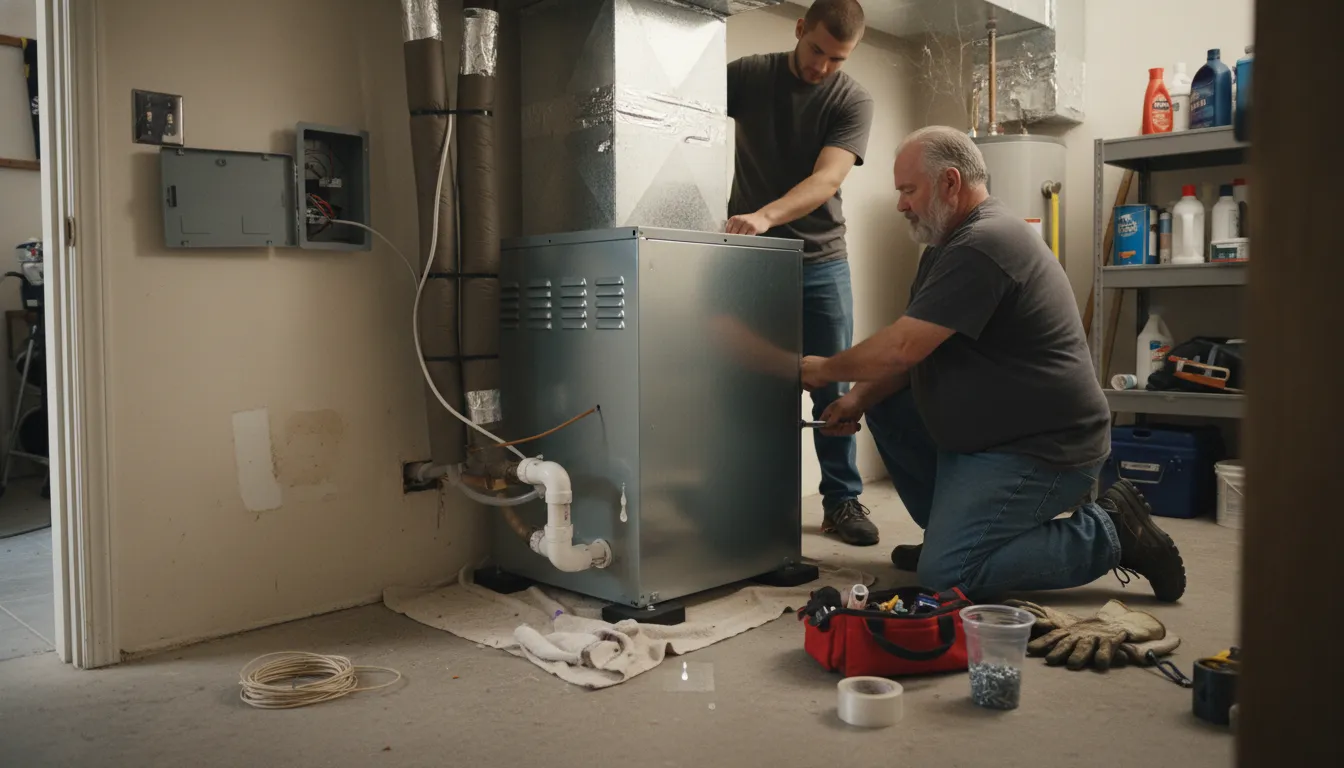
Find the Best HVAC Installers for Your Business
No obligation • Fast responses • Nationwide coverage

Why you can trust HVAC Firms
HVAC Firms is a leading United States resource for evaluating HVAC service providers. Our team researches companies, checks credentials, and reviews customer feedback to present clear, unbiased information. Listings and rankings are based on merit, and companies cannot pay to change our editorial content.
Search providers near you
Best HVAC Installers in Pennsylvania Ranked
Installing a new heating and cooling system is a significant investment in your Pennsylvania home's comfort, efficiency, and value. With the state's humid summers and cold winters, choosing the right system is crucial for managing energy costs and ensuring year-round reliability. This guide provides a detailed overview of HVAC installation options, costs, and key considerations specific to Pennsylvania, helping you make an informed decision and connect with qualified local professionals for your project.
J&J Mechanical Inc.
200 Grove Rd, Paulsboro, NJ 08066
J&J Mechanical Inc. is a family-owned HVAC and generator service provider serving Philadelphia, PA, and the surrounding South Jersey and Southeastern Pennsylvania areas. They offer a wide range of services including air conditioning and heating installation, repair, maintenance, and indoor air quality solutions. Their N.A.T.E certified technicians provide reliable system tune-ups and emergency repairs, along with energy-efficient and environmentally friendly options such as high-efficiency HVAC systems and backup generators. With over two decades of experience, J&J Mechanical Inc. is committed to transparent pricing and community involvement.
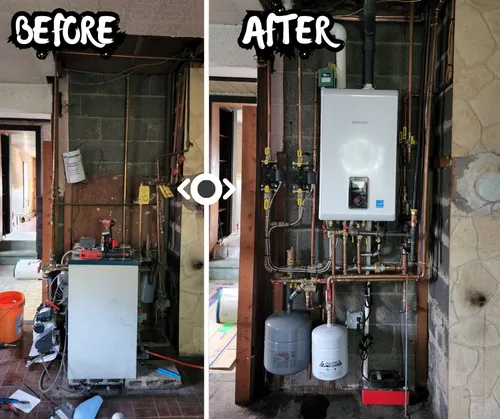
McGinley Services Heating & Cooling
746 Chester Pike STE A, Prospect Park, PA 19076
McGinley Services Heating & Cooling is a family-owned HVAC company serving Philadelphia, PA, and nearby Delaware and Montgomery counties. Since 2020, they have provided heating, air conditioning, indoor air quality, and water heating services, including installations, repairs, duct cleaning, and maintenance. The company offers 24/7 emergency service and same-day appointments, ensuring support during inconvenient times. Their licensed and insured team is experienced in heat pump and furnace installations as well as boiler repairs, focusing on safety and quality.
Supreme Heating and Cooling
1475 Frey Rd, Penn Hills Township, PA 15235
Supreme Heating and Cooling is an HVAC company based in Pittsburgh, PA, offering a wide range of heating and cooling services. They provide installation, repair, and maintenance for air conditioners, furnaces, heat pumps, boilers, mini split systems, and indoor air quality equipment. Their certified technicians also handle electrical services related to HVAC systems. The company emphasizes energy efficiency and improved indoor air quality in their work. Supreme Heating and Cooling is known for working with trusted brands and offers comprehensive HVAC solutions to keep homes comfortable year-round.
D’Auria & Son Heating and Air
26 Evergreen Ave, Blackwood, NJ 08012
D'Auria & Son Heating and Air is a family-owned HVAC company serving Philadelphia, PA, and the South Jersey area. With over 30 years of experience, they provide residential and commercial heating and cooling services, including installation, repair, and tune-ups for air conditioners and furnaces. The company offers 24/7 emergency repair services and focuses on maintaining comfortable indoor environments through reliable HVAC solutions.
DiBiase Heating and Cooling Company
565 Abbott Dr, Broomall, PA 19008
DiBiase Heating and Cooling Company is an HVAC contractor based in Philadelphia, PA, offering a range of heating, cooling, and water heater services. They provide furnace and air conditioning repairs, full system installations, and energy-saving solutions such as high-efficiency water heaters and smart thermostats. Their services cover routine maintenance, emergency repairs, and energy-efficient upgrades to help maintain home comfort year-round. DiBiase Heating and Cooling Company also offers 24/7 service availability and specializes in ductless mini split AC systems and refrigerant leak repairs.
Understanding Pennsylvania's Climate & HVAC Needs
Pennsylvania's climate presents a unique challenge for home comfort systems. Summers can be hot and muggy, especially in the southeastern regions around Philadelphia, while winters bring sustained cold, with areas like the Poconos and the Laurel Highlands experiencing significant snowfall. This dual demand means your HVAC system must be robust enough for efficient cooling and powerful, reliable heating.
A system that is properly sized and selected for Pennsylvania's specific conditions does more than just heat and cool. It manages indoor humidity levels in the summer, preventing mold and mildew, and provides consistent, draft-free warmth in the winter. An undersized system will struggle, leading to higher energy bills and premature wear, while an oversized system will short-cycle, failing to dehumidify properly and causing uncomfortable temperature swings. The right installation starts with understanding these regional demands.
2025 HVAC System Options for Pennsylvania Homes
Homeowners in the Keystone State have several effective system types to choose from, each with its own advantages. The best choice depends on your existing home infrastructure (like ductwork), fuel availability (natural gas, propane, or electricity), and your efficiency goals.
Central Air Conditioner & Furnace Systems
This is the most common setup in Pennsylvania homes with existing ductwork, particularly where natural gas is available. It combines a gas, propane, or oil furnace for heating with a separate central air conditioner for cooling.
- How It Works: The furnace generates heat in the winter, and the air conditioner's outdoor condenser unit provides cooling in the summer. Both use the same network of ducts and indoor air handler to distribute conditioned air.
- Best For: Homes with existing, functional ductwork. Gas furnaces are often preferred for their lower operating costs in Pennsylvania's cold climate.
- Typical Installation Cost: A full system installation typically ranges from $4,000 to $9,000 or more, depending on efficiency ratings and system capacity.
Heat Pump Systems
Heat pumps are becoming increasingly popular due to their high efficiency for both heating and cooling. They work by transferring heat rather than generating it, making them exceptionally efficient.
- How It Works: In summer, it acts like an air conditioner, removing heat from your home. In winter, it reverses the process, extracting heat from the outside air (even in cold weather) and moving it indoors. Modern cold-climate models are effective in Pennsylvania winters.
- Best For: Homeowners seeking high efficiency and lower carbon footprints. Ideal for areas with high electricity costs or where natural gas is not available.
- Typical Installation Cost: Installation generally falls between $5,000 and $10,000.
Ductless Mini-Split Systems
These systems provide a flexible solution for homes without ductwork or for adding comfort to specific zones like additions, sunrooms, or finished basements.
- How It Works: A small outdoor condenser connects to one or more indoor air-handling units mounted on walls or ceilings. Each indoor unit can be controlled independently.
- Best For: Older homes without ducts, room additions, or for providing zoned comfort control. They are excellent for targeted heating and cooling.
- Typical Installation Cost: Costs are typically $4,000 to $8,000 per zone (each indoor unit) 1.
Hybrid Dual-Fuel Systems
A hybrid system pairs a gas furnace with an electric heat pump to optimize efficiency and cost based on outdoor temperatures.
- How It Works: The energy-efficient heat pump handles heating during milder winter weather. When temperatures drop below a certain set point (often around 35°F), the system automatically switches to the gas furnace for more powerful and cost-effective heating.
- Best For: Homeowners who want to maximize energy savings without sacrificing reliable heat during the coldest Pennsylvania nights.
- Typical Installation Cost: Similar to or slightly higher than a high-end central system, often starting in the $8,000 to $12,000+ range.
Find the perfect hvac installers for your needs
Get personalized recommendations and expert advice
Breaking Down Installation Costs in PA
The total cost of an HVAC installation in Pennsylvania is influenced by several factors. Understanding these can help you interpret estimates and budget effectively.
System Type & Size: This is the primary cost driver. Larger capacity systems (measured in tons for cooling, BTUs for heating) cost more. For example, a 1.5-ton system for a smaller space (750-900 sq ft) may cost $2,500-$4,500, while a common 3-ton system for a 1,500-1,800 sq ft home can run $3,400-$5,400 for the AC unit alone 2. A full furnace and AC replacement will be higher.
Efficiency Ratings: Higher-efficiency models with superior SEER2 (Seasonal Energy Efficiency Ratio) for cooling and HSPF2 (Heating Seasonal Performance Factor) for heat pumps command a premium but offer lower utility bills. Due to federal standards, new systems must meet minimum SEER2 ratings of 14.3 to 15.2, depending on the region. Investing in a unit above this minimum can yield significant savings.
Labor & Complexity: Labor typically accounts for $1,000 to $3,000 of the total cost. Complexity, such as installing new ductwork, upgrading electrical service, or navigating a difficult attic or crawlspace, will increase labor time and cost.
Regional Variations: Prices can differ across the state.
- Philadelphia & Southeast PA: Estimates often range from $4,445 to $8,622.
- Pittsburgh & Western PA: Costs can be similar or slightly higher, with some averages reported around $6,800+.
- Central PA: Homeowners might expect costs between $5,500 and $8,0003.
A full high-efficiency system upgrade, including potential duct modifications, can reach $12,000 to $18,000 or more4.
Key Regulations and Efficiency Standards for 2025
New federal appliance efficiency standards took effect in 2023, impacting all new installations. For Pennsylvania, which is in the northern region, the key requirements are:
- Air Conditioners: Must have a minimum SEER2 of 14.3.
- Heat Pumps: Must have a minimum SEER2 of 15.2 and a minimum HSPF2 of 7.55 6 7.
When selecting a system, look for ratings above these minimums. For Pennsylvania's climate, a heat pump with a high HSPF2 rating (around 10-11+) is recommended for effective and efficient winter operation 8 9. Furthermore, installation standards require that new ductwork in unconditioned spaces (like attics) be well-sealed and insulated, often to R-8 for supply ducts and R-6 for returns 9.
Critical Considerations Before You Install
The Importance of Professional Sizing (Manual J Load Calculation): Never guess your home's HVAC needs. A reputable contractor will perform a Manual J calculation, which factors in your home's square footage, insulation, window types, orientation, and local climate to determine the precise system capacity required. This is the single most important step to ensure efficiency and comfort.
The "$5,000 Rule" for Older Systems: If you're deciding between repairing an old system or replacing it, this rule of thumb can help. Multiply the age of your equipment by the estimated repair cost. If the result exceeds $5,000, replacement is usually the more economical long-term choice 10. For example, a 12-year-old furnace needing a $600 repair (12 x 600 = 7,200) suggests replacement is advisable.
Long-Term Value of High-Efficiency Systems: While the upfront cost is higher, premium systems with variable-speed compressors and blowers offer superior humidity control, more consistent temperatures, and significantly lower operating costs. They can be especially worthwhile given Pennsylvania's wide temperature swings.
Permits and Inspections: Most municipalities in Pennsylvania require a permit for HVAC system replacement. Your contractor should handle this process, ensuring the installation meets all local building and mechanical codes.
Frequently asked questions
Sources
Footnotes
-
High-Efficiency HVAC Systems: Are They Worth the ... - https://hallerent.com/blog/high-efficiency-hvac-worth-it-pa/ ↩
-
How Your HVAC Contractor Determines The Cost Of AC Installation - https://kliemannbros.com/how-your-hvac-contractor-determines-the-cost-of-ac-installation/ ↩
-
AC Installation Cost in Pennsylvania: 2025 Price Guide - https://lehighhvac.com/blogs/ac-installation-cost-in-pennsylvania-2025-price-guide/ ↩
-
HVAC Replacement Cost Pennsylvania: Factors Influencing ... - https://www.leokobco.com/post/hvac-replacement-cost-pennsylvania ↩
-
Cost to Replace AC Unit - 2025 Homeowner's Guide - https://regionserviceco.com/cost-to-replace-ac-unit/ ↩
-
Understanding the New 2023 SEER Requirements | Matheson - https://www.mathesonheating.com/hvac/understanding-the-new-2023-seer-requirements/ ↩
-
Effects Of New SEER Regulations On DC, MD & VA Residents - https://wheatandsons.com/blog/new-seer-hvac-regulations/ ↩
-
Mini-Split vs Central AC: Which Works Best in Pennsylvania's Climate? - https://lehighhvac.com/blogs/mini-split-vs-central-ac-which-works-best-in-pennsylvania's-climate/ ↩
-
Choosing a system in Central PA : r/heatpumps - Reddit - https://www.reddit.com/r/heatpumps/comments/z2qv2l/choosing_a_system_in_central_pa/ ↩ ↩2
-
The $5,000 HVAC Rule | Repair or Replace Your HVAC? - https://www.myqualitycomfort.com/tips-tricks/5000-rule-hvac/ ↩