Find the Best HVAC Installers for Your Business
No obligation • Fast responses • Nationwide coverage

Why you can trust HVAC Firms
HVAC Firms is a leading United States resource for evaluating HVAC service providers. Our team researches companies, checks credentials, and reviews customer feedback to present clear, unbiased information. Listings and rankings are based on merit, and companies cannot pay to change our editorial content.
Search providers near you
Best HVAC Installers in North Dakota Ranked
Choosing the right heating and cooling system is a critical decision for any North Dakota homeowner. The state's extreme climate, with frigid winters and warm summers, demands reliable and efficient HVAC solutions. This guide explains the installation options, efficiency standards, and long-term value considerations for residential systems in North Dakota, helping you make an informed choice for your home's comfort and energy savings.
Understanding Your Heating and Cooling Options
North Dakota's diverse energy landscape and climate mean there is no one-size-fits-all solution. The right system depends on your home's existing infrastructure, local fuel availability, and your comfort priorities. Here are the primary system types available for residential installation.
Gas and Propane Furnaces: Forced-air furnaces remain a popular and powerful choice for primary heating, especially in areas with access to natural gas or where propane is the standard fuel source. Modern high-efficiency models can convert over 95% of the fuel's energy into heat for your home, providing strong, consistent warmth during the coldest months.
Central Air Conditioning: A central AC system, often paired with a furnace, is the standard for whole-home cooling. It uses the same ductwork as a forced-air furnace to distribute cool air. When installing a new system, it's crucial to ensure the air conditioner is properly matched to the furnace's blower capacity for optimal efficiency and performance.
Heat Pumps: This versatile technology is gaining significant traction in North Dakota. An air-source heat pump acts as both a highly efficient air conditioner and an electric heater. It works by transferring heat rather than generating it, making it exceptionally efficient. For climates like North Dakota's, cold-climate heat pump models are designed to operate effectively at very low outdoor temperatures, often serving as the primary heating source or as part of a hybrid system with a furnace.
Ductless Mini-Split Systems: These systems are an excellent solution for homes without existing ductwork, for room additions, or for creating independent temperature zones. A mini-split consists of an outdoor compressor unit connected to one or more indoor air handlers mounted on walls or ceilings. They provide both heating and cooling with high efficiency and offer flexible installation options.
North Dakota's Energy Efficiency Standards and Codes
All new HVAC installations must comply with federal and state energy codes, which are designed to improve home performance and reduce energy consumption. Understanding these standards helps you grasp the minimum performance levels of new equipment.
Federal SEER2 and HSPF2 Standards: As of 2023, new federal minimum efficiency standards are in effect for air conditioners and heat pumps. These standards use updated testing metrics (SEER2 and HSPF2) that better reflect real-world conditions. North Dakota falls into the "Northern" region. For central air conditioners, the minimum is generally around 14 SEER (approximately 13.4-14.3 SEER2). For heat pumps, the requirements are higher, such as approximately 14.3 SEER2 and 7.5 HSPF2 for split-system models 1.
State Building Codes: North Dakota has historically followed national model energy codes. The state has considered adopting stricter standards like the 2021 International Energy Conservation Code (IECC), which includes provisions for improved insulation, air sealing, and overall building envelope efficiency. A more efficient home envelope directly impacts the size and efficiency requirements of your HVAC system, often allowing for a smaller, properly sized unit 2.
Find the perfect hvac installers for your needs
Get personalized recommendations and expert advice
Installation Costs and Long-Term Value Analysis
The investment in a new HVAC system is substantial, but it's important to view it through the lens of total cost of ownership, which includes purchase price, installation, and decades of operational costs.
Typical Cost Ranges: For a complete system replacement in a North Dakota home, homeowners can expect a wide range, typically from $6,000 to over $15,000. The final price depends heavily on several factors:
- Home Size and System Capacity: Larger homes (e.g., over 2,000 sq ft) require larger capacity units (measured in tons), which cost more.
- System Type and Efficiency: A basic, code-minimum system will cost less upfront than a high-efficiency model with advanced features. Heat pumps and systems requiring new ductwork or electrical upgrades will also increase the project cost.
- Equipment Brand and Labor: Premium brands and complex installations that require significant labor for duct modification, electrical work, or system configuration will be at the higher end of the spectrum 3.
The High-Efficiency Payback in North Dakota: While premium systems have a higher initial price tag, they can offer dramatic savings on utility bills. Energy modeling specific to North Dakota shows that choosing high-efficiency equipment is a cost-effective investment. For example, replacing an old electric furnace with an ENERGY STAR certified cold-climate heat pump can save a typical household over $1,200 annually on energy costs. These savings can allow the system to pay for its upfront premium in a relatively short number of years, after which the savings continue for the life of the equipment 4 5.
Key Factors Influencing Price:
- Ductwork Assessment: The condition, design, and size of your existing ducts are critical. Leaky or poorly sized ducts can undermine the performance of a new, high-efficiency unit, often necessitating repairs or modifications.
- Proper Sizing (Manual J Load Calculation): A professional should always perform a Manual J calculation to determine the exact heating and cooling needs of your home. An oversized system will short-cycle, reducing comfort, efficiency, and lifespan. An undersized system will struggle to maintain temperature.
- Electrical Service: Some high-efficiency systems, particularly heat pumps, may require an electrical service upgrade or dedicated circuit, adding to the project cost.
Choosing the Right System for Your Home
Making the final decision involves balancing immediate needs with future savings and comfort.
For Maximum Efficiency and Year-Round Comfort: A cold-climate air-source heat pump is increasingly considered a top-tier option. It provides efficient cooling in summer and very efficient heating for most of the winter. In North Dakota, it is often installed in a dual-fuel or hybrid configuration with a gas furnace. This system intelligently switches to the most cost-effective heat source based on outdoor temperature, using the heat pump for moderate cold and the furnace for extreme cold snaps.
For Homes with Existing Ductwork and Gas Access: A high-efficiency gas furnace paired with a central air conditioner or standard heat pump remains a robust and familiar choice. This setup delivers powerful heating performance with the potential for lower fuel costs compared to propane or electric resistance heat.
For Targeted Solutions and Additions: Ductless mini-splits are ideal for heating and cooling specific zones, such as a finished basement, sunroom, or an older home without ducts. They avoid the energy losses associated with ductwork and offer individual room control.
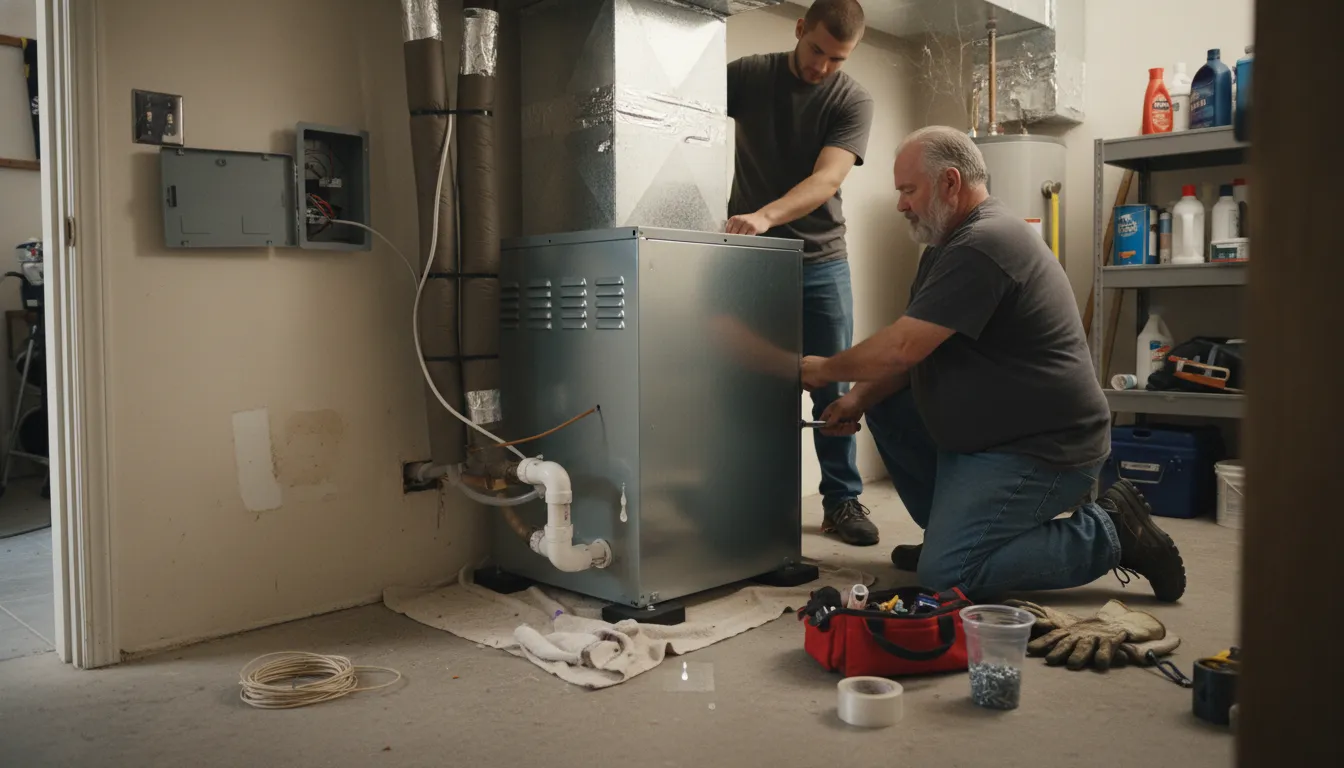
The Importance of Professional Installation: Regardless of the equipment you choose, professional installation is non-negotiable for performance, efficiency, and warranty validity. A qualified installer will ensure proper sizing, refrigerant charge, airflow, and electrical connections. They will also pull the necessary permits and ensure the installation meets all North Dakota and local code requirements.
Frequently asked questions
Sources
Footnotes
-
New 2024 Residential Efficiency Standards: What HVAC ... - https://fieldedge.com/blog/energy-efficiency-minimum-seer-rating-2023/ ↩
-
Cost-Effectiveness of the 2021 IECC for Residential Buildings ... - https://www.energycodes.gov/sites/default/files/2021-07/NorthDakotaResidentialCostEffectiveness_2021_0.pdf ↩
-
HVAC Installation Costs and Breakdowns - TMC Heating and Cooling - https://tmcservice.com/hvac-installation-costs-and-breakdowns/ ↩
-
North Dakota Residential Energy Efficiency Potential - ResStock - https://resstock.nrel.gov/factsheets/ND ↩
-
New HVAC System Cost Calculator: Get a Custom Estimate in 2026 - https://modernize.com/hvac/cost-calculator ↩