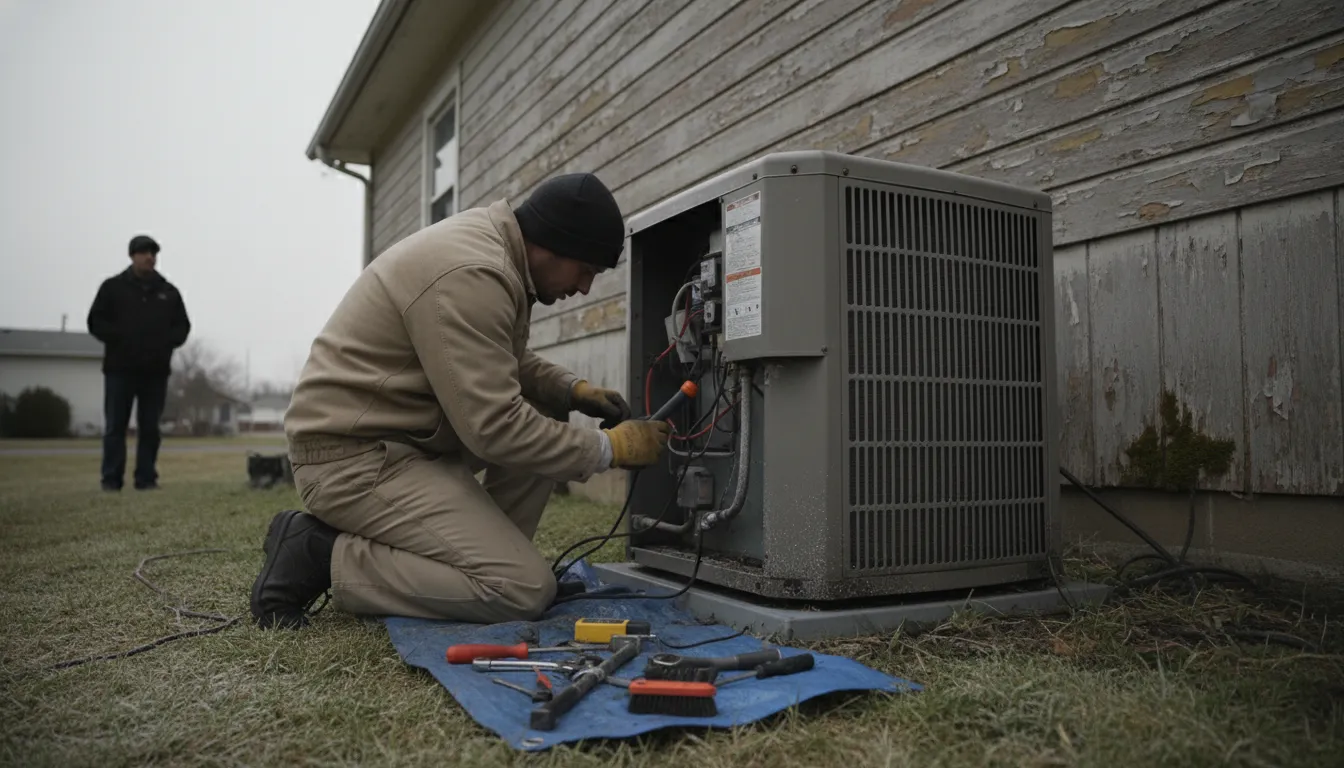
Find the Best Heat Pump Repair Contractors for Your Business
No obligation • Fast responses • Nationwide coverage

Why you can trust HVAC Firms
HVAC Firms is a leading United States resource for evaluating HVAC service providers. Our team researches companies, checks credentials, and reviews customer feedback to present clear, unbiased information. Listings and rankings are based on merit, and companies cannot pay to change our editorial content.
Search providers near you
Top Heat Pump Repair Contractors in Spokane Valley, Washington Ranked
When your heat pump starts acting up in Spokane Valley, it can quickly turn your comfortable home into a place of frustration, whether it's struggling to keep you warm during a chilly winter or cool during a summer heatwave. Heat pump repair is the specialized service that diagnoses and fixes the mechanical and electrical issues preventing your system from operating efficiently. This guide is designed to help you understand common problems, the repair process, and what to expect, so you can confidently connect with a qualified local technician to restore your home's comfort and your system's performance.
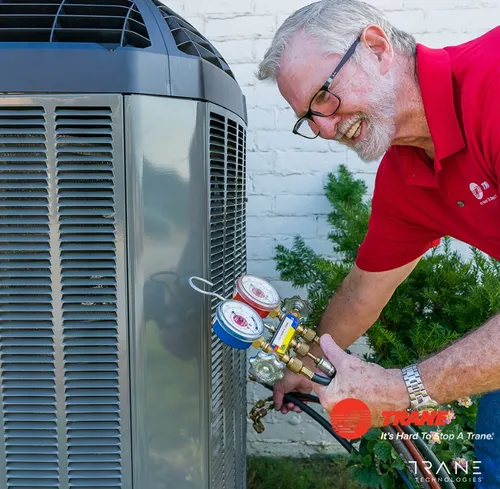
Comfort Heating, Cooling, Electrical & Plumbing
11711 E Trent Ave, Spokane Valley, WA 99206
Comfort Heating, Cooling, Electrical & Plumbing is a home services company based in Spokane, WA, offering a wide range of HVAC, plumbing, electrical, and water treatment services. They provide repair, maintenance, and installation for heating and cooling systems, including air conditioners, heat pumps, and ductless units. Comfort Heating, Cooling, Electrical & Plumbing has been serving the Post Falls and surrounding areas since 1993, bringing over 30 years of experience to their work. The company also offers 24/7 emergency service without extra charges for evenings or weekends.
Bill's Heating & A/C
1007 N Boulder Ct, Post Falls, ID 83854
Bill's Heating & A/C is a full-service HVAC contractor serving Spokane, WA, and surrounding areas including Idaho and Eastern Washington. They provide installation, maintenance, and repair services for air conditioners, furnaces, and heat pumps for both residential and commercial clients. With over 35 years of experience, the company offers 24/7 emergency services and has expanded its coverage to include Lewiston, Clarkston, Moscow, Pullman, Boise, Meridian, Eagle, and the Treasure Valley. Their technicians are equipped to handle complex technical issues across a wide range of HVAC systems.

🏅 Hurliman Heating & Air Conditioning
515 S Dishman Mica Rd, Spokane Valley, WA 99206
Hurliman Heating & Air Conditioning is an HVAC company serving Spokane, WA, and nearby areas including Spokane Valley, Mead, Airway Heights, and Cheney. They provide installation and repair services for air conditioners, furnaces, heat pumps, and other HVAC systems. The company emphasizes quick response times by having experts stationed near their service locations to handle emergency needs efficiently.
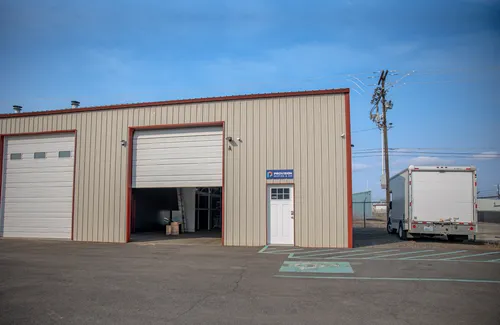
Provision Heating & Air
3810 E Joseph Ave, Spokane, WA 99217
Provision Heating & Air is an HVAC company based in Spokane, WA, offering heating and air conditioning repair and installation services. They serve Spokane and the surrounding areas, providing repairs and installations for air conditioners, furnaces, heat pumps, and other HVAC systems. The company partners with leading brands and offers a one-year labor guarantee along with a ten-year parts warranty. Their services include thorough diagnostics and system installations with a focus on honest and quality work.
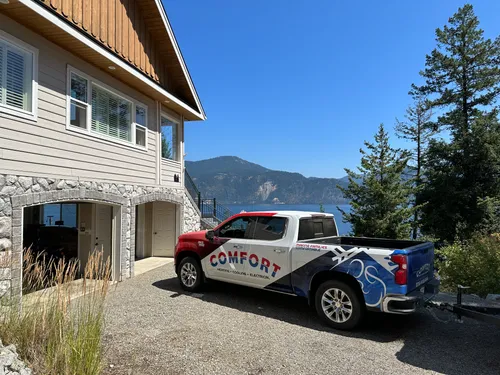
Comfort Heating, Cooling, Electrical & Plumbing
3620 E Covington Ave, Post Falls, ID 83854
Comfort Heating, Cooling, Electrical & Plumbing is a locally owned home services company based near Spokane, WA, serving Post Falls, Coeur d'Alene, Hayden, Rathdrum, and Kootenai County Idaho. They provide a wide range of services including HVAC installation and repair, plumbing, electrical work, generators, and water treatment. Comfort specializes in heating and air conditioning systems such as heat pumps, mini splits, and ductless units. Established in 1993, the company has over 30 years of experience and offers 24/7 emergency service without extra charges for evenings or weekends.
Recognizing Common Heat Pump Problems
A malfunctioning heat pump often sends clear signals. Knowing these signs can help you describe the issue to a technician and understand the potential urgency of the repair.
Poor Heating or Cooling Performance: If some rooms are too cold while others are too hot, or the system runs constantly without reaching the set temperature, you likely have a performance issue. This is frequently caused by restricted airflow from a clogged air filter, dirty evaporator or condenser coils, or blockages around the outdoor unit. It can also stem from more serious issues like low refrigerant charge or a failing compressor.
Unusual Noises: Your heat pump should operate relatively quietly. New or loud sounds are a red flag. Grinding noises often point to a failing blower motor or issues with the indoor air handler's bearings. Rattling or banging could indicate loose parts or a broken component inside the compressor. Hissing may signal a refrigerant leak, which requires immediate professional attention.
Short-Cycling: This occurs when the unit turns on and off in rapid, frequent cycles. Not only does this fail to properly condition your home, but it also places extreme stress on components like the compressor and drives up your energy bills. Short-cycling can be triggered by an oversized unit, a faulty thermostat, a dirty air filter, or low refrigerant levels.
Ice Buildup: Finding ice on the coils of your outdoor unit (in heating mode) or indoor unit (in cooling mode) is a common symptom. Contrary to intuition, this usually indicates a problem with heat transfer, not that the unit is too cold. The most common culprits are low refrigerant, which lowers coil temperature, or poor airflow caused by a dirty filter or failing fan, which prevents warm air from melting frost 1.
Skyrocketing Energy Bills: A sudden, unexplained increase in your monthly energy costs is often one of the first signs of an inefficiently operating heat pump. When components like the compressor, fan motors, or reversing valve begin to fail, the system must work much harder and longer to maintain temperature, consuming significantly more electricity 2.
The Professional Repair Process: What to Expect
When you call a technician for heat pump service in Spokane Valley, a systematic process is followed to accurately diagnose and resolve your issue.
Step 1: Comprehensive Diagnosis The repair begins with a thorough inspection. A skilled technician won't just guess at the problem; they will perform a detailed diagnostic check. This often includes a 20-point inspection or similar comprehensive evaluation 3. They will:
- Check refrigerant pressure and levels to identify leaks or improper charge.
- Test electrical components for proper voltage, including capacitors, contactors, and the circuit board.
- Measure airflow at the vents and inspect the ductwork for restrictions.
- Calibrate and test the thermostat for accuracy.
- Examine the reversing valve, which is crucial for switching between heating and cooling modes 4.
- Inspect the indoor and outdoor coils for dirt and damage.
- Clear the condensate drain line to prevent water leaks and overflow.
Step 2: Explanation and Recommendation After the diagnosis, the technician should clearly explain what they found, why it's causing your symptoms, and what the repair options are. They will provide a detailed estimate that includes the cost of parts and labor. For major repairs, such as a compressor failure, they may also discuss the option of replacement versus repair, considering the age and condition of your entire system.
Step 3: The Repair Work With your approval, the technician will proceed with the fix. This could be a quick service, like cleaning coils and replacing a filter, or a more involved component replacement. They will use proper tools and procedures, such as a vacuum pump and manifold gauges for refrigerant work, to ensure the repair is done correctly and safely. After replacing parts, they will test the entire system to verify it is operating at peak efficiency before considering the job complete.
Find the perfect heat pump repair contractors for your needs
Get personalized recommendations and expert advice
Understanding Repair Types and Associated Costs
Repair complexity and cost in Spokane Valley can vary widely based on the failed component and the labor required. Here's a breakdown of common repairs.
Minor Repairs and Maintenance (Often 1-3 hours): These are the most frequent service calls and typically have the fastest turnaround.
- Air Filter Replacement/Cleaning: The simplest fix for airflow issues. Technicians may also clean the blower wheel and housing.
- Capacitor or Contactor Replacement: These electrical components help start and run the motors. They are relatively inexpensive parts but crucial for operation.
- Condensate Drain Line Clearing: A clogged drain line can cause water damage. Technicians use specialized vacuums and tools to clear the blockage.
- Thermostat Calibration or Replacement: If the issue is with control, a new programmable or smart thermostat may be recommended. Cost Estimate: These minor fixes can range from approximately $100 for a simple capacitor replacement to $250 for a thorough drain line cleaning and system check.
Moderate Repairs (Several hours to a full day): These involve more labor or more costly components.
- Blower Motor Replacement: The motor that circulates air through your ducts can wear out. Replacing it requires electrical work and alignment.
- Reversing Valve Replacement: This valve directs refrigerant flow for heating vs. cooling. Replacing it is a complex repair involving refrigerant recovery.
- Control Board Replacement: The system's "brain" can fail due to power surges or age. Diagnosis is key, as these boards can be expensive.
- Refrigerant Leak Repair and Recharge: Finding and sealing a leak, then recharging the system to the correct level, is a skilled job. Cost Estimate: Repairs in this category often fall between $200 to $700 for a fan motor replacement, while a circuit board can range from $75 to $600 for the part plus labor. Refrigerant leak repair and recharge can range from $200 to $1,500 depending on the leak's location and the amount of refrigerant needed.
Major Repairs (Could take multiple days): These are significant investments and sometimes lead homeowners to consider full system replacement.
- Compressor Replacement: The compressor is the heart of the heat pump. Replacing it is labor-intensive, as it requires recovering all refrigerant, welding new lines, and performing a deep vacuum. It is often one of the most expensive single-component repairs.
- Coil Replacement: If the evaporator or condenser coil develops a leak, it may need replacement. This is also a major repair involving refrigerant handling. Cost Estimate: Major repairs like compressor or coil replacement in Spokane Valley can range from $1,200 to over $2,800, with the final price heavily dependent on the specific unit's requirements and labor costs 5 6 7.
The Value of Proactive Maintenance
While repairs are inevitable over a system's lifespan, consistent preventative maintenance is your best defense against unexpected breakdowns and costly major repairs. A seasonal tune-up by a professional can catch small issues-like a weakening capacitor or a minor refrigerant leak-before they lead to system failure 8. Homeowners should also perform simple tasks like changing air filters every 1-3 months, keeping the outdoor unit clear of leaves and debris, and ensuring indoor vents are not blocked 9. Investing in maintenance not only improves reliability but also maintains your system's energy efficiency, protecting your comfort and your wallet.
Frequently asked questions
Sources
Footnotes
-
Spokane Heat Pump Installation & Repair - https://cougarmechanical.com/our-services/heating-services/heat-pump-repair/ ↩
-
Heat Pump Repair or Replacement Info - https://west.americoolonline.com/blog/heat-pump-service/heat-pump-repair-or-replace/ ↩
-
Heat Pump Repair - Provision Heating & Air - https://provisionhvac.com/heating/heat-pump-repair/ ↩
-
Heat Pump Repair in Spokane, WA - https://epicfixedit.com/heating/heat-pump-repair/ ↩
-
The HVAC Repair Process: What to Expect from Start to Finish - https://eliteairandheatllc.com/the-hvac-repair-process-what-to-expect-from-start-to-finish/ ↩
-
Heat Pump & HVAC Maintenance Auckland | AC Repair Services - EPS - https://epservices.co.nz/electrical-services/heat-pump-repairs/ ↩
-
2026 HVAC Repairs Cost: A Comprehensive Price Guide | Angi - https://www.angi.com/articles/how-much-hvac-repair-cost.htm ↩
-
Heat Pump Troubleshooting: 11 Heat Pump Issues & Their Fixes - https://cielowigle.com/blog/heat-pump-troubleshooting/ ↩
-
Operating and Maintaining Your Heat Pump | Department of Energy - https://www.energy.gov/energysaver/operating-and-maintaining-your-heat-pump ↩