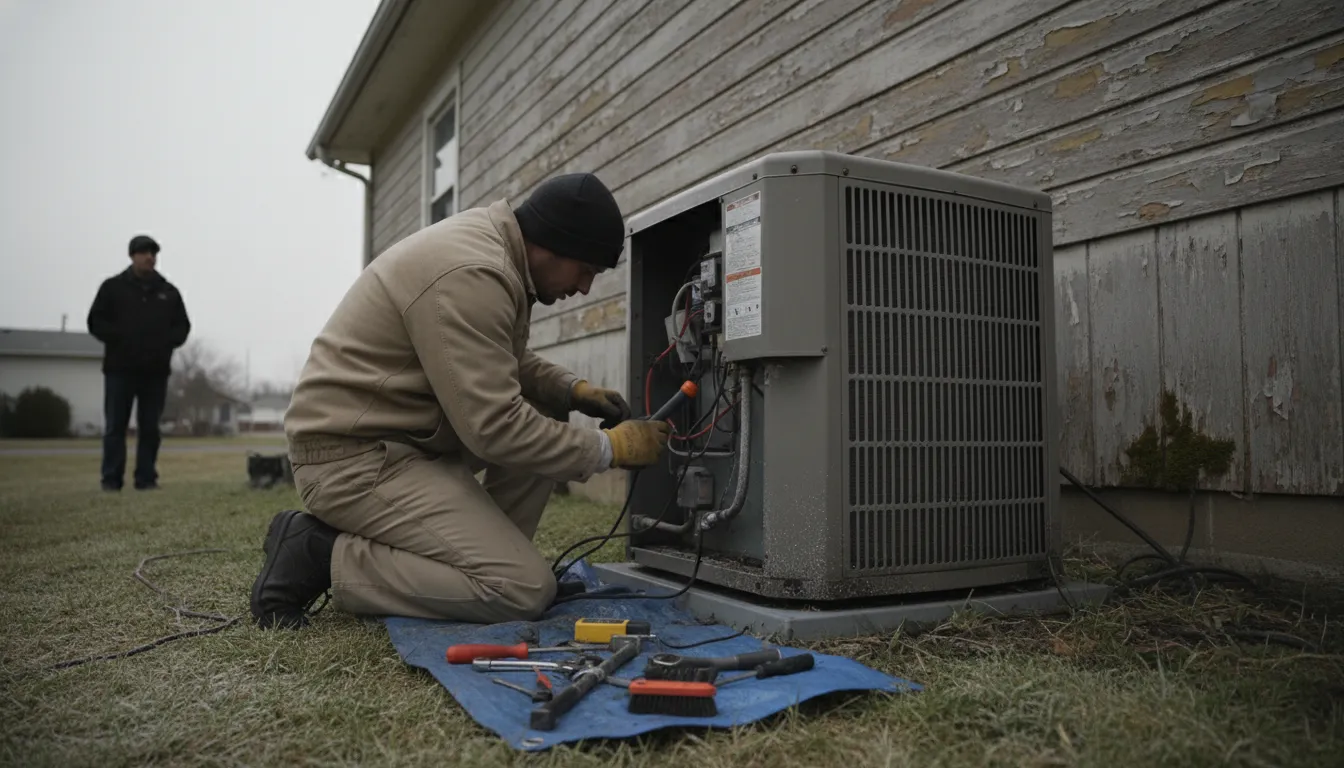
Find the Best Heat Pump Repair Contractors for Your Business
No obligation • Fast responses • Nationwide coverage

Why you can trust HVAC Firms
HVAC Firms is a leading United States resource for evaluating HVAC service providers. Our team researches companies, checks credentials, and reviews customer feedback to present clear, unbiased information. Listings and rankings are based on merit, and companies cannot pay to change our editorial content.
Search providers near you
Best Heat Pump Repair Contractors in Nevada Ranked
A heat pump is a versatile, energy-efficient system that provides both heating and cooling for your Nevada home. When it malfunctions, it can quickly lead to discomfort, especially during the state's extreme temperature swings. This guide provides clear, practical information on common heat pump problems in Nevada, troubleshooting steps, and what to expect from professional repair services. You can use this resource to understand your system's needs and connect with qualified local technicians to restore your home's comfort.
Mountain West Heating and Air Conditioning LLC
3265 Eastlake Blvd, New Washoe City, NV 89704
Mountain West Heating and Air Conditioning LLC provides heating, air conditioning, and HVAC services in Reno, NV. They offer installation, repair, and maintenance for furnaces, heat pumps, and air conditioning systems, along with backup generator installations and various electrical services. Their certified technicians handle energy-efficient upgrades, emergency repairs, and preventative maintenance to ensure reliable home comfort. The company also installs and maintains backup generators powered by oil, propane, or natural gas, supporting power reliability during outages.
Century AC & Heating Repair
1635 Village Center Cir Ste. 250, Las Vegas, NV 89134
Century AC & Heating Repair is a family-run furnace and heat pump repair company serving Las Vegas, NV. With decades of experience, they specialize in diagnosing and fixing a wide range of heating issues, including worn-out parts and faulty thermostats. The company focuses on honest repairs without unnecessary upselling, providing clear explanations supported by photos or videos. Their trucks are stocked with common parts to ensure faster repairs, and they understand the specific heating needs of homes in the Las Vegas area.
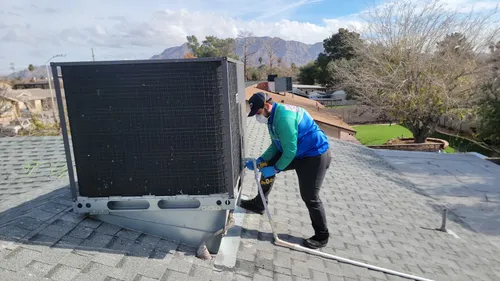
Doctor Heat Pump
401 Courtney Ln, Las Vegas, NV 89107
Doctor Heat Pump is a heat pump repair and installation company based in Las Vegas, NV. They specialize in high-efficiency heat pump systems tailored for high-rise condos and luxury towers, including notable buildings like Waldorf Astoria and Veer Towers. Their expertise includes water-source heat pump systems designed to address space constraints and noise concerns common in multi-unit buildings.
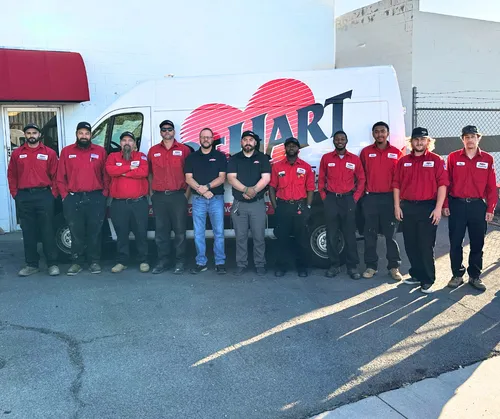
DeHart Plumbing, Heating, and Air Inc.
1842 Hymer Ave, Sparks, NV 89431
DeHart Plumbing, Heating, and Air Inc. is an HVAC and plumbing contractor serving Reno, NV, as well as the Central Valley and Modesto, CA. They offer a range of services including air conditioning, furnace, heat pump, and boiler repair and installation, along with HVAC tune-up services. Established in 1946, DeHart has a long history of providing heating and cooling solutions with NATE-certified technicians and offers an industry-leading 10-year parts and labor warranty. Their Love Club maintenance program includes biannual HVAC tune-ups and plumbing inspections, supporting ongoing home comfort and efficiency.
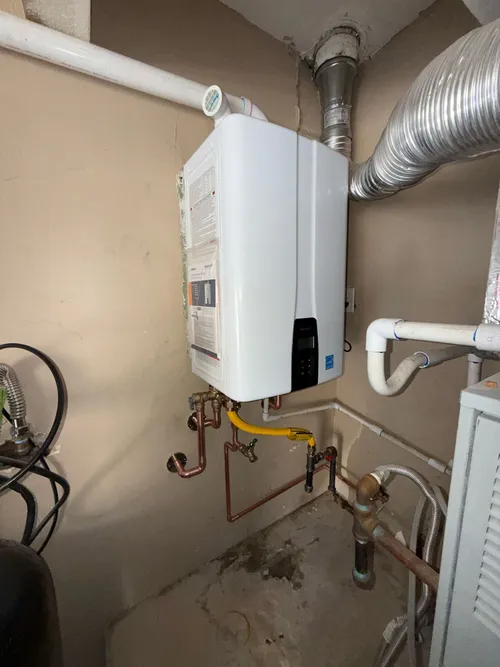
702 PlumbAIR
137 N Gibson Rd, Henderson, NV 89014
702 PlumbAIR is a family-owned plumbing and HVAC company serving Henderson, NV, and the surrounding Las Vegas area. They provide a range of services including air conditioning, furnace, and heat pump repair and installation, as well as HVAC tune-ups. The company emphasizes integrity and customer care, offering tailored solutions without upselling. Their team is experienced in plumbing and HVAC systems, aiming to maintain home comfort efficiently. 702 PlumbAIR also offers financing options and a membership program with benefits like priority scheduling and maintenance discounts.
Why Nevada's Climate is Tough on Heat Pumps
Nevada's unique desert environment presents specific challenges for HVAC systems, particularly heat pumps. The combination of extreme summer heat, pervasive dust, and low humidity can accelerate wear and lead to frequent issues.
- Extreme Heat: Prolonged exposure to temperatures over 100°F forces the compressor and other components to work harder and longer, increasing the risk of motor burnout, capacitor failure, and refrigerant pressure problems.
- Dust and Debris: High desert winds carry fine dust and sand that can quickly clog air filters, coat evaporator and condenser coils, and infiltrate electrical components. This reduces system efficiency, strains the blower fan, and can cause overheating.
- Low Humidity: While often a comfort benefit, very low summer humidity can sometimes affect sensor readings or cause coils to dry out and become less effective at heat transfer.
Understanding these environmental stressors is the first step in proactive maintenance and recognizing when your system needs attention.
Common Heat Pump Problems in Nevada Homes
Recognizing the symptoms of a failing heat pump can help you describe the issue accurately to a technician. Here are the most frequent complaints from Nevada homeowners:
Insufficient Heating or Cooling
This is the most common reason for a service call. The heat pump runs but fails to bring your home to the desired temperature. Causes often include:
- Reduced Airflow: A severely clogged air filter or dust-covered indoor coil is a primary culprit.
- Low Refrigerant: A leak in the sealed system reduces its capacity to absorb and release heat. This requires professional leak detection and repair.
- Faulty Reversing Valve: This component switches the system between heating and cooling modes. If it's stuck, the heat pump may only work in one mode or struggle to achieve the set temperature 1.
Short Cycling
The unit turns on and off every few minutes, never completing a full cycle. This is inefficient, wears out components quickly, and fails to condition your home. Short cycling can be caused by:
- An oversized unit.
- A dirty air filter or blocked coil.
- A malfunctioning thermostat.
- Low refrigerant charge 2.
System Runs Constantly
If your heat pump never seems to shut off, it could be struggling due to:
- A thermostat set to a temperature too extreme for the outdoor conditions (e.g., trying to cool to 68°F on a 115°F day).
- Low refrigerant, forcing it to run longer to meet the demand.
- A dirty filter or blocked airflow, reducing its output.
No Power or Failure to Start
If the unit is completely unresponsive, check the simplest solutions first: ensure the thermostat has batteries, check that the system switch is in the correct "Heat" or "Cool" position, and inspect your home's electrical panel for a tripped circuit breaker dedicated to the heat pump.
Find the perfect heat pump repair contractors for your needs
Get personalized recommendations and expert advice
Troubleshooting Steps Before You Call for Service
Before scheduling a repair visit, you can safely perform a few basic checks. These steps can resolve simple issues or provide valuable information for your technician.
- Check the Thermostat: Verify it's set to "Heat" or "Cool" (not "Off"), the temperature setting is correct, and the display is active. If it's battery-operated, try replacing the batteries 3.
- Inspect the Air Filter: Locate the filter (usually in the return air grille or indoor air handler) and remove it. Hold it up to a light. If you can't see light through it, it needs to be replaced. A clean filter is the easiest way to prevent airflow problems 4.
- Examine the Outdoor Unit: Ensure the condenser unit (the outdoor cabinet) is clear of debris, overgrown shrubs, or piles of leaves. There should be at least 2 feet of clearance on all sides for proper airflow.
- Reset the System: Turn the thermostat to "Off," wait for 30 seconds, and then switch it back to your desired mode. You can also turn off the power at the breaker for 5 minutes before restoring it. This can reset the control board.
- Listen and Observe: When the system tries to start, listen for unusual noises (clicking, buzzing, grinding) and note if any lights are flashing on the indoor unit. This information is very helpful for diagnostics.
What to Expect from Professional Heat Pump Repair
When basic troubleshooting doesn't solve the problem, it's time to call a professional. A certified technician will perform a systematic diagnosis, which typically involves checking electrical components, measuring refrigerant pressures, inspecting coils, and testing the compressor and fans.
Common Repairs and Estimated Costs in Nevada
Repair costs in Nevada can vary based on the component, labor rates in your area (like Las Vegas vs. Reno), and the time of year. Here is a general range for common repairs 5 6 7 8:
- Minor Electrical & Maintenance ($100 - $300): Replacing a dirty air filter, fixing a tripped breaker, cleaning accessible coils, or replacing a thermostat battery or unit.
- Mid-Range Component Repairs ($250 - $1,000): This covers frequent failures like replacing a run capacitor, repairing or replacing a condenser fan motor, fixing a minor refrigerant leak and recharging the system, or addressing a stuck reversing valve.
- Major System Repairs ($1,000 - $3,000+): These are significant jobs such as replacing a failed compressor, repairing major refrigerant leaks in hard-to-access areas, replacing the entire indoor coil, or installing a new control board.
The Repair vs. Replacement Decision: The $5,000 Rule
For older heat pumps, a major repair may not be the most economical choice. A helpful guideline is the $5,000 Rule9. To use it:
- Multiply the age of your heat pump (in years) by the estimated repair cost.
- If the product is greater than $5,000, replacement is usually the better long-term investment.
- If the product is less than $5,000, repair is likely the sensible option.
- Example: A 12-year-old heat pump needs a $1,200 compressor repair. 12 x $1,200 = $14,400. Since this is far greater than $5,000, replacing the entire system is generally recommended.
Other factors favoring replacement include rising energy bills, frequent repairs, and the use of outdated R-22 refrigerant, which is no longer produced and is very expensive to service.
Maintaining Your Heat Pump for Nevada's Seasons
Preventive maintenance is the best way to avoid costly repairs and extend the life of your system. Key tasks include:
- Monthly Filter Changes: Especially during high-use seasons and dusty periods.
- Bi-Annual Professional Tune-ups: Schedule a service visit in the spring (before cooling season) and fall (before heating season). A technician will clean coils, check refrigerant levels, tighten electrical connections, and ensure all components are operating safely and efficiently.
- Keep the Area Clear: Regularly remove debris from around the outdoor unit.
- Monitor Performance: Pay attention to changes in airflow, noise, or comfort levels, and address them promptly.
Frequently asked questions
Sources
Footnotes
-
Heat Pump Troubleshooting: MGI's Solutions for Common Issues - https://www.mgimechanicalservices.com/heat-pump-troubleshooting-common-issues-and-solutions/ ↩
-
Basic Heat Pump Troubleshooting for Homeowners - https://www.kemnitzhvac.com/blog/basic-heat-pump-troubleshooting-for-homeowners/ ↩
-
Heat pump not heating: 5 Quick Fixes - Southern Air - https://www.southern-air.com/blog/heat-pump-not-heating ↩
-
Seven Most Common AC Problems | Service Experts - https://www.serviceexperts.com/blog/categories/cooling/seven-most-common-ac-problems-and-how-to-fix-the/ ↩
-
Heat Pump Troubleshooting: 12 Common Issues & Steps to Take - https://www.conwayservices.net/blog/heat-pump-troubleshooting-12-common-issues-and-tips-for-what-to-do ↩
-
How Much Does AC Repair Cost in Las Vegas (2024)? - https://nrs.vegas/blog/air-conditioners/how-much-does-ac-repair-cost-in-2024 ↩
-
What is the Average Heat Pump Repair Cost? - Dick Ray - https://dickray.com/what-is-the-average-heat-pump-repair-cost-kansas-city/ ↩
-
Average Repair Prices for Six Common Heat Pump Issues - https://prestigeplumbingandair.com/blog/average-repair-costs-for-common-heat-pump-issues/ ↩
-
The $5,000 HVAC Rule | Repair or Replace Your HVAC? - https://www.myqualitycomfort.com/tips-tricks/5000-rule-hvac/ ↩