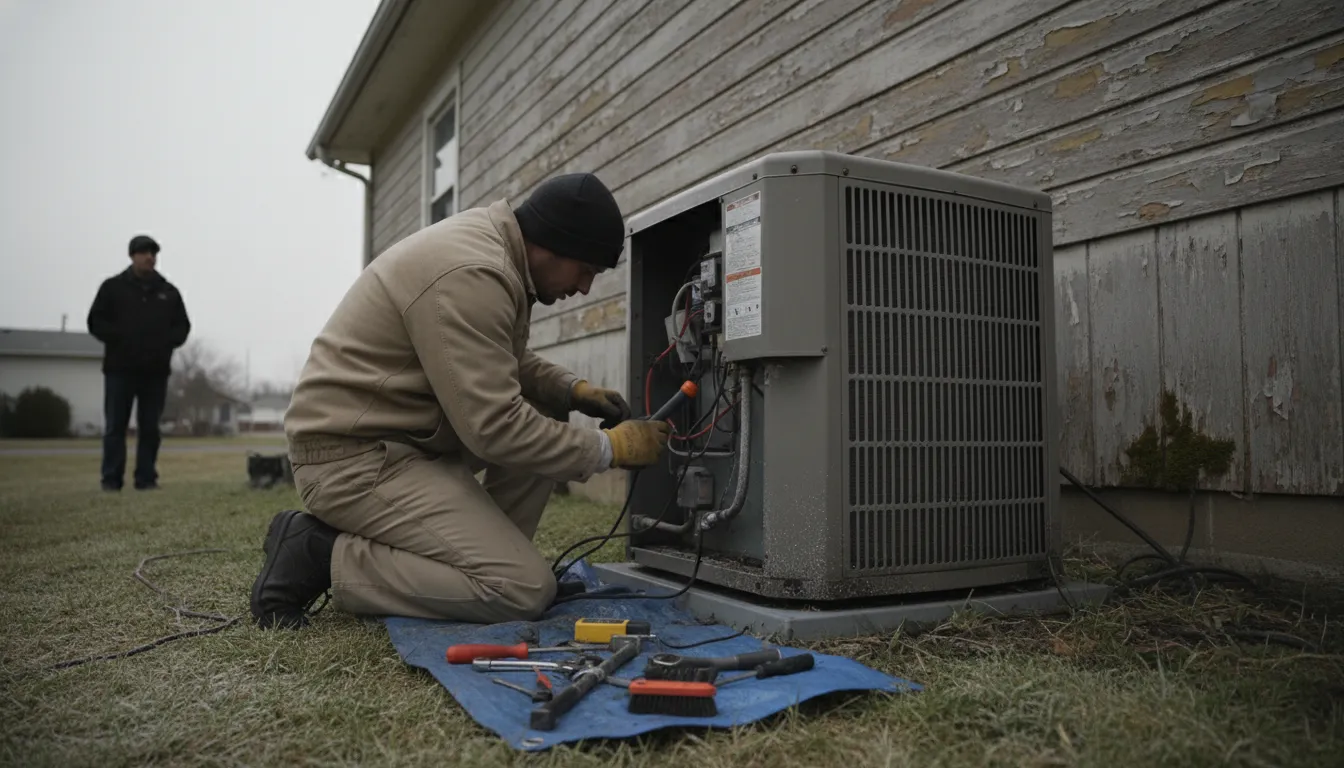
Find the Best Heat Pump Repair Contractors for Your Business
No obligation • Fast responses • Nationwide coverage

Why you can trust HVAC Firms
HVAC Firms is a leading United States resource for evaluating HVAC service providers. Our team researches companies, checks credentials, and reviews customer feedback to present clear, unbiased information. Listings and rankings are based on merit, and companies cannot pay to change our editorial content.
Search providers near you
Top Heat Pump Repair Contractors in Taylor, Michigan Ranked
When your heat pump starts blowing cold air in winter or struggling to cool in summer, you need a reliable local technician who can diagnose and fix the issue quickly. Heat pump service is essential for maintaining year-round comfort and energy efficiency in your Taylor home. This guide will help you understand common problems, typical repair processes, and how to connect with qualified professionals in the Downriver area to get your system running smoothly again.
Downriver Climate Control, LLC
3336 Charles St, Trenton, MI 48183
Downriver Climate Control, LLC provides heating, ventilation, and air conditioning services in Detroit, MI. They offer installation, repair, and maintenance for air conditioners, furnaces, heat pumps, and boilers. The company also focuses on improving indoor air quality. Their experienced team serves residential and commercial customers with personalized HVAC solutions.
Airman Heat & Air LLC
5129 8 Mile Rd, Warren, MI 48091
Airman Heat & Air LLC is a family-owned HVAC company serving Detroit, MI. They provide residential and commercial heating and cooling services, including installation and repair of air conditioners, furnaces, and heat pumps. The company uses factory-authorized brand name equipment and offers a labor warranty alongside the manufacturer's warranty. Established in 2001, Airman Heat & Air LLC emphasizes professionalism and a personalized approach to customer service.
Quality Air Control Heating & Cooling
18421 Valleyview St, Riverview, MI 48193
Quality Air Control Heating & Cooling is an HVAC company based in Detroit, MI, serving Downriver, Wayne County, and nearby areas. They offer a full range of heating and cooling services including AC repair and installation, furnace repair and installation, heat pump repair, mini split installation, duct cleaning, and indoor air quality solutions. With over 20 years of experience, the company handles both residential and commercial projects and is licensed, insured, and EPA certified.
Temperature Repair
Detroit, MI
Temperature Repair is an HVAC contractor based in Detroit, MI, serving Troy and nearby communities. They provide a range of heating and cooling services including AC repair, furnace repair and installation, heat pump repair, thermostat installation, HVAC tune-ups, and indoor air quality improvements. The company supports central air, ductless systems, and high-efficiency units to help maintain home comfort and safety throughout the year.
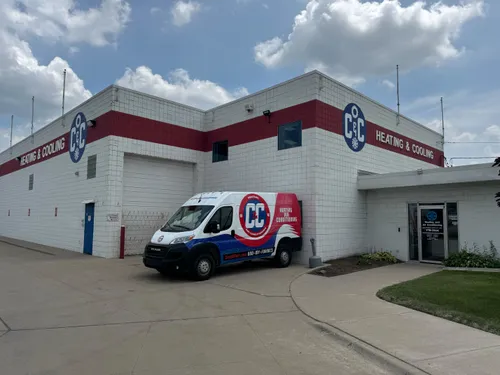
C & C Heating & Air Conditioning
29420 Groesbeck Hwy, Roseville, MI 48066
C & C Heating & Air Conditioning is an HVAC company based in Detroit, MI, offering a full range of heating and cooling services. They install and repair air conditioners, furnaces, heat pumps, and indoor air quality products from major manufacturers like Carrier, Lennox, and Trane. The company also provides humidifiers, generators, hot water heaters, and advanced air purification systems including UV lamps and germicidal lights. Their technicians are trained to handle installation and repair for all makes and models, ensuring comprehensive indoor air control solutions.
Understanding Your Heat Pump System
A heat pump is a versatile HVAC system that provides both heating and cooling by transferring heat rather than generating it. In heating mode, it extracts warmth from the outside air (even in cold weather) and moves it indoors. In cooling mode, it reverses the process, acting like an air conditioner by removing heat from your home. This dual functionality makes regular maintenance and prompt repair critical for system longevity and performance.
Common Heat Pump Issues in Taylor Homes
Taylor's climate, with its cold winters and humid summers, puts consistent demand on heat pumps. Being aware of frequent malfunctions can help you identify problems early.
System Blows Cold Air in Heat Mode
This is one of the most common complaints during Michigan winters. The issue is often less severe than it seems. Potential causes include:
- Dirty Air Filter: A clogged filter severely restricts airflow, causing the system to overheat and shut down the heating function as a safety measure.
- Low Refrigerant Charge: Refrigerant is the lifeblood of the heat transfer process. A leak can lead to insufficient pressure, preventing the system from absorbing enough heat from the outdoors.
- Faulty Reversing Valve: This component is responsible for switching the system between heating and cooling cycles. If it's stuck or fails, the pump may run in the wrong mode.
- Electrical Issues: Problems with capacitors, contactors, or the thermostat can disrupt the signal to initiate the heating cycle.
Icing or Freezing on Coils
Ice buildup on the indoor or outdoor unit is a clear sign of trouble. While a brief frost during defrost cycles is normal, persistent ice indicates:
- Restricted Airflow: Again, a dirty filter, blocked vents, or a failing indoor blower motor can cause coils to freeze.
- Refrigerant Leak: Low refrigerant pressure causes a drop in coil temperature, leading to condensation freezing on contact.
- Outdoor Unit Issues: Debris like leaves or grass clippings blocking the outdoor coil, or a faulty fan motor, can prevent proper heat exchange and cause freezing.
Short Cycling or Continuous Running
If your system turns on and off every few minutes (short cycling) or never seems to reach the set temperature and runs constantly, it's working inefficiently.
- Thermostat Problems: Incorrect calibration or placement can cause inaccurate temperature readings.
- Electrical Component Failure: A weak run capacitor can prevent the compressor or fan motor from starting properly, leading to rapid safety shut-offs.
- Refrigerant Issues: Both overcharging and undercharging the system can lead to improper pressure and temperature control, causing abnormal run cycles.
Unusual Noises or Odors
Strange sounds or smells are never a good sign and warrant immediate attention.
- Grinding or Squealing: Often points to a worn-out blower motor or fan motor bearings in need of replacement.
- Hissing or Bubbling: This can be the sound of refrigerant escaping from a leak.
- Burning or Electrical Smell: Could indicate an overheating motor, melted wiring, or an electrical short within the system.
The Professional Heat Pump Repair Process
When you call a technician for heat pump service in Taylor, they follow a systematic approach to diagnose and resolve your issue.
1. Initial Consultation and System Check: The technician will start by asking about the symptoms and checking the basics, including your thermostat settings and the condition of the air filter.
2. Visual Inspection: A thorough examination of both the indoor air handler and the outdoor condenser unit looks for obvious signs of damage, ice accumulation, debris blockage, or corrosion.
3. Electrical Diagnostics: Using a multimeter, the tech will test vital electrical components for proper operation. This includes capacitors (which help motors start and run), contactors (which engage the compressor and fan), relays, wiring connections, and the system control board.
4. Refrigerant System Evaluation: The technician will connect manifold gauges to measure the system's high and low-side pressures. Abnormal pressures can indicate a leak, a blockage, or a compressor problem. If a leak is suspected, they may use a electronic leak detector or UV dye to locate it.
5. Airflow and Mechanical Testing: The indoor coil and blower assembly are inspected for dirt buildup. The blower fan and outdoor fan motor are checked for proper operation and amp draw. The compressor, the heart of the system, is tested for electrical integrity and mechanical function 1 2.
6. Repair and Verification: Once the problem is identified, the technician will explain the needed repairs, provide an estimate, and replace the faulty parts. After repairs, they will reassemble the unit, restore power, and test the system in both heating and cooling modes to ensure it operates correctly and efficiently.
Find the perfect heat pump repair contractors for your needs
Get personalized recommendations and expert advice
What to Expect: Repair Timelines and Costs
Understanding potential timelines and investments can help you plan when a heat pump problem arises.
How Long Do Repairs Take?
- Diagnosis & Simple Fixes: A service call for troubleshooting and a minor repair like replacing a dirty filter or resetting a tripped breaker typically takes 1-2 hours.
- Standard Component Replacement: Swapping out a failed capacitor, contactor, or thermostat usually requires 1-3 hours on site.
- Major Repairs: Jobs like replacing a compressor, fixing a refrigerant leak, or installing a new reversing valve are more complex. The repair itself may take a full day or longer, and there can be additional delays if special-order parts are required 3 4.
Heat Pump Repair Cost Considerations in Taylor
Repair costs depend on the part needed and the labor involved. Many companies charge a diagnostic fee (typically $75 - $150), which is often waived if you proceed with the repair.
- Capacitor Replacement: One of the most common repairs, costing between $150 and $350 for parts and labor.
- Fan Motor Repair: Replacing an indoor blower motor or outdoor fan motor is more involved, generally ranging from $300 to $800+5.
- Reversing Valve Replacement: This is a labor-intensive repair due to its location within the refrigerant circuit, often costing $500 to $1,000 or more.
- Refrigerant Leak Repair and Recharge: The cost here varies widely based on the leak's location and the type of refrigerant. Expect a range of $200 to $600+, which includes finding the leak, repairing it, and recharging the system to the correct level 6 7 8.
The Critical Role of Annual Maintenance
The best way to avoid unexpected repair bills and extend the life of your heat pump is through professional preventative maintenance. An annual tune-up performed in the spring or fall typically includes:
- Cleaning indoor and outdoor coils.
- Checking and tightening electrical connections.
- Testing system pressures and refrigerant charge.
- Lubricating moving parts (if applicable).
- Inspecting ductwork, filters, and thermostat operation. Regular maintenance not only prevents up to 95% of common breakdowns but also keeps your system running at peak efficiency, lowering your energy bills 9 10 11. With proper care, a well-installed heat pump can last 10 to 15 years or more 12.
Frequently asked questions
Sources
Footnotes
-
Heat Pump Maintenance: How To Properly Service A Heat Pump - https://aquariushomeservices.com/blog/heat-pump-maintenance/ ↩
-
10 Things That Should be Included in a Heat Pump Inspection - https://iaqcolorado.com/blog/10-things-that-should-be-included-in-a-heat-pump-inspection/ ↩
-
Heat Pump & HVAC Maintenance Auckland | AC Repair Services - EPS - https://epservices.co.nz/electrical-services/heat-pump-repairs/ ↩
-
Servicing your heat pump | Daikin - https://www.daikin.co.uk/en_gb/residential/inspiration/articles/servicing-your-heat-pump.html ↩
-
What is the Average Heat Pump Repair Cost? - Dick Ray - https://dickray.com/what-is-the-average-heat-pump-repair-cost-kansas-city/ ↩
-
Heat Pump Repair and Installation Taylor - https://www.lewisheatingandcooling.com/webapp/p/625/heat-pump ↩
-
Heat Pump Replacement Taylor MI - R&L Heating and Cooling - https://www.rlheating.com/heat-pump-replacement ↩
-
Heat Pumps | Service Professor - https://www.serviceprofessor.com/heat-pumps/ ↩
-
What Are Common Problems With Heat Pumps? Find Solutions - https://totalcomfortcooling.com/essential-guide-to-common-heat-pump-problems-and-their-solutions/ ↩
-
Operating and Maintaining Your Heat Pump | Department of Energy - https://www.energy.gov/energysaver/operating-and-maintaining-your-heat-pump ↩
-
My Heat Pump Isn't Heating: A Homeowner's Troubleshooting Guide - https://www.southern-air.com/blog/heat-pump-not-heating ↩
-
How Long Do Heat Pumps Last? - Trane® - https://www.trane.com/residential/en/resources/troubleshooting/heat-pumps/how-long-do-heat-pumps-last/ ↩