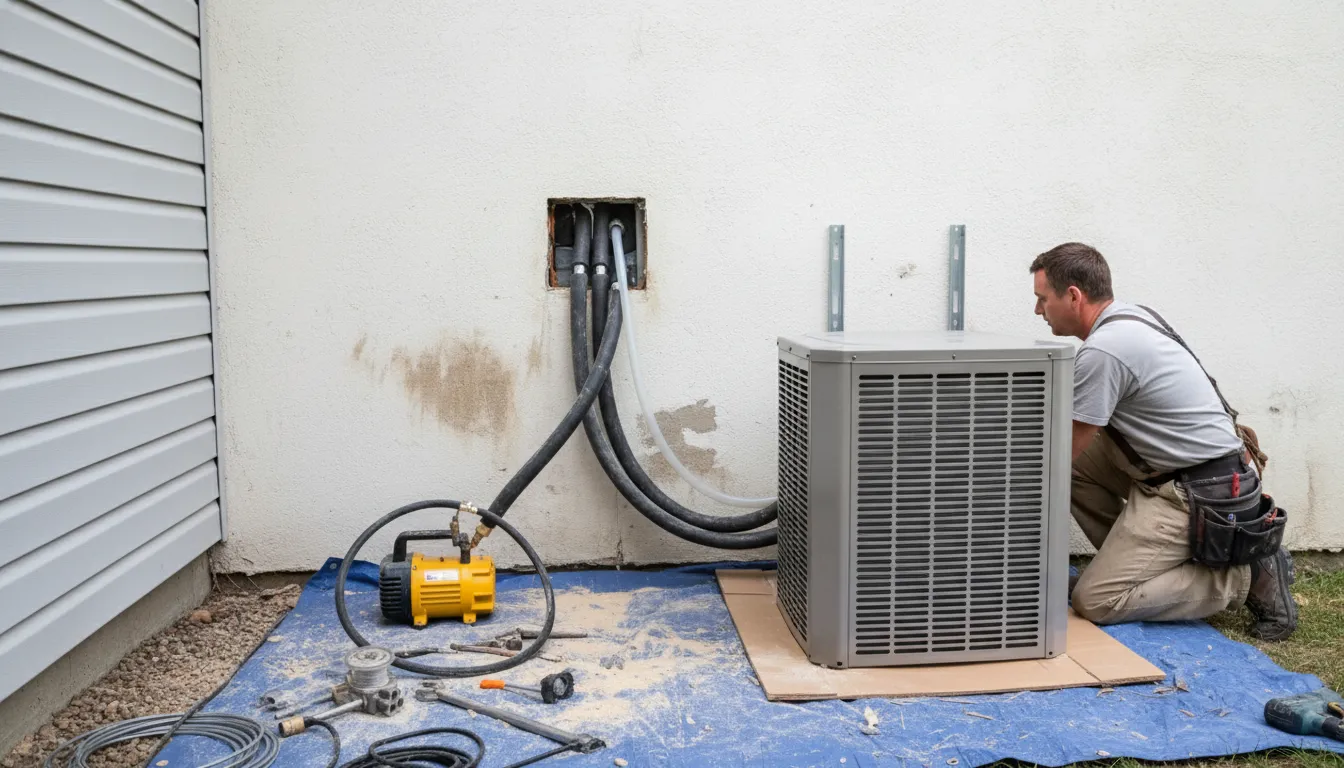
Find the Best Heat Pump Installation & Replacement Contractors for Your Business
No obligation • Fast responses • Nationwide coverage

Why you can trust HVAC Firms
HVAC Firms is a leading United States resource for evaluating HVAC service providers. Our team researches companies, checks credentials, and reviews customer feedback to present clear, unbiased information. Listings and rankings are based on merit, and companies cannot pay to change our editorial content.
Search providers near you
Top Heat Pump Installation & Replacement Contractors in Nashville, Tennessee Ranked
Upgrading your home's heating and cooling system with a heat pump is a smart investment for Nashville homeowners. These versatile systems provide efficient, all-in-one climate control, which is ideal for Middle Tennessee's moderate but variable weather. This guide will help you understand your options, from standard air-source units to advanced geothermal systems, and how to navigate local incentives to find the right professional for your installation or replacement project.
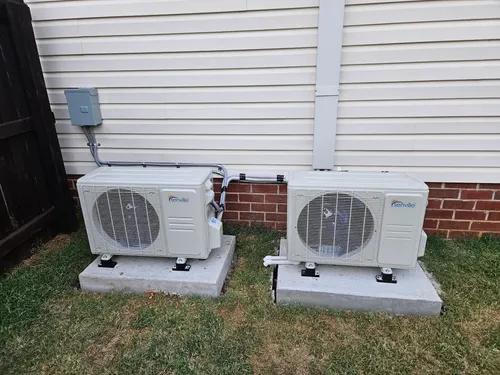
Right Time HVAC
5300 Old Hickory Blvd, Nashville, TN 37218
Right Time HVAC is a full-service heating, cooling, and geothermal contractor serving Nashville, TN. They offer installation, repair, and maintenance for air conditioners, furnaces, heat pumps, and geothermal systems, along with indoor air quality solutions for homes and businesses. The company specializes in advanced HVAC technologies including hydronics and inverter systems, and provides ductwork services to improve airflow and comfort. With over 30 years of combined experience among their technicians, Right Time HVAC focuses on honest, customer-focused solutions to meet diverse home comfort needs.
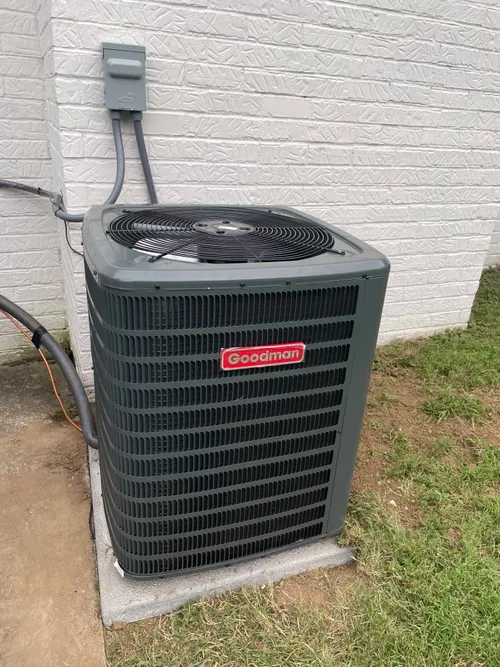
Bradley Maintenance & Air LLC
Nashville, TN
Bradley Maintenance & Air LLC is an HVAC and plumbing contractor serving Nashville, TN, and nearby areas including Brentwood, Antioch, and Murfreesboro. They provide HVAC maintenance, repair, and system changeouts, along with plumbing services such as water heater installation and repair. Their services cover air conditioning, furnace, heat pump installation, and tune-ups to maintain home and business comfort throughout the year.
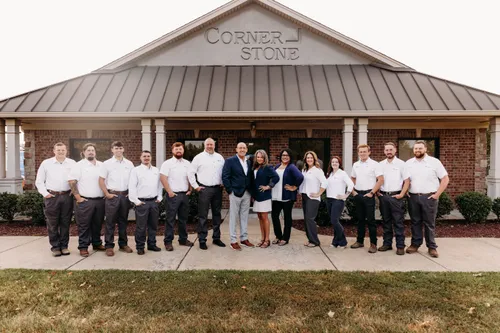
Petitt Heating and Cooling
127 Raymond Hirsch Pkwy, White House, TN 37188
Petitt Heating and Cooling is an HVAC company serving White House, TN, and nearby areas including Goodlettsville and Hendersonville. They provide a range of heating and cooling services such as air conditioning installation, furnace repair, heat pump installation, and HVAC tune-ups. The company also offers indoor air quality solutions like UV light air purification, advanced air filtration systems, dehumidifiers, humidifiers, and crawl space encapsulation. Petitt Heating and Cooling installs attic solar fans and gas logs to improve home comfort and energy efficiency. They provide emergency AC repairs after hours and have a maintenance plan with priority emergency service and no overtime charges.
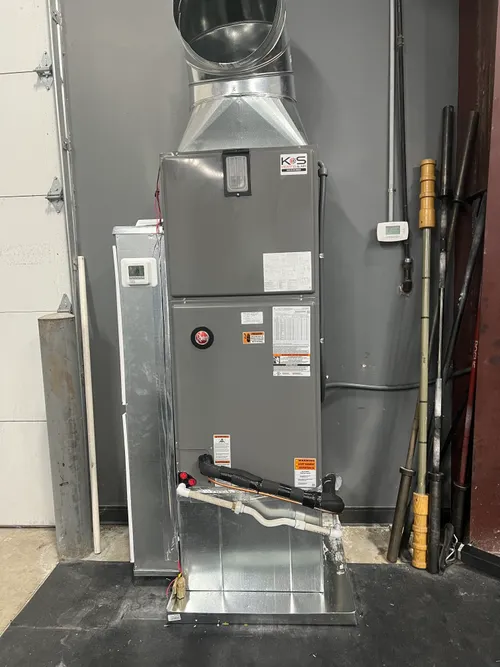
KandS HVAC
2055 Holloway Rd, Lebanon, TN 37090
KandS HVAC is an HVAC company based in Nashville, TN, providing repair, installation, and maintenance services for air conditioning, furnaces, heat pumps, and boilers. They offer convenient options for obtaining quotes, including in-home visits and remote assessments using photos. KandS HVAC handles a range of services from urgent repairs to routine tune-ups and new system installations, aiming to meet various heating and cooling needs efficiently.
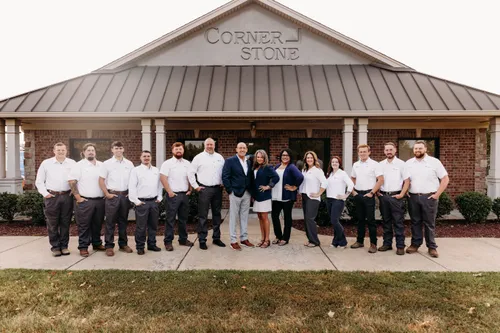
Petitt Heating and Cooling
1007 Lavern Cir, Hendersonville, TN 37075
Petitt Heating and Cooling is an HVAC company serving Nashville, TN, and surrounding areas including Hendersonville. They provide a range of heating and cooling services such as air conditioning installation and repair, furnace and heat pump installation, HVAC tune-ups, and indoor air quality solutions. Their capabilities include installing attic solar fans, gas log fireplaces, UV light air purification systems, dehumidifiers, humidifiers, air filtration systems, and crawl space encapsulation. Petitt Heating and Cooling offers maintenance plans and flexible financing options to support ongoing home comfort and system upkeep.
Understanding Heat Pump Technology for Nashville Homes
A heat pump is an energy-efficient HVAC system that moves heat rather than generating it. In the summer, it acts like an air conditioner, extracting heat from inside your home and releasing it outdoors. In the winter, the process reverses, pulling ambient heat from the outside air (or ground) and transferring it indoors to warm your living spaces. This dual functionality makes a heat pump installation a comprehensive solution for year-round comfort in Nashville.
The primary appeal of a heat pump replacement or new installation is efficiency. Because they transfer existing heat, they can deliver over three times more heating energy than the electrical energy they consume, especially in our region's temperate climate. This can lead to significant savings on utility bills compared to traditional furnaces and air conditioners.
Types of Heat Pump Systems
Choosing the right system type is the first critical step in your project. The three main categories each have distinct advantages and cost implications.
Air-Source Heat Pumps
This is the most common and widely installed type. An air-source system uses an outdoor unit (similar to a central AC condenser) paired with an indoor coil and air handler. It's an excellent choice for homes with existing ductwork looking to replace both a furnace and an air conditioner with one unified system. Modern, high-efficiency models perform well in Nashville's climate, though their capacity decreases as outdoor temperatures drop significantly.
Ductless Mini-Split Heat Pumps
For homes without ductwork, like older historic properties, additions, sunrooms, or for creating independent temperature zones, ductless mini-splits are ideal. These systems involve one or more quiet, wall-mounted indoor units connected to a single outdoor compressor via a small refrigerant line. They offer exceptional flexibility and efficiency because you can heat or cool only the rooms you're using. This zoning capability can prevent the common issue of uneven temperatures in multi-story Nashville homes.
Geothermal (Ground-Source) Heat Pumps
Geothermal systems offer the highest efficiency and longest lifespan by leveraging the earth's stable underground temperature. Instead of exchanging heat with the outside air, a loop system buried in your yard exchanges heat with the ground. While the upfront installation cost is considerably higher due to the required excavation or drilling, the operational savings are substantial, and they provide incredibly consistent performance regardless of air temperature 1. They are a premium, long-term investment in home comfort and efficiency.
Climate Considerations for Middle Tennessee
Nashville's climate is generally well-suited for heat pump operation. With average winter lows in the 30s°F and summer highs in the 90s°F, a properly sized system can handle most of the year with high efficiency 2. However, it's crucial to understand that standard air-source heat pumps lose heating capacity as the mercury dips below approximately 40°F. At this point, the system will engage an auxiliary or "backup" heat source-typically electric resistance strips-to meet your thermostat's demand.
This is a key design consideration. A correctly sized system and a well-insulated home will minimize the use of this less-efficient backup heat, keeping your winter energy bills in check. For those concerned about cold-weather performance, some newer models are specifically designed as "cold climate heat pumps" that maintain better efficiency at lower temperatures.
Evaluating Costs and Incentives
The total investment for a heat pump installation varies widely based on system type, size, home layout, and the complexity of the installation work, such as modifying existing ductwork.
- Standard Air-Source System: For a complete replacement in a typical ducted home, homeowners can expect a range of roughly $5,000 to $10,000 or more3 4. The final price depends on the system's efficiency rating (SEER2 for cooling, HSPF for heating) and capacity.
- Ductless Mini-Split System: A single-zone system for one room typically costs between $5,400 and $8,5005. A multi-zone system to cover an entire home can range from $10,000 to $25,000+6.
- Geothermal System: Given the ground loop installation, these are the most expensive upfront, often ranging from $18,000 to $40,000 or more7 8.
Find the perfect heat pump installation & replacement contractors for your needs
Get personalized recommendations and expert advice
Financial Incentives Can Lower Your Net Cost
Fortunately, significant incentives are available to Nashville residents, which can dramatically reduce the net cost of a high-efficiency system.
- Federal Tax Credit: The Inflation Reduction Act provides a tax credit of up to $2,000 for the installation of a qualifying heat pump 9 10. This is a direct dollar-for-dollar reduction of your tax liability.
- TVA & Local Utility Rebates: The Tennessee Valley Authority (TVA), in partnership with local power companies like Nashville Electric Service (NES), often offers substantial instant rebates for upgrading to high-efficiency heat pumps. These can range from $2,000 to $4,000 or more and are applied directly at the point of sale 11.
- Property Tax Relief: The City of Nashville may offer property tax abatement for certain energy-efficient home improvements, potentially including qualifying heat pump installations.
Key Takeaway: Always ask your contractor for a detailed breakdown of all available rebates and tax credits for the models they quote. The most expensive system upfront could have the lowest net cost after incentives.
The Installation Process and Choosing a Provider
A successful heat pump installation is more than just equipment swap. It involves a detailed home evaluation, correct sizing (Manual J calculation), and quality craftsmanship.
- Home Assessment: A reputable provider will inspect your home's insulation, windows, ductwork (if applicable), and electrical service to determine the correct system size and type.
- System Sizing: An oversized system will short-cycle, wasting energy and failing to dehumidify properly. An undersized system will struggle to maintain temperature. Proper sizing is non-negotiable for efficiency and comfort 12.
- Quality Installation: The manufacturer's rated efficiency can only be achieved with a precision installation. This includes proper refrigerant charging, secure duct sealing (for ducted systems), and correct electrical connections.
When seeking quotes, look for licensed, insured, and NATE-certified technicians with strong local references specifically for heat pump work. Be wary of quotes given over the phone without a site visit. Compare not only the bottom-line price but also the proposed equipment's efficiency ratings, warranty terms, and the contractor's reputation for service.
Maximizing Your Investment
To get the most from your new heat pump system, consider these final tips:
- Pair with a Smart Thermostat: A programmable or smart thermostat can optimize your system's schedule, further enhancing savings.
- Maintain Your System: Commit to annual professional maintenance. A spring tune-up for cooling and a fall check for heating will keep the system running at peak efficiency and prevent costly repairs.
- Address Home Envelope Issues: Sealing air leaks and adding insulation in your attic and crawl space will reduce the workload on your new heat pump, lowering bills and improving comfort.
Frequently asked questions
Sources
Footnotes
-
The Impact of Tennessee's Climate on HVAC System Design - https://wondercooling.com/tennessee-climate-hvac-solutions/ ↩
-
Heat Pumps & Outside Weather | Middle Tennessee Electric - https://mte.com/cooperative/news-media/blog/heat-pumps-outside-weather ↩
-
How much does it cost for a heat pump - Comfort Temp - https://comforttemp.com/how-much-does-it-cost-for-a-heat-pump/ ↩
-
Heat Pump Installation and Replacement in Nashville, TN - https://universalhtgclg.com/heating/heat-pump-install ↩
-
Cost of a Heat Pump Installation in 2025 - https://www.cabshvac.com/heat-pump-installation-cost/ ↩
-
2026 Heat Pump Cost Guide: Purchase, Installation & Repair - https://www.carrier.com/residential/en/us/products/heat-pumps/how-much-does-a-heat-pump-cost/ ↩
-
Understanding Geothermal HVAC Cost in Middle Tennessee - https://www.righttimehvac.com/geothermal-hvac-cost/ ↩
-
HVAC Installation Costs and Breakdowns - https://tmcservice.com/hvac-installation-costs-and-breakdowns/ ↩
-
Choosing the Right Heat Pump for Older Tennessee Homes - https://www.griffin-mechanical.com/blog/2025/october/choosing-the-right-heat-pump-for-older-tennessee/ ↩
-
Heat Pump vs Furnace: Choose the Best Way to Heat Your Home - https://www.hoffmannbros.com/nashville/hvac/heat-pump-vs-furnace ↩
-
Heat Pump Installation Nashville, TN - Hoffmann Brothers - https://www.hoffmannbros.com/nashville/hvac/heat-pump/installation ↩
-
How Much Do Heat Pumps Cost? (2024 Price Estimate Guide) - https://jarboes.com/knowledge-center/how-much-do-heat-pumps-cost/ ↩