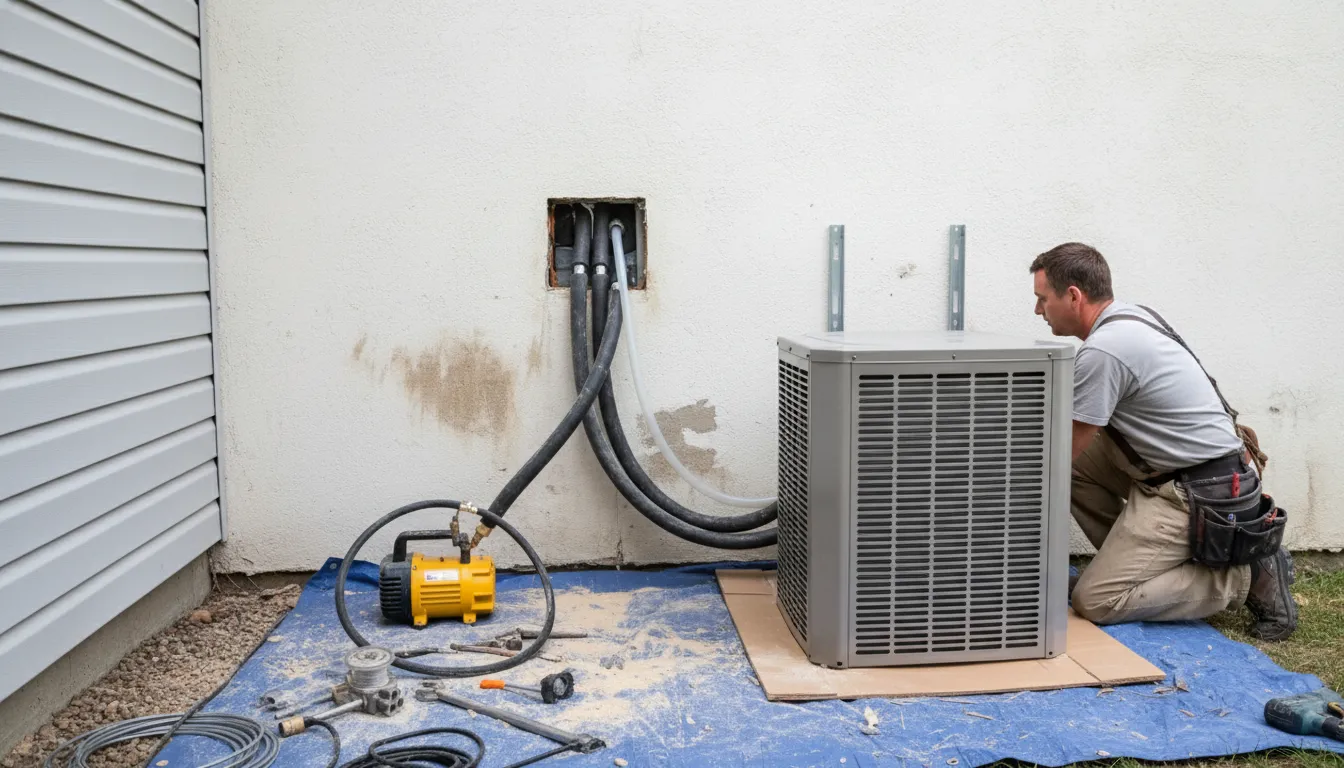
Find the Best Heat Pump Installation & Replacement Contractors for Your Business
No obligation • Fast responses • Nationwide coverage

Why you can trust HVAC Firms
HVAC Firms is a leading United States resource for evaluating HVAC service providers. Our team researches companies, checks credentials, and reviews customer feedback to present clear, unbiased information. Listings and rankings are based on merit, and companies cannot pay to change our editorial content.
Search providers near you
Top Heat Pump Installation & Replacement Contractors in New York, New York Ranked
Upgrading your home's heating and cooling system with a heat pump is a smart move for New York City residents looking for year-round comfort, lower energy bills, and a reduced carbon footprint. Unlike traditional furnaces and air conditioners, a heat pump transfers heat rather than generating it, making it exceptionally efficient for both warming your home in winter and cooling it in summer. For NYC's specific climate, choosing the right cold-climate model and a qualified installer is crucial to maximize performance and savings. This guide will help you understand your options, the associated costs, and the significant incentives available to make your upgrade more affordable.
KOKA-TECH HVAC INC
60-21 Menahan St, Ridgewood, NY 11385
KOKA-TECH HVAC INC provides professional heating and cooling services in New York, NY, including installation, repair, and tune-ups for air conditioners, furnaces, heat pumps, boilers, and mini splits. They offer 24/7 emergency support and same-day availability, serving Queens, Brooklyn, Manhattan, Bronx, and Long Island. The company is licensed and insured, with a strong local presence and expertise in NYC buildings. With nearly 300 five-star reviews, KOKA-TECH HVAC INC is recognized for upfront quotes and customer approval before starting work.
Air Cubes HVAC
2431 Dorchester Rd, Union, NJ 07083
Air Cubes HVAC is a family-owned HVAC contractor serving Newark, NJ, and surrounding areas in Essex, Hudson, Middlesex, and Union counties. They provide heating and air conditioning services including installation, repair, and maintenance for furnaces, air conditioners, heat pumps, and duct systems. The company is fully licensed and insured, with a master HVACR contractor leading the team. Air Cubes HVAC offers duct cleaning and HVAC tune-up services to help maintain system efficiency and comfort year-round.
Aeromark Mechanical Inc
153 Morgan St, Jersey City, NJ 07302
Aeromark Mechanical Inc provides residential and commercial HVAC services in New York, NY, and the surrounding Northern New Jersey area. They specialize in heating and air conditioning repair, installation, and maintenance, including heat pumps, ductless HVAC systems, and indoor air quality solutions. With over 15 years of experience, Aeromark Mechanical offers seasonal maintenance plans and has expertise in installing advanced systems like VRF and high-velocity HVAC. Their certified technicians also handle smart thermostat installations and duct repair services.
Energywise Inc
2231 5th Ave Suite 26, Ronkonkoma, NY 11779
Energywise Inc is an HVAC company based in New York, NY, specializing in heating and cooling solutions. They offer installation, repair, and maintenance services for a variety of systems including heat pumps, central air conditioning, ductless mini splits, geothermal systems, and traditional furnaces. Their factory-trained technicians provide expert guidance and personalized recommendations to optimize home comfort and energy efficiency. Energywise Inc emphasizes energy-efficient products and sustainable solutions to reduce environmental impact while maintaining reliable system performance. The company has decades of experience and provides 24/7 emergency repair services to address urgent heating or cooling issues promptly.
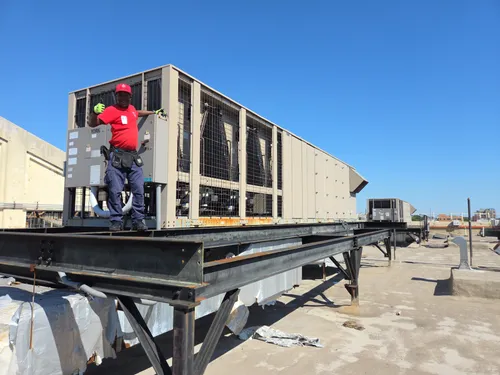
American HVAC Corp - Brooklyn, Heating, Air Conditioning, Refrigeration, Ductless Mini Split, Rooftop, Commercial HVAC NYC
77 Sands St 6th Floor, Brooklyn, NY 11201
American HVAC Corp - Brooklyn, Heating, Air Conditioning, Refrigeration, Ductless Mini Split, Rooftop, Commercial HVAC NYC provides HVAC repair, installation, and maintenance services in New York, NY. Their certified technicians handle a wide range of heating and air conditioning equipment, including furnaces, heat pumps, mini splits, and rooftop systems. The company serves numerous neighborhoods across Brooklyn and extends service to Queens, Manhattan, Staten Island, and The Bronx. They support various industries such as banks, data centers, educational institutions, and commercial office buildings. Their technicians are accredited by EPA and NATE, ensuring professional expertise.
Understanding Heat Pump Technology for NYC Homes
At its core, a heat pump is a versatile, all-in-one HVAC system. It works by moving thermal energy from one place to another. In the winter, it extracts heat from the outside air (or ground) and transfers it indoors. In the summer, it reverses the process, acting like an air conditioner by removing heat from your home. This transfer process is far more efficient than burning fuel to create heat, which is why modern heat pumps can be two to four times more efficient than traditional furnaces or baseboard heaters.
This efficiency translates directly to lower utility bills and reduced greenhouse gas emissions, especially when replacing oil or propane systems. For a dense, energy-conscious city like New York, adopting this technology is a key part of local and state sustainability goals.
Choosing the Right System Type for Your Building
Not all heat pumps are created equal, and New York's mix of historic brownstones, modern high-rises, and everything in between means the ideal system varies. The two primary categories are air-source and ground-source (geothermal) heat pumps.
Cold-Climate Air-Source Heat Pumps
This is the most common type installed in NYC. Modern "cold-climate" models are specifically engineered to extract heat efficiently from outdoor air even when temperatures drop well below freezing, making them suitable for our winters. They come in two main configurations:
- Ductless Mini-Split Systems: These are ideal for homes without existing ductwork, such as many older NYC apartments, brownstones, or for room additions. They consist of an outdoor compressor unit connected to one or more quiet, wall-mounted indoor air handlers. A key advantage is zoned heating and cooling, allowing you to control temperatures in individual rooms 1.
- Central Ducted Systems: If your home already has a functional duct system for forced-air heating or central air conditioning, a central heat pump can often utilize that infrastructure. This can be a more straightforward replacement for an old furnace and AC unit. However, existing ducts must be properly inspected, sealed, and sized to handle the new system's airflow requirements for optimal efficiency.
Geothermal (Ground-Source) Heat Pumps
Geothermal systems use the earth's stable underground temperature to heat and cool your home. They are the most efficient type of heat pump available and have the longest lifespan, but they require significant upfront investment. Installation involves burying loops of pipe underground, which can be challenging in a dense urban environment with limited yard space, though vertical boreholes are an option. The exceptional efficiency leads to the lowest operating costs over the system's life.
Key Performance Factors: Efficiency and Sizing
Selecting a high-efficiency model and ensuring it's correctly sized for your specific home are the two most important factors for success in our climate.
Efficiency Ratings to Look For
When comparing models, pay close attention to these ratings:
- SEER2 (Seasonal Energy Efficiency Ratio): Measures cooling efficiency. The higher the number, the more efficient the cooling.
- HSPF2 (Heating Seasonal Performance Factor): Measures heating efficiency. A higher HSPF2 is critical for New York winters.
For any system to be eligible for rebates, it must meet ENERGY STAR® requirements. As of 2023, the minimum for split-system heat pumps is 15.2 SEER2, 11.0 EER2, and 8.5 HSPF22. For the best performance in NYC, look for models that exceed these minimums, specifically those marketed as "cold-climate" with high HSPF2 ratings3.
The Critical Importance of Proper Sizing
A system that is too large will short-cycle (turn on and off frequently), leading to uneven temperatures, higher wear and tear, and reduced efficiency. One that is too small will struggle to keep your home comfortable during extreme cold or heat 4. Proper sizing, performed by a qualified contractor through a Manual J load calculation, takes into account your home's square footage, insulation levels, window quality, and air leakage. Never base your system size solely on the capacity of your old furnace or AC unit.
Find the perfect heat pump installation & replacement contractors for your needs
Get personalized recommendations and expert advice
Navigating Costs and Financial Incentives
The investment in a heat pump system is significant but is supported by some of the most generous incentives in the country, dramatically reducing the net cost.
Installation Cost Overview
Total costs in New York City can range widely, typically from $7,000 on the average end to over $25,000, depending on the system type, size, and complexity of the installation5 6.
- Ductless Mini-Split: Costs increase with the number of indoor "heads" (air handlers). A single-zone system for one room is on the lower end, while a multi-zone system for a whole home is higher.
- Central Ducted System: If existing ducts are in good shape, this can be a cost-effective solution. Installing new ductwork adds considerable expense.
- Geothermal System: Has the highest upfront cost due to the ground loop excavation or drilling required.
Available Rebates and Tax Credits
New York State and the federal government offer substantial financial assistance:
- NYS Clean Heat Program: This program offers point-of-sale rebates for installing qualifying heat pumps. Rebates can be up to $8,000 for the heat pump itself, with additional incentives for necessary upgrades like insulation or electrical panel work 7.
- Federal Tax Credits: The Inflation Reduction Act (IRA) provides a tax credit of 30% of the total installation cost, up to $2,000 per year8.
- Combined Savings: In many cases, homeowners can combine the NYSERDA rebate with the federal tax credit, significantly lowering the out-of-pocket expense. It's essential to work with a NYS Clean Heat participating contractor to access these rebates seamlessly.
The Installation Process: What to Expect
A professional installation is non-negotiable for performance and warranty validity. Here's what the process typically involves:
- Initial Consultation and Load Calculation: A reputable contractor will assess your home, discuss your needs, and perform the necessary calculations to determine the correct system size and type.
- Electrical Assessment: Heat pumps often have different electrical requirements than old systems. Your home may need an electrical service panel upgrade or new wiring, which your contractor should identify upfront9.
- Ductwork Evaluation (for central systems): Existing ducts will be inspected for leaks, proper sizing, and insulation. Sealing and insulating ducts is a common and recommended prerequisite10.
- Equipment Installation: The outdoor and indoor units are mounted, refrigerant lines and electrical connections are run, and the system is charged.
- Commissioning and Testing: The contractor will start the system, test all components, measure airflow, and ensure it is operating at peak efficiency before handing it over to you.