Find the Best Geothermal Heat Pump Contractors for Your Business
No obligation • Fast responses • Nationwide coverage

Why you can trust HVAC Firms
HVAC Firms is a leading United States resource for evaluating HVAC service providers. Our team researches companies, checks credentials, and reviews customer feedback to present clear, unbiased information. Listings and rankings are based on merit, and companies cannot pay to change our editorial content.
Search providers near you
Top Geothermal Heat Pump Contractors in Wayne, New Jersey Ranked
Geothermal heat pumps, also known as ground-source heat pumps, are a highly efficient method for heating and cooling your home by leveraging the stable temperatures found underground. For Wayne homeowners, this technology offers a path to significant energy savings, increased comfort, and reduced environmental impact. This guide explains how geothermal systems work, what installation entails locally, and how you can connect with qualified professionals in the area to explore this sustainable home comfort solution.
MDL Electric Cooling & Heating
4 Harrison Ave, West Orange, NJ 07052
MDL Electric Cooling & Heating is a family-owned company serving Newark, NJ, and the surrounding North Jersey area. With over 30 years of experience, they provide a wide range of HVAC and electrical services including installation, repair, and maintenance of air conditioning, furnaces, heat pumps, boilers, and geothermal heat pumps. Their team is EPA certified and offers advanced solutions such as inverter-driven compressors and natural gas conversions. MDL Electric Cooling & Heating is available 24/7 to support residential and commercial customers with licensed and trained technicians.
Geothermal Works, Inc.
New York, NY
Geothermal Works, Inc. is a geothermal heat pump contractor based in New York, NY. They specialize in installing efficient geothermal heating and cooling systems that transfer heat energy between the ground and buildings. This technology helps reduce energy use and environmental impact. The company shares extensive knowledge about geothermal systems and supports clients through the installation process.
Lightning Mechanical LLC
65 Newark Way, Maplewood, NJ 07040
Lightning Mechanical LLC is an HVAC service provider based in Newark, NJ, offering repair, installation, and maintenance for residential and commercial heating and cooling systems. They specialize in a wide range of equipment including air conditioners, furnaces, heat pumps, boilers, and Daikin VRV systems. The company fabricates custom sheet metal in-house and serves clients throughout the New York metro area, including Newark. Since 2005, Lightning Mechanical has provided factory-trained technicians skilled in servicing multiple HVAC brands and advanced systems like Variable Refrigerant Volume (VRV). They also offer rapid response teams for mission-critical facilities and maintain an extensive inventory of Daikin VRV parts for quick repairs.
How a Geothermal System Works
A geothermal heating and cooling system operates on a simple but brilliant principle: it exchanges heat with the earth, which maintains a remarkably constant temperature of approximately 55°F year-round just below the surface. This process involves three key components working in harmony.
First, a ground loop-a network of pipes buried in your yard-circulates a water-based fluid. In the winter, this fluid absorbs the earth's natural warmth. In the summer, the system reverses, drawing heat from your home and depositing it into the cooler ground. Second, a heat pump unit inside your home acts as a concentrator. It uses a refrigeration cycle to amplify the collected heat for warming your house or, in cooling mode, to transfer indoor heat into the loop fluid 1. Finally, the distribution system delivers the conditioned air through your existing ductwork or via a hydronic system like radiant floor heating.
Types of Ground Loops for Wayne Properties
Choosing the right type of ground loop is a critical decision that depends on your property's characteristics. In New Jersey, closed-loop systems are the most common due to state regulations and water resource considerations.
- Vertical Closed-Loop: This is often the preferred and most practical option for residential properties in suburban areas like Wayne, where lot sizes can be limited. Installers drill deep boreholes, typically 150 to 500 feet deep, and insert U-shaped high-density polyethylene (HDPE) pipes into each one. The vertical approach requires less horizontal land but involves specialized drilling equipment and specific licensing.
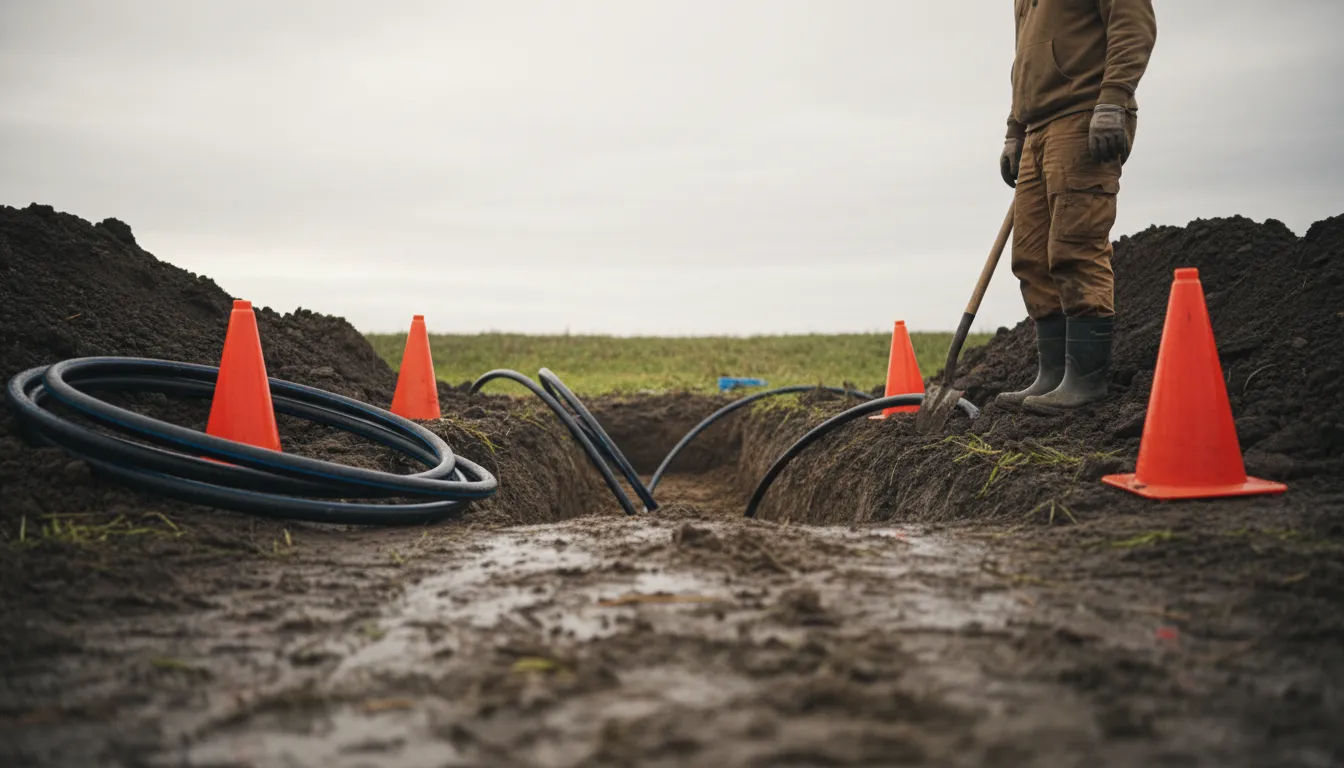
- Horizontal Closed-Loop: If you have ample yard space, a horizontal loop may be an option. Installers dig trenches several feet deep-often hundreds of feet long-and lay pipes in a serpentine pattern before backfilling 2 3. This method generally has lower excavation costs than vertical drilling but requires a significant amount of usable land.
- Open-Loop System: This system uses groundwater from a well as the direct heat exchange fluid. After passing through the heat pump, the water is returned to the ground via a discharge well or approved surface body of water. These systems are less common in New Jersey due to strict regulations concerning water quality, quantity, and discharge 4.
Local Installation Process and Regulations
Installing a geothermal system in Wayne is a significant project that requires careful planning and adherence to state and local codes. The process is typically managed by a certified installer and follows a structured path.
The journey begins with a detailed site assessment. A qualified installer will evaluate your property's soil composition, available space, and existing HVAC infrastructure to determine the feasibility and optimal design for your ground loop and heat pump system. A crucial early step is securing permits. For vertical ground-source heat pump systems, the installer must obtain a well construction permit from the New Jersey Department of Environmental Protection (NJDEP), as the boreholes are classified as closed-loop geothermal wells. Installers performing this work must hold the appropriate NJDEP license.
The physical installation starts with earthwork. For a vertical system, a drilling rig will create the necessary boreholes. For a horizontal system, a backhoe will dig the trenches. Next, the ground loop is installed. HDPE pipes are placed in the boreholes or trenches, connected into a continuous loop, pressure-tested, and filled with the heat-transfer fluid. Finally, the indoor components are set up. The geothermal heat pump unit is installed in your basement, garage, or mechanical closet and connected to your home's ductwork or radiant heating system. The loop is connected to the pump, and the entire system is charged, tested, and commissioned 5.
Find the perfect geothermal heat pump contractors for your needs
Get personalized recommendations and expert advice
Long-Term Value and Financial Considerations
While the upfront investment for a geothermal heating and cooling system is higher than for a conventional HVAC system, the long-term value proposition is compelling. The primary financial benefit comes from dramatically reduced operating costs. By using the earth's consistent temperature, geothermal heat pumps are extremely efficient, often achieving savings of up to 65% on heating and cooling bills compared to traditional systems 6 7.
This leads to a favorable payback period. Many homeowners find that the initial premium is offset by energy savings within 5 to 10 years, after which they enjoy decades of significantly lower utility bills 8 9. Furthermore, the system longevity is exceptional. The underground polyethylene piping is designed to last for more than 50 years, while the indoor heat pump unit typically has a lifespan of 20 years or more, which is often longer than conventional air conditioners and furnaces 9 10. It's also important to research available incentives. Federal tax credits, and sometimes state or local rebates, can substantially reduce the net installed cost, improving the overall economics.
Benefits Beyond Energy Savings
The advantages of a ground-source heat pump extend well beyond your monthly bill. These systems provide superior home comfort. They deliver steady, even heating and cooling without the drafts and temperature swings associated with fossil fuel systems, and they operate very quietly. From an environmental standpoint, geothermal systems have a minimal footprint. They use electricity to move heat rather than create it by burning fuel, which can drastically reduce your household's carbon emissions, especially when paired with renewable electricity 11.
For homeowners concerned with reliability and space, geothermal systems have fewer exposed outdoor components (like an AC condenser) that can be damaged by weather, and they free up yard space by being mostly underground. They also provide versatile domestic hot water generation. Many units can be equipped with a "desuperheater" that captures excess heat to preheat your home's water, saving additional energy year-round.
Finding the Right Professional in Wayne
Given the technical and regulatory complexity of geothermal installations, selecting the right contractor is paramount. Look for a provider with specific, proven experience in installing ground-source heat pumps, not just general HVAC work. They should be fully versed in NJDEP permitting and licensing requirements for well construction 12. A reputable installer will always start with a comprehensive load calculation and site evaluation, not a quick quote. They should be able to explain the pros and cons of different loop types for your specific property and provide clear, detailed proposals. Checking for certifications from organizations like the International Ground Source Heat Pump Association (IGSHPA) and reviewing local customer testimonials can also help you identify a trustworthy partner for this long-term home investment.
Frequently asked questions
Sources
Footnotes
-
NC Geothermal Heat Pumps - NJ Green Building Manual - https://greenmanual.rutgers.edu/nc-geothermal-energy-systems/ ↩
-
All You Need to Know About Home Geothermal Heating & ... - https://dandelionenergy.com/all-you-need-to-know-about-home-geothermal-heating-cooling ↩
-
Geothermal Installation Steps Explained - https://ultrageothermal.com/geothermal-installation-steps-explained/ ↩
-
What Is Geothermal Heating and How Does It Work? - https://www.aireserv.ca/about/blog/2020/march/what-is-geothermal-heating-and-how-does-it-work-/ ↩
-
NJDEP| Clean Buildings | GSHP - https://dep.nj.gov/cleanbuildings/gshp/ ↩
-
5 Things You Should Know about Geothermal Heat Pumps - https://www.energy.gov/cmei/articles/5-things-you-should-know-about-geothermal-heat-pumps ↩
-
Geothermal Heat Pumps - Department of Energy - https://www.energy.gov/energysaver/geothermal-heat-pumps ↩
-
Guide to Geothermal Heat Pumps - https://www.energy.gov/sites/prod/files/guide_to_geothermal_heat_pumps.pdf ↩
-
Geothermal Heat Pump Guide: Installation Costs, Types And Benefits - https://modernize.com/hvac/heating-repair-installation/heat-pump/geothermal ↩ ↩2
-
Geothermal Heat Pumps: How They Work and Benefits for Your ... - https://www.rbiva.com/resources/geothermal-heat-pumps-how-they-work-and-benefits/ ↩
-
Clean Energy | GSHP - NJDEP - https://dep.nj.gov/cleanenergy/technologies/gshp/ ↩
-
New Jersey Ground Source Heat Pump Baseline Report - https://dep.nj.gov/wp-content/uploads/cleanenergy/new-jersey-ground-source-heat-pump-baseline-report_final.pdf ↩