Find the Best Geothermal Heat Pump Contractors for Your Business
No obligation • Fast responses • Nationwide coverage

Why you can trust HVAC Firms
HVAC Firms is a leading United States resource for evaluating HVAC service providers. Our team researches companies, checks credentials, and reviews customer feedback to present clear, unbiased information. Listings and rankings are based on merit, and companies cannot pay to change our editorial content.
Search providers near you
Top Geothermal Heat Pump Contractors in Piscataway, New Jersey Ranked
Geothermal heat pumps, also known as ground-source heat pumps, offer a highly efficient way to heat and cool your Piscataway home by tapping into the stable temperatures underground. This technology matters because it can dramatically reduce energy bills and your household's carbon footprint, aligning with New Jersey's clean energy goals. This guide explains how these systems work, what installation involves, and how you can connect with qualified local specialists for your project.

MDL Electric Cooling & Heating
4 Harrison Ave, West Orange, NJ 07052
MDL Electric Cooling & Heating is a family-owned company serving Newark, NJ, and the surrounding North Jersey area. With over 30 years of experience, they provide a wide range of HVAC and electrical services including installation, repair, and maintenance of air conditioning, furnaces, heat pumps, boilers, and geothermal heat pumps. Their team is EPA certified and offers advanced solutions such as inverter-driven compressors and natural gas conversions. MDL Electric Cooling & Heating is available 24/7 to support residential and commercial customers with licensed and trained technicians.
Lightning Mechanical LLC
65 Newark Way, Maplewood, NJ 07040
Lightning Mechanical LLC is an HVAC service provider based in Newark, NJ, offering repair, installation, and maintenance for residential and commercial heating and cooling systems. They specialize in a wide range of equipment including air conditioners, furnaces, heat pumps, boilers, and Daikin VRV systems. The company fabricates custom sheet metal in-house and serves clients throughout the New York metro area, including Newark. Since 2005, Lightning Mechanical has provided factory-trained technicians skilled in servicing multiple HVAC brands and advanced systems like Variable Refrigerant Volume (VRV). They also offer rapid response teams for mission-critical facilities and maintain an extensive inventory of Daikin VRV parts for quick repairs.
How Geothermal Systems Work: The Basic Principle
The core concept behind a geothermal heating and cooling system is elegantly simple. Just a few feet below the surface, the earth maintains a nearly constant temperature between 50°F and 60°F year-round, regardless of the summer heat or winter chill above ground. A geothermal heat pump (GHP) leverages this stable resource as a source of heat in the winter and a place to dump excess heat in the summer.
Here's the process: A sealed loop of piping, buried in your yard, circulates a water-based fluid. In the winter, this fluid absorbs the earth's natural warmth and carries it to an indoor heat pump unit. The heat pump then concentrates this low-grade heat and distributes warm air throughout your home via your existing ductwork. In the summer, the system reverses, pulling heat from your home's air and transferring it into the cooler ground loop 1 2. Because the system is moving heat rather than generating it through combustion, it achieves remarkable efficiencies of 400-600% 3.
Types of Ground Loops for Piscataway Properties
The underground piping system, or "ground loop," is the heart of the installation. The right type for your home depends on your lot size, soil composition, and local geology. Most residential systems in New Jersey use closed-loop designs, where a mixture of water and antifreeze circulates through a continuous, sealed pipe.
- Vertical Closed Loops: This is often the ideal choice for smaller residential lots common in Piscataway. Contractors use a drilling rig to bore holes 150 to 450 feet deep. U-shaped pipes are inserted into these boreholes and connected at the bottom to form a loop. The holes are then filled with a special grout to enhance heat transfer and protect groundwater. Vertical systems have a smaller surface footprint but involve more specialized drilling equipment.
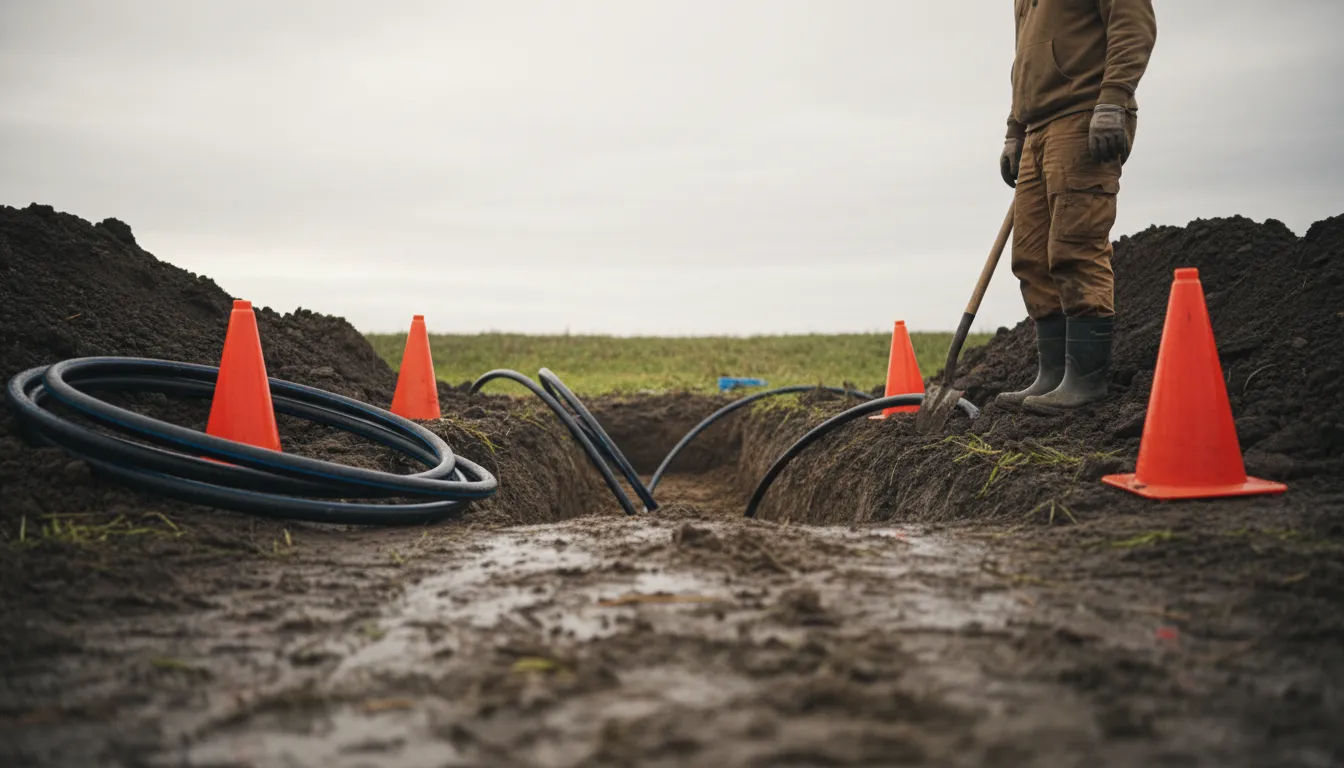
- Horizontal Closed Loops: If you have more available land, a horizontal loop may be an option. Trenches are dug about four to six feet deep, and pipes are laid in long coils or straight runs. This method typically requires more square footage of open land but can be less expensive than vertical drilling if the site conditions are suitable.
- Open-Loop Systems: These systems use groundwater from a well as the direct heat exchange fluid. After passing through the heat pump, the water is returned to the ground via a second well or discharged to a pond or stream. These are less common in New Jersey due to strict environmental regulations, water availability, and potential mineral content issues 4.
A professional site assessment is crucial to determine which loop configuration will deliver the best performance and value for your specific property.
The Installation Process: What to Expect
Installing a geothermal HVAC system is a significant project that requires careful planning and expert execution. Understanding the steps can help you prepare.
- Site Evaluation and Design: A qualified installer will assess your home's heating and cooling loads, inspect your property, and may conduct a soil thermal conductivity test. This information is used to design a correctly sized loop field and select the appropriate indoor heat pump unit.
- Loop Field Installation: For a vertical system, a drilling rig will create the necessary boreholes. For a horizontal system, a backhoe will dig the trenches. High-density polyethylene (HDPE) pipe, known for its durability and corrosion resistance, is then placed in the ground 5 6.
- Loop Connection and Grouting: The pipes from individual boreholes or trenches are connected to a manifold in a trench near the home. For vertical bores, the annulus around the pipe is filled with grout-a critical step for thermal performance and environmental protection 7.
- Indoor Unit Installation: The ground loop is connected to the indoor heat pump unit. This unit, which is typically quieter than a traditional furnace or air conditioner, is integrated with your home's ductwork or hydronic distribution system.
- System Charging and Startup: The loop is filled and purged of air, and the system is charged with refrigerant. The installer will then commission the system, ensuring all components work together efficiently and programming the thermostat for optimal operation.
Find the perfect geothermal heat pump contractors for your needs
Get personalized recommendations and expert advice
Benefits and Financial Considerations
The decision to invest in a geothermal system is driven by its compelling long-term benefits.
- Substantial Energy Savings: By harnessing the earth's free thermal energy, geothermal heat pumps can reduce energy consumption for heating, cooling, and even hot water production by up to 70% compared to conventional systems 8. This translates to significantly lower utility bills month after month.
- Environmental Impact: Geothermal systems run on electricity and have no on-site emissions. By reducing your reliance on fossil fuels, you directly lower your household's carbon footprint, contributing to cleaner air in New Jersey 9.
- Durability and Longevity: The underground loop is built to last, with a lifespan often exceeding 50 years. The indoor heat pump unit typically lasts 20-25 years, which is longer than the average lifespan of a standard air conditioner or furnace 10.
- Financial Payback and Incentives: While the upfront cost is higher than conventional systems, the dramatic energy savings lead to a typical payback period of 5 to 10 years 11 12. This timeline is greatly accelerated by federal incentives, including a 30% federal tax credit for qualified geothermal heat pump property 12 13. It's essential to check the current status and details of this credit with your installer or tax advisor.
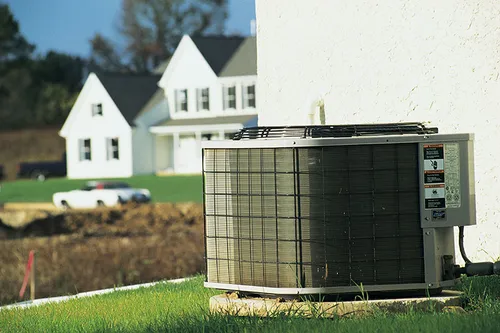
- Comfort and Quiet: These systems provide consistent, even heating and cooling without the blast of hot air or rush of cold air common with forced-air systems. The indoor units operate very quietly, and there is no noisy outdoor condenser unit.
Is a Geothermal System Right for Your Home?
Geothermal technology is a versatile solution, but its suitability depends on several factors. It works well for both new construction and retrofits, especially if you are already planning to replace an aging HVAC system. Homes with sufficient land for a horizontal loop or appropriate sub-surface conditions for vertical drilling are excellent candidates. Even homes on smaller lots can often accommodate a vertical loop system. The key is to consult with an experienced local installer who can provide a detailed analysis of your property's potential.
Frequently asked questions
Sources
Footnotes
-
How Does a Geothermal System Work? - ClimateMaster - https://www.climatemaster.com/homeowner/side-links/how-it-works ↩
-
How Geothermal Heat Pumps Work - https://www.youtube.com/watch?v=XxlTnBukweI&t=37 ↩
-
New Jersey Ground Source Heat Pump Baseline Report - https://dep.nj.gov/wp-content/uploads/cleanenergy/new-jersey-ground-source-heat-pump-baseline-report_final.pdf ↩
-
Geothermal Heating, Geothermal HVAC & Geothermal AC | Springdale, AR, Lowell, AR, Rogers, AR, Tontitown, AR, Johnson, AR & Elm Springs, AR - https://www.trinityhvacr.com/residential-services/geothermal/ ↩
-
NJDEP| Clean Buildings | GSHP - https://dep.nj.gov/cleanbuildings/gshp/ ↩
-
Geothermal heating & cooling, heat pumps, heat exchange ... - https://aztechgeo.com/residential-geothermal/how-it-works/ ↩
-
All You Need to Know About Home Geothermal Heating & ... - https://dandelionenergy.com/all-you-need-to-know-about-home-geothermal-heating-cooling ↩
-
How Does A Geothermal Heat Pump Work? Complete 2025 Guide - https://solartechonline.com/blog/how-does-geothermal-heat-pump-work/ ↩
-
Geothermal Heating and Cooling - https://geothermal.colorado.gov/geothermal-heating-and-cooling ↩
-
Guide to Geothermal Heat Pumps - https://www.energy.gov/sites/prod/files/guide_to_geothermal_heat_pumps.pdf ↩
-
Geothermal Heating & Cooling Systems in South Jersey - https://connmechanical.com/services/geothermal/ ↩
-
5 Things You Should Know about Geothermal Heat Pumps - https://www.energy.gov/cmei/articles/5-things-you-should-know-about-geothermal-heat-pumps ↩ ↩2
-
Geothermal Heating System in Southern New Jersey - https://foleymech.com/products-services/geothermal-heating/ ↩