Find the Best Geothermal Heat Pump Contractors for Your Business
No obligation • Fast responses • Nationwide coverage

Why you can trust HVAC Firms
HVAC Firms is a leading United States resource for evaluating HVAC service providers. Our team researches companies, checks credentials, and reviews customer feedback to present clear, unbiased information. Listings and rankings are based on merit, and companies cannot pay to change our editorial content.
Search providers near you
Top Geothermal Heat Pump Contractors in Perth Amboy, New Jersey Ranked
A geothermal heat pump is a highly efficient heating and cooling system that uses the Earth's constant underground temperature to regulate your home's climate. For Perth Amboy residents, this technology offers a path to significant energy savings and reduced environmental impact, especially when paired with New Jersey's clean energy incentives. This guide explains how these ground-source systems work, what installation entails locally, and how you can find experienced professionals to evaluate your property for this long-term investment.

MDL Electric Cooling & Heating
4 Harrison Ave, West Orange, NJ 07052
MDL Electric Cooling & Heating is a family-owned company serving Newark, NJ, and the surrounding North Jersey area. With over 30 years of experience, they provide a wide range of HVAC and electrical services including installation, repair, and maintenance of air conditioning, furnaces, heat pumps, boilers, and geothermal heat pumps. Their team is EPA certified and offers advanced solutions such as inverter-driven compressors and natural gas conversions. MDL Electric Cooling & Heating is available 24/7 to support residential and commercial customers with licensed and trained technicians.
Lightning Mechanical LLC
65 Newark Way, Maplewood, NJ 07040
Lightning Mechanical LLC is an HVAC service provider based in Newark, NJ, offering repair, installation, and maintenance for residential and commercial heating and cooling systems. They specialize in a wide range of equipment including air conditioners, furnaces, heat pumps, boilers, and Daikin VRV systems. The company fabricates custom sheet metal in-house and serves clients throughout the New York metro area, including Newark. Since 2005, Lightning Mechanical has provided factory-trained technicians skilled in servicing multiple HVAC brands and advanced systems like Variable Refrigerant Volume (VRV). They also offer rapid response teams for mission-critical facilities and maintain an extensive inventory of Daikin VRV parts for quick repairs.
How Geothermal Heating and Cooling Works
The principle behind a geothermal system, often called a ground-source heat pump (GSHP), is elegant in its simplicity. It leverages the fact that just a few feet below the surface, the Earth maintains a nearly constant temperature of approximately 55°F (12°C) year-round, regardless of the weather above ground 1.
- For Heating: During winter, a fluid (typically a water-antifreeze mixture) circulates through a loop of pipes buried underground, absorbing the Earth's stable warmth. This slightly warmed fluid is brought to an indoor heat pump unit, which concentrates the thermal energy and distributes it as warm air through your home's ductwork or as hot water through a radiant floor system 2.
- For Cooling: In the summer, the process reverses. The system extracts heat and humidity from your indoor air. This heat is transferred to the circulating fluid, which then travels into the underground loop where it is dissipated into the cooler earth. The result is efficient, dehumidified cooling for your home 3.
This exchange with the stable ground temperature is far more efficient than battling the extreme outdoor air temperatures, which is why geothermal heat pumps can achieve remarkable efficiency ratings.
Types of Ground Loops for Perth Amboy Properties
The underground pipe network, known as the ground heat exchanger or ground loop, is the core of the system. The right type for your Perth Amboy home depends on your lot size, soil composition, and local geology. The two primary categories are closed-loop and open-loop systems.
Closed-Loop Systems
This is the most common residential configuration. A sealed loop of high-density polyethylene pipe is buried and filled with an environmentally friendly antifreeze solution that circulates continuously.
- Vertical Closed-Loop: Ideal for smaller residential lots common in many Perth Amboy neighborhoods. Contractors drill boreholes 100 to 400 feet deep and insert U-shaped loops of pipe into each hole. This minimizes landscape disturbance but involves specialized drilling equipment.
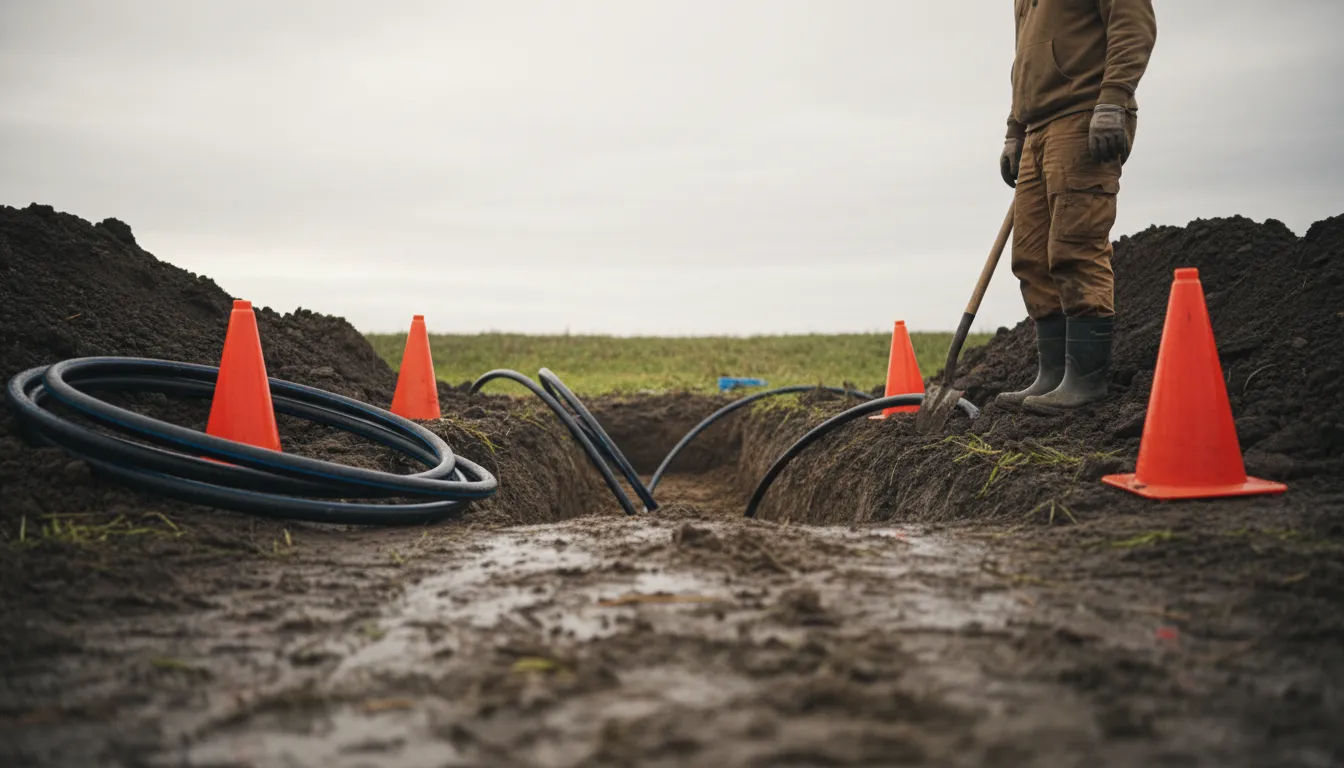
- Horizontal Closed-Loop: A cost-effective option if you have sufficient yard space. Contractors dig trenches about six feet deep and hundreds of feet long, laying the pipe loops in them before backfilling. This method requires more horizontal space but can be less expensive than drilling.
Open-Loop Systems
This system uses groundwater from a well or a suitable surface water body as the heat exchange fluid. After passing through the heat pump, the water is returned to a second well, a recharge basin, or the original body of water (where permitted) 4. While often lower in installation cost, open-loop systems require an adequate supply of clean water, are subject to more regulatory permits, and require careful maintenance to prevent scaling or corrosion 5.
Key Components of a Geothermal System
Understanding the main parts of a geothermal installation helps clarify the scope of the project:
- Ground Heat Exchanger: This is the buried loop field (vertical or horizontal) and represents the most significant portion of the installation work and upfront cost 6 7.
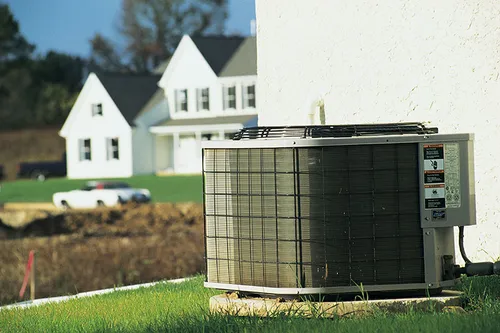
- The Heat Pump Unit: This indoor cabinet contains the compressor, heat exchanger, and controls. It is comparable in size to a traditional furnace.
- The Distribution System: This is how conditioned air or water is delivered throughout your home. Most systems use existing forced-air ductwork. Alternatively, some systems use a hydronic (water-based) distribution with radiant floor heating or fan coil units 8.
- The Circulating Pumps: These move the heat transfer fluid between the ground loop and the heat pump.
The Installation Process: What to Expect
Installing a ground-source heat pump is a significant undertaking that requires careful planning and skilled execution. Here's a general overview of the steps involved 9 10:
- Site Assessment & Design: A qualified installer will evaluate your property, considering soil conditions, available land, bedrock depth, and groundwater. This assessment is critical for determining the optimal loop type and size. A Manual J load calculation will also be performed to right-size the heat pump for your home.
- Site Preparation & Loop Installation: For a vertical system, a drilling rig will create the necessary boreholes. For a horizontal system, a backhoe will dig the trenches. The polyethylene pipe is then placed in the holes or trenches.
- Loop Connection & Pressure Testing: The pipe loops are connected into a continuous circuit, filled with the heat transfer fluid, and pressure-tested to ensure there are no leaks.
- Indoor Unit Installation: The heat pump unit is installed and connected to the ground loop on one side and to your home's ductwork or hydronic system on the other.
- System Startup & Commissioning: The system is charged, electrical connections are made, and the entire system is tested for proper operation, efficiency (measured as Coefficient of Performance or COP), and airflow.
Find the perfect geothermal heat pump contractors for your needs
Get personalized recommendations and expert advice
Costs, Savings, and Incentives in New Jersey
The decision to install a geothermal system involves weighing high initial costs against long-term operational savings and environmental benefits.
- Upfront Costs: The total installed cost for a residential geothermal system is typically 2 to 3 times that of a high-efficiency conventional HVAC system 11. The major cost drivers are the ground loop excavation/drilling and the specialized equipment. Site-specific challenges in Perth Amboy, such as rocky soil or limited yard space, can further influence this cost.
- Operational Savings: This is where geothermal excels. Homeowners often see savings of 30% to 70% on heating costs and 20% to 50% on cooling costs compared to conventional systems 12 13 14. The exact savings depend on your local utility rates, the efficiency of your previous system, and your home's insulation.
- Payback Period & System Life: The financial payback period-the time it takes for energy savings to recoup the installation premium-can vary widely. With federal and state incentives, it may range from 5 to 10 years. Without incentives, or with difficult site conditions, it can be much longer. However, the system components are exceptionally durable: the underground loops often carry warranties of 50 years or more, and the heat pump units typically last 20-25 years.
- New Jersey Incentives: Financial incentives are crucial for improving the return on investment. Always check for current programs through the NJ Clean Energy Program and the NJDEP 15. These may include rebates for installed systems. Additionally, a Federal Tax Credit is available for qualifying geothermal heat pump installations, which can significantly reduce your net cost.
Choosing a Contractor in Perth Amboy
Selecting the right installer is the most important step. Look for a contractor with specific, proven experience in geothermal installations, not just general HVAC.
- Ask for Local References: Request addresses of previous geothermal installations in the area and follow up with those homeowners.
- Verify Certifications: Look for installers certified by the International Ground Source Heat Pump Association (IGSHPA) or who have manufacturer-specific training.
- Assess the Site Evaluation: A thorough contractor will conduct a detailed site survey before giving a final quote, assessing soil thermal conductivity, available space, and any potential drilling obstacles 16.
- Get Detailed Proposals: Compare proposals that include the specific equipment model numbers, loop type and size, estimated efficiency (COP and EER), labor warranty, and a clear outline of the installation process.
Frequently asked questions
Sources
Footnotes
-
Geothermal Heating & Cooling | City of Ann Arbor - A2gov.org - https://www.a2gov.org/sustainability-innovations-home/sustainability-me/for-families-individuals/geothermal-heating-cooling/ ↩
-
Geothermal heat pumps: The ultimate guide to ground-source ... - https://termo-plus.com/blog/geothermal-ultimate-guide-to-ground-source-heat-pumps/ ↩
-
Geothermal Heating System in Southern New Jersey - https://foleymech.com/products-services/geothermal-heating/ ↩
-
What Is a Geothermal Heat Pump? - https://www.hvac.com/expert-advice/what-is-a-geothermal-heat-pump/ ↩
-
Geothermal Heat Pumps | Definition, Benefits, Types & How to Install - https://www.carboncollective.co/sustainable-investing/geothermal-heat-pumps ↩
-
Geothermal Heat Pumps - EnergySmart CNY - https://www.energysmartcny.org/heat-pumps/geothermal/ ↩
-
Geothermal heat pump systems: Status review and comparison with other heating options - https://www.sciencedirect.com/science/article/pii/S0306261912000542 ↩
-
Geothermal heating & cooling, heat pumps, heat exchange ... - https://aztechgeo.com/residential-geothermal/how-it-works/ ↩
-
Guide to Geothermal Heat Pumps - https://www.energy.gov/sites/prod/files/guide_to_geothermal_heat_pumps.pdf ↩
-
A review of environmental assessments of ground-source heat pumps - https://www.sciencedirect.com/science/article/pii/S2352484725004652 ↩
-
Should I Choose a Geothermal System Over Traditional HVAC? - https://aspenaireinc.com/should-i-choose-geothermal-system/ ↩
-
NR Geothermal Heat Pumps - NJ Green Building Manual - https://greenmanual.rutgers.edu/nr-geothermal-heat-pumps/ ↩
-
Geothermal Heat Pumps - Department of Energy - https://www.energy.gov/energysaver/geothermal-heat-pumps ↩
-
How to Choose the Right System for Your Home - Morrison Inc. - https://morrisongeothermal.com/how-to-choose-the-right-system-for-your-home/ ↩
-
Clean Energy | GSHP - NJDEP - https://dep.nj.gov/cleanenergy/technologies/gshp/ ↩
-
Geothermal Heating and Cooling - Open Energy Information - https://openei.org/wiki/GeoBridge/Heating_and_Cooling ↩