Find the Best Geothermal Heat Pump Contractors for Your Business
No obligation • Fast responses • Nationwide coverage

Why you can trust HVAC Firms
HVAC Firms is a leading United States resource for evaluating HVAC service providers. Our team researches companies, checks credentials, and reviews customer feedback to present clear, unbiased information. Listings and rankings are based on merit, and companies cannot pay to change our editorial content.
Search providers near you
Top Geothermal Heat Pump Contractors in Hoboken, New Jersey Ranked
A geothermal heat pump, or ground-source heat pump, is a highly efficient heating and cooling system that uses the earth's stable underground temperature to regulate your home's climate. For Hoboken residents, this technology offers a powerful way to reduce energy bills and environmental impact, especially in a dense, urban environment where space is at a premium. This guide explains how these systems work, what installation entails in Hoboken, and how you can connect with qualified local specialists for your project.

MDL Electric Cooling & Heating
4 Harrison Ave, West Orange, NJ 07052
MDL Electric Cooling & Heating is a family-owned company serving Newark, NJ, and the surrounding North Jersey area. With over 30 years of experience, they provide a wide range of HVAC and electrical services including installation, repair, and maintenance of air conditioning, furnaces, heat pumps, boilers, and geothermal heat pumps. Their team is EPA certified and offers advanced solutions such as inverter-driven compressors and natural gas conversions. MDL Electric Cooling & Heating is available 24/7 to support residential and commercial customers with licensed and trained technicians.
Lightning Mechanical LLC
65 Newark Way, Maplewood, NJ 07040
Lightning Mechanical LLC is an HVAC service provider based in Newark, NJ, offering repair, installation, and maintenance for residential and commercial heating and cooling systems. They specialize in a wide range of equipment including air conditioners, furnaces, heat pumps, boilers, and Daikin VRV systems. The company fabricates custom sheet metal in-house and serves clients throughout the New York metro area, including Newark. Since 2005, Lightning Mechanical has provided factory-trained technicians skilled in servicing multiple HVAC brands and advanced systems like Variable Refrigerant Volume (VRV). They also offer rapid response teams for mission-critical facilities and maintain an extensive inventory of Daikin VRV parts for quick repairs.
How a Geothermal System Works: Tapping into the Earth's Constant Temperature
The core principle behind a geothermal heating and cooling system is simple: while air temperatures in New Jersey swing from hot summers to cold winters, the ground just a few feet below the surface maintains a nearly constant temperature of about 50-55°F year-round. A ground-source heat pump leverages this stable resource as a "heat source" in winter and a "heat sink" in summer.
In the heating mode, a fluid (typically water mixed with antifreeze) circulates through a loop of pipes buried in the ground. This fluid absorbs the earth's warmth and carries it to the indoor heat pump unit. The heat pump then concentrates this low-grade thermal energy and distributes it as warm air through your home's ducts or as hot water through a radiant floor system 1. During cooling season, the process reverses: the system extracts heat and humidity from your indoor air and transfers it into the cooler ground loop, leaving your home comfortably cooled. This exchange is far more efficient than traditional air-source systems that must work harder against extreme outdoor air temperatures.
Types of Ground Loops: Choosing the Right System for Hoboken
The buried pipe system, or "ground loop," is the heart of the installation. The right type for your property depends heavily on available land, soil conditions, and local geology. In a compact city like Hoboken, certain configurations are much more common than others.
- Closed-Loop Vertical System: This is the most prevalent and practical option for Hoboken homes. Since yards are often small, installers use a drilling rig to create deep boreholes, typically 150 to 400 feet deep. U-shaped pipes are inserted into these boreholes, which are then sealed with a special grout. This method requires minimal surface area, causing less disruption to existing landscaping, patios, or driveways, making it ideal for urban and suburban lots.
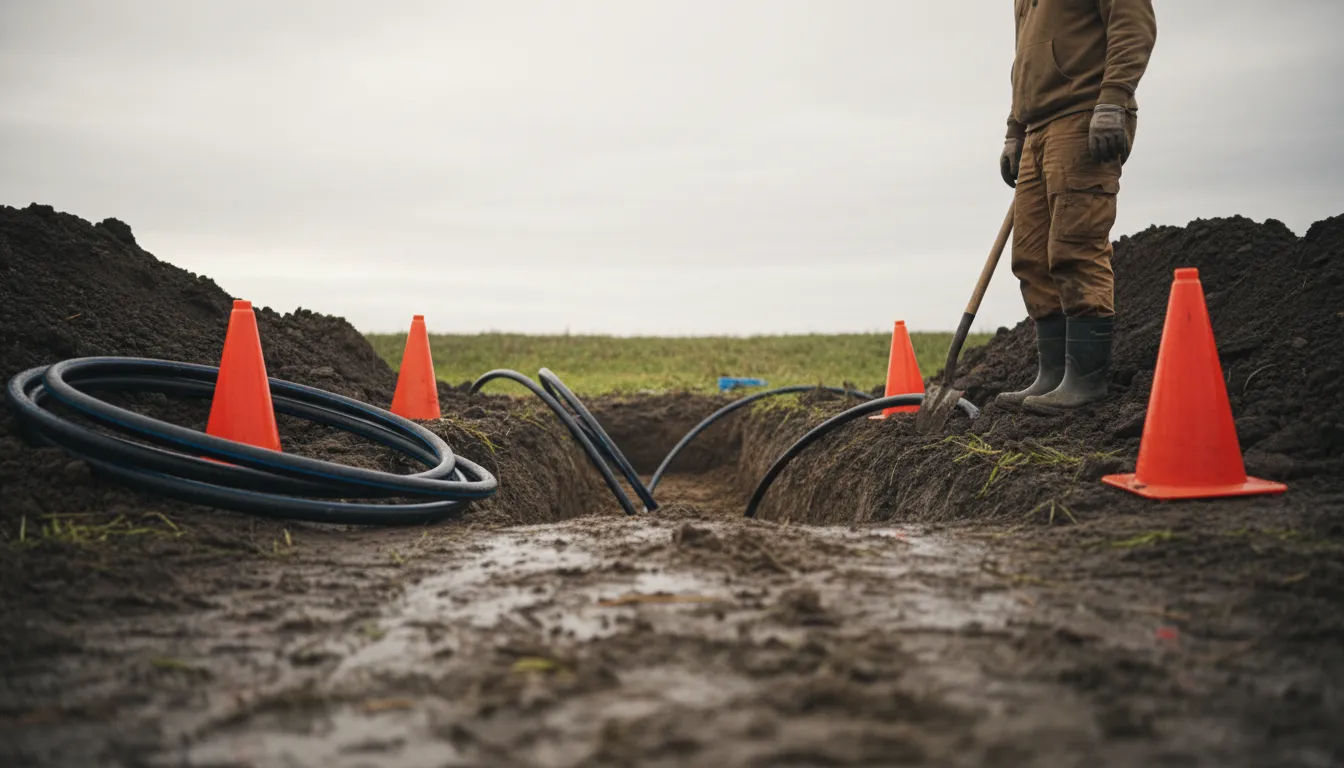
- Closed-Loop Horizontal System: This configuration requires trenches to be dug about four to six feet deep across a significant area of your yard. While the installation is often less expensive than vertical drilling where space allows, it requires a large, open plot of land. This makes it less feasible for most properties in densely built areas like Hoboken.
- Open-Loop System: This system uses groundwater from a well as the direct heat exchange fluid, pumping it through the heat pump and then discharging it. While potentially efficient, open-loop systems are less common in New Jersey due to strict environmental regulations, potential permitting complexity, and specific geological requirements.
For the majority of Hoboken installations, the vertical closed-loop is the standard choice, expertly navigating the challenge of limited space to deliver an efficient, long-lasting system.
The Installation Process: What Hoboken Homeowners Can Expect
Installing a geothermal HVAC system is a significant project that requires specialized expertise. Understanding the steps can help you prepare and know what to expect from local contractors.
- Site Assessment & Design: A certified installer will first evaluate your property. They'll assess your home's heating and cooling loads, examine your yard's size and soil composition, and check for any underground utilities. This assessment determines the optimal loop type (almost certainly vertical in Hoboken), the required number and depth of boreholes, and the sizing of the indoor heat pump unit 2.
- Ground Loop Installation: For a vertical system, a drilling rig will be brought to your property to create the boreholes. This is a precise operation that can take several days. The pipes are then connected into a continuous loop, pressure-tested, and placed in the holes before being grouted for optimal thermal conductivity and environmental protection. The process is managed to minimize disruption, but homeowners should expect some noise and activity during this phase.
- Indoor Unit Installation: The indoor heat pump unit, which is typically about the size of a traditional furnace, is installed in your basement, utility room, or garage. Your installer will connect it to the ground loop, your home's electrical system, and your existing ductwork or radiant distribution system 3.
- System Startup & Yard Restoration: Once everything is connected, the system is charged with fluid, powered up, and tested for performance. The installer will also restore your yard, filling and compacting the borehole areas. While some settling may occur, landscaping typically recovers within a growing season 4.
Find the perfect geothermal heat pump contractors for your needs
Get personalized recommendations and expert advice
Benefits and Long-Term Value of Geothermal in Hoboken
The decision to install a geothermal system is an investment that pays dividends for decades in efficiency, comfort, and savings.
- Substantial Energy Savings: This is the most compelling benefit. By using the earth's consistent temperature, geothermal heat pumps operate with remarkable efficiency, often achieving 300-600% efficiency compared to the 95-98% of the best gas furnaces. Hoboken homeowners frequently report savings of 30% to 70% on their annual heating and cooling bills, with many seeing reductions in the 50-60%+ range 5 6. This can lead to a significant reduction in your carbon footprint.
- Exceptional System Lifespan: The components of a geothermal system are built to last. The durable underground piping, often made of high-density polyethylene, is warranted for 50 years and can last for generations 7. The indoor heat pump unit typically has a lifespan of 20-25 years, which is longer than most conventional air conditioners and heat pumps.
- Quiet Operation and Increased Comfort: With no noisy outdoor condenser unit, geothermal systems run very quietly. They also provide more consistent temperatures without the drafts and hot/cold blasts associated with forced-air systems, and they excel at dehumidifying in the summer.
- Reliability and Low Maintenance: With most of the system protected underground and fewer mechanical parts exposed to the elements, ground-source systems are incredibly reliable and require minimal maintenance-usually just an annual check of the indoor components and fluid levels.
Key Considerations for Hoboken Properties
While the advantages are clear, it's important to go into the process with a full understanding of the specifics for our area.
- Higher Upfront Cost: The initial investment for a geothermal heating and cooling system is higher than that for a traditional high-efficiency gas furnace and air conditioner. This is primarily due to the cost of drilling and installing the ground loop 8 9. However, federal tax credits (currently 30% through 2032), potential state or utility rebates, and the dramatic monthly utility savings work together to provide a strong return on investment, often paying back the premium within 5-10 years 10.
- Space for Vertical Drilling: The feasibility of a vertical loop system depends on having enough accessible space on your property for the drilling rig to maneuver and operate. A reputable local installer will determine this during the initial site assessment. For some very tight lots, creative solutions like directional drilling may be an option 11 12.
- Ideal for Electrification Goals: For homeowners looking to eliminate natural gas and fully electrify their homes, a geothermal heat pump is arguably the most efficient and effective central heating and cooling solution available, pairing perfectly with solar panels to create a ultra-low carbon home.
Frequently asked questions
Sources
Footnotes
-
Geothermal Heat Pump Manual - NYC.gov - https://www.nyc.gov/html/ddc/downloads/pdf/geotherm.pdf ↩
-
NJDEP| Clean Buildings | GSHP - https://dep.nj.gov/cleanbuildings/gshp/ ↩
-
Upgrade Your Home to Geothermal - https://dandelionenergy.com/homeowners ↩
-
Geothermal Heating & Cooling on Long Island (2025 Guide) - https://www.easternenviro.com/post/long-island-geothermal-heating-cooling-2025-homeowner-guide ↩
-
Geothermal Heating, Cooling, and Hot Water Systems - https://igshpa.org/wp-content/uploads/Homeowners-Guide-to-Geothermal.pdf ↩
-
5 Things You Should Know about Geothermal Heat Pumps - https://www.energy.gov/cmei/articles/5-things-you-should-know-about-geothermal-heat-pumps ↩
-
Guide to Geothermal Heat Pumps - https://www.energy.gov/sites/prod/files/guide_to_geothermal_heat_pumps.pdf ↩
-
All You Need to Know About Home Geothermal Heating & ... - https://dandelionenergy.com/all-you-need-to-know-about-home-geothermal-heating-cooling ↩
-
Should I Choose a Geothermal System Over Traditional HVAC? - https://aspenaireinc.com/should-i-choose-geothermal-system/ ↩
-
New Jersey Ground Source Heat Pump Baseline Report - https://dep.nj.gov/wp-content/uploads/cleanenergy/new-jersey-ground-source-heat-pump-baseline-report_final.pdf ↩
-
Geothermal Heat Pump Installation: What To Expect For Your Property - https://jomory.com/geothermal-heat-pump-installation-what-to-expect-for-your-property/ ↩
-
Geothermal Heat Pumps - Department of Energy - https://www.energy.gov/energysaver/geothermal-heat-pumps ↩