Find the Best Geothermal Heat Pump Contractors for Your Business
No obligation • Fast responses • Nationwide coverage

Why you can trust HVAC Firms
HVAC Firms is a leading United States resource for evaluating HVAC service providers. Our team researches companies, checks credentials, and reviews customer feedback to present clear, unbiased information. Listings and rankings are based on merit, and companies cannot pay to change our editorial content.
Search providers near you
Top Geothermal Heat Pump Contractors in Bayonne, New Jersey Ranked
A geothermal heat pump is a highly efficient heating and cooling system that uses the Earth's stable underground temperature to regulate your home's climate. For Bayonne residents, this technology offers a path to significant energy savings and reduced environmental impact, especially when paired with local utility incentives. This guide explains how ground-source systems work, what installation involves, and how you can find qualified local experts to assess your property.
MDL Electric Cooling & Heating
4 Harrison Ave, West Orange, NJ 07052
MDL Electric Cooling & Heating is a family-owned company serving Newark, NJ, and the surrounding North Jersey area. With over 30 years of experience, they provide a wide range of HVAC and electrical services including installation, repair, and maintenance of air conditioning, furnaces, heat pumps, boilers, and geothermal heat pumps. Their team is EPA certified and offers advanced solutions such as inverter-driven compressors and natural gas conversions. MDL Electric Cooling & Heating is available 24/7 to support residential and commercial customers with licensed and trained technicians.
Lightning Mechanical LLC
65 Newark Way, Maplewood, NJ 07040
Lightning Mechanical LLC is an HVAC service provider based in Newark, NJ, offering repair, installation, and maintenance for residential and commercial heating and cooling systems. They specialize in a wide range of equipment including air conditioners, furnaces, heat pumps, boilers, and Daikin VRV systems. The company fabricates custom sheet metal in-house and serves clients throughout the New York metro area, including Newark. Since 2005, Lightning Mechanical has provided factory-trained technicians skilled in servicing multiple HVAC brands and advanced systems like Variable Refrigerant Volume (VRV). They also offer rapid response teams for mission-critical facilities and maintain an extensive inventory of Daikin VRV parts for quick repairs.
How Geothermal Heating and Cooling Works
The core principle behind a geothermal system, often called a ground-source heat pump, is simple: it exchanges heat with the ground, which maintains a relatively constant temperature of 50-60°F year-round just a few feet below the surface 1. This is far more stable than Bayonne's fluctuating outdoor air temperatures.
In the winter, a fluid (usually water mixed with antifreeze) circulates through a loop of pipes buried in your yard. This fluid absorbs the Earth's natural warmth. It then travels to a heat pump unit inside your home, which concentrates that low-grade heat and distributes it as warm air through your existing ductwork or a ductless system. The process reverses in the summer. The system extracts heat and humidity from your indoor air and transfers it into the cooler fluid in the underground loop, which then dissipates the heat into the ground, leaving your home comfortably cooled 2.
This method of heat exchange is incredibly efficient because the system is moving existing heat rather than generating it through combustion, like a furnace does. This leads to the dramatic energy savings geothermal systems are known for.
Types of Ground-Source Systems for Bayonne Homes
Not all geothermal installations are the same. The right system for your Bayonne property depends on your lot size, soil conditions, and budget. The most common type installed in New Jersey is the closed-loop system, where a continuous, sealed pipe circulates the heat-transfer fluid.
- Vertical Closed-Loop: This is often the best choice for residential properties in denser areas like Bayonne, where yard space is limited. Contractors use a drilling rig to bore narrow holes 150 to 400 feet deep. U-shaped pipe loops are inserted into each borehole and connected below ground. While drilling requires specialized equipment, it causes minimal disruption to your landscaping after the fact.
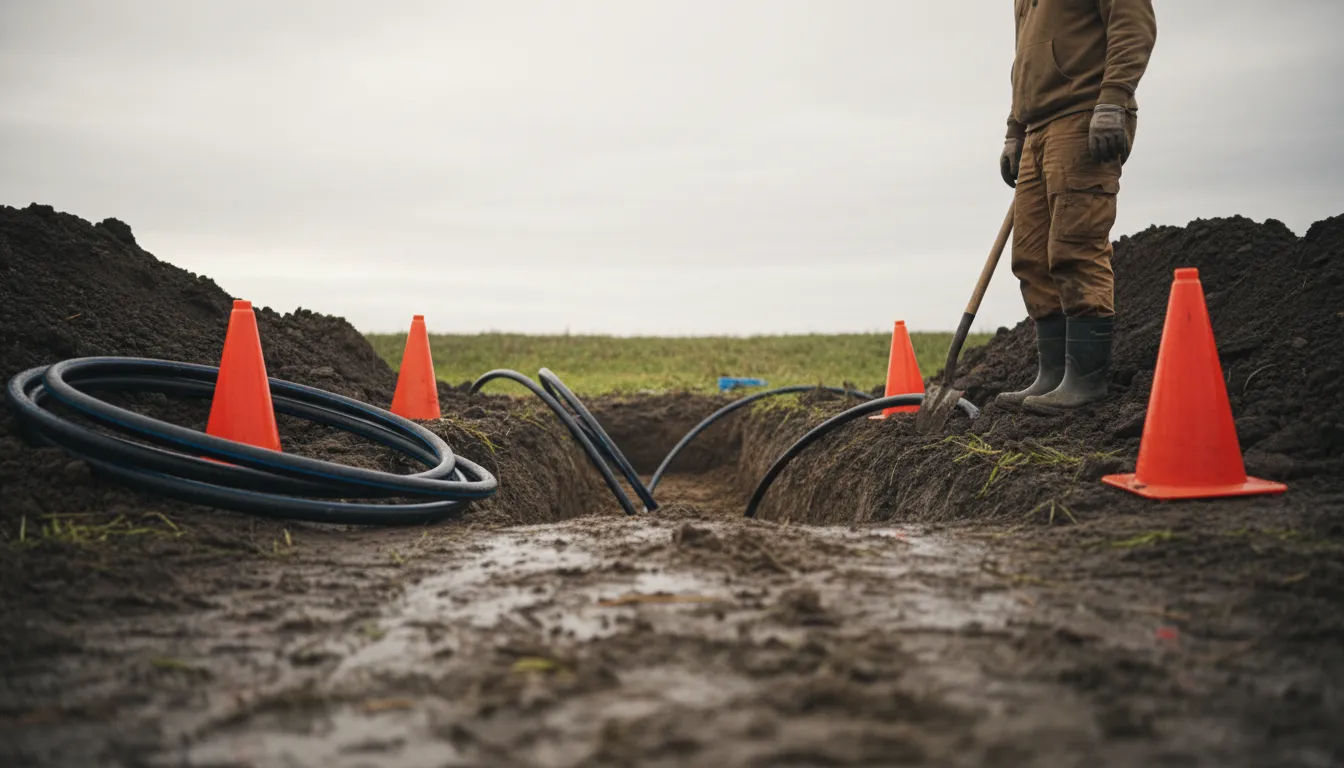
- Horizontal Closed-Loop: This configuration requires more land. Contractors dig trenches six feet deep or more and lay coils of pipe horizontally. This method typically has a lower installation cost than vertical drilling but is only feasible if you have sufficient, unobstructed yard space 3 4.
- Open-Loop System: This system uses groundwater from a well directly as the heat-exchange fluid. After circulating through the heat pump, the water is discharged back into a well, pond, or stream. These systems are less common in New Jersey due to strict environmental regulations concerning groundwater use and discharge, and they require an abundant, clean water source 5 6.
Find the perfect geothermal heat pump contractors for your needs
Get personalized recommendations and expert advice
What to Expect During Installation
Installing a geothermal heat pump is a significant project that involves both indoor and outdoor work. Understanding the process can help you prepare and choose the right contractor.
- Site Evaluation and Design: A qualified installer will first assess your property. They'll evaluate your home's heating and cooling loads, insulation quality, and ductwork. Outside, they'll survey your yard to determine the best loop type (vertical vs. horizontal) based on soil composition, rock content, and available space.
- Ground Loop Installation: This is the most distinctive phase. For a vertical system, a drilling rig will be brought in to create the boreholes. For a horizontal system, a backhoe will dig the necessary trenches. The high-density polyethylene pipes are then placed, connected, and pressure-tested before being buried.
- Indoor Unit and Connection: The geothermal heat pump unit, which is about the size of a traditional furnace, is installed indoors-often in a basement, utility room, or garage. The refrigerant and water lines are connected from the indoor unit to the underground loop field. Your existing ductwork is typically integrated with the new system, or a ductless mini-split system can be installed if needed.
- System Startup and Landscaping: Once everything is connected, the system is charged with fluid, powered up, and tested for optimal performance. Finally, the drilling or trenching sites are backfilled. You are responsible for restoring any landscaping, such as reseeding grass or replanting shrubs, over the buried loops 7.
The Financial and Efficiency Benefits
The primary advantage of switching to a geothermal system in Bayonne is long-term savings. While the upfront cost is higher than a conventional air-source heat pump or furnace, the operational savings are substantial.
- Dramatic Energy Savings: Geothermal heat pumps can reduce your heating, cooling, and hot water costs by up to 70% compared to conventional systems like electric resistance heating or oil furnaces 8 9. This is because they are remarkably efficient, delivering 4 to 6 units of heat for every 1 unit of electricity used-an efficiency rate of 400-600% 10 11.
- Return on Investment (ROI): The high initial investment is often recouped through utility savings within 5 to 10 years. After that, the continued savings go directly into your pocket for the life of the system, which can exceed 25 years for the ground loops and 15+ years for the indoor heat pump unit.
- Incentives and Rebates: Homeowners in New Jersey can take advantage of federal tax credits for renewable energy installations. Additionally, state programs and local utility rebates may be available to help offset the installation cost, improving the payback period.
- Increased Home Value: A permanent, high-efficiency geothermal system is an attractive feature that can increase your property's market value and appeal to energy-conscious buyers.
Preparing Your Home for Maximum Efficiency
To get the most out of your geothermal investment, it's wise to ensure your home is as efficient as possible before or during installation. A well-sealed and insulated home requires a smaller, less expensive system to heat and cool.
- Seal Air Leaks: Caulk and weatherstrip around windows, doors, and other openings to prevent conditioned air from escaping.
- Upgrade Insulation: Ensure your attic, walls, and basement are properly insulated to the recommended levels for our climate zone.
- Ductwork Evaluation: Have your installer inspect your ducts for leaks. Sealing and insulating ducts, especially those in unconditioned spaces like attics or crawl spaces, can improve system efficiency by 20% or more.
By addressing these areas, you allow your new ground-source heat pump to operate at its peak performance, maximizing your comfort and savings.
Frequently asked questions
Sources
Footnotes
-
How Geothermal Heat Pumps Work - https://www.youtube.com/watch?v=XxlTnBukweI&t=37 ↩
-
Geothermal (Ground Source) Heat Pumps - NY.gov - https://cleanheat.ny.gov/geothermal-heat-pumps/ ↩
-
Geothermal Heat Pump Installation: What To Expect For Your Property - https://jomory.com/geothermal-heat-pump-installation-what-to-expect-for-your-property/ ↩
-
Complete Guide To Geothermal Heat Pump Installation - https://coolwithbowman.com/geothermal-heat-pump-installation/ ↩
-
NJDEP| Clean Buildings | GSHP - https://dep.nj.gov/cleanbuildings/gshp/ ↩
-
Geothermal Installation Steps Explained - https://ultrageothermal.com/geothermal-installation-steps-explained/ ↩
-
All You Need to Know About Home Geothermal Heating & ... - https://dandelionenergy.com/all-you-need-to-know-about-home-geothermal-heating-cooling ↩
-
Ground Source (Geothermal) Centrally Ducted System for a Two- ... - https://cleanheat.ny.gov/ground-source-heat-pump-for-a-two-story-home/ ↩
-
Geothermal Heat Pumps - Department of Energy - https://www.energy.gov/energysaver/geothermal-heat-pumps ↩
-
Ground Source (Geothermal) Centrally Ducted System for a ... - https://cleanheat.ny.gov/ground-source-heat-pump-for-a-one-story-home/ ↩
-
How Does a Geothermal System Work? - ClimateMaster - https://www.climatemaster.com/homeowner/side-links/how-it-works ↩