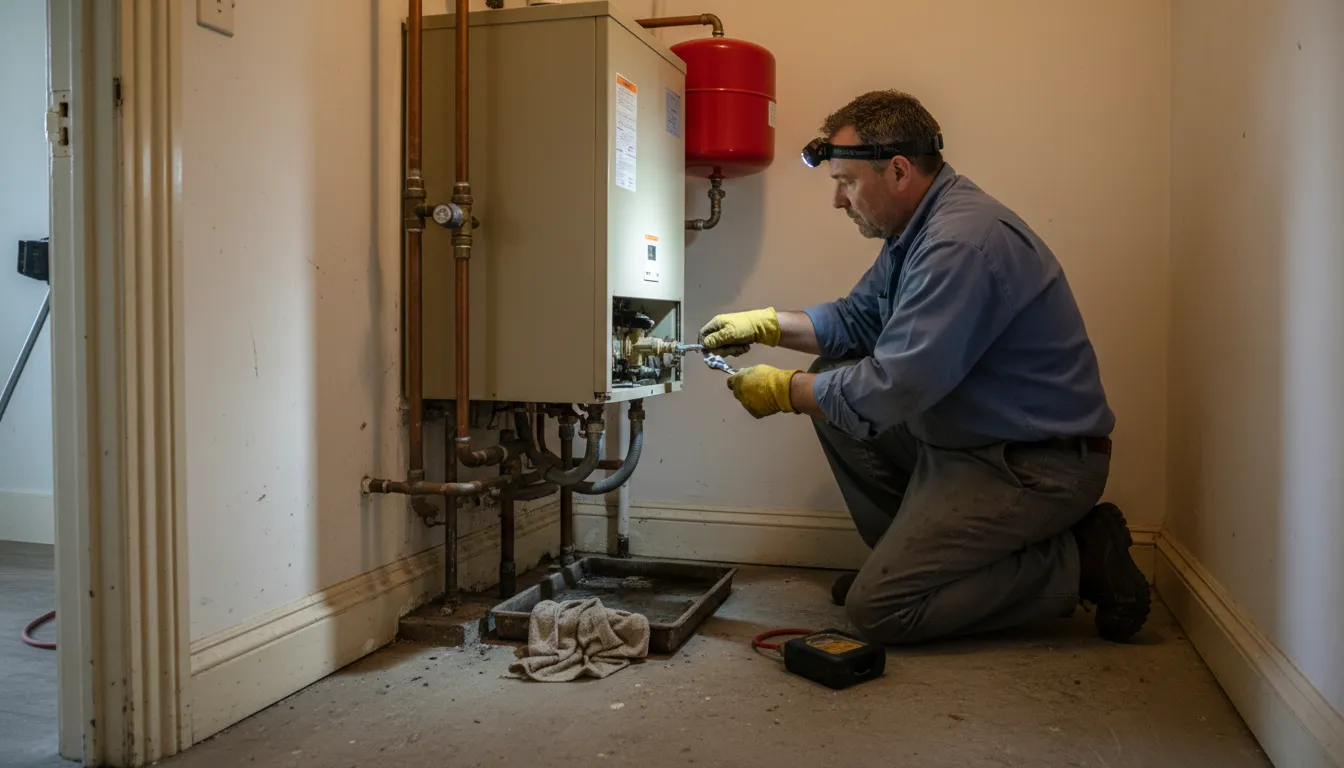
Find the Best Boiler Repair Contractors for Your Business
No obligation • Fast responses • Nationwide coverage

Why you can trust HVAC Firms
HVAC Firms is a leading United States resource for evaluating HVAC service providers. Our team researches companies, checks credentials, and reviews customer feedback to present clear, unbiased information. Listings and rankings are based on merit, and companies cannot pay to change our editorial content.
Search providers near you
Top Boiler Repair Contractors in Columbus, Ohio Ranked
When your boiler stops working on a cold Columbus morning, it's more than an inconvenience-it's an urgent need for reliable heat. Boiler repair services address the specific issues that can plague your home's hydronic heating system, from faulty circulator pumps to pressure relief valves. This resource helps you understand your options, from common fixes to full system replacement, so you can make informed decisions to restore warmth and efficiency to your home.
Foust Plumbing & Heating
321 W Bigelow Ave Suite 200, Plain City, OH 43064
Foust Plumbing & Heating is a family-owned HVAC and plumbing contractor serving Columbus, OH, and surrounding areas. They offer installation, repair, and maintenance services for air conditioning, furnaces, heat pumps, boilers, and geothermal heat pumps. With over 40 years of experience, they work with all major brands and provide emergency service availability. Their team is licensed, insured, and certified, focusing on transparent pricing and skilled workmanship.
AK Services
5615 Rocky Pine Loop N, Columbus, OH 43229
AK Services is a family-owned heating and air conditioning company based in Columbus, OH. They provide a wide range of HVAC services including installation, repair, maintenance, and indoor air quality solutions for both residential and commercial properties. Their skilled technicians use modern diagnostic tools and energy-efficient technologies to handle systems such as air conditioners, furnaces, heat pumps, boilers, mini splits, and thermostats. AK Services offers 24/7 emergency support throughout Columbus and nearby areas. With over 10 years of experience, they focus on accurate diagnosis and tailored solutions to meet customer needs.

Dor-Mar Pataskala Heating Cooling Plumbing Electrical Appliances Radon
24 Front St Suite 207, Pataskala, OH 43062
Dor-Mar Pataskala Heating Cooling Plumbing Electrical Appliances Radon is a family-owned home services contractor serving Columbus, OH, and the surrounding Central Ohio area. The company offers a wide range of services including installation, repair, and maintenance of heating and cooling systems such as furnaces, heat pumps, boilers, air conditioners, and mini splits. They also provide duct cleaning, thermostat installation, indoor air quality services, plumbing, electrical, appliance repair, water filtration, and radon testing and mitigation. Established in 1962, Dor-Mar has grown from a small door-to-door business to one of the largest heating and cooling service companies in Ohio, with a team of trained technicians and 24/7 availability for furnace and air conditioning repairs.

Dor-Mar Westerville Heating Cooling Plumbing Electric Appliances Radon
924 Eastwind Dr #2, Westerville, OH 43081
Dor-Mar Westerville Heating Cooling Plumbing Electric Appliances Radon is a family-owned home services contractor based in Columbus, OH. They provide a wide range of services including heating, air conditioning, plumbing, electrical, appliance repair, water filtration, and radon testing and mitigation. Serving Central Ohio with multiple locations, Dor-Mar offers installation, maintenance, and repair for HVAC systems such as furnaces, heat pumps, boilers, and mini splits. They have been in business since 1962 and maintain a team of trained technicians who stay current with industry updates. The company also provides 24-hour emergency furnace repair and air conditioning services to ensure customer comfort at any time.

Dor-Mar Dublin Heating Cooling Plumbing Electrical Appliances Radon
6543 Commerce Pkwy D, Dublin, OH 43017
Dor-Mar Dublin Heating Cooling Plumbing Electrical Appliances Radon is a full-service home services contractor based in Columbus, OH. They provide a wide range of services including HVAC installation, repair, and maintenance for air conditioners, furnaces, heat pumps, boilers, and mini splits, as well as duct cleaning, thermostat installation, indoor air quality services, plumbing, electrical, appliance repair, water filtration, and radon testing and mitigation. With a history dating back to 1962, Dor-Mar has grown from a small family-owned business to one of Central Ohio's largest heating and cooling companies. They offer 24/7 furnace repair and emergency air conditioning services, ensuring support is available any time it is needed.
Understanding Your Columbus Boiler System
Most homes in Central Ohio rely on gas-fired boilers for their heating needs. These systems are particularly well-suited to our climate, providing consistent and powerful heat even during the coldest winter snaps. A boiler heats water, which is then circulated through pipes to radiators, baseboard heaters, or even in-floor tubing to warm your living spaces. This method, known as hydronic heating, is prized for its even, comfortable warmth without the drafts or noise associated with forced-air systems.
While gas models dominate, you may also encounter oil-fired or electric boilers in some Columbus homes, typically where natural gas service is not available or for specific applications like smaller additions 1. Regardless of the fuel type, the core principle is the same: creating and distributing hot water for heat. Knowing whether you have a steam or hot water system, and what type of fuel it uses, is the first step in diagnosing any problem.
Common Boiler Problems in Central Ohio
Boilers are robust, but like any complex mechanical system, they experience wear and tear. Some malfunctions are more frequent than others, especially in systems that work hard through our long heating season.
- No Heat or Insufficient Heat: This is the most obvious sign of trouble. It can stem from a malfunctioning thermostat, a failed circulator pump that isn't moving water, low water pressure, or a problem with the gas valve or ignition system.
- Strange Noises: Banging, whistling, or gurgling sounds (often called "kettling") are not normal. These can indicate air in the lines, limescale buildup on the heat exchanger, or a failing pump.
- Leaks: Any sign of water around the boiler or pipes is a red flag. Leaks can originate from corroded pipes, a faulty pressure relief valve, or a cracked heat exchanger-a serious issue that requires immediate attention.
- Pilot Light or Ignition Issues: For a boiler to fire, the pilot light must stay lit or the electronic ignition must function. If it keeps going out, it could point to a faulty thermocouple, a draft, or a gas supply problem.
- Fluctuating Pressure: Your boiler's pressure gauge should remain in a stable, optimal range. Consistently high or low pressure can signal a failing expansion tank, a leak, or a problem with the pressure relief valve.
Addressing these issues promptly can prevent a minor repair from escalating into a major failure, especially during peak winter demand.
Repair vs. Replacement: A Critical Decision for Homeowners
One of the most significant decisions you'll face is whether to fix your current boiler or invest in a new one. This isn't just about the immediate repair bill; it's about long-term reliability, efficiency, and cost. Here are the key factors to consider:
The Age of Your Boiler: A well-maintained boiler can last 15 to 20 years. If your system is within or beyond this range, its efficiency has likely declined significantly, and components are more prone to failure. Frequent repairs on an older unit are a strong economic signal that replacement may be the wiser path.
The 50% Cost Rule: A common industry guideline is to consider replacement if the repair estimate approaches or exceeds 50% of the cost of a new, high-efficiency boiler installation 2. Pouring substantial money into an aging system often yields diminishing returns compared to the benefits of a new unit.
Energy Efficiency Gains: Modern Energy Star® certified boilers, especially condensing models, can achieve Annual Fuel Utilization Efficiency (AFUE) ratings over 90%, compared to 70-85% for older systems 3. This leap in efficiency translates directly to lower monthly gas bills, helping offset the investment over time.
Major Component Failure: Some repairs are so costly they tilt the scales toward replacement. If the heat exchanger-the core component that transfers heat to the water-is cracked, repair costs can range from $1,200 to $3,000 or more. At that point, investing in a new, reliable, and efficient system often makes more financial sense.
Find the perfect boiler repair contractors for your needs
Get personalized recommendations and expert advice
What to Expect: Boiler Repair and Replacement Costs in Columbus
Costs can vary based on the specific problem, the boiler's make and model, and the time of year. However, understanding general price ranges can help you budget and evaluate estimates.
Common Repair Costs:
- Thermostat Replacement: $100 - $300
- Pressure Relief Valve Replacement: $200 - $500
- Circulator Pump Repair/Replacement: $500 - $800
Major Repair Costs:
- Heat Exchanger or Control Board Replacement: $1,200 - $3,000+
Full Boiler Replacement Cost: A complete boiler replacement is a more substantial investment, typically ranging from $4,000 to over $10,000 in Columbus 4 5. The final price depends heavily on:
- Boiler Type: A high-efficiency condensing gas boiler will cost more upfront than a standard-efficiency model but saves more on operating costs.
- System Complexity: The difficulty of the installation (e.g., reconfiguring piping, updating venting) adds labor time.
- Fuel Type: Switching from oil to gas, for example, involves additional work and cost.
It's worth investigating potential rebates from local utilities or state programs for installing high-efficiency equipment, as these can reduce your net cost.
Maintaining Your Boiler for Longevity and Efficiency
The best way to avoid costly emergency repairs is through proactive maintenance. An annual tune-up by a qualified technician before each heating season is crucial. This service typically includes:
- Inspecting and cleaning the burner and heat exchanger.
- Checking all system controls and safety devices.
- Testing water pressure and the pressure relief valve.
- Lubricating moving parts like the circulator pump.
- Looking for signs of corrosion or leaks.
This preventative care keeps your system running safely and efficiently, can extend its lifespan, and often identifies small problems before they become big, expensive ones. For Columbus homeowners, prioritizing a gas-fired boiler system and maintaining it regularly is the key to cost-effective and reliable winter comfort 6.
Frequently asked questions
Sources
Footnotes
-
Columbus, OH Boiler Repair & Maintenance Services - https://bestservicehvac.com/hvac/columbus-oh/boilers/ ↩
-
Boiler Repair vs. Replacement: Make the Right Choice - https://www.smithandcompanyhvac.com/boiler-repair-vs-replacement-how-to-make-the-right-choice/ ↩
-
A Comprehensive Guide to Heating Systems for Residences - https://kandkheatingandcooling.com/2024/11/26/a-comprehensive-guide-to-heating-systems-for-residences-choosing-the-best-fit-for-your-home/ ↩
-
Boiler Repair Cost Guide 2026 | Prices & Common ... - Modernize - https://modernize.com/hvac/heating-repair-installation/boiler/repair-cost ↩
-
How Much Do HVAC Repairs Cost in Columbus, Ohio? - https://www.servicefirstair.com/blog/how-much-do-hvac-repairs-cost-in-columbus-ohio ↩
-
When to replace vs repair your boiler - https://yorkshireheatingrenewables.co.uk/advice/when-to-replace-vs-repair-your-boiler/ ↩