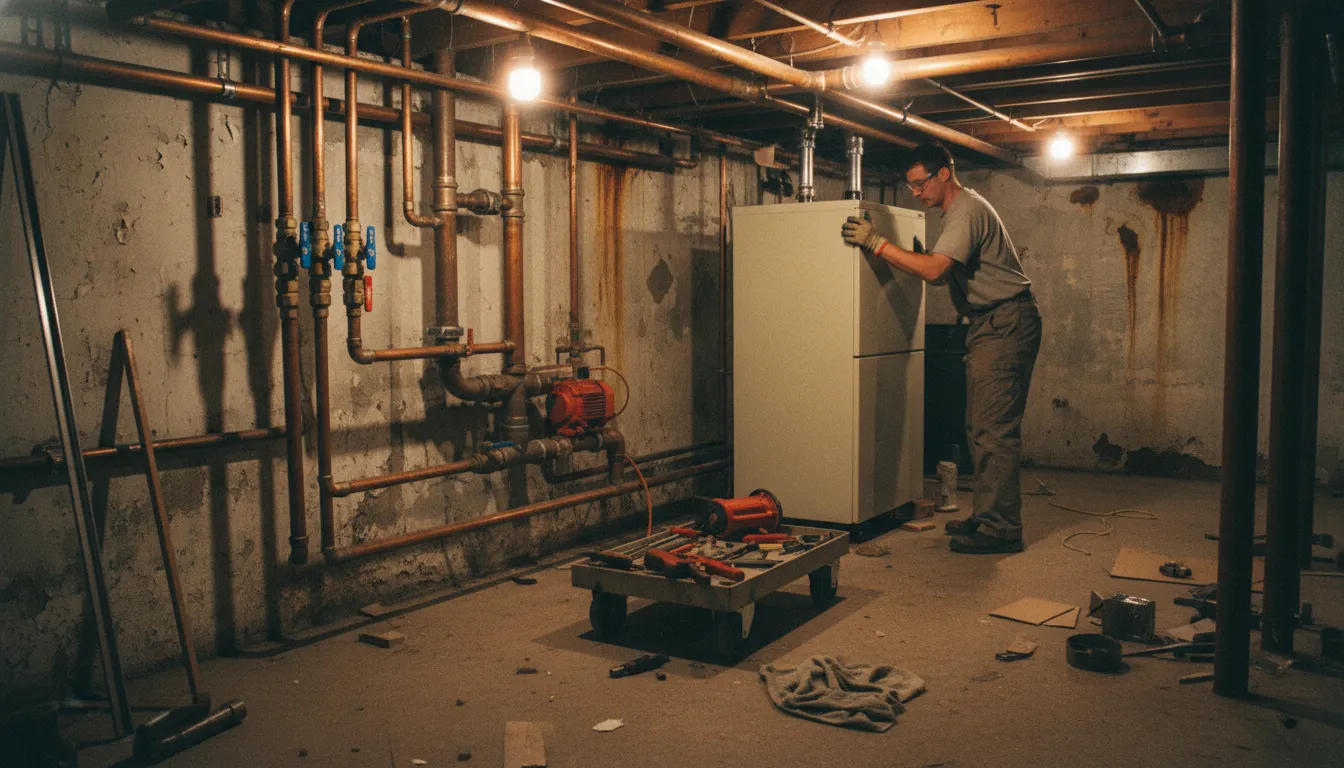
Find the Best Boiler Installation & Replacement Contractors for Your Business
No obligation • Fast responses • Nationwide coverage

Why you can trust HVAC Firms
HVAC Firms is a leading United States resource for evaluating HVAC service providers. Our team researches companies, checks credentials, and reviews customer feedback to present clear, unbiased information. Listings and rankings are based on merit, and companies cannot pay to change our editorial content.
Search providers near you
Top Boiler Installation & Replacement Contractors in Troy, Michigan Ranked
A boiler is the heart of your home's hydronic heating system, providing reliable warmth through radiators or baseboard heaters. In Troy's climate, a properly installed and efficient boiler is essential for comfort and managing energy costs. This guide helps you understand the key considerations for boiler installation and replacement, from selecting the right system to navigating local regulations, so you can make an informed decision for your home.
Warm or Breezy Heating & Cooling
220 S Main St #430, Royal Oak, MI 48067
Warm or Breezy Heating & Cooling is an HVAC contractor based in Detroit, MI, providing heating and cooling services including repair, installation, and maintenance. They serve residential and commercial customers with furnace, boiler, air conditioning, and mini split system services. Their technicians offer energy efficiency diagnostics and city safety inspections, along with installation of Wi-Fi thermostats and tankless water heaters. With over 20 years of experience in heater repair, Warm or Breezy emphasizes fair pricing and uses durable American-made replacement parts. The company operates seven days a week to support customers throughout the heating season.
MOTOWN HEATING, COOLING, REFRIGERATION
Detroit, MI
MOTOWN HEATING, COOLING, REFRIGERATION is a family-owned HVAC company serving Detroit, MI. They provide residential, commercial, and industrial heating, cooling, and refrigeration services including installation, repair, and preventative maintenance. With over 25 years of experience since 1979, they handle a wide range of systems such as air conditioners, furnaces, boilers, and mini splits. Their team is equipped to manage commercial plumbing and boiler services as well. Customers can reach them 24/7 for assistance.
Cregger Plumbing, Heating & Cooling
2335 Goodrich St, Ferndale, MI 48220
Cregger Plumbing, Heating & Cooling is a third-generation, locally operated company serving Detroit, MI. They provide a range of HVAC and plumbing services including repair and installation of air conditioners, furnaces, heat pumps, and boilers. Their licensed and insured team is experienced in handling plumbing and HVAC needs throughout Michigan, with a capability in hydro jetting and emergency plumbing services. Established in 1987, Cregger offers 24/7 emergency plumbing support to address urgent issues at any time.
Detroit Furnace LLC
31313 Kendall, Fraser, MI 48026
Detroit Furnace LLC provides heating, cooling, and plumbing services in Detroit, MI. They offer repair, installation, and maintenance for furnaces, air conditioners, heat pumps, boilers, and mini-split systems. Their team services all brands and models and is equipped to handle plumbing needs such as water heater installation, leak repairs, and drain cleaning. Detroit Furnace LLC offers 24/7 emergency service to address urgent issues promptly. They serve the Detroit Metro area and surrounding communities, ensuring comprehensive home comfort solutions.
Birmingham Plumbing Heating & Cooling Company
655 S Eton St, Birmingham, MI 48009
Birmingham Plumbing Heating & Cooling Company is a licensed plumbing and HVAC contractor serving Detroit, MI, and surrounding counties including Macomb, Oakland, and Wayne. The company offers a range of residential and commercial services such as plumbing repairs, drain cleaning, sewer line inspections with telescope cameras, and heating and cooling system installation and repair. With over 15 years of experience and a family-owned background, Birmingham Plumbing Heating & Cooling emphasizes quality service and customer satisfaction. Their team is equipped to handle air conditioning, furnace, and boiler services, supporting home comfort needs throughout the Detroit area.
Understanding Your Boiler Options
When it's time for a new boiler installation, you'll encounter several primary types, each with distinct advantages. The right choice depends on your home's layout, your hot water needs, and your efficiency goals.
- Standard/Conventional Boilers: These systems heat water for your radiators and typically work with a separate storage tank to supply your domestic hot water (DHW). They are a reliable, traditional choice for homes with existing tank setups.
- Combination (Combi) Boilers: A combi boiler is an all-in-one unit that provides both space heating and hot water on demand, without the need for a storage tank. This saves significant space and can be more energy-efficient, as it heats water only when you need it.
- High-Efficiency (Condensing) Boilers: These advanced units capture more heat from the combustion gases, which would otherwise be lost through the flue. This process condenses water vapor, extracting extra energy and leading to lower fuel bills. While they have a higher upfront cost, the long-term savings in Michigan's cold winters can be substantial.
- System Boilers: Similar to conventional boilers but with key components built into the unit, system boilers work with a separate hot water cylinder. They are often easier to install than conventional models and are suitable for homes with multiple bathrooms.
Key Considerations for Your Troy Home
Selecting a new boiler involves more than just choosing a type. Several critical factors will determine the system's performance, efficiency, and cost.
Proper Sizing (BTU Output): This is arguably the most crucial step. An oversized boiler will short-cycle (turn on and off frequently), wasting energy and causing wear. An undersized unit will struggle to heat your home. A professional contractor will perform a heat load calculation, considering your home's square footage, insulation, window quality, and Troy's climate. For example, a 2,000 sq ft home in a cold climate like Michigan's might need approximately 100,000 BTU, while a home in a more moderate area would require less.
Energy Efficiency: Look for the Annual Fuel Utilization Efficiency (AFUE) rating. This percentage indicates how much fuel is converted into heat. Modern high-efficiency models have AFUE ratings of 90% or higher. Investing in a higher AFUE boiler can lead to significant savings on your heating bills over its lifespan 1.
Hydronic System Compatibility: Your new boiler must work seamlessly with your existing distribution system, whether it's cast-iron radiators, baseboard heaters, or radiant floor tubing. Discuss zoning controls with your installer; these allow you to heat different areas of your home independently, enhancing both comfort and efficiency 2.
Find the perfect boiler installation & replacement contractors for your needs
Get personalized recommendations and expert advice
Navigating Permits, Codes, and Safety in Michigan
Boiler installation is heavily regulated to ensure safety. In Troy, installations must comply with both state and local codes, and permits are mandatory.
The Permit Process: In Michigan, a state boiler permit is required for any installation or alteration. This permit is obtained by your licensed contractor through the Michigan Department of Licensing and Regulatory Affairs (LARA). As a homeowner, you may pull your own mechanical permit, but this requires demonstrating knowledge of all applicable codes and may not be advisable for such a complex system 3. Your contractor should handle this entire process, including scheduling the required inspections.
Essential Safety Features: Code compliance is non-negotiable for safety. Your new boiler system must include:
- Pressure and temperature relief valves.
- Low-water cutoffs to prevent the boiler from operating without adequate water.
- Properly sized and installed shutoff valves.
- Correct venting and combustion air supply, which is especially critical for high-efficiency condensing models that may use special PVC venting 4 5 6.
Governing Codes: Installations in Troy are governed by the 2021 Michigan Building Code, Michigan Residential Code, Michigan Mechanical Code, and the Michigan Energy Code, which are based on the 2021 International Codes 7. These codes cover everything from equipment clearances to pipe sizing and safety device installation.
Understanding Installation Costs
The cost of a boiler replacement in Troy varies widely based on the system type, complexity of the installation, and the efficiency of the unit. Here's a general breakdown based on local data:
- Standard or Combination Boilers: These typically range from $2,850 to $8,390 for the unit and installation. Combi boilers may be on the higher end of this range due to their dual functionality.
- System Boilers: For larger homes, these units generally fall between $3,000 and $6,000.
- High-Efficiency Condensing Boilers: Offering the best long-term energy savings, these systems have a higher initial investment, usually starting around $8,390 and can exceed $12,5008.
Remember, these figures are for the boiler and basic installation. Costs can increase with complex factors like moving the boiler location, upgrading piping, or integrating with advanced zoning systems.
Choosing a Qualified Contractor
Your installer's expertise is as important as the equipment itself. Ensure any contractor you consider holds the appropriate Michigan Mechanical Contractor License and/or Plumbing License. They should be fully insured and have extensive experience with hydronic heating systems. A reputable professional will:
- Perform a detailed heat load calculation.
- Explain your options clearly, including efficiency trade-offs.
- Provide a written, detailed estimate.
- Secure all necessary Michigan state and local permits.
- Schedule and manage all required inspections.
Frequently asked questions
Sources
Footnotes
-
How To Choose the Right Boiler for Your Home | AHS - https://www.ahs.com/home-matters/quick-tips/how-to-choose-residential-boiler/ ↩
-
What Are the Different Boilers Types? | BWS Plumbing, Heat & Air - https://bwsheatingandair.com/blog/what-are-the-different-types-of-boilers/ ↩
-
Mechanical FAQ's 1. Can I pull a permit as a homeowner? a. Yes ... - https://www.michigan.gov/lara/-/media/Project/Websites/lara/bcc-media/FAQs/Mechanical-FAQs.pdf?rev=3ae8e8c334204b46a245bd9e8bc62b55&hash=69942647DACCE1A5C1DBF2359BD21E76 ↩
-
Boiler Permit Information - https://www.michigan.gov/lara/bureau-list/bcc/sections/permit-section/permits/boiler-permit-information ↩
-
Boilers and Water Heaters, Michigan Residential Code 2015 | UpCodes - https://up.codes/viewer/michigan/mi-residential-code-2015/chapter/20/boilers-and-water-heaters ↩
-
Chapter 10 Boilers, Water Heaters and Pressure Vessels - UpCodes - https://up.codes/viewer/detroit/mi-mechanical-code-2015/chapter/10/boilers-water-heaters-and-pressure-vessels ↩
-
Building Department - Codes Currently in Effect - https://troymi.gov/departments/building_inspections/codes_currently_in_effect.php ↩
-
How Much Does Boiler Replacement Cost in Detroit, MI? | Angi - https://www.angi.com/articles/how-much-does-boiler-installation-cost/mi/detroit ↩