Find the Best Mini-Split Installers for Your Business
No obligation • Fast responses • Nationwide coverage

Why you can trust HVAC Firms
HVAC Firms is a leading United States resource for evaluating HVAC service providers. Our team researches companies, checks credentials, and reviews customer feedback to present clear, unbiased information. Listings and rankings are based on merit, and companies cannot pay to change our editorial content.
Search providers near you
Best Mini-Split Installers in West Virginia Ranked
Installing a ductless mini-split system is an excellent way to add efficient, zoned heating and cooling to your West Virginia home, especially in areas without existing ductwork. This process involves placing a compact outdoor unit connected to one or more indoor air handlers, providing targeted comfort control. For a successful installation that ensures safety, efficiency, and eligibility for potential rebates, it's essential to work with a licensed West Virginia HVAC professional who understands state codes and local permit requirements. The following guide outlines the key steps, regulations, and considerations to help you navigate your mini-split project.
Understanding Ductless Mini-Split Systems
A ductless mini-split system consists of two main components: an outdoor condenser/compressor and one or more indoor air-handling units. Refrigerant lines, power cables, and a condensate drain line run through a small hole in the wall to connect them. This design eliminates the need for extensive ductwork, making it ideal for room additions, garages, older homes, or any space where extending central air is impractical or too costly. The primary advantage is zoned comfort; you can control the temperature in individual rooms, which can lead to significant energy savings compared to heating or cooling your entire home.
In West Virginia's climate, with cold winters and humid summers, a properly sized and installed mini-split can serve as a primary heating and cooling source or an efficient supplement. Modern heat pump models are effective at providing heat even in lower outdoor temperatures, offering a versatile year-round solution.
Licensing and Legal Requirements in West Virginia
Before any work begins, it's crucial to verify that your installer holds the proper credentials. West Virginia state law mandates that anyone performing HVAC work, including the installation, repair, or maintenance of systems like mini-splits, must be licensed 1 2. This requirement protects homeowners by ensuring the technician has the necessary training and knowledge of state codes.
Hiring a licensed professional is not just a legal formality; it's a safeguard. Licensed contractors carry insurance, provide warranties on their work, and are accountable for meeting safety standards. They are also familiar with the specific procedures for pulling permits, which is your next critical step.
Permits and Building Codes
Most mini-split installations in West Virginia will require permits from your local building department. This is a non-negotiable aspect of a legal and safe installation 3 4. The permit process ensures the work will be inspected to verify it complies with state and local mechanical, electrical, and safety codes.
- Electrical Permit: Required for the new circuit run from your electrical panel to the outdoor unit. This ensures the wiring, breaker, and disconnect are installed correctly to prevent fire hazards.
- Mechanical Permit: Covers the physical installation of the HVAC equipment, refrigerant line connections, and condensate drainage.
Your licensed contractor will typically handle pulling these permits. Codes you'll encounter include the International Residential Code (IRC) and National Electrical Code (NEC), as adopted by West Virginia. Specific guidelines, such as those found in UpCodes, detail requirements for clearances around the outdoor unit, proper mounting of indoor units, and correct condensate drainage to prevent water damage 5. Skipping permits can result in fines, problems when selling your home, and could void your equipment warranty.
The Professional Installation Process
A proper ductless installation is a multi-step process that requires specialized tools and expertise. Here's what a professional installation typically involves:
- Load Calculation and System Sizing: A technician will perform a Manual J load calculation to determine the correct heating and cooling capacity (in BTUs) needed for your space. An oversized or undersized system will lead to poor performance, higher energy bills, and reduced equipment life.
- Site Survey and Planning: The installer will determine the optimal locations for the indoor and outdoor units, considering airflow, noise, aesthetics, and accessibility for future service.
- Mounting the Indoor Unit: The wall-mounted indoor unit is securely fastened to a wall stud. A small hole is carefully drilled through the exterior wall for the connecting lines.
- Installing the Outdoor Unit: A stable, level pad (often concrete) is placed for the outdoor condenser. The unit must have adequate clearance (usually 12-24 inches on all sides) for airflow and service access.
- Running the Line Set: The pre-charged refrigerant lines, electrical conduit, and condensate drain line are run from the outdoor unit, through the wall, and connected to the indoor unit. This requires careful routing and sealing.
- Electrical Connection: A dedicated circuit is run from your home's main electrical panel to a disconnect box near the outdoor unit, then to the unit itself. This must be done by a qualified electrician or HVAC tech.
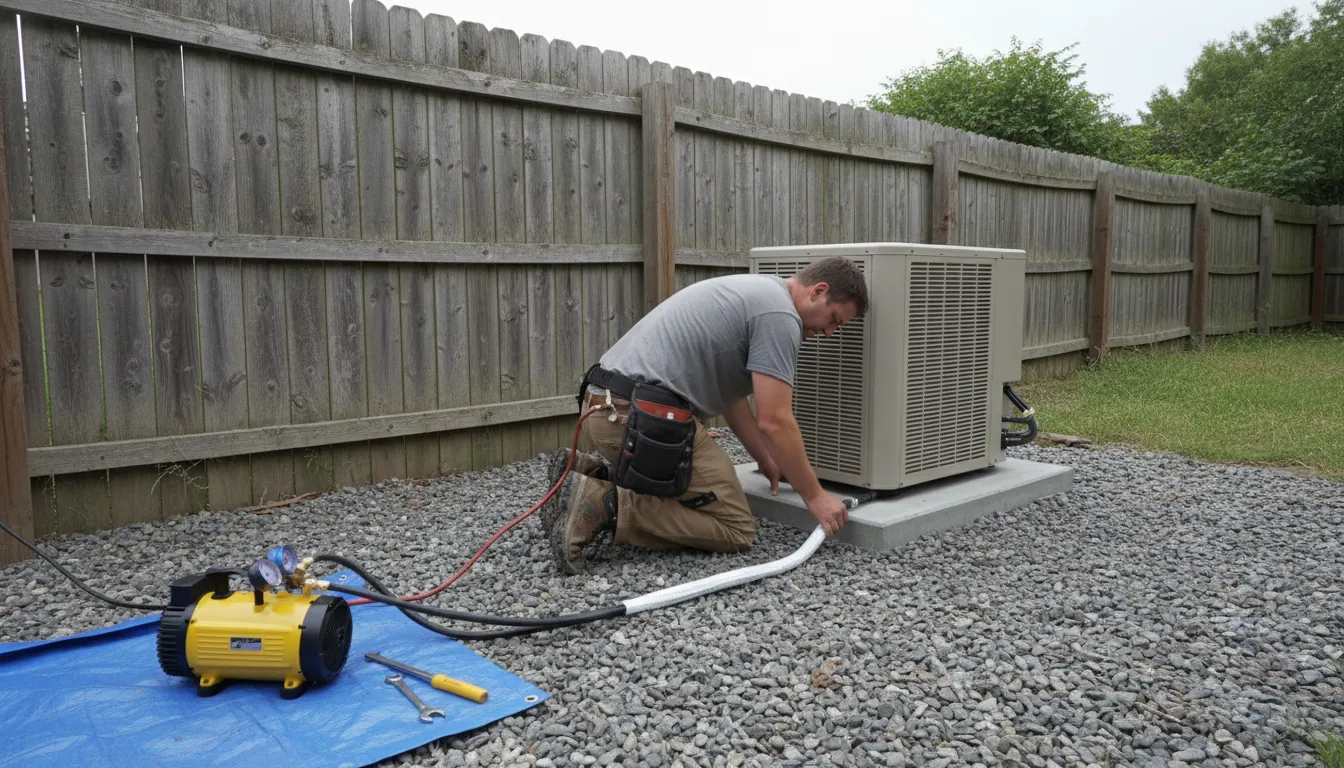
- Evacuation and Charging: This is a critical, highly technical step. The installer uses a vacuum pump to remove all air and moisture from the refrigerant lines (achieving a deep vacuum of 500 microns or less) before releasing the refrigerant from the unit's pre-charged lines 6. A pressure test with nitrogen may also be performed to check for leaks.
- System Testing and Commissioning: Finally, the system is powered on and tested in both heating and cooling modes. The technician will check for proper operation, airflow, and thermostat control.
Find the perfect mini-split installers for your needs
Get personalized recommendations and expert advice
Why DIY Installation is Not Recommended
While DIY mini-split kits are marketed, attempting a self-installation in West Virginia is strongly discouraged and often illegal for the unlicensed 7 8. The complexities and risks are substantial:
- Refrigerant Handling: Federal law requires a Section 608 EPA certification to handle refrigerant. Improper charging can ruin the compressor and lead to inefficient operation.
- Electrical Work: Incorrect wiring can cause equipment failure, create fire hazards, or lead to electrocution.
- Vacuum and Pressure Testing: Without a professional-grade vacuum pump and micron gauge, you cannot properly evacuate the lines. Trapped moisture will cause acid formation inside the compressor, leading to premature system failure.
- Warranty and Code Violations: Most manufacturers will void the equipment warranty if the system is not installed by a licensed professional. Unpermitted work can also lead to code violations and complications with your home insurance.
The potential cost of fixing mistakes from a DIY job far outweighs the initial savings of professional installation.
Cost Factors for Mini-Split Installation in West Virginia
The total cost for a ductless mini-split installation in West Virginia varies widely, typically ranging from a few thousand dollars to over ten thousand for multi-zone systems 9. Key factors influencing the price include:
- System Capacity and Zones: The BTU capacity and the number of indoor heads (single-zone vs. multi-zone) are the primary cost drivers.
- Equipment Efficiency: Higher SEER (cooling) and HSPF (heating) ratings indicate greater efficiency and come at a higher upfront cost.
- Labor Complexity: The difficulty of running lines (e.g., through finished walls, across attics, or to second stories), the need for an electrical panel upgrade, and the overall job site accessibility affect labor costs, which can range from $1,000 to $3,500 or more.
- Additional Materials and Services: Costs for a concrete pad ($150-$400), new electrical circuit or panel upgrade ($500-$2,000+), local permit fees ($100-$500), and any necessary drywall repair after installation should be factored into the total estimate 10 11.
Rebates and Incentives in West Virginia
West Virginia homeowners may qualify for financial incentives that can significantly offset the cost of a new, high-efficiency mini-split system.
- TakeCharge WV Home Performance Program: This program offers rebates for energy-efficient upgrades. For example, replacing electric resistance heat (like baseboard heaters) with a high-efficiency ductless mini-split heat pump (19 SEER) can qualify for a rebate of up to $750 12. Rebate amounts vary based on the system's efficiency ratings (SEER and EER) and the existing heat source being replaced.
- Home Efficiency Rebates (HER): Administered by the West Virginia Office of Energy, these upcoming rebates (based on the federal Inflation Reduction Act) will provide point-of-sale discounts on qualifying efficiency upgrades. The rebate amount will be tiered based on your household income relative to the Area Median Income (AMI) and the projected energy savings of the project 13.
A qualified HVAC professional can help you determine your eligibility and navigate the application process for these programs.
Maintaining Your New System
To protect your investment and ensure long-term efficiency, regular maintenance is key. This includes cleaning the filters in the indoor units monthly, ensuring the outdoor condenser coil is free of leaves and debris, and scheduling a professional tune-up every year or two. A professional service will check refrigerant levels, electrical connections, and overall system performance.
Frequently asked questions
Sources
Footnotes
-
West Virginia HVAC License & Certification | 2025 Contractor Guide - https://www.servicetitan.com/licensing/hvac/west-virginia ↩
-
West Virginia Code | §21-16-3 - https://code.wvlegislature.gov/email/21-16-3/ ↩
-
Do You Need a Permit to Install a Mini Split? Find Out Now - https://www.edsheatingandcooling.com/blog/do-you-need-a-permit-to-install-a-mini-split-find-out-now/ ↩
-
Do Mini Splits Need Permits? Installation Requirements Guide - https://www.greecomfort.com/news-and-events/do-mini-splits-need-permits/ ↩
-
935.0 Ductless Mini-Split Systems Installation - UpCodes - https://up.codes/s/ductless-mini-split-systems-installation ↩
-
Ductless mini-split installation: Cool 2025 Guide - Southern Air - https://www.southern-air.com/blog/ductless-mini-split-installation ↩
-
Can I Install a Mini-Split Myself? What You Should Know 2025 - https://bigalsservices.com/blog/can-i-install-mini-split-myself/ ↩
-
Mini Split Installation Guide: Permits, Codes & What DIYers Must ... - https://thefurnaceoutlet.com/blogs/news/mini-split-installation-guide-permits-codes-amp-what-diyers-must-know-to-stay-legal ↩
-
How Much Does it Cost to Install a Ductless Mini Split? | VA - https://arlingtonheating.com/how-much-does-it-cost-to-install-a-ductless-mini-split/ ↩
-
Ductless Mini-Split Installation Cost in 2025: Full Breakdown - https://osborneheatingncooling.com/ductless-mini-split-installation-cost/ ↩
-
Mini-Split Cost Breakdown & Incentives - The Furnace Outlet - https://thefurnaceoutlet.com/blogs/hvac-tips/mini-split-cost-breakdown ↩
-
West Virginia Home Performance Program - TakeCharge WV - https://takechargewv.com/resources/docs/Home%20Performance%20WV%20Rebates%20-%20valid%20until%2012.31.24.pdf ↩
-
Home Efficiency Rebates - West Virginia Office of Energy - https://energywv.org/funding-opportunities/home-energy-rebate-programs/home-efficiency-rebates/ ↩