Find the Best Mini-Split Installers for Your Business
No obligation • Fast responses • Nationwide coverage

Why you can trust HVAC Firms
HVAC Firms is a leading United States resource for evaluating HVAC service providers. Our team researches companies, checks credentials, and reviews customer feedback to present clear, unbiased information. Listings and rankings are based on merit, and companies cannot pay to change our editorial content.
Search providers near you
Best Mini-Split Installers in South Dakota Ranked
Installing a ductless mini-split system is a smart way to add efficient heating and cooling to your South Dakota home, especially for additions, sunrooms, or older properties without existing ductwork. These systems provide targeted comfort control and can significantly reduce energy bills compared to traditional HVAC options. This guide will help you understand the key considerations-from permits and professional standards to costs and incentives-so you can confidently find qualified local experts for your project.
Understanding Permits and Legal Requirements in South Dakota
Before any work begins, it's crucial to understand the local regulations governing HVAC installations. In South Dakota, installing a mini-split is considered a permanent mechanical system alteration, which typically requires official approval.
- Required Permits: Most city and county building departments will require you to pull permits for a mini-split installation. This often includes separate mechanical, electrical, and building permits. The mechanical permit covers the refrigerant lines and system integrity, the electrical permit ensures safe wiring and dedicated circuit installation, and the building permit addresses the structural penetration of your home's exterior wall.
- The Importance of Compliance: Skipping the permit process is not advisable. Unpermitted work can lead to fines, complications when selling your home, and may void your homeowner's insurance if a problem arises1. Furthermore, a proper inspection that follows the permit provides a vital safety check on the electrical and refrigerant work2.
- How to Proceed: Always check with your local city or county building department for their specific requirements. A reputable installation professional will be familiar with these local codes and often handle the permit application process on your behalf3.
The Critical Role of Professional Installation
While DIY "mini-split in a box" kits are marketed, professional installation is highly recommended for performance, safety, and warranty protection. Key technical steps require expert training and tools.
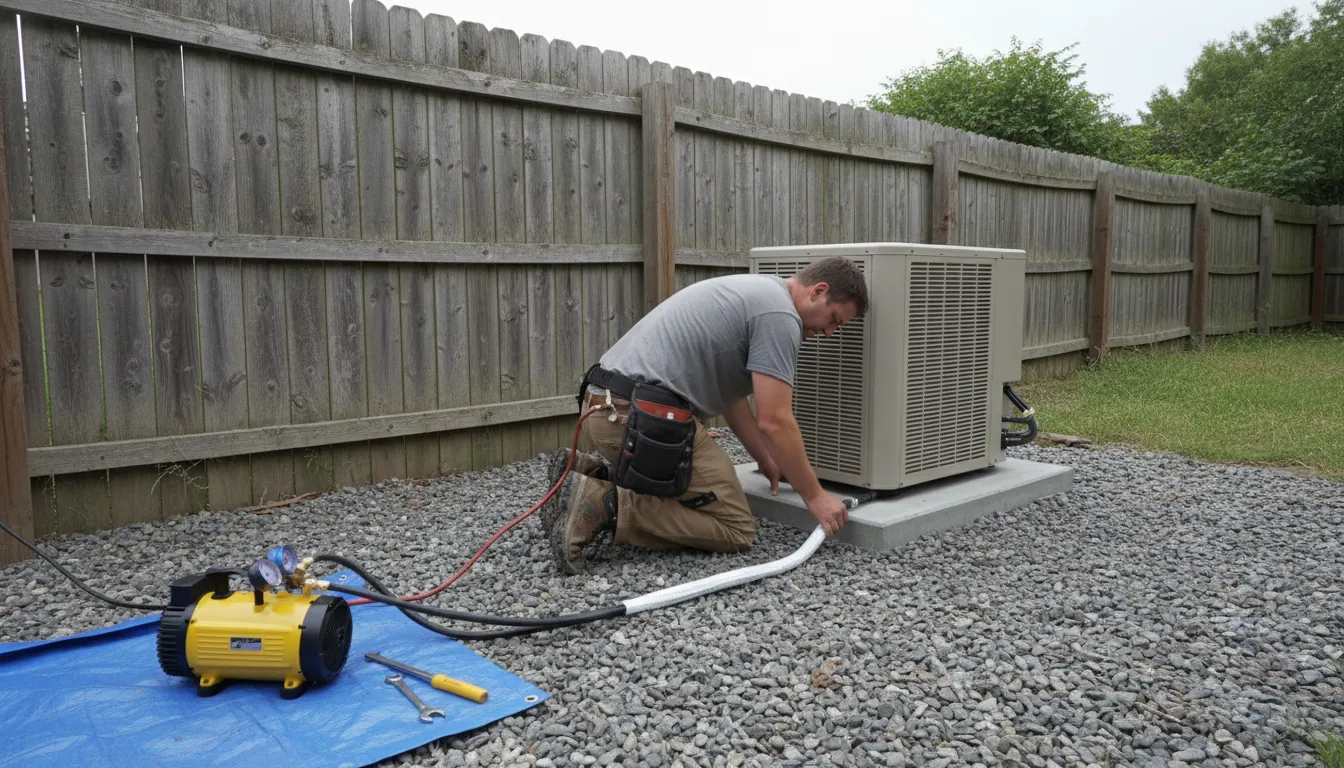
- Refrigerant Handling: Federal law mandates that anyone handling HVAC refrigerants must hold an EPA Section 608 Certification4. A professional will properly vacuum the lines to remove all moisture and air, which is essential for efficiency and preventing compressor damage. They also perform pressure tests to ensure there are no leaks.
- Electrical Safety: Installing a dedicated electrical circuit and correctly connecting the high-voltage power to the outdoor condenser is dangerous work best left to a licensed electrician or HVAC technician. Improper wiring poses a serious fire risk.
- System Optimization: Professionals ensure the system is charged with the correct amount of refrigerant, which is critical for achieving the advertised efficiency and heating/cooling capacity. They also test the system in both heating and cooling modes to verify proper operation.
Key Steps for a Successful Installation
A quality installation follows a meticulous process. Understanding these steps helps you evaluate potential installers and ensures your system performs well for years.
- Load Calculation and Sizing: The first step is a Manual J calculation. This is not a guess; it's a detailed assessment of your room's size, insulation, windows, and sun exposure to determine the exact heating and cooling capacity (measured in BTUs) needed. An oversized unit will short-cycle, wasting energy and failing to dehumidify properly. An undersized unit will struggle to maintain comfort.
- Strategic Unit Placement:
- Indoor Air Handler: Mounted high on an interior wall for optimal air circulation. It should be placed away from direct sunlight, heat sources, and obstructions to airflow5.
- Outdoor Condenser: Requires a stable, level pad (often concrete) at least 2-3 feet from the house to ensure adequate airflow. It should be positioned in a location with good drainage and clear access for future maintenance.
- Line Set and Drainage: The copper refrigerant lines and condensate drain line are run through a small hole in the wall. Professionals seal this penetration thoroughly to prevent air and water infiltration. The drain line must have a proper slope to allow condensation to flow away6.
Find the perfect mini-split installers for your needs
Get personalized recommendations and expert advice
Financial Considerations: Costs and Incentives
Investing in a mini-split system involves upfront costs but offers long-term savings and valuable financial incentives.
- Installation Cost Range: In South Dakota, total installed costs vary based on system complexity and brand.
- Single-Zone System: Installing one indoor unit connected to one outdoor condenser typically ranges from $4,000 to $8,000.
- Multi-Zone System: Installing one outdoor unit that supports two or more indoor air handlers generally costs $8,000 to $12,000 or more.
- Federal Tax Credits: The Inflation Reduction Act (IRA) provides a significant incentive. Homeowners can claim a tax credit of up to $2,000 or 30% of the project cost (whichever is less) for installing a qualifying high-efficiency mini-split heat pump7 8. This credit is available through 2032. The system must meet specific efficiency tiers (CEE Tier 1) set by the Consortium for Energy Efficiency9.
- Maximizing Efficiency and Savings: To qualify for incentives and ensure lower utility bills, look for systems with high SEER2 (Seasonal Energy Efficiency Ratio) ratings for cooling and high HSPF2 (Heating Seasonal Performance Factor) ratings for heating. A SEER2 rating of 20 or higher is considered excellent. While specific South Dakota utility rebates may be limited, it's always worth checking the U.S. Department of Energy and Energy Star websites for any updated local programs.
Choosing the Right Equipment and Professional
Your long-term satisfaction hinges on selecting a quality system and a qualified installer.
- Focus on the Installer, Not Just the Brand: A top-tier brand installed poorly will underperform. Seek out licensed, insured, and EPA-certified contractors. Ask for references and examples of past mini-split installations.
- Get a Detailed Quote: A professional quote should include the model numbers, a Manual J calculation summary, a breakdown of labor and equipment costs, permit fees, and a clear description of the work scope and warranty terms.
- Understand the Warranty: Equipment warranties often span 5-12 years for parts and the compressor. Crucially, the manufacturer's warranty usually requires professional installation to remain valid, another reason to avoid DIY attempts on complex systems10.
Frequently asked questions
Sources
Footnotes
-
Is It Legal to Install a Ductless Mini Split Without Permission? - https://dellahome.com/blogs/della-blog/is-it-legal-to-install-a-ductless-mini-split-without-permission ↩
-
Do You Need a Permit to Install a Mini Split? Find Out Now - https://www.edsheatingandcooling.com/blog/do-you-need-a-permit-to-install-a-mini-split-find-out-now/ ↩
-
Do You Need a Permit to Install a Mini Split System? - https://tosotdirect.com/blogs/life-well-lived/do-you-need-a-permit-to-install-a-mini-split-system ↩
-
Do Mini Splits Need Permits? Installation Requirements Guide - https://www.greecomfort.com/news-and-events/do-mini-splits-need-permits/ ↩
-
Ductless Mini Split Installation: A Complete Guide - https://www.goairflow.com/blog/ductless-mini-split-installation/ ↩
-
Ductless Mini Split Installation Guide: What Every Homeowner ... - https://www.aceanda.com/blog/ductless-mini-split-installation-guide-what-every-homeowner-should-know/ ↩
-
Ductless Mini-Split Installation Cost in 2025: Full Breakdown - https://osborneheatingncooling.com/ductless-mini-split-installation-cost/ ↩
-
Explore Discounts & Mini Split Tax Credits in 2025 - Carrier - https://www.carrier.com/residential/en/us/products/ductless-mini-splits/tax-credits/ ↩
-
Energy Efficiency and Tax Credits: Do Ductless Mini-Splits Qualify? - https://thefurnaceoutlet.com/blogs/hvac-tips/energy-efficiency-and-tax-credits-do-ductless-mini-splits-qualify ↩
-
Mini Split Installation Guide: Permits, Codes & What DIYers Must ... - https://thefurnaceoutlet.com/blogs/news/mini-split-installation-guide-permits-codes-amp-what-diyers-must-know-to-stay-legal ↩