Find the Best Mini-Split Installers for Your Business
No obligation • Fast responses • Nationwide coverage

Why you can trust HVAC Firms
HVAC Firms is a leading United States resource for evaluating HVAC service providers. Our team researches companies, checks credentials, and reviews customer feedback to present clear, unbiased information. Listings and rankings are based on merit, and companies cannot pay to change our editorial content.
Search providers near you
Best Mini-Split Installers in South Carolina Ranked
Installing a ductless mini-split system is a smart way to add efficient, zoned heating and cooling to your South Carolina home. These systems are particularly valuable for room additions, sunrooms, older homes without ductwork, or for targeting hot or cold spots. A professional installation is crucial for safety, performance, and to access available financial incentives. This guide will help you understand the process, regulations, and benefits of mini-split installation in the Palmetto State, so you can confidently connect with qualified local professionals.
Understanding Ductless Mini-Split Systems
A ductless mini-split system consists of one outdoor compressor/condenser unit connected by refrigerant lines to one or more indoor air-handling units. Unlike central HVAC, it requires no ductwork, which eliminates the energy losses associated with ducts-losses that can account for more than 30% of energy consumption for space conditioning, especially if the ducts are in an unconditioned space like an attic.
This ductless design makes mini-splits exceptionally efficient for targeted comfort. You can cool or heat individual rooms (zones) independently, which avoids wasting energy on unoccupied spaces. For South Carolina homeowners dealing with humid summers, many models also offer excellent dehumidification in cooling mode, improving indoor air comfort.
Why Professional Installation is Non-Negotiable
While DIY projects can be tempting, installing a mini-split is a job for licensed professionals. The process involves handling refrigerants under pressure, precise electrical work, and complex system commissioning.
- Refrigerant Handling: Federal law requires that anyone who performs installation, maintenance, or repair on systems containing refrigerant must be certified under Section 608 of the Clean Air Act 1. An improper seal can lead to leaks, which harm the environment, reduce system efficiency, and lead to costly repairs.
- Voided Warranties: Most manufacturers will void the equipment warranty if the system is not installed by a licensed HVAC professional 2.
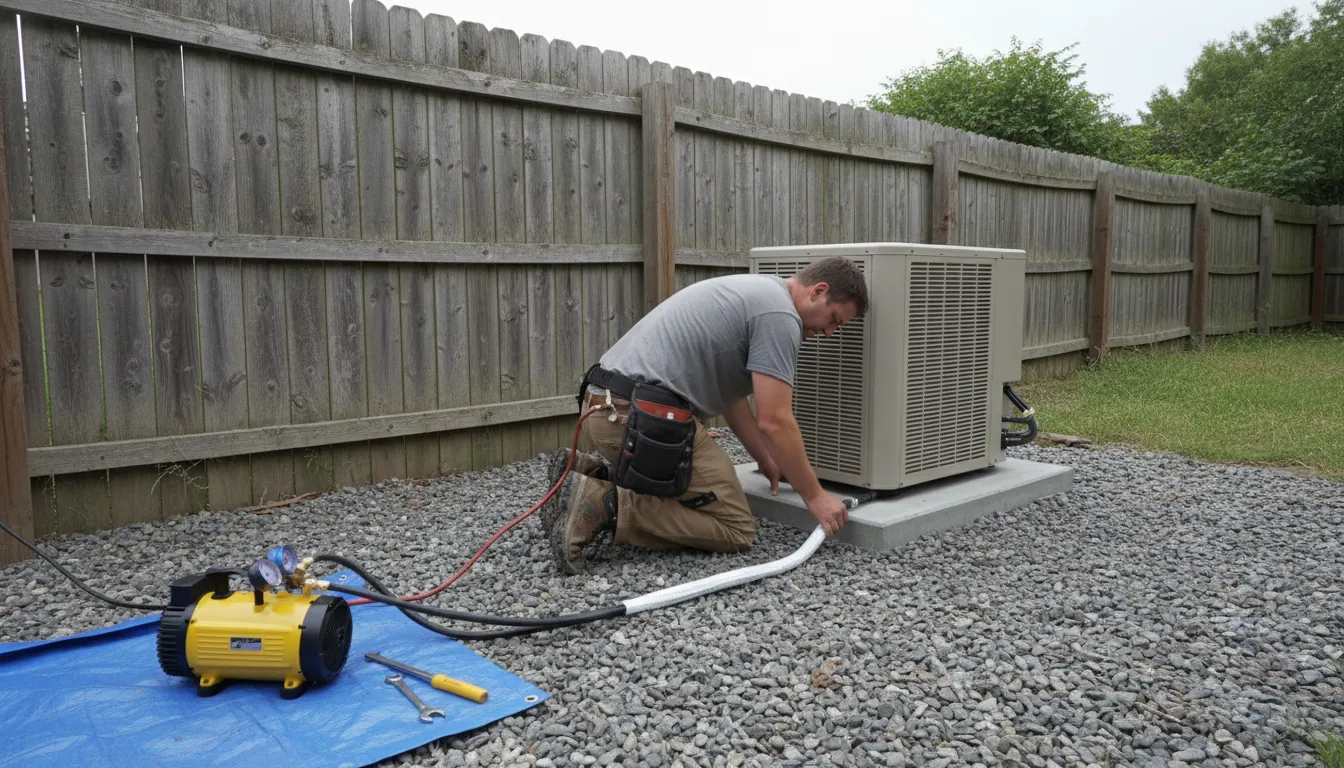
- Technical Precision: Key steps like properly evacuating air and moisture from the refrigerant lines with a vacuum pump are critical. Any moisture left in the lines can cause corrosion and compressor failure. Professionals also ensure the system is correctly charged with refrigerant for optimal performance.
Licensing and Permit Requirements in South Carolina
Navigating local regulations is a key part of a professional installer's job. Here's what you need to know:
- HVAC License: In South Carolina, contractors handling HVAC work, including the installation of mini-split systems, are required to hold the appropriate state license. This ensures they have the necessary training and insurance.
- EPA Certification: As mentioned, technicians must also hold EPA Section 608 certification to legally handle refrigerants.
- Permits: Most local municipalities in South Carolina require building and/or electrical permits for mini-split installation 3 4. The permit process ensures the installation complies with local building codes for electrical connections, structural support for the outdoor unit, and safe refrigerant line routing. Your installer will typically pull these permits on your behalf.
The Professional Installation Process: What to Expect
A quality installation follows a meticulous process to ensure long-term reliability and efficiency.
- Load Calculation and System Design: A professional will perform a Manual J load calculation to determine the precise heating and cooling needs (in BTUs) for your space. Proper sizing prevents short-cycling and inefficient operation.
- Unit Placement Planning: The installer will help determine optimal locations for the indoor and outdoor units. Indoor units should be placed high on a wall for best airflow, away from direct sunlight or heat sources. The outdoor unit needs a level, stable pad with adequate clearance for airflow and service access.
- Mounting and Drilling: The indoor unit bracket is securely mounted. A small, clean hole (typically 3 inches) is drilled through the wall to connect the indoor and outdoor units.
- Line Set Connection: The copper refrigerant lines, electrical wiring, and condensate drain line are run through the wall hole and connected between the units. These connections are meticulously brazed (soldered) to prevent leaks.
- Electrical Hookup: A dedicated electrical circuit is run from your home's panel to the outdoor unit, following all local code requirements.
- System Evacuation and Charging: This critical step involves using a vacuum pump to remove all air and moisture from the refrigerant lines before the system is charged with refrigerant 5 6.
- Testing and Commissioning: The installer will test the system for proper operation in both heating and cooling modes, check for refrigerant leaks, verify drainage, and demonstrate the controls to you.
Find the perfect mini-split installers for your needs
Get personalized recommendations and expert advice
Cost Breakdown for Mini-Split Installation in SC
The total cost for a ductless mini-split system in South Carolina varies based on system capacity, the number of indoor zones, and installation complexity. Here is a typical range:
- Equipment Costs: A single-zone system (one outdoor unit, one indoor head) ranges from $1,500 to $3,000 for the equipment itself. Multi-zone systems (one outdoor unit serving 2-5 indoor heads) can range from $3,000 to $10,000 or more for the equipment.
- Installation Labor: Professional installation for a single-zone system typically costs between $800 and $1,500. For multi-zone systems, installation labor can range from $1,500 to $3,000 or more, depending on the number of heads and the difficulty of running lines 7.
- Total Project Cost: For a complete installed system, homeowners in South Carolina can expect a total investment starting around $3,000 for a basic single-zone installation and ranging up to $12,000 or more for a comprehensive multi-zone system 8.
Maximizing Efficiency and Savings
Mini-splits are among the most efficient residential HVAC options available. Their inverter-driven compressors adjust speed to match demand precisely, avoiding the energy-intensive stop-start cycle of traditional systems.
- Efficiency Gains: Ductless systems can be 30-50% more efficient than conventional central HVAC systems with ductwork 9 10. Look for units with high SEER (Seasonal Energy Efficiency Ratio) ratings for cooling and high HSPF (Heating Seasonal Performance Factor) for heating.
- Financial Incentives: Significant incentives can offset the upfront cost.
- Utility Rebates: Always check with your local utility provider, such as Duke Energy, for available rebates on energy-efficient equipment. These rebates can provide direct savings on your bill or as a check after installation 13.
Long-Term Maintenance for Peak Performance
To protect your investment, simple maintenance is key. The primary task is regularly cleaning the reusable air filters in the indoor units-typically every few weeks during peak season. This maintains airflow, efficiency, and indoor air quality. While homeowners can handle filter cleaning, scheduling an annual professional maintenance check is recommended. A technician will inspect electrical connections, check refrigerant levels, clean the outdoor coil, and ensure all components are operating correctly for long system life.
Frequently asked questions
Sources
Footnotes
-
Your Guide to Buying Ductless Mini-Splits in Johns Island, SC - https://www.achvac.com/article/your-guide-to-buying-ductless-mini-splits-in-johns-island-sc ↩
-
Can I Install a Mini-Split Myself? What You Should Know 2025 - https://bigalsservices.com/blog/can-i-install-mini-split-myself/ ↩
-
Do You Need a Permit to Install a Mini Split? Find Out Now - https://www.edsheatingandcooling.com/blog/do-you-need-a-permit-to-install-a-mini-split-find-out-now/ ↩
-
Do Mini Splits Need Permits? Installation Requirements Guide - https://www.greecomfort.com/news-and-events/do-mini-splits-need-permits/ ↩
-
Ductless Mini-Split Installation in Upstate, SC - https://www.callwaldrop.com/ductless-mini-splits/installation/ ↩
-
Ductless Mini Split Installation Guide: What Every Homeowner ... - https://www.aceanda.com/blog/ductless-mini-split-installation-guide-what-every-homeowner-should-know/ ↩
-
Your Complete Guide to Ductless Mini-Split Systems - https://midstateheating.com/blog-details/your-complete-guide-to-ductless-mini-split-systems ↩
-
Ductless Mini-Split Installation Cost in 2025: Full Breakdown - https://osborneheatingncooling.com/ductless-mini-split-installation-cost/ ↩
-
Ductless mini-split installation: Cool 2025 Guide - Southern Air - https://www.southern-air.com/blog/ductless-mini-split-installation ↩
-
Mini-Split AC Installation Columbia SC | Zoned Comfort - https://carolinacomfortsc.com/home-air-conditioner-installation/mini-split-ac-installation/ ↩
-
Energy Efficiency and Tax Credits: Do Ductless Mini-Splits Qualify? - https://thefurnaceoutlet.com/blogs/hvac-tips/energy-efficiency-and-tax-credits-do-ductless-mini-splits-qualify ↩
-
Cost Breakdown: Equipment, Installation & Long-Term Value of Mini ... - https://thefurnaceoutlet.com/blogs/hvac-tips/cost-breakdown-equipment-installation-long-term-value-of-mini-splits ↩
-
SCPSC - Docket # 2024-303-E - Page 1 of 5 - DMS - https://dms.psc.sc.gov/Attachments/Matter/c76a5928-f9d5-424b-a331-90cd433473b1 ↩