Find the Best Mini-Split Installers for Your Business
No obligation • Fast responses • Nationwide coverage

Why you can trust HVAC Firms
HVAC Firms is a leading United States resource for evaluating HVAC service providers. Our team researches companies, checks credentials, and reviews customer feedback to present clear, unbiased information. Listings and rankings are based on merit, and companies cannot pay to change our editorial content.
Search providers near you
Best Mini-Split Installers in Ohio Ranked
Ductless mini-split systems are an increasingly popular solution for efficient heating and cooling in Ohio homes and businesses. These systems provide targeted comfort control, or zoning, without the need for extensive ductwork, making them ideal for room additions, older homes, or spaces where extending ducts is impractical. A successful installation is crucial for safety, efficiency, and system longevity. This guide explains the key considerations for installing a ductless mini-split in Ohio, from permits and professional requirements to costs and available financial incentives, helping you connect with qualified local experts for your project.

Lakeshore Heating & Cooling
1017 Woodstock Rd, Eastlake, OH 44095
Lakeshore Heating & Cooling is a locally owned HVAC contractor based in Eastlake, Ohio, serving Cleveland and surrounding areas including Willoughby, Mentor, and Painesville. They offer a full range of heating and cooling services such as furnace, boiler, heat pump, and air conditioning repair and installation, along with thermostat and mini split system services. The company is known for handling all major brands and providing tailored solutions to improve home comfort and energy efficiency. Lakeshore Heating & Cooling holds an A+ BBB rating and has earned a strong reputation for quality workmanship and customer care.
Mr. Air Heating and Air Conditioning
276 Trail E, Etna, OH 43062
Mr. Air Heating and Air Conditioning provides heating and cooling services in Columbus, OH. Since 2011, they have offered installation, repair, and tune-up services for air conditioners, furnaces, heat pumps, and ductless mini splits. The company also addresses indoor air quality concerns and offers a signature HVAC maintenance package. Their technicians are equipped to handle a variety of HVAC needs and provide 24-hour priority service without overtime rates.
High Performance Heating and Air
Cincinnati, OH
High Performance Heating and Air is an HVAC company based in Cincinnati, OH, offering a wide range of heating and cooling services. Their expertise includes air conditioning repair and installation, furnace and heat pump repair and replacement, ductless and mini split system installation, as well as indoor air quality services such as duct cleaning, air purifiers, and dehumidifiers. They also provide commercial HVAC services and sheet metal forming. The company emphasizes regular maintenance and tune-ups to improve system efficiency and indoor air quality.
Apollo Home
4538 Camberwell Rd, Cincinnati, OH 45209
Apollo Home is a Cincinnati, OH-based company offering a wide range of home services including HVAC installation and repair, duct cleaning, indoor air quality solutions, plumbing, and electrical work. They serve many neighborhoods around Cincinnati and specialize in maintaining and repairing heating and cooling systems, such as furnaces, heat pumps, air conditioners, and mini-split systems. Apollo Home also provides drain cleaning, sewer repair, and electrical upgrades to meet modern home demands. With decades of experience working in Cincinnati homes, they understand local challenges like aging systems and seasonal extremes. The company offers 24/7 emergency support to address urgent heating, cooling, and plumbing issues.
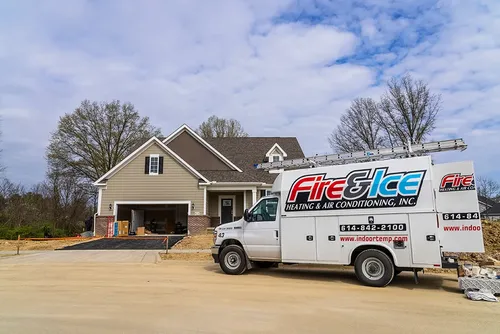
Fire & Ice Heating and Air Conditioning
848 Freeway Dr N, Columbus, OH 43229
Fire & Ice Heating and Air Conditioning provides heating, cooling, plumbing, and electrical services in Columbus, OH. They offer installation, repair, and tune-up services for HVAC systems including air conditioners, furnaces, heat pumps, and mini splits. The company supports homeowners with professional assessments and maintenance plans to ensure system efficiency and longevity. Fire & Ice also offers after-hours and weekend diagnostic services to address urgent HVAC issues promptly.
Why Choose a Ductless Mini-Split in Ohio?
Ohio's climate, with its hot, humid summers and cold winters, demands a versatile and efficient HVAC solution. Ductless mini-splits, which are essentially heat pumps, excel in this environment. They provide both cooling and highly efficient electric heating, often at a fraction of the cost of traditional electric resistance heat 1. For homes without existing ductwork, such as those with hydronic (boiler) heat or older properties, installing a ductless system is often more cost-effective and less invasive than adding a full duct system. They also solve comfort issues in specific rooms, like a sunroom that gets too hot or a finished basement that's too cold, by providing independent temperature control for different zones.
The Installation Process: What to Expect
A professional ductless mini-split installation is a multi-step process that requires specific expertise. Understanding what it entails can help you evaluate contractors and ensure the job is done correctly.
- Site Evaluation and Load Calculation: A certified technician will first assess your space to determine the correct size (capacity) of the system. An improperly sized unit will cycle too frequently, reduce efficiency, and fail to properly dehumidify or heat your space.
- Planning and Permitting: The installer will identify the best locations for the indoor air-handling unit(s) and the outdoor condenser. They will also handle pulling the necessary mechanical and electrical permits from your local municipality.
- Mounting and Drilling: The indoor unit is securely mounted on an interior wall, and a small, 3-inch hole is drilled through the exterior wall to connect it to the outdoor unit.
- Electrical Work: A licensed electrician must run a dedicated electrical circuit from your main panel to a disconnect box near the outdoor unit, and then to the unit itself. This is a critical safety and code requirement.
- Line Set Connection: The copper refrigerant lines, condensate drain line, and electrical wiring are run through the wall hole and connected between the indoor and outdoor units. These connections must be perfectly sealed.
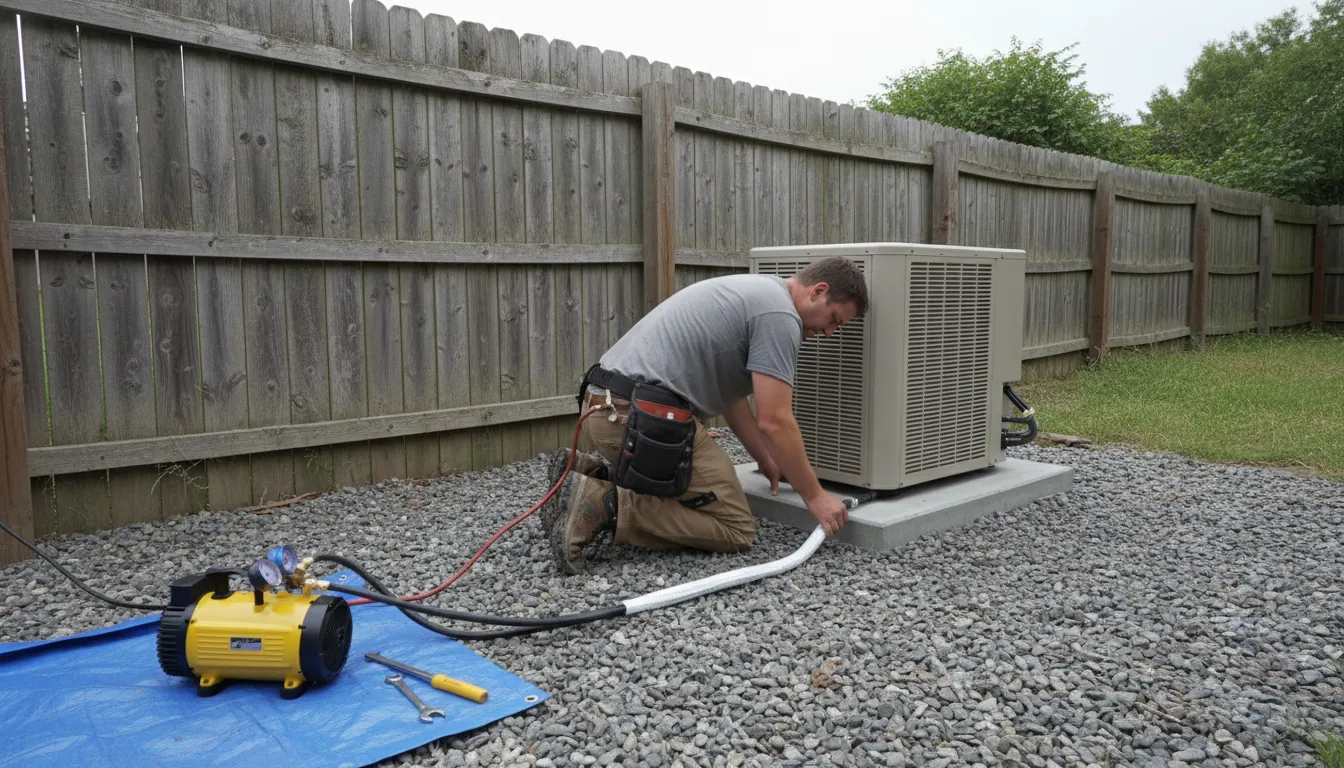
- Vacuum and Charge: The refrigerant lines are evacuated of all air and moisture using a high-powered vacuum pump-a step that is absolutely essential for system longevity and efficiency. The system is then charged with refrigerant.
- Testing and Commissioning: The technician will test all functions, check for leaks, verify drainage, and ensure the system is operating at peak performance before explaining its operation to you.
Permits, Codes, and the Importance of Professional Installation
In Ohio, installing a mini-split is not a typical DIY project. Local building codes require permits and licensed professionals to ensure safety and compliance.
- Permits Are Required: Most Ohio cities and townships require both a mechanical permit (for the HVAC system itself) and an electrical permit (for the new dedicated circuit) 2 3. Your contractor should obtain these. Failing to pull permits can result in fines, complicate a future home sale, and may void equipment warranties.
- Licensing is Crucial: Always hire a licensed HVAC contractor. In Ohio, this ensures the individual or company has met state requirements for knowledge and experience. The installation also involves handling refrigerant, which requires EPA Section 608 certification. The electrical work should be performed or finalized by a licensed electrician to meet National Electrical Code (NEC) standards 4 5.
- Key Code Considerations: Installations must adhere to codes that dictate proper clearances around the outdoor unit, secure mounting of both units, correct wiring gauge and circuit protection, and the installation of an accessible outdoor disconnect switch 6 7. A professional installer will be familiar with all local amendments to state and national codes.
Find the perfect mini-split installers for your needs
Get personalized recommendations and expert advice
Understanding the Costs of Mini-Split Installation in Ohio
The total investment for a ductless mini-split system in Ohio varies based on several factors. On average, homeowners can expect a range of $3,000 to $8,000 or more for a complete single-zone system installation. This wide range accounts for:
- System Capacity and Brand: Higher BTU capacity units and premium brands (like Mitsubishi, Daikin, or Fujitsu) command a higher price.
- Number of Zones: Multi-zone systems, with one outdoor unit serving multiple indoor heads, have a higher upfront cost but can be more cost-effective than installing several separate systems.
- Installation Complexity: The difficulty of running electrical lines, the distance between indoor and outdoor units, and the need for custom mounting solutions can affect labor costs.
- Additional Required Components: The total price should include the cost of permits (typically $250-$400), the outdoor condenser pad, a protective cover or stand, and the essential dedicated electrical circuit, which can cost $250 or more if your electrical panel needs updating 8 9.
Financial Incentives and Rebates in Ohio
A significant benefit of installing an energy-efficient ductless heat pump in Ohio is access to financial incentives that can substantially lower your net cost.
- Federal Tax Credit: The Energy Efficient Home Improvement Credit offers a tax credit for 30% of the project cost, up to a maximum of $2,000 per year. This applies to the purchase and installation of qualifying heat pump equipment 10 11 12.
- State and Utility Rebates: Ohio's Home Energy Savings Program, funded by federal HEEHRA and HOMES legislation, is rolling out substantial rebates for whole-home energy upgrades, including high-efficiency heat pumps 13. Income-eligible households may qualify for significant direct discounts.
- Local Utility Programs: Many Ohio utility companies offer rebates for installing efficient heat pumps. It's essential to check with your specific provider (e.g., Duke Energy Ohio, AEP Ohio, FirstEnergy utilities like Ohio Edison or The Illuminating Company) for current offers. Your HVAC contractor should be knowledgeable about available programs and can often help with the application paperwork.
Choosing the Right Contractor in Ohio
Selecting a qualified professional is the most important step in your mini-split project. Look for a contractor who:
- Holds valid Ohio HVAC and electrical licenses (or partners with a licensed electrician).
- Has specific, proven experience installing the brand of ductless system you are considering.
- Provides a detailed, written estimate that includes all equipment, labor, permit fees, and a description of the work to be performed.
- Is willing to perform a proper load calculation (Manual J) rather than just estimating by square footage.
- Can explain the local permit process and provide references from past mini-split installation clients.
Frequently asked questions
Sources
Footnotes
-
Are Ductless Mini Splits Suitable for Ohio? | JM Mechanical - https://www.jmmechanical.com/blog/heat-pump-service/are-ductless-mini-splits-suitable-for-ohio/ ↩
-
Ductless mini-split installation: Cool 2025 Guide - Southern Air - https://www.southern-air.com/blog/ductless-mini-split-installation ↩
-
Do You Need a Permit to Install a Mini Split? Find Out Now - https://www.edsheatingandcooling.com/blog/do-you-need-a-permit-to-install-a-mini-split-find-out-now/ ↩
-
Ductless Mini Split Installation Guide: What Every Homeowner ... - https://www.aceanda.com/blog/ductless-mini-split-installation-guide-what-every-homeowner-should-know/ ↩
-
Can I Install a Mini-Split Myself? What You Should Know 2025 - https://bigalsservices.com/blog/can-i-install-mini-split-myself/ ↩
-
Understanding Clevelands Mini Split Installation Regulations - https://www.wilsonplumbingandheating.com/post/cleveland-mini-split-installation-regulations ↩
-
Ductless Mini Split Setup: An Ultimate Guide - Airflow Heating & Air - https://www.goairflow.com/blog/ductless-mini-split-installation/ ↩
-
Mini Split AC Installation Cost Breakdown for Willoughby, OH Homes - https://www.tomschaeferplumbing.com/blog/air-conditioning-service/mini-split-ac-installation-cost-breakdown-for-willoughby-oh-homes/ ↩
-
Is a Ductless Mini-Split Installation a DIY Project A Complete Guide - https://www.heating-ac.com/blog/is-a-ductless-mini-split-installation-a-diy-project-a-complete-guide ↩
-
8 Energy Rebates and Incentives in Ohio | Cleveland, OH - https://www.pkwadsworth.com/blog/4-energy-rebates-and-incentives-in-ohio/ ↩
-
hvac rebates and tax incentives for energy efficient upgrades in ohio - https://cwaohio.com/blog/end-of-year-tax-credits-cwa/ ↩
-
Incentives and Rebates for Heat Pump Installation in Ohio | Anderson - https://www.myandersonhvac.com/incentives-and-rebates-for-heat-pump-installation-in-ohio/ ↩
-
Home Energy Savings Program - https://development.ohio.gov/individual/energy-assistance/energy-savings ↩