Find the Best Mini-Split Installers for Your Business
No obligation • Fast responses • Nationwide coverage

Why you can trust HVAC Firms
HVAC Firms is a leading United States resource for evaluating HVAC service providers. Our team researches companies, checks credentials, and reviews customer feedback to present clear, unbiased information. Listings and rankings are based on merit, and companies cannot pay to change our editorial content.
Search providers near you
Top Mini-Split Installers in Rio Rancho, New Mexico Ranked
A ductless mini-split system is a versatile heating and cooling solution that provides zoned comfort without the need for extensive ductwork. This makes it an ideal choice for many homes and businesses in Rio Rancho, from older properties to new additions. Understanding the installation process, costs, and benefits can help you decide if a ductless system is right for your space. This guide provides a detailed look at what to expect when installing a mini-split in Rio Rancho, helping you connect with qualified local professionals for your project.
Hi-Tech Heating and Cooling
2601 Wyoming Blvd NE #115D, Albuquerque, NM 87112
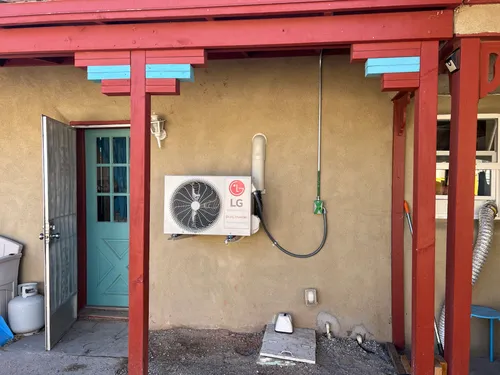
Hi-Tech Heating and Cooling provides residential and commercial HVAC services in Albuquerque, NM. With 20 years of experience, they specialize in the installation, repair, and maintenance of air conditioning, heating systems, heat pumps, furnaces, boilers, and ductless mini-splits. Their services include indoor air quality solutions, thermostat installation, and duct cleaning, all tailored to meet the unique climate needs of the Albuquerque area. The company offers comprehensive diagnostics, preventive maintenance, and emergency 24/7 repair services to ensure reliable system performance and comfort year-round. As authorized Lennox and LG dealers, they emphasize precise system sizing and energy-efficient installations backed by a satisfaction guarantee.
Kidzz Mechanical
11920 Menaul Blvd NE, Albuquerque, NM 87112
Kidzz Mechanical is a licensed contractor based in Albuquerque, NM, offering heating, cooling, plumbing, and electrical services. They provide HVAC repair and installation, including ductless mini split systems, as well as plumbing repairs and electrical upgrades. The company serves a broad area from Santa Fe to Las Cruces and extends into parts of Arizona such as Tucson and Phoenix. Kidzz Mechanical emphasizes precise and professional work supported by a dedicated customer service team. They also offer financing options and assist with tax credits and incentives for qualifying equipment.
Airlink Cooling & Heating Systems
Albuquerque, NM
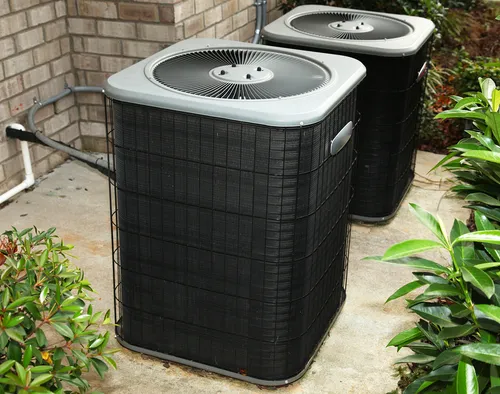
Airlink Cooling & Heating Systems is an HVAC contractor based in Albuquerque, NM, offering a range of heating and cooling services. They provide installation, repair, and maintenance for air conditioners, furnaces, heat pumps, mini splits, thermostats, and indoor air quality products. As a Carrier® dealer, they supply various indoor comfort equipment including air conditioners, heat pumps, gas furnaces, humidifiers, and air cleaners. Airlink Cooling & Heating Systems is experienced in servicing all brands and emphasizes integrity and respect in their customer interactions.
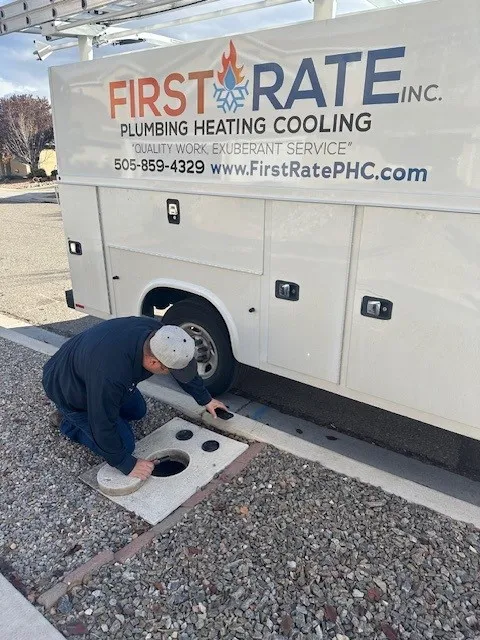
First Rate Plumbing Heating and Cooling Inc
4311 Sara Rd #212, Rio Rancho, NM 87124
First Rate Plumbing Heating and Cooling Inc is a locally owned HVAC and plumbing company based in Albuquerque, NM, serving the Rio Rancho area. With over 20 years of experience since 1999, they provide a wide range of services including air conditioning, furnace, heat pump, boiler, and mini split installation and repair, as well as indoor air quality solutions tailored to the local climate. Their certified technicians are knowledgeable about Rio Rancho building codes and offer expertise in installing and maintaining evaporative coolers and Breezair systems. The company also handles plumbing services, commercial HVAC projects, and ensures compliance with permits and regulations.
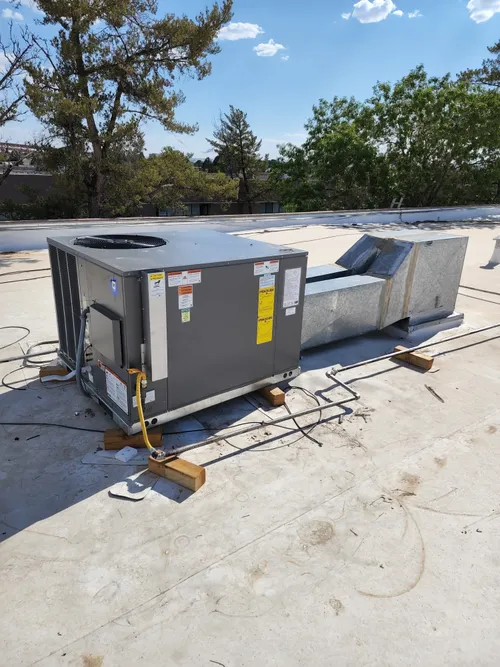
Armor Heating & Cooling LLC
2 Tribal Rd 47, Isleta, NM 87022
Armor Heating & Cooling LLC is a family-owned HVAC contractor serving Albuquerque, NM, and nearby areas including Rio Rancho and Los Lunas. They provide a range of heating and cooling services such as air conditioner and furnace repair, heat pump installation, mini-split systems, and indoor air quality solutions. The company also offers specialized services like UV air purifier installation, blower wheel cleaning, and gas line repair or installation. Armor Heating & Cooling LLC is licensed, bonded, and insured, and they provide a 10-year labor and parts warranty on select Coleman products. They handle both residential and commercial projects, emphasizing repairs to extend system life and offering competitive pricing.
Why Choose a Ductless System for Your Rio Rancho Home?
The New Mexico climate, with its hot summers and cool winters, demands an efficient and flexible climate control system. Ductless mini-split installations are increasingly popular in Rio Rancho because they solve specific challenges common in the area. For homes built without central air ducts-a frequent scenario in older properties-running new ductwork can be prohibitively expensive and invasive. A ductless system bypasses this need entirely.
Beyond whole-home solutions, these systems excel at providing targeted comfort. They are perfect for conditioning room additions, sunrooms, converted garages, or any space where extending the existing ducted system is impractical 1. The core benefit is zoned control, allowing you to heat or cool only the rooms you are using. This can lead to significant energy savings, as you're not conditioning unoccupied spaces 1.
Understanding Zoning: Single-Zone vs. Multi-Zone Setups
The flexibility of a ductless mini-split system comes from its zoning capabilities. Your choice between a single-zone or multi-zone configuration will define the system's scope and cost.
- Single-Zone Systems: This is the most straightforward setup, consisting of one indoor air-handling unit connected to one outdoor condenser. It's designed to condition a single room or open area, such as a master bedroom suite, home office, or garage workshop. Due to its simplicity, a single-zone installation is often the most budget-friendly entry point into ductless comfort.
- Multi-Zone Systems: A multi-zone configuration uses a single, more powerful outdoor condenser unit that connects to multiple indoor units (typically 2 to 8+). This allows you to create independent temperature zones throughout your home-keeping bedrooms cool at night while maintaining a different setting in the living room, for example. While the upfront investment is higher, a multi-zone system can be a comprehensive and efficient solution for whole-home comfort without ducts.
The Professional Installation Process: A Step-by-Step Overview
Professional installation is not just recommended for a ductless mini-split; it's critical for system performance, efficiency, and maintaining the manufacturer's warranty. The process involves precise technical work, particularly with refrigerant lines. Here's what a professional installation in Rio Rancho typically entails:
- Site Assessment and Planning: A technician will visit your home to determine the optimal locations for both the indoor and outdoor units. This involves considering airflow, drainage, electrical access, and aesthetics. They will also help you select the right type of indoor unit (wall-mounted, ceiling cassette, or floor console) for each space.
- Mounting the Indoor Unit: A mounting bracket is securely attached to an interior wall. A small hole (usually about 3 inches) is carefully drilled through the wall to the exterior for the connection lines. The indoor unit is then hung on the bracket.
- Placing the Outdoor Condenser: The outdoor unit is positioned on a stable, level pad or concrete slab. It's crucial to ensure adequate clearance on all sides (as specified in the manual) for proper airflow, drainage, and future servicing access.
- Connecting the Line Set: Insulated copper refrigerant lines, a condensate drain line, and electrical wiring are run through the wall hole and connected between the indoor and outdoor units. This is a precision task where lines must be kept clean and free of kinks.
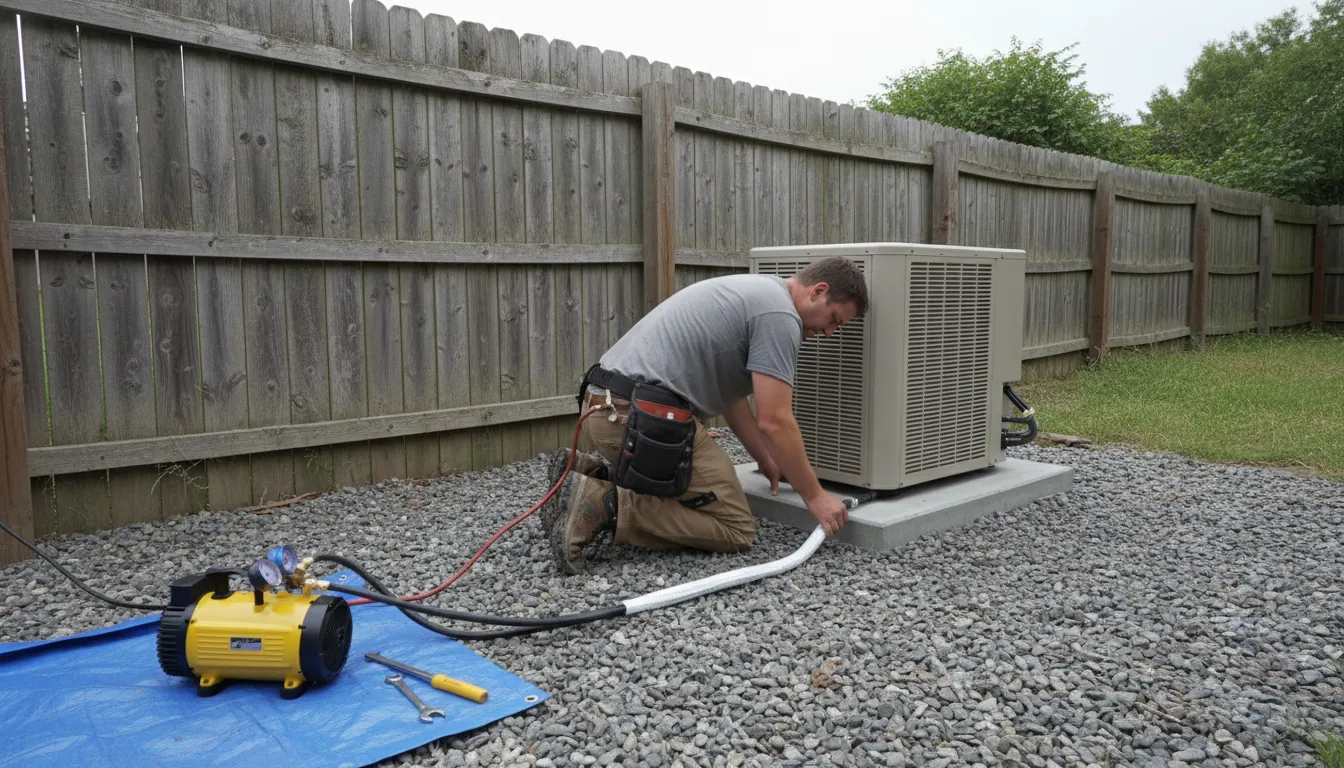
- Pressure Testing and Evacuation: This is one of the most important steps. The refrigerant lines are pressurized with nitrogen to check for leaks, then a deep vacuum is pulled to remove all moisture and non-condensable gases. Failure to do this correctly can lead to premature system failure.
- Electrical Connection: A licensed electrician will run a dedicated electrical circuit from your home's panel to the outdoor unit to ensure it has safe and adequate power 2 3.
- System Charging and Testing: Finally, the system is charged with the correct type and amount of refrigerant. The technician will test all modes of operation, check thermostat controls, and ensure the system is functioning efficiently before completing the job.
Key Considerations for Unit Placement
Where you place the indoor and outdoor units has a major impact on comfort, efficiency, and longevity.
- Indoor Unit Placement: For wall-mounted units (the most common type), installation high on a wall is standard. This allows cool air to be distributed downward in summer. Since heat rises, the high placement also helps circulate warm air in heating mode. The unit must be placed where there is unimpeded airflow, away from corners or behind furniture, and with easy access for filter cleaning 4.
- Outdoor Unit Clearances: The outdoor condenser needs space to breathe. Manufacturers specify minimum clearances (often 12-24 inches on the sides and much more from the top) to ensure hot exhaust air can dissipate. Placing it in a tightly enclosed space or against a wall can cause it to overheat, reduce efficiency, and shorten its life. Proper placement also facilitates easy access for routine maintenance and repairs 5 6.
Find the perfect mini-split installers for your needs
Get personalized recommendations and expert advice
Cost Ranges for Mini-Split Installation in Rio Rancho
The cost of a ductless mini-split installation in Rio Rancho can vary widely based on the system's complexity, capacity, and efficiency. The following ranges are based on typical professional installations in the area 7 8 9 10:
- Single-Zone System: A complete installation for one indoor/outdoor pair typically ranges from $2,000 to $6,000. The final price depends on the brand, the system's efficiency rating (SEER2 for cooling, HSPF for heating), the length of the line set run, and the complexity of the electrical work.
- Multi-Zone System: For a system with one outdoor unit serving 2-3 indoor zones, homeowners can expect costs in the range of $3,000 to $10,000 or more. Larger systems with four or more zones will be at the higher end of this scale and beyond. Multi-zone installations offer better value per zone for whole-home projects.
Major factors influencing cost include the equipment brand (e.g., Mitsubishi, Daikin, Fujitsu, Carrier), the need for additional electrical upgrades, the physical difficulty of the installation (e.g., second-story units, long line set runs), and local labor rates. Always obtain detailed, written estimates from licensed and insured local HVAC contractors.
The Local Advantage for Rio Rancho Residents
Choosing a local Rio Rancho or New Mexico-based HVAC company for your ductless installation offers distinct benefits. Local professionals are familiar with the specific demands of the high-desert climate and common home construction styles in the area. They understand the importance of a system that can handle both intense summer heat and winter chills efficiently. Furthermore, a local company provides quicker response times for any follow-up service needs or warranty work, ensuring your long-term comfort and satisfaction 11 12.
Frequently asked questions
Sources
Footnotes
-
Commercial Ductless Mini-Split Systems | Rio Rancho, NM - https://www.enchantedhillsmechanical.com/commercial-ductless-mini-split-systems ↩ ↩2
-
Ductless mini-split installation: Cool 2025 Guide - Southern Air - https://www.southern-air.com/blog/ductless-mini-split-installation ↩
-
How to Install a Ductless Mini-Split Air Conditioner | This Old ... - https://www.youtube.com/watch?v=ozaw9QhxkQU&t=25 ↩
-
How Much Does It Cost to Install a Mini-Split? [2026 Data] | Angi - https://www.angi.com/articles/how-much-does-it-cost-install-ductless-mini-split-ac.htm ↩
-
How to Install a Mini Split System - https://www.youtube.com/watch?v=J2nkLRbhfPY&t=99 ↩
-
Ductless Mini Split Setup: An Ultimate Guide - Airflow Heating & Air - https://www.goairflow.com/blog/ductless-mini-split-installation/ ↩
-
Mini Split Installation at The Home Depot - https://www.homedepot.com/services/c/mini-split-installation/723194ce9 ↩
-
Ductless Mini-Split Installation Cost in 2025: Full Breakdown - https://osborneheatingncooling.com/ductless-mini-split-installation-cost/ ↩
-
Understanding Mini Split Installation Costs A Complete Guide - https://armusmech.net/understanding-mini-split-installation-costs-a-complete-guide/ ↩
-
Ductless Mini Split Installation Costs in 2026 - Carrier - https://www.carrier.com/residential/en/us/products/ductless-mini-splits/ductless-mini-split-installation-cost/ ↩
-
Residential Ductless Mini-Split Systems | Rio Rancho, NM - https://www.enchantedhillsmechanical.com/residential-ductless-mini-split-systems ↩
-
Ductless Mini Split Installation and Repair in Rio Rancho, NM - https://airefficiencyhvac.com/ductless-mini-split-installation-rio-rancho-nm/ ↩