Find the Best Heat Pump Installation & Replacement Contractors for Your Business
No obligation • Fast responses • Nationwide coverage

Why you can trust HVAC Firms
HVAC Firms is a leading United States resource for evaluating HVAC service providers. Our team researches companies, checks credentials, and reviews customer feedback to present clear, unbiased information. Listings and rankings are based on merit, and companies cannot pay to change our editorial content.
Search providers near you
Best Heat Pump Installation & Replacement Contractors in West Virginia Ranked
Upgrading to a modern heat pump is one of the most effective ways for West Virginia homeowners to improve home comfort, reduce energy bills, and lower their carbon footprint. These efficient systems provide both heating and cooling from a single unit, making them a versatile choice for the state's varied climate. This guide provides clear, actionable information on heat pump options, costs, and the substantial financial incentives available to help you find and evaluate qualified local service providers for your project.
Understanding Heat Pump Technology
A heat pump is an all-in-one HVAC system that moves heat rather than generating it. In the winter, it extracts heat from the outside air (even in cold weather) and transfers it indoors. In the summer, the process reverses, pulling heat from your home and releasing it outside, functioning as an air conditioner. This efficient transfer of energy makes heat pumps significantly more efficient than traditional furnaces and standard air conditioners.
The two primary types available for West Virginia homes are:
- Air-Source Heat Pumps: The most common type, which includes central ducted systems and ductless mini-split units. They are effective in West Virginia's climate, especially with newer cold-climate models.
- Geothermal (Ground-Source) Heat Pumps: These systems use the stable temperature of the earth for heat exchange. They offer the highest efficiency but involve higher upfront costs due to required ground excavation or drilling.
Financial Incentives and Rebates in West Virginia
A combination of federal and state programs can dramatically reduce the net cost of a new heat pump system. Understanding these incentives is crucial for planning your budget.
Federal Tax Credit: Energy Efficient Home Improvement Credit (EEHIC)
This is a direct credit against your federal income tax liability.
- Amount: 30% of the total project cost, including equipment and installation.
- Maximum Credit: Up to $2,000 per year for a qualifying heat pump.
- Key Details: The credit applies through 2032. The heat pump must meet specific efficiency tiers set by the Consortium for Energy Efficiency (CEE). Your contractor should verify that the selected model qualifies 1.
Upfront Rebates: HEEHRA and HEER Programs
West Virginia is administering two major rebate programs funded by the Inflation Reduction Act, which provide point-of-sale discounts.
1. Home Electrification and Appliance Rebates (HEEHRA): This program offers substantial upfront discounts for low- and moderate-income households.
- Heat Pump Rebate: Up to $8,000 for a qualifying heat pump installation.
- Additional Support: Covers up to $4,000 for necessary electrical panel upgrades and up to $1,600 for insulation/weatherization.
- Total Potential: Up to $14,000 in total rebates per household.
- Income Limits: Rebates cover 100% of costs for households earning less than 80% of the Area Median Income (AMI), and 50% for those earning between 80-150% of AMI 2 3.
2. Home Efficiency Rebates (HEER): Focused on whole-home energy savings, this program provides rebates for comprehensive upgrades.
- Rebate Amount: Up to $8,000.
- Requirement: The package of improvements must achieve modeled energy savings of 15% or more. A professional home energy assessment is typically required to qualify 4 5.
Find the perfect heat pump installation & replacement contractors for your needs
Get personalized recommendations and expert advice
Cost Expectations for Installation & Replacement
The total investment for a heat pump system in West Virginia varies based on system type, home size, and installation complexity.
- Air-Source Heat Pump: For a full system replacement (including indoor and outdoor units), homeowners can expect a range of $7,000 to $20,000+ before incentives 6 7 8. A typical good-quality system often starts around $10,000.
- Geothermal System: These high-efficiency systems have a higher initial cost, typically starting around $20,000 to $25,000 or more, due to the ground-loop installation 9.
- Additional Costs: Be prepared for potential ancillary costs, such as upgrading electrical service ($1,500-$4,000), modifying ductwork, or completing a required home energy assessment ($200-$500).
Net Cost Example After Incentives
The power of combining incentives is substantial. Here's a simplified example for a moderate-income household:
- System & Install Cost: $10,000
- Federal Tax Credit (EEHIC): -$2,000 (30% of eligible cost, max applied)
- HEEHRA Rebate (50% for 80-150% AMI): -$4,000 (50% of the $8,000 max heat pump rebate)
- Estimated Net Cost: $4,000
For a lower-income household qualifying for 100% of the HEEHRA rebate, the net cost could be $0 or very minimal after the tax credit 10 11 12. It's essential to get a detailed quote and confirm your eligibility with contractors and the state program administrators.
Efficiency Standards and Qualifications
To qualify for the financial incentives mentioned, your new heat pump must meet specific efficiency ratings.
- Minimum Federal Standards: As of 2023, new central air-source heat pumps in the Southeast region (including West Virginia) must have a SEER2 rating of at least 14.3 and an HSPF2 of at least 7.5.
- Incentive Requirements: The federal tax credit and rebate programs require equipment to meet higher efficiency tiers. Generally, you will need a system that qualifies for the ENERGY STAR label and meets the highest efficiency tier defined by the Consortium for Energy Efficiency (CEE) for your region and equipment type 13. Your HVAC professional must provide the Manufacturer's Certification Statement to prove eligibility.
The Installation Process in West Virginia
A successful installation is key to achieving the promised efficiency and comfort.
- Initial Consultation & Assessment: A reputable contractor will perform a Manual J load calculation to correctly size the system for your home, avoiding inefficiency and comfort issues.
- Home Energy Audit: Many rebate programs, particularly HEER, require a professional energy assessment. This audit identifies other cost-effective upgrades like insulation and air sealing.
- System Selection & Quote: Based on the assessment, your contractor will recommend appropriately sized and efficient models that qualify for incentives and provide a detailed written quote.
- Rebate Pre-Approval: Work with your contractor and the West Virginia Office of Energy to understand the rebate application process and secure any necessary pre-approvals before work begins.
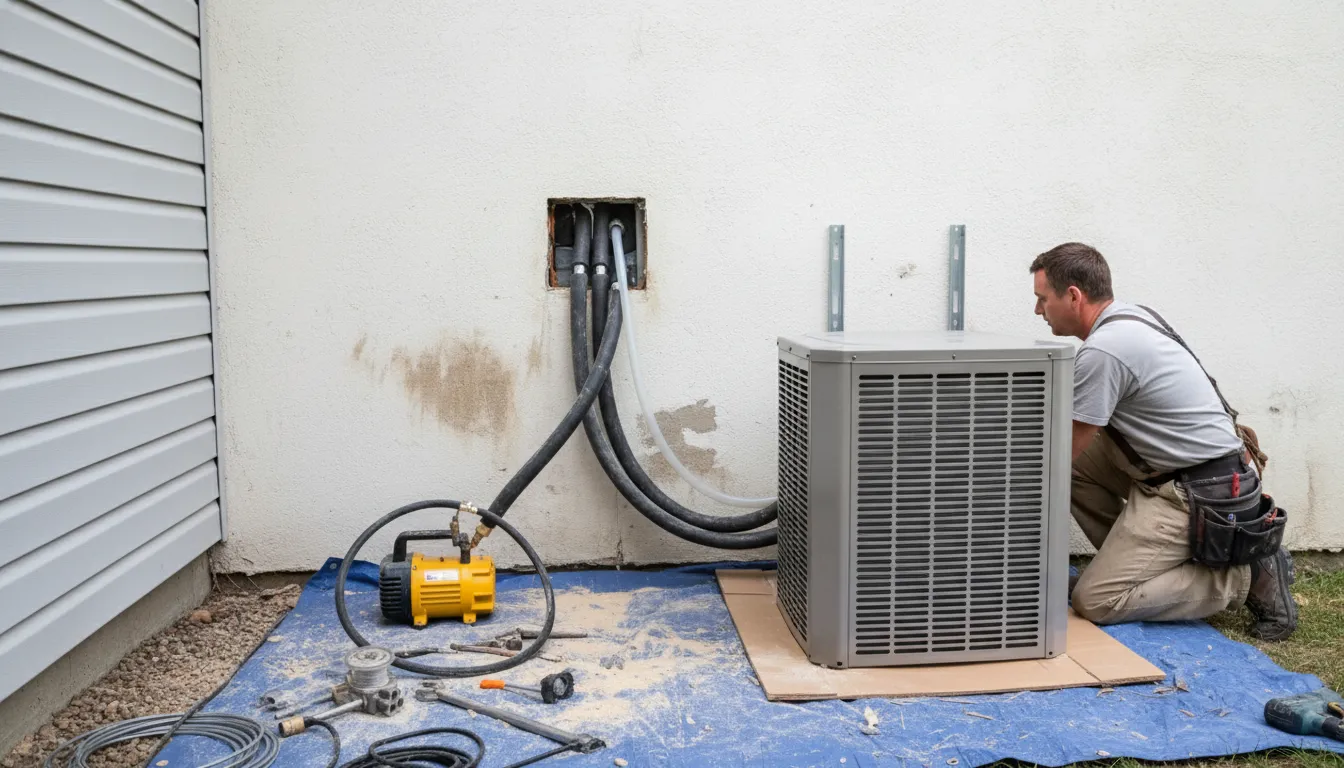
- Professional Installation: Proper installation includes setting correct refrigerant charge, ensuring airtight duct connections, and configuring the thermostat for optimal performance.
- Post-Installation: Keep all receipts, model numbers, and the Manufacturer's Certification Statement for your tax credit paperwork and final rebate submissions.
Finding a Qualified Provider
Choosing the right contractor is critical. Look for a West Virginia-based HVAC company that:
- Is licensed, insured, and has strong local references.
- Has specific experience installing the type of heat pump you are considering.
- Is familiar with the state and federal incentive paperwork and can help guide you through the process.
- Performs a detailed home assessment rather than providing a quote over the phone.
- Offers clear warranties on both equipment and labor.
The West Virginia Office of Energy website (energywv.org) is a recommended starting point for program details and may list participating or certified contractors.
Frequently asked questions
Sources
Footnotes
-
Federal Tax Credits for Energy Efficiency - https://www.energystar.gov/about/federal-tax-credits ↩
-
Heat Pump And The Inflation Reduction Act of 2022 - https://www.hillsidehvac.com/heat-pump-and-the-inflation-reduction-act-of-2022/ ↩
-
HEEHRA Rebate Program 2024 - Get full Details Here - https://www.acdirect.com/heehra-rebate-program-heat-pump ↩
-
Home Efficiency Rebates - West Virginia Office of Energy - https://energywv.org/funding-opportunities/home-energy-rebate-programs/home-efficiency-rebates/ ↩
-
Home Energy Rebates Frequently Asked Questions - https://www.energy.virginia.gov/energy-efficiency/HomeEnergyRebatesFrequentlyAskedQuestions.shtml ↩
-
West Virginia Home Performance Program - TakeCharge WV - https://takechargewv.com/resources/docs/Home%20Performance%20WV%20Rebates%20-%20valid%20until%2012.31.24.pdf ↩
-
Heat Pump Replacement Cost Guide by The Otter Guys - https://calltheotterguys.com/heat-pump-replacement-cost/ ↩
-
How Much Does It Cost To Install A Heat Pump? (Cost Guide) - https://aquariushomeservices.com/blog/heat-pump-installation-cost/ ↩
-
Home Electrification and Appliance Rebates - https://energywv.org/funding-opportunities/home-energy-rebate-programs/home-electrification-and-appliance-rebates/ ↩
-
Energy Efficient Home Improvement Credit | Internal Revenue Service - https://www.irs.gov/credits-deductions/energy-efficient-home-improvement-credit ↩
-
Air Source Heat Pumps Tax Credit - Energy Star - https://www.energystar.gov/about/federal-tax-credits/air-source-heat-pumps ↩
-
Maximize Savings with Heat Pump Tax Credits - Unlock Secrets Today! - https://www.richaircomfort.com/blog/heat-pump-tax-credits/ ↩
-
Southeast Region SEER2 New Efficiency Standards - https://seer2.com/region-southeast.html ↩