Find the Best Heat Pump Installation & Replacement Contractors for Your Business
No obligation • Fast responses • Nationwide coverage

Why you can trust HVAC Firms
HVAC Firms is a leading United States resource for evaluating HVAC service providers. Our team researches companies, checks credentials, and reviews customer feedback to present clear, unbiased information. Listings and rankings are based on merit, and companies cannot pay to change our editorial content.
Search providers near you
Best Heat Pump Installation & Replacement Contractors in South Carolina Ranked
Upgrading to a heat pump is a smart move for South Carolina homeowners seeking year-round comfort, lower energy bills, and a reduced carbon footprint. These efficient systems provide both heating and cooling by transferring heat rather than generating it, making them a versatile solution for the state's humid summers and mild winters. With significant new federal and local utility incentives available, the cost of installing a high-efficiency heat pump is more affordable than ever. This guide will help you understand your options, the available financial rebates, and how to find qualified local professionals to ensure a successful installation.
Understanding Heat Pump Technology
A heat pump is an all-in-one heating and cooling system that moves heat from one place to another. In the summer, it extracts heat from inside your home and releases it outdoors, functioning like an air conditioner. In the winter, the process reverses, pulling ambient heat from the outside air or ground and concentrating it inside to warm your home. This method of heat transfer is significantly more energy-efficient than traditional systems that create heat by burning fuel.
For South Carolina's climate, which features hot, humid summers and generally mild winters, a properly sized heat pump is an ideal primary system. It efficiently manages humidity during cooling season and provides ample heat for most winter days, offering consistent comfort throughout the year.
Types of Heat Pumps Available
When considering a heat pump upgrade, you'll encounter three main types, each with its own advantages.
Air-Source Heat Pumps: This is the most common and widely installed type. It transfers heat between your home and the outside air. Modern cold-climate air-source models are highly efficient even in cooler temperatures, making them a excellent fit for nearly all of South Carolina. They are typically less expensive to install than geothermal systems.
Geothermal Heat Pumps (Ground-Source): These systems use the stable temperature of the earth a few feet below the surface as a heat exchange medium. While they have a higher upfront installation cost due to the required ground loop, they offer the highest efficiency and lowest operating costs, leading to greater long-term savings 1. They are also exceptionally quiet and have a long lifespan.
Hybrid or Dual-Fuel Systems: This configuration pairs an air-source heat pump with a traditional gas furnace. The system intelligently switches between the two fuel sources based on outdoor temperature and efficiency. The heat pump handles heating during milder weather, and the furnace takes over during extreme cold snaps. This can be a cost-effective option for maximizing efficiency while ensuring backup heating capacity 2.
Financial Incentives and Rebates in South Carolina
A major reason to consider a heat pump installation now is the unprecedented amount of financial assistance available from federal and state programs, as well as local utilities. These incentives can reduce your net cost by thousands of dollars.
Federal Tax Credits
The Energy Efficient Home Improvement Credit (IRS Form 5695) provides a tax credit worth 30% of the cost of a qualified heat pump, up to $2,000 per year3. This credit is available for systems "placed in service" between 2023 and 2032. The heat pump must meet specific efficiency criteria, which most ENERGY STAR certified models satisfy.
State of South Carolina Rebate Programs
The South Carolina Energy Office is administering two key federal rebate programs funded by the Inflation Reduction Act:
- Home Electrification and Appliance Rebates (HEAR): This program offers point-of-sale rebates for low- and moderate-income households. Rebates are based on your household income as a percentage of the Area Median Income (AMI). For heat pumps, you could receive up to $8,000. The total maximum rebate across all eligible electrification projects (like heat pumps, water heaters, and electrical panel upgrades) is $14,000 for a single home.
- Home Efficiency Rebates (HOMES): This program provides rebates based on the verified energy savings achieved through a whole-home energy upgrade. If you undertake a comprehensive retrofit that includes a heat pump, you could qualify for rebates up to $16,000, depending on the percentage of energy saved 4 5.
Find the perfect heat pump installation & replacement contractors for your needs
Get personalized recommendations and expert advice
Local Utility Rebate Programs
Many South Carolina utilities offer their own rebates to encourage the adoption of high-efficiency equipment. These often stack with federal incentives.
- Dominion Energy South Carolina: Offers rebates for replacing old, inefficient systems with high-efficiency heat pumps. Rebates can be up to $1,000, and they sometimes offer a "double rebate" for early replacement of functioning but inefficient equipment 6.
- Duke Energy: Provides rebates for upgrading to high-efficiency heat pumps, with amounts up to $1,000. The exact rebate value often increases with the system's efficiency rating (SEER2/HSPF2) 7 8.
- Santee Cooper (and its electric cooperatives): Offers rebates through its EmpowerHome program. For a standard air-source heat pump meeting minimum efficiency (16.2 SEER2/8.0 HSPF2), the rebate is $400. For qualifying geothermal heat pump systems, the rebate increases to $6009.
Heat Pump Costs and What Influences Them
The total cost for a new heat pump system in South Carolina typically ranges from $6,000 to over $25,00010 11. This wide range is due to several key factors:
- System Size and Capacity: Measured in tons, the correct size for your home is calculated based on square footage, insulation, window quality, and other factors. An undersized or oversized system will perform poorly.
- Efficiency Rating: Higher efficiency units with superior SEER2 (cooling) and HSPF2 (heating) ratings cost more upfront but save significantly on monthly utility bills and often qualify for higher rebates.
- Equipment Type: As discussed, geothermal systems have a much higher installation cost due to the ground loop. Hybrid systems are generally more expensive than standard air-source models.
- Installation Complexity: The cost can increase if new ductwork is needed, electrical service must be upgraded, or if the installation site is difficult to access.
- Brand and Features: Premium brands and models with advanced features (like variable-speed compressors for ultra-quiet operation and precise temperature control) will be at the higher end of the price spectrum.
It's crucial to view this cost through the lens of available incentives. A $15,000 high-efficiency system might qualify for an $8,000 HEAR rebate, a $1,000 utility rebate, and a $2,000 federal tax credit, bringing your net investment down to $4,000.
How to Choose the Right Contractor
The quality of the installation is just as important as the quality of the equipment. A improper installation can drastically reduce efficiency, lifespan, and comfort.
- Verify Licensing and Insurance: Always hire a contractor who is licensed to work in South Carolina and carries both liability and workers' compensation insurance.
- Look for Certifications: Seek out companies with technicians certified by organizations like North American Technician Excellence (NATE) or who are factory-trained by specific heat pump manufacturers.
- Get Multiple Detailed Quotes: Obtain written estimates from at least three contractors. The quote should include the specific model numbers, efficiency ratings, a detailed scope of work, warranty information, and a complete breakdown of all costs.
- Ask About Rebate Expertise: A knowledgeable contractor will be familiar with the HEAR, HOMES, and local utility rebate processes and can often help you with the paperwork.
- Check References and Reviews: Read online reviews on independent platforms and ask the contractor for references from recent heat pump installation projects.
The Installation Process: What to Expect
A professional heat pump installation typically follows these steps:
- Initial Consultation and Load Calculation: A technician will visit your home to assess your needs, discuss options, and perform a Manual J load calculation to determine the precise system size required.
- Equipment Selection and Proposal: Based on the assessment, the contractor will recommend specific models and provide a formal proposal.
- Rebate Pre-Qualification (if applicable): For income-based programs like HEAR, you may need to verify eligibility with the South Carolina Energy Office before proceeding.
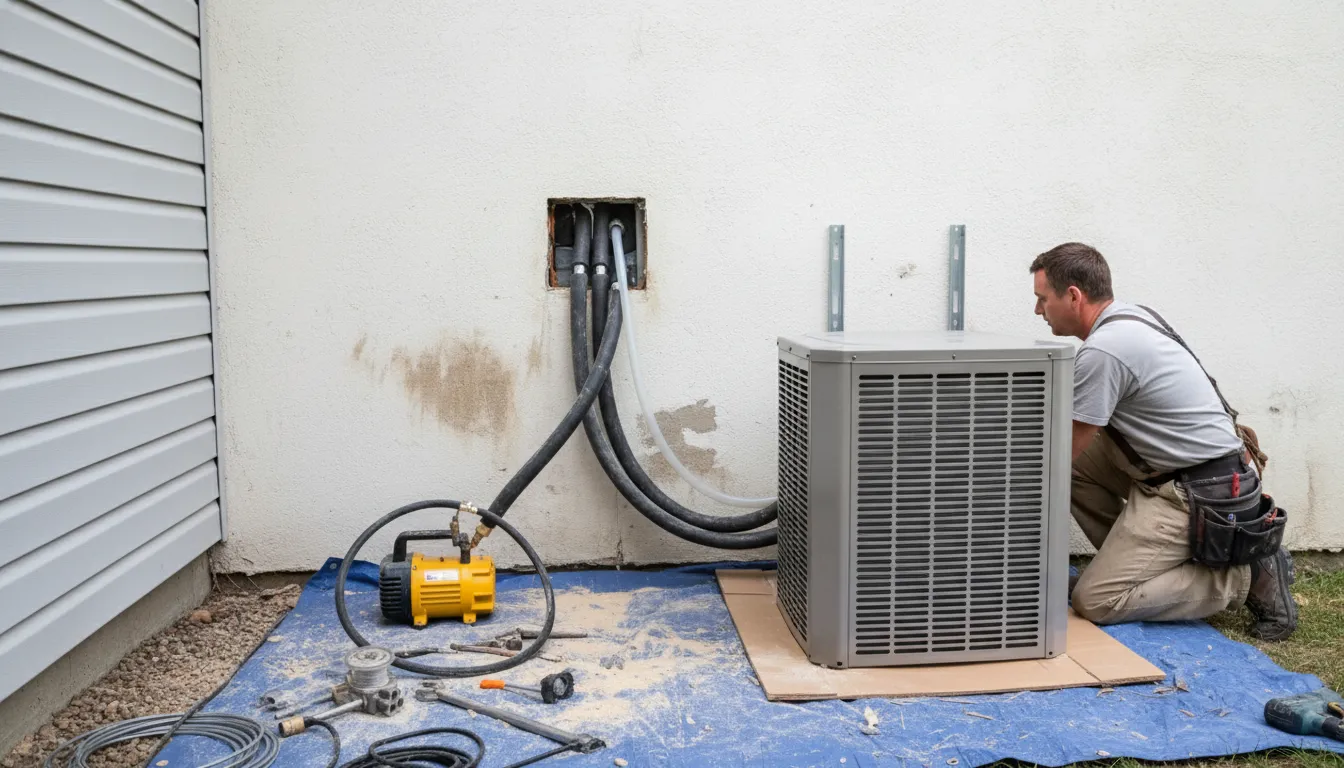
- Installation Day: The crew will remove the old equipment, install the new outdoor condenser and indoor air handler or coil, connect refrigerant lines and electrical wiring, and integrate the system with your existing ductwork or install new ducts if needed.
- System Testing and Commissioning: The technician will test the system for proper operation, check refrigerant charge, ensure airflow is correct, and calibrate the thermostat. They will also review the system's operation and maintenance requirements with you.
- Rebate Submission: You or your contractor will submit the necessary documentation to your utility and any other rebate programs.
Maintaining Your New Heat Pump
To protect your investment and ensure peak efficiency, regular maintenance is essential. This includes simple tasks like cleaning or replacing air filters monthly and keeping the outdoor unit clear of debris like leaves and grass clippings. You should also schedule a professional tune-up at least once a year. A qualified technician will inspect electrical components, check refrigerant levels, clean coils, and ensure the system is operating at its designed efficiency.
Frequently asked questions
Sources
Footnotes
-
Home Upgrades | Department of Energy - https://www.energy.gov/save/home-upgrades ↩
-
Dual Fuel Heat Pump Cost | Hybrid Heat Pump Cost - https://www.fixr.com/costs/hybrid-heat-pump ↩
-
Energy Efficient Home Improvement Credit - IRS - https://www.irs.gov/credits-deductions/energy-efficient-home-improvement-credit ↩
-
South Carolina Home Energy Rebates - https://energy.sc.gov/rebates ↩
-
INFLATION REDUCTION ACT REBATES: - SC Energy Office - https://energy.sc.gov/sites/energy/files/Documents/Inflation%20Reduction%20Act%20Rebate%20Information%20%26%20FAQ.pdf ↩
-
Replacing New Equipment | South Carolina - Dominion Energy - https://www.dominionenergy.com/south-carolina/save-energy/heating-and-cooling-rebates/replacing-new-equipment ↩
-
Rebate for HVAC Replacement - Duke Energy - https://www.duke-energy.com/Home/Products/Home-Energy-Improvement/HVAC-Replacement?jur=FL01 ↩
-
Guide to South Carolina Energy Rebate Programs - https://iconwindowanddoor.com/guide-to-south-carolina-energy-rebate-programs/ ↩
-
Energy Efficient Heat Pumps - Santee Cooper - https://www.santeecooper.com/programs-incentives/empowerhome/heat-pumps/ ↩
-
2026 Heat Pump Cost Guide: Purchase, Installation & Repair - Carrier - https://www.carrier.com/residential/en/us/products/heat-pumps/how-much-does-a-heat-pump-cost/ ↩
-
Everything Homeowners Need to Know About 2-Ton Heat Pumps: Costs, Installation, and Replacement - https://thefurnaceoutlet.com/blogs/news/everything-homeowners-need-to-know-about-2-ton-heat-pumps-costs-installation-and-replacement ↩