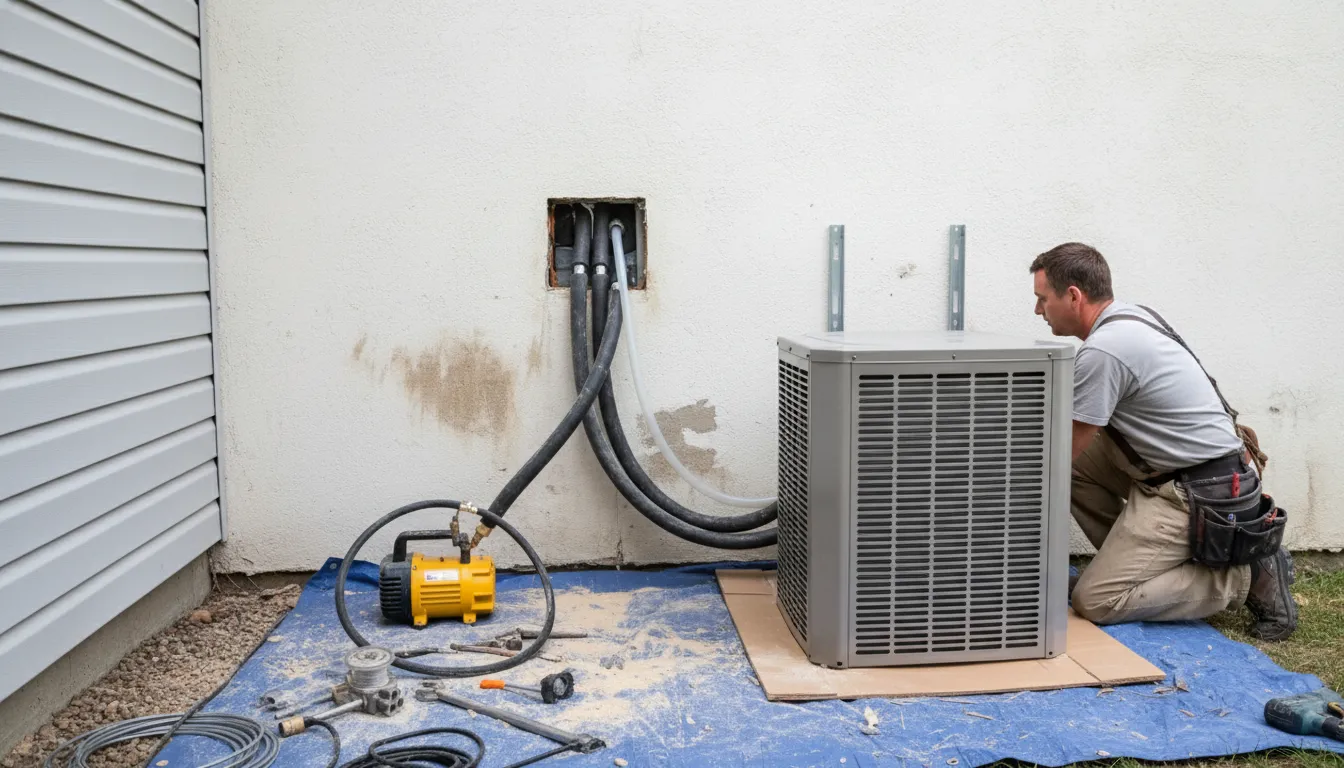
Find the Best Heat Pump Installation & Replacement Contractors for Your Business
No obligation • Fast responses • Nationwide coverage

Why you can trust HVAC Firms
HVAC Firms is a leading United States resource for evaluating HVAC service providers. Our team researches companies, checks credentials, and reviews customer feedback to present clear, unbiased information. Listings and rankings are based on merit, and companies cannot pay to change our editorial content.
Search providers near you
Top Heat Pump Installation & Replacement Contractors in Cranston, Rhode Island Ranked
Upgrading your home's heating and cooling system to a modern heat pump is one of the most impactful energy decisions a Cranston homeowner can make. This technology provides efficient, year-round comfort by moving heat rather than generating it, which can lead to significant savings on utility bills. For residents navigating this upgrade, understanding the types of systems available, the substantial local incentives, and the process for finding a qualified installer is key to a successful project.
Why Consider a Heat Pump in Cranston?
Cranston's climate, with its cold winters and warm, humid summers, is ideally suited for modern cold-climate heat pump technology. Unlike older models, today's advanced systems are engineered to extract heat from the outdoor air efficiently, even when temperatures drop well below freezing. This makes them a viable primary heating source for most Rhode Island homes, replacing or supplementing traditional furnaces or boilers. The dual functionality of providing both heating and cooling from one unit simplifies your home's mechanical systems and can improve overall indoor air quality and comfort.
The move toward heat pumps is strongly supported by state and federal goals to reduce carbon emissions. For you, this translates into powerful financial incentives that make the transition more affordable than ever. By choosing a heat pump, you're not only investing in home comfort but also participating in Rhode Island's clean energy future, often with a faster payback period thanks to lower operating costs and available rebates 1.
Types of Heat Pump Systems
Choosing the right system depends on your home's layout, existing infrastructure, and comfort goals. The two primary categories are air-source and ground-source heat pumps.
Air-Source Heat Pumps (ASHPs) This is the most common type installed in Cranston homes. ASHPs transfer heat between your house and the outside air. They come in two main configurations:
- Ducted Systems: These utilize your home's existing forced-air ductwork to provide whole-home heating and cooling. They are an excellent replacement for a traditional central air conditioner and furnace combo.
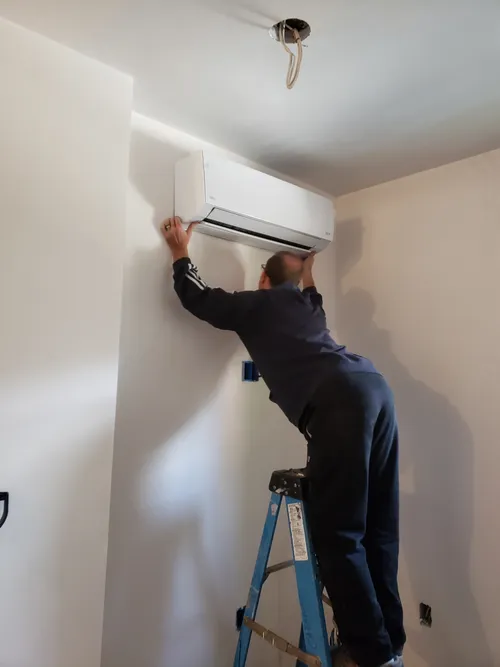
- Ductless Mini-Split Systems: These consist of an outdoor compressor unit connected to one or more indoor air handlers mounted on walls or ceilings. They are perfect for homes without ducts, for room additions, or for creating "zones" with independent temperature control in different parts of the house 2 3.
Ground-Source Heat Pumps (Geothermal) Geothermal systems use the stable temperature of the earth a few feet below the surface as a heat exchange medium. They are exceptionally efficient and reliable in all weather conditions but come with a significantly higher upfront cost due to the required ground loop installation 4. For homeowners with the property and budget, they offer unparalleled long-term efficiency and savings.
Efficiency & Performance in Our Climate
A major concern for homeowners is whether a heat pump can handle a Cranston winter. The good news is that cold-climate air-source heat pumps are specifically designed for this challenge. Their efficiency is measured by coefficients of performance (COP); a COP of 3 or 4 means the system moves 3 to 4 units of heat for every 1 unit of electricity consumed, achieving 300-400% efficiency 5. This is dramatically more efficient than traditional electric resistance heating or standard gas furnaces.
While heat pumps excel in moderate to cold temperatures, their heating capacity gradually decreases as the outdoor temperature plummets. In extreme cold snaps, a secondary or backup heat source (like electric resistance strips integrated into the system or your existing furnace in a hybrid setup) may activate to maintain comfort 6. This design ensures reliable performance year-round, making them a robust solution for our region.
Understanding Costs & Incentives
The total investment for a heat pump installation in Cranston varies widely based on system type, size, and home complexity. For a standard air-source system, homeowners can expect a typical range of $6,000 to $25,000. Ductless mini-splits for a single zone start on the lower end, while whole-home, ducted replacements or multi-zone systems reach the higher end. Geothermal systems are more, often starting above $20,000.
Crucially, these upfront costs are substantially offset by generous incentives:
- Rhode Island Energy Clean Heat Program: This local utility offers rebates of up to $10,000 for qualifying heat pump installations 7. The exact amount depends on the system's efficiency and your household income.
- Federal Tax Credit: The Residential Clean Energy Credit provides a 30% tax credit on the total cost of purchase and installation, with no upper limit, through 2032 8. This credit can be combined with state rebates.
- Additional Rebates: Programs like those for Heat Pump Water Heaters can provide up to $600 back, further increasing your savings 9.
When you stack these incentives, the out-of-pocket expense can be reduced by 40-50% or more10. The ongoing energy savings-often 30-60% compared to traditional electric or oil heat-mean the system can pay for itself in as little as 5 to 8 years11 10.
Find the perfect heat pump installation & replacement contractors for your needs
Get personalized recommendations and expert advice
The Installation Process: A Step-by-Step Guide
A successful heat pump project starts with careful planning. Here's a roadmap for Cranston homeowners:
- Home Assessment: Begin by evaluating your home's needs. Key factors include the size and layout of your living space, the quality of your insulation and windows, and whether you have existing ductwork. A well-insulated home ensures your new system works efficiently.
- Professional Consultation & Quotes: It is essential to get detailed proposals from multiple licensed, local HVAC contractors who specialize in heat pumps. They should perform a formal load calculation (like a Manual J) to correctly size the system for your home-a critical step for efficiency and comfort 12.
- Incentive Navigation: Before finalizing any contract, visit the Rhode Island Energy website to confirm the latest rebate amounts and application procedures for the Clean Heat RI program. Your chosen contractor should be familiar with these programs and able to guide you.
- Consider a Home Energy Audit: Organizations like RISE Engineering offer free or low-cost home energy assessments 13. An audit can identify air leaks, insulation gaps, and other issues that should be addressed to maximize your heat pump's performance and savings.
Choosing the Right Local Contractor
Your installer's expertise is as important as the equipment itself. Look for a Cranston-area contractor with specific, proven experience installing the type of heat pump system you're considering. They should be fully licensed, insured, and offer strong warranties on both labor and equipment. Ask for references from recent local installations and verify they are an authorized dealer for the brands they propose. A reputable professional will transparently explain your options, provide a clear, detailed quote, and handle all permitting and incentive paperwork.
Frequently asked questions
Sources
Footnotes
-
Heat Pump Performance in Rhode Island Winters - UG Nasons - https://ugnasons.com/energy-efficiency/heat-pump-performance-in-rhode-island-winters-separating-fact-from-fiction/ ↩
-
Air-Source Heat Pumps | Rhode Island Office of Energy ... - https://energy.ri.gov/heating-cooling/renewables/air-source-heat-pumps ↩
-
Heat Pump Price Guides - https://heatpumppriceguides.com/ ↩
-
Heat Pump Installation & Repair in Rhode Island & Massachusetts - https://armusmech.net/heat-pumps/ ↩
-
Heat Pump Installation | Northern RI & Southern MA - https://www.kafinoil.com/heat-pump-system-installation ↩
-
Heat Pump vs Traditional Heating RI | Best Winter Options - https://ugnasons.com/energy-efficiency/heat-pump-vs-traditional-heating-what-works-best-in-rhode-island-winters/ ↩
-
Incentives - Clean Heat Rhode Island - https://cleanheatri.com/resources/incentives/ ↩
-
2026 Heat Pump Cost Guide: Purchase, Installation & Repair - Carrier - https://www.carrier.com/residential/en/us/products/heat-pumps/how-much-does-a-heat-pump-cost/ ↩
-
Clean Heating & Cooling Incentives | Rhode Island Office of Energy ... - https://energy.ri.gov/heating-cooling/clean-heating-cooling-incentives ↩
-
Winter Heating Costs Rhode Island 2024 - UG Nasons - https://ugnasons.com/energy-efficiency/winter-heating-costs-in-rhode-island-how-much-should-you-really-expect-to-pay/ ↩ ↩2
-
The Ultimate Guide to Heat Pumps - https://www.martelplumbingri.com/blog/ultimate-guide-rhode-island-heat-pumps/ ↩
-
How to Choose the Ideal Home Heating System for Your Home in Rhode Island - T.H. Malloy & Sons, Inc. - https://www.thmalloy.com/posts/how-to-choose-the-ideal-home-heating-system-for-your-home-in-rhode-island ↩
-
Heat Pumps in Rhode Island: Pros and Cons to Know Before ... - https://www.neighborhoodsolar.us/post/heat-pumps-in-rhode-island-pros-and-cons-to-know-before-buying-and-installing ↩