Find the Best Heat Pump Installation & Replacement Contractors for Your Business
No obligation • Fast responses • Nationwide coverage

Why you can trust HVAC Firms
HVAC Firms is a leading United States resource for evaluating HVAC service providers. Our team researches companies, checks credentials, and reviews customer feedback to present clear, unbiased information. Listings and rankings are based on merit, and companies cannot pay to change our editorial content.
Search providers near you
Best Heat Pump Installation & Replacement Contractors in Arkansas Ranked
Upgrading to a modern heat pump is one of the most effective ways for Arkansas homeowners to improve home comfort, reduce energy bills, and lower their carbon footprint. These efficient systems provide both heating and cooling from a single unit, making them a smart year-round solution for the state's humid summers and chilly winters. Finding the right local professional for your heat pump project is crucial, as proper sizing, installation, and integration with existing ductwork are key to achieving optimal performance and unlocking valuable financial incentives.
Understanding Heat Pump Technology
A heat pump doesn't generate heat by burning fuel; instead, it moves existing heat from one place to another. In cooling mode, it extracts heat from inside your home and releases it outdoors. In heating mode, the process reverses, pulling ambient heat from the outside air-even in cold weather-and concentrating it inside your home. This method of heat transfer is significantly more efficient than traditional electric resistance heating or standard air conditioners paired with furnaces.
Modern air-source heat pumps are engineered to perform efficiently in a wide range of climates, including Arkansas's temperature swings. Key performance metrics to understand include:
- SEER2 (Seasonal Energy Efficiency Ratio): Measures cooling efficiency. A higher SEER2 rating means greater cooling efficiency and lower summer electricity costs.
- HSPF2 (Heating Seasonal Performance Factor): Measures heating efficiency. A higher HSPF2 rating indicates better heating performance, which is vital for winter comfort and savings.
- COP (Coefficient of Performance): A ratio of heating output to electrical energy input. A COP of 3.6, for example, means the system delivers 3.6 units of heat for every 1 unit of electricity consumed.
For Arkansas homeowners, selecting a system with high SEER2 and HSPF2 ratings is not just about energy savings; it's often a requirement to qualify for substantial rebates and tax credits.
Financial Incentives for Arkansas Homeowners
The upfront cost of a new heat pump system is offset by a robust combination of federal, state, and utility incentives designed to make high-efficiency upgrades more accessible.
Federal Tax Credit
The Energy Efficient Home Improvement Credit offers a significant benefit. You can claim 30% of the total project cost, up to a maximum of $2,000 per year, for the purchase and installation of a qualifying heat pump system. This credit applies to your federal income tax liability and is available for installations completed through the end of 2032 1 2. There is no lifetime dollar limit, so you can use the credit in subsequent years for other eligible improvements.
Utility Rebate Programs
Many Arkansas utility companies offer direct rebates that reduce your invoice at the point of installation or provide a check after the work is completed.
- SWEPCO (Southwestern Electric Power Company): Offers some of the most substantial incentives in the state. Rebates can exceed $2,200 for upgrading to a high-efficiency heat pump, with even higher amounts available for homes converting from electric resistance heat (like baseboard heaters). To qualify, systems must meet specific high-efficiency thresholds (e.g., 15.2 SEER2 and 7.25 HSPF2) and be installed by a participating contractor 3 4 5.
- Liberty Utilities: Provides tiered rebates based on the efficiency of the installed system. For example, rebates may range from $150 to $500 for heat pumps meeting certain SEER and HSPF criteria 6.
- Entergy Arkansas: While their current residential rebate focus is often on heat pump water heaters and appliances, it is always wise to check their website or contact them directly for any updated HVAC incentive programs.
Arkansas Home Energy Rebates (IRA Programs)
Arkansas is administering federal Inflation Reduction Act (IRA) funding through the Home Energy Rebates Program. Managed by the Arkansas Department of Energy and Environment (ADEQ), these programs are expected to offer direct rebates for whole-home energy upgrades, including heat pumps, with a focus on lowering the burden for middle- and low-income households. Homeowners should monitor the ADEQ website for official launch dates and application details 7.
Find the perfect heat pump installation & replacement contractors for your needs
Get personalized recommendations and expert advice
Cost Considerations and System Selection
The total investment for a new heat pump installation in Arkansas typically ranges from $6,000 to $25,000 8 9. This wide range is influenced by several factors:
- System Capacity and Size: Proper sizing, measured in tons, is critical. An oversized or undersized unit will perform inefficiently. A professional should perform a Manual J load calculation to determine the correct size for your home.
- Efficiency Rating: Higher SEER2 and HSPF2 systems have a higher initial cost but offer greater long-term savings and qualify for better rebates.
- Equipment Type: Options include standard single-stage, more efficient two-stage, and premium variable-speed (inverter-driven) models that offer the quietest operation and most precise temperature control.
- Installation Complexity: The condition of existing ductwork, electrical service, and the need for new linesets or thermostats can affect labor costs.
- Brand and Features: Different manufacturers offer various warranties, smart features, and durability.
While the sticker price may seem high, the combination of monthly energy savings and available incentives can dramatically improve the return on investment, making a high-efficiency system a financially sound choice.
The Installation Process: Steps to Success
A successful heat pump installation is a multi-step process that ensures your system delivers on its promise of efficiency and comfort.
- Initial Consultation and Load Calculation: A reputable contractor will assess your home's insulation, windows, square footage, and layout to perform a Manual J calculation. This determines the precise heating and cooling capacity needed, avoiding guesswork.
- System Design and Proposal: The contractor will recommend specific equipment that matches the load calculation, fits your budget, and meets rebate requirements. They should provide a detailed, written proposal outlining equipment models, labor scope, warranty information, and a final price.
- Verification of Incentives: Before signing a contract, confirm that the chosen equipment meets the specific SEER2/HSPF2/COP requirements for the rebates you plan to use (e.g., SWEPCO's criteria) 10 11. Ensure the contractor is approved by your utility if required.
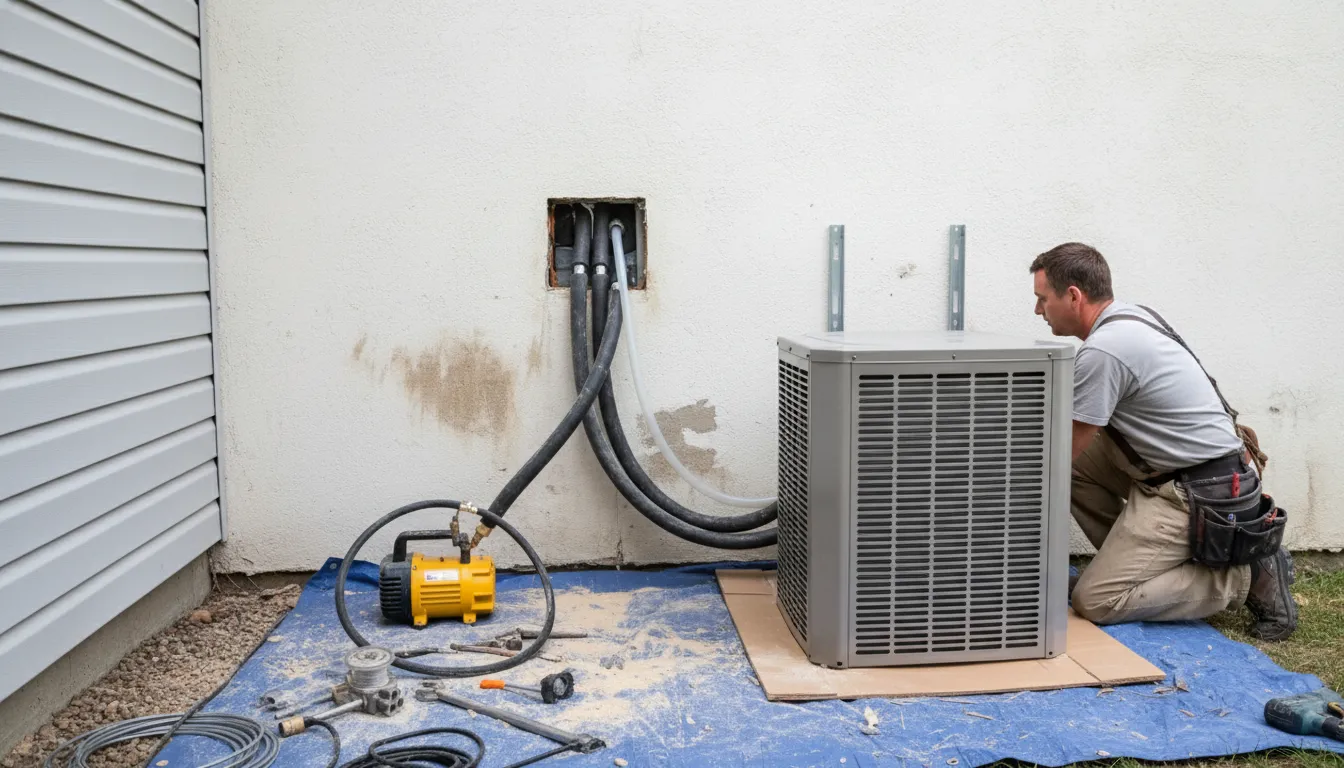
- Professional Installation: A proper installation includes setting the outdoor unit on a stable pad, correctly brazing refrigerant lines with nitrogen purge to prevent contamination, ensuring proper airflow across indoor coils, and calibrating the thermostat.
- Post-Installation and Rebate Submission: The contractor should test the system, demonstrate its operation, and provide you with all necessary documentation (model numbers, serial numbers, efficiency certificates) for submitting rebate applications and claiming your federal tax credit 12.
Maintaining Your Heat Pump for Peak Performance
To protect your investment and maintain efficiency, regular maintenance is essential. Homeowners should change or clean air filters every 1-3 months. Annually, a professional HVAC technician should perform a comprehensive check, including cleaning coils, inspecting refrigerant levels, checking electrical connections, and ensuring the defrost cycle operates correctly in winter. Proper maintenance helps prevent costly repairs, extends the system's lifespan, and keeps it running at its advertised efficiency.
Frequently asked questions
Sources
Footnotes
-
Energy Efficient Home Improvement Credit | Internal Revenue Service - https://www.irs.gov/credits-deductions/energy-efficient-home-improvement-credit ↩
-
Heat Pump Incentives, Tax Credits, and Rebates (2025) - EnergySage - https://www.energysage.com/heat-pumps/heat-pump-incentives/ ↩
-
Arkansas Heat Pump Rebates 2025: Federal Tax Credits ... - https://thefurnaceoutlet.com/blogs/news/arkansas-heat-pump-rebates-2025-federal-tax-credits-swepco-incentives-amp-savings ↩
-
HVAC Incentive Program - https://www.swepco.com/savings/home/money/incentives/hvac ↩
-
Tax Credits For Home Energy Upgrades - 2255 - https://www.swepco.com/savings/home/newsletter/story?StoryID=2255 ↩
-
Arkansas Residential HVAC Rebates - Liberty Utilities - https://central.libertyutilities.com/uploads/AR%20Electric%20Residential%20Rebate%20Flyer%20and%20Application.pdf ↩
-
Home Energy Rebates Program | DEQ - https://www.adeq.state.ar.us/energy/assistance/home-energy-rebates.aspx ↩
-
2026 Heat Pump Costs | Purchase, Installation & Repair - Carrier - https://www.carrier.com/residential/en/us/products/heat-pumps/how-much-does-a-heat-pump-cost/ ↩
-
How Much Does It Cost To Install A Heat Pump? (Cost Guide) - https://aquariushomeservices.com/blog/heat-pump-installation-cost/ ↩
-
Heat Pump HVAC Savings | EPA ENERGY STAR - https://www.energystar.gov/homesavings/air-source-heat-pumps/learn?zipcode=11218&incentiveid=100001 ↩
-
[2026] Northwest Arkansas HVAC & Energy Rebates: A Complete List - https://www.getfranklin.com/blog/northwest-arkansas-hvac-energy-rebates-complete-list ↩
-
Residential point of purchase solutions - Entergy Arkansas - https://www.entergyarkansas.com/energyefficiency/residential/point-of-purchase ↩