Find the Best Furnace Repair Companies for Your Business
No obligation • Fast responses • Nationwide coverage

Why you can trust HVAC Firms
HVAC Firms is a leading United States resource for evaluating HVAC service providers. Our team researches companies, checks credentials, and reviews customer feedback to present clear, unbiased information. Listings and rankings are based on merit, and companies cannot pay to change our editorial content.
Search providers near you
Best Furnace Repair Companies in Vermont Ranked
A reliable furnace is essential for comfort and safety during Vermont's long, cold winters. When your heating system fails, finding a qualified professional quickly becomes a top priority. This guide provides practical information on common furnace problems, the repair process, and key considerations for Vermont homeowners to help you understand your options and make informed decisions about maintaining and repairing your heating system.
Common Furnace Problems in Vermont Homes
Understanding the symptoms of a failing furnace can help you communicate more effectively with a technician. Here are the most frequent issues encountered in Vermont households.
No Heat or Weak Heat: This is the most obvious sign of trouble. Causes often include dirty air filters restricting airflow, a faulty ignitor or pilot light in gas systems, a worn-out blower motor, or incorrect thermostat settings. In older systems, a cracked heat exchanger can also lead to inefficient heating.
Strange Noises: Unusual sounds are rarely a good sign. Banging, rattling, or screeching can indicate problems with the blower fan assembly, loose internal components, or issues within the ductwork. A humming sound without the fan starting often points to a failing capacitor or motor.
Gas Smells or Soot Buildup: The smell of gas (in a gas furnace) or the presence of soot around the furnace is a serious concern. This can signal a cracked heat exchanger, which poses a significant safety risk by potentially leaking carbon monoxide into your home, or problems with the burner assembly.
Short Cycling: If your furnace turns on and off more frequently than normal, it's called short cycling. This can be caused by a malfunctioning thermostat, dirty burners, clogged air filters, or airflow issues. Not only is this annoying, but it also puts extra wear on the system and reduces efficiency.
The Professional Furnace Repair Process
When you call a technician for furnace service in Vermont, they typically follow a structured process to diagnose and resolve the issue safely and effectively.
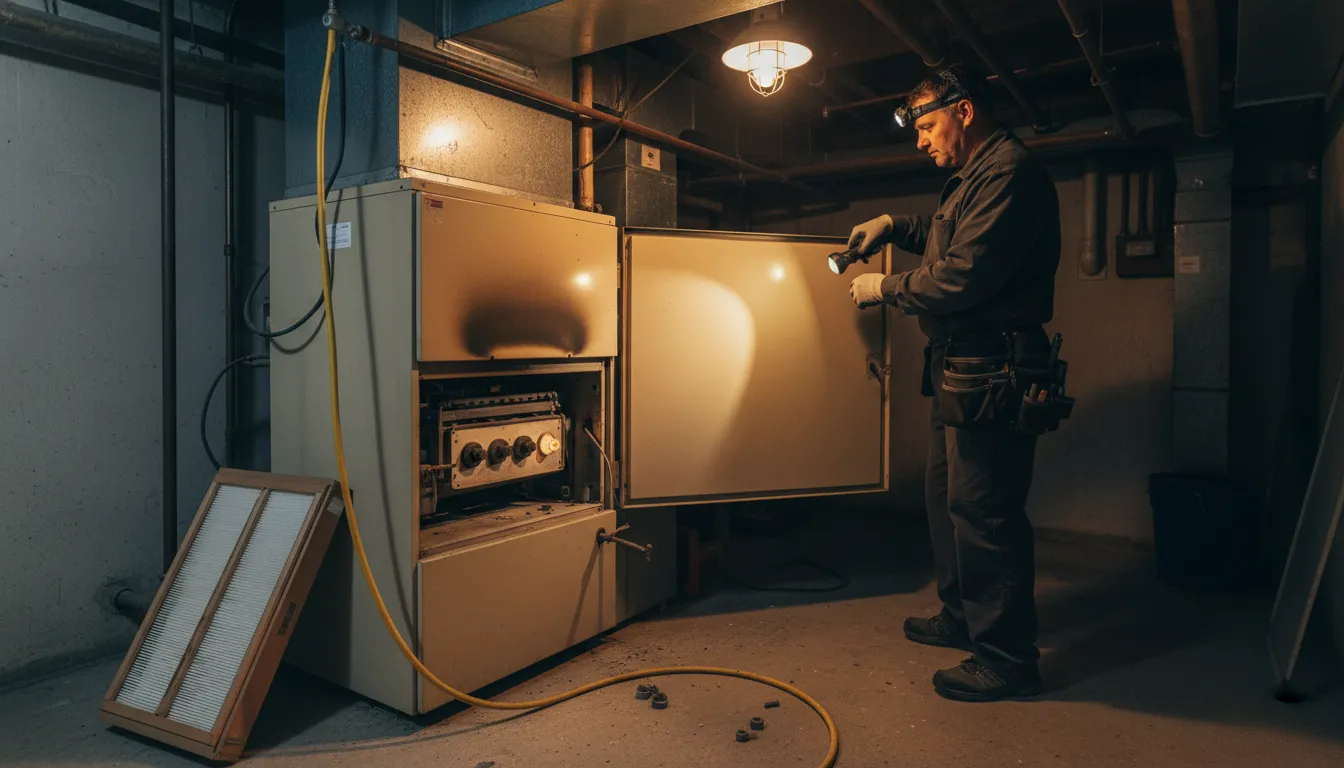
1. Comprehensive Inspection: The technician will start by checking the thermostat settings and operation. They will then inspect the air filters, examine the burner flames for proper color and alignment, listen to the blower motor, check electrical connections and wiring, and perform a crucial visual inspection of the heat exchanger for cracks or corrosion.
2. Accurate Diagnosis: Based on the inspection, the professional will identify the root cause of the problem-whether it's a faulty hot surface ignitor, a clogged condensate drain line, dirty evaporator coils, or a more serious component failure 1.
3. Repair or Replacement: The technician will clean necessary components and replace faulty parts. This could involve swapping out a standard air filter, installing a new ignitor or flame sensor, replacing a blower capacitor, or sealing minor cracks in accessible components. They will advise if a repair is sufficient or if a full component (or system) replacement is more economical.
4. Critical Safety Checks: Before concluding, a reputable technician will always conduct safety tests. This includes checking for gas or fuel oil leaks, testing combustion to ensure it is within safe parameters, measuring carbon monoxide levels in the exhaust and around the furnace, and verifying proper electrical grounding.
5. System Testing and Explanation: Finally, the furnace will be run through a complete cycle to ensure it heats effectively and efficiently. The technician should explain what was found, what was done, and offer any recommendations for ongoing maintenance 2.
Find the perfect furnace repair companies for your needs
Get personalized recommendations and expert advice
Seasonal Considerations for Vermont Furnace Care
Vermont's distinct seasons create an ideal rhythm for furnace maintenance and repair planning.
Fall (Pre-Winter Tune-Up): This is the most critical time for furnace service in Vermont. Scheduling a professional tune-up before the heating season ensures your system is safe, efficient, and ready for the heavy demand of winter. For Vermont's many oil-heated homes, this includes checking the oil tank, fuel lines, and filter. A fall inspection focuses on cleaning burners, checking the heat exchanger, testing the blower, and ensuring all vents are clear.
Winter (Emergency Repairs): This is when service calls peak for no-heat situations. The focus shifts to reliable, urgent repairs to restore heat. Technicians also watch for issues like frozen condensate drain lines in high-efficiency furnaces. Having a relationship with a service provider established in the fall is invaluable during a winter emergency.
Spring (Post-Winter Evaluation): Once the heating season winds down, it's a good time to address less urgent maintenance items noted during the winter. It's also an excellent period for a thorough cleaning and to plan for any potential system upgrades or replacements without the pressure of cold weather 3.
Essential Safety Checks for Your Vermont Furnace
Safety is the paramount concern with any fuel-burning appliance. Key checks that should be part of any service include:
Heat Exchanger Inspection: This metal chamber separates combustion gases from your home's breathable air. Cracks can allow deadly carbon monoxide (CO) to leak into your living spaces. A visual inspection for cracks, rust, or corrosion is a non-negotiable part of a professional tune-up 4.
Carbon Monoxide Detectors: A working furnace is only one part of the safety equation. Ensure you have functioning CO detectors installed near the furnace and on every level of your home, especially outside sleeping areas. Test them monthly and replace batteries as needed.
Electrical Connections: The technician should check wiring, connections, and the system's grounding. Proper grounding is a primary safety requirement, particularly when replacing older systems, to prevent electrical shock 5.
Fuel System Integrity: For both gas and oil systems, checking fuel lines, valves, and connections for leaks is vital. This is especially crucial for oil tank and line inspections in Vermont homes to prevent environmental hazards and ensure efficient operation 6.
Understanding Furnace Repair Costs in Vermont
Costs can vary based on the specific problem, your furnace's age and model, and the service provider. Here are general guidelines for common services:
Professional Tune-Up/Inspection: Typically ranges from $100 to $200. Scheduling this service in the off-season (spring or summer) can sometimes result in lower promotional pricing.
Common Part Replacements: Replacing a standard air filter or a hot surface ignitor generally falls in the $150 to $350 range, including parts and labor.
Major Component Repair: Repairing or replacing a blower motor is a more involved job, often costing between $400 and $800 or more.
Serious Repairs (e.g., Cracked Heat Exchanger): Repairing a cracked heat exchanger is often so labor-intensive and costly that it may not be economical. In many cases, this diagnosis leads to a recommendation for full furnace replacement, which can range from $2,000 to over $5,000 installed, depending on the system's efficiency and capacity 7 8.
Investing in annual maintenance is the most effective way to manage long-term costs, improve efficiency, and prevent small issues from turning into expensive, emergency repairs during a Vermont cold snap 9 10.
Frequently asked questions
Sources
Footnotes
-
What Is The Most Common Part to Fail on a Furnace? - https://www.myqualitycomfort.com/general/what-is-the-most-common-part-to-fail-on-a-furnace/ ↩
-
Seasonal and Annual Furnace Maintenance Checklist - https://micksplumbinghvac.com/seasonal-furnace-maintenance-checklist/ ↩
-
How Often Should You Get a Furnace Inspection? (Homeowner's Guide) - https://aquariushomeservices.com/blog/furnace-inspection/ ↩
-
Furnace Inspection: Importance, Costs, and What to Expect | Bryant - https://www.bryant.com/en/us/products/gas-furnaces/inspection/ ↩
-
Which of the following is a primary safety requirement when replacing ... - https://www.gauthmath.com/solution/1833240034590770/Which-of-the-following-is-a-primary-safety-requirement-when-replacing-an-older-f ↩
-
Heating System Tune Up & Repair - Energy Co-op of Vermont - https://www.ecvt.net/service-category/heating-system-tune-repair/ ↩
-
What to Do If Your Furnace Has a Cracked Heat Exchanger - Lennox - https://www.lennox.com/residential/lennox-life/consumer/furnace-cracked-heat-exchanger ↩
-
Furnace Inspection Cost in 2026 | Angi - https://www.angi.com/articles/furnace-inspection-cost.htm ↩
-
Furnace Maintenance (Benefits, Process and More) - Genz-Ryan - https://genzryan.com/blog/furnace-maintenance/ ↩
-
Factors Impacting Furnace Efficiency & Improvement Tips - Shipley Energy - https://www.shipleyenergy.com/resources/efficiency/furnace-efficiency-tips/ ↩