Find the Best Duct Cleaning Companies for Your Business
No obligation • Fast responses • Nationwide coverage

Why you can trust HVAC Firms
HVAC Firms is a leading United States resource for evaluating HVAC service providers. Our team researches companies, checks credentials, and reviews customer feedback to present clear, unbiased information. Listings and rankings are based on merit, and companies cannot pay to change our editorial content.
Search providers near you
Best Duct Cleaning Companies in Vermont Ranked
Maintaining clean air ducts is a key part of ensuring healthy indoor air quality in your Vermont home. Over time, heating and cooling ducts can accumulate dust, allergens, pet dander, and even mold, which are then circulated throughout your living spaces. This guide explains what professional duct cleaning entails, when it's truly necessary, and how to find qualified local specialists who follow industry best practices to improve your home's environment.
Understanding Professional Duct Cleaning
Professional duct cleaning, often called HVAC duct cleaning or air duct cleaning, is a specialized service focused on removing contaminants from the various components of your forced-air heating and cooling system. This includes the supply and return air ducts, registers, grilles, diffusers, heat exchangers, cooling coils, fan motors, and the air handler unit itself.
The goal is not just to remove visible dust, but to eliminate particulate matter that can affect your home's air quality and your HVAC system's efficiency. In Vermont, where homes are sealed tightly for winter efficiency, ensuring clean air pathways is especially important for maintaining a healthy indoor environment.
The Standard Cleaning Process: What to Expect
A reputable service provider will follow a meticulous, multi-step process. Understanding this procedure helps you know what to look for when hiring a professional.
1. Initial Inspection A thorough service begins with a visual inspection of your ductwork, often using specialized cameras. The technician will look for visible mold growth, signs of pest infestation (like droppings or nesting materials), and excessive dust or debris buildup. This inspection determines the scope of work and the necessary equipment.
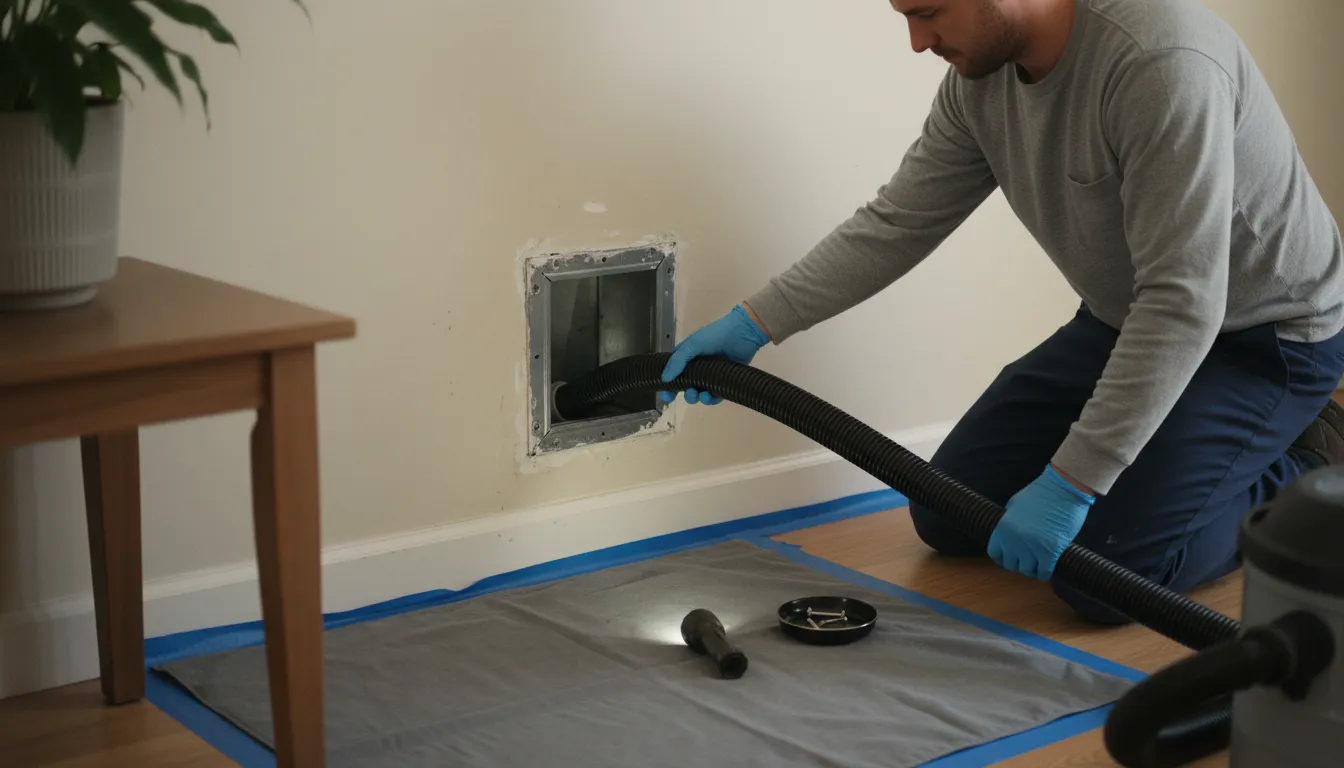
2. Containment and Protection Before any cleaning starts, the work area must be contained. Professionals use negative air machines equipped with HEPA filters to create negative pressure within the duct system. This critical step prevents dislodged contaminants from escaping into your home's living areas. Furniture and flooring near vents are also protected.
3. Agitation and Dislodging Technicians then use specialized tools, such as controlled air whips, skipper balls, or soft-bristled brushes, to agitate and loosen debris adhered to the interior surfaces of the ducts. This step ensures that the vacuum can effectively remove all contaminants.
4. Vacuum Extraction (Source Removal) This is the core of the "source removal" method. A powerful, truck-mounted or portable HEPA vacuum system is connected to the ductwork. The negative pressure created by this vacuum pulls all the loosened dust, debris, and allergens out of the system and contains them in a filtration unit.
5. Final Steps and System Restart After vacuuming, the entire system is given a final check. Technicians will often place new filters on the supply registers temporarily to catch any residual dust when the system is turned back on 1. All access points are securely resealed. A key point of professional ethics is that technicians should avoid recommending or applying chemical biocides or sealants unless there is a specific, verified need (like a mold problem) and you fully understand the potential risks 2 3.
When is Duct Cleaning Recommended in Vermont?
Duct cleaning is not a routine maintenance task like changing your air filter. It is recommended based on specific conditions or events.
- Every 3 to 5 Years: This is a general guideline suggested by organizations like the National Air Duct Cleaners Association (NADCA) for normal household conditions 4 5.
- After Home Renovations: Major remodeling, construction, or even significant drywall work generates immense amounts of fine dust that can clog your ductwork 6.
- Visible Contamination: If you see visible mold growth on hard surfaces inside your ducts or other components, cleaning is necessary.
- Pest Infestation: Evidence of rodents or insects in your ducts requires professional cleaning after the pest problem has been eliminated 7.
- Excessive Dust & Debris: If your registers are blowing visible dust, or if dust accumulates quickly on surfaces shortly after cleaning, your ducts may be the source.
- For Health Reasons: If household members are experiencing unexplained allergies or respiratory issues that worsen indoors, cleaner ducts may help, especially when combined with other indoor air quality strategies 8.
Find the perfect duct cleaning companies for your needs
Get personalized recommendations and expert advice
The Vermont Perspective: Source Control First
The Vermont Department of Health provides crucial guidance for homeowners concerned about indoor air quality (IAQ). Their primary recommendation is source control. This means preventing contaminants from entering your air in the first place is more effective and important than trying to remove them later.
Before considering duct cleaning, Vermont health officials advise focusing on these steps:
- Use High-Quality Air Filters: Install the highest MERV-rated filter your HVAC system can handle and change it regularly.
- Seal Duct Leaks: Have your ductwork tested for leaks, especially in unconditioned spaces like attics or crawl spaces, and have them sealed. Leaky ducts pull in dirty air.
- Ensure Proper Ventilation: Use exhaust fans in kitchens and bathrooms, and consider an energy recovery ventilator (ERV) or heat recovery ventilator (HRV) for a tight, modern Vermont home.
- Manage Moisture: Control humidity levels to prevent mold growth. Fix leaks promptly and use dehumidifiers in damp areas like basements.
- Choose Cleaning Products Wisely: Opt for less-toxic household cleaners to reduce chemical vapors circulated by your HVAC system 9.
Duct cleaning should be viewed as a component of a broader IAQ plan, not a standalone solution. It is most valuable for addressing specific, identified contamination that source control measures cannot resolve 10.
What Does Duct Cleaning Cost in Vermont?
The cost for professional residential duct cleaning in Vermont typically ranges from $450 to $1,000 for an average-sized home, according to industry standards 11. Several factors influence the final price:
- Size of the HVAC System: The number of furnaces, air handlers, and the linear footage of ductwork.
- Duct Accessibility: Easily accessible, exposed ducts in a basement cost less to clean than ducts hidden behind walls or in tight crawl spaces.
- Type of Ducts: The material (flexible duct, sheet metal, fiberglass) can affect the cleaning method and time.
- Level of Contamination: A heavily soiled system or one requiring mold or pest remediation will cost more.
- Additional Services: Cleaning other components like the coil, blower motor, or adding UV lights will increase the price.
Always get a detailed, written estimate that breaks down the services included before work begins.
How to Choose a Qualified Service Provider
Selecting the right professional is critical. Look for a company that:
- Follows NADCA Standards: Ask if they adhere to the ACR standard (Assessment, Cleaning, and Restoration) set by NADCA.
- Uses Proper Equipment: They should use HEPA-filtered negative air machines and agitation tools, not just a vacuum attached to a single vent.
- Is Licensed and Insured: Verify they carry liability insurance for your protection.
- Provides a Clear Inspection: They should be willing to show you before-and-after evidence, often with camera footage.
- Avoids Upselling Unnecessary Chemicals: Be wary of companies that aggressively push chemical treatments, sealants, or deodorizers.
- Answers Questions Clearly: A good technician will explain the process, why (or why not) your ducts need cleaning, and how it fits into your overall home health.
Frequently asked questions
Sources
Footnotes
-
What Happens During a Duct Cleaning Appointment? | Novak - https://www.novakheating.com/what-happens-during-duct-cleaning/ ↩
-
Everything You Need to Know about PROPER Air Duct Cleaning - https://nadca.com/blog/everything-you-need-know-about-proper-air-duct-cleaning ↩
-
DOHS Fact Sheet On HVAC Duct Cleaning - ORS - https://ors.od.nih.gov/sr/dohs/Documents/fact-sheet-hvac-duct-cleaning.pdf ↩
-
How Often Do Air Ducts Need to Be Cleaned? - COIT - https://www.coit.com/blog/healthy-home/how-often-do-air-ducts-need-be-cleaned ↩
-
How Often Should Air Ducts Be Professionally Cleaned? - https://comfortbros.com/blog/how-often-should-air-ducts-be-professionally-cleaned/ ↩
-
Best time to clean air ducts in 2026 - One Hour Heating & Air Conditioning - https://www.onehourheatandair.com/west-valley/about-us/blog/2025/november/best-time-to-clean-air-ducts-in-2026/ ↩
-
5 Signs Your Air Ducts Need Cleaning - https://nadca.com/blog/5-signs-your-air-ducts-need-cleaning ↩
-
How Often Should You Clean Your Air Ducts? Cleaning Guide - https://www.hoffmannbros.com/indoor-air-quality/duct-cleaning/how-often ↩
-
Is Duct Cleaning a Waste of Money? The Truth Revealed - https://www.tripleotoday.com/blog/hvac/is-duct-cleaning-a-waste-of-money-the-truth-revealed/ ↩
-
Indoor Air Quality | Vermont Department of Health - https://www.healthvermont.gov/environment/healthy-homes/indoor-air-quality ↩
-
Cost and Time Estimates | National Air Duct Cleaners Association ... - https://nadca.com/homeowners/cost-and-time-estimates ↩