Find the Best Boiler Repair Contractors for Your Business
No obligation • Fast responses • Nationwide coverage

Why you can trust HVAC Firms
HVAC Firms is a leading United States resource for evaluating HVAC service providers. Our team researches companies, checks credentials, and reviews customer feedback to present clear, unbiased information. Listings and rankings are based on merit, and companies cannot pay to change our editorial content.
Search providers near you
Best Boiler Repair Contractors in Delaware Ranked
A properly functioning boiler is essential for reliable heat and hot water in your Delaware home, especially during chilly coastal winters. When your hydronic heating system fails, it's more than an inconvenience-it can be a safety risk and lead to costly damage. This guide provides clear, practical information on recognizing common boiler problems, understanding maintenance requirements, and knowing when to call a professional technician for repair or inspection.
Recognizing Common Boiler Problems in Delaware Homes
Boilers, or hydronic heating systems, can develop issues that range from minor annoyances to serious safety hazards. Knowing the signs can help you address problems quickly.
Loss of Heat or Hot Water: This is the most obvious sign of trouble. It can be caused by several issues, including low water pressure, a malfunctioning thermostat, a failed circulator pump, or a problem with the gas valve or ignition system on fueled units.
Unusual Noises: Your boiler should operate relatively quietly. Banging or kettling sounds often indicate limescale buildup on the heat exchanger, causing water to overheat and steam. Gurgling or whistling noises typically point to trapped air in the system, which can reduce efficiency.
Visible Leaks: Any sign of water around the base of the unit or from pipes and valves is a red flag. Leaks can stem from a cracked heat exchanger, corroded pipes, or failed seals and gaskets. Even a small drip can lead to significant water damage and indicate internal corrosion. 1 2
Yellow Flame or Strange Odors: For gas or oil-fired boilers, the burner flame should be blue and steady. A yellow, flickering flame can signal incomplete combustion, which produces carbon monoxide (CO). Any unusual smell, especially a "rotten egg" scent (added to natural gas) or a metallic, overheating smell, requires immediate attention. 3 4
Rising Pressure or Temperature: Keep an eye on your system's gauges. Consistently high pressure or temperature readings can stress the system and indicate a faulty pressure relief valve or other control issue.
What You Can Check Before Calling a Professional
Before you schedule a service call, there are a few safe, basic checks you can perform that might resolve simple issues or provide valuable information to your technician.
- Visual Inspection: Look for any obvious signs of water leakage, corrosion on pipes, or soot around the burner assembly. Ensure the area around the boiler is clear of debris, storage items, or flammable materials that could obstruct airflow or vents.
- Check System Pressure: Most boilers have a pressure gauge. For a typical residential system, the pressure should often be between 12 and 25 psi when cold. If it's too low, you may have a leak or need to repressurize the system via the filling loop (consult your manual). If it's dangerously high, shut the system down and call for service.
- Review Thermostat Settings: Verify that your thermostat is set to "Heat" and the temperature setting is above the current room temperature. Replace the batteries if it's a wireless model.
- Reset the System: Some boilers have a reset button. If the unit has locked out due to a minor fault, a reset may restart it. Only press it once. If it locks out again, a professional diagnosis is needed.
- Note Error Codes: Modern boilers often have digital displays that show fault codes. Write down any error codes displayed; this can greatly speed up the technician's troubleshooting process. 5
Delaware's Boiler Inspection Requirements
Delaware has specific regulations for boiler safety administered by the Department of Natural Resources and Environmental Control (DNREC). These rules are in place to prevent catastrophic failures and ensure safe operation.
- Low-Pressure Boilers: This category includes most residential heating boilers. Delaware law requires a biennial (every two years) external inspection. An internal inspection may also be required by the inspector depending on the unit's condition and history.
- High-Pressure Boilers: These are more common in commercial or industrial settings. They require a more rigorous annual inspection, which includes both internal and external examination. 6
A professional inspection is not just about compliance; it's a critical maintenance activity. A certified inspector or technician will check safety valves, low-water cutoffs, pressure and temperature gauges, the condition of the heat exchanger, burner combustion efficiency, and overall system controls. 7
Find the perfect boiler repair contractors for your needs
Get personalized recommendations and expert advice
The Professional Repair and Maintenance Process
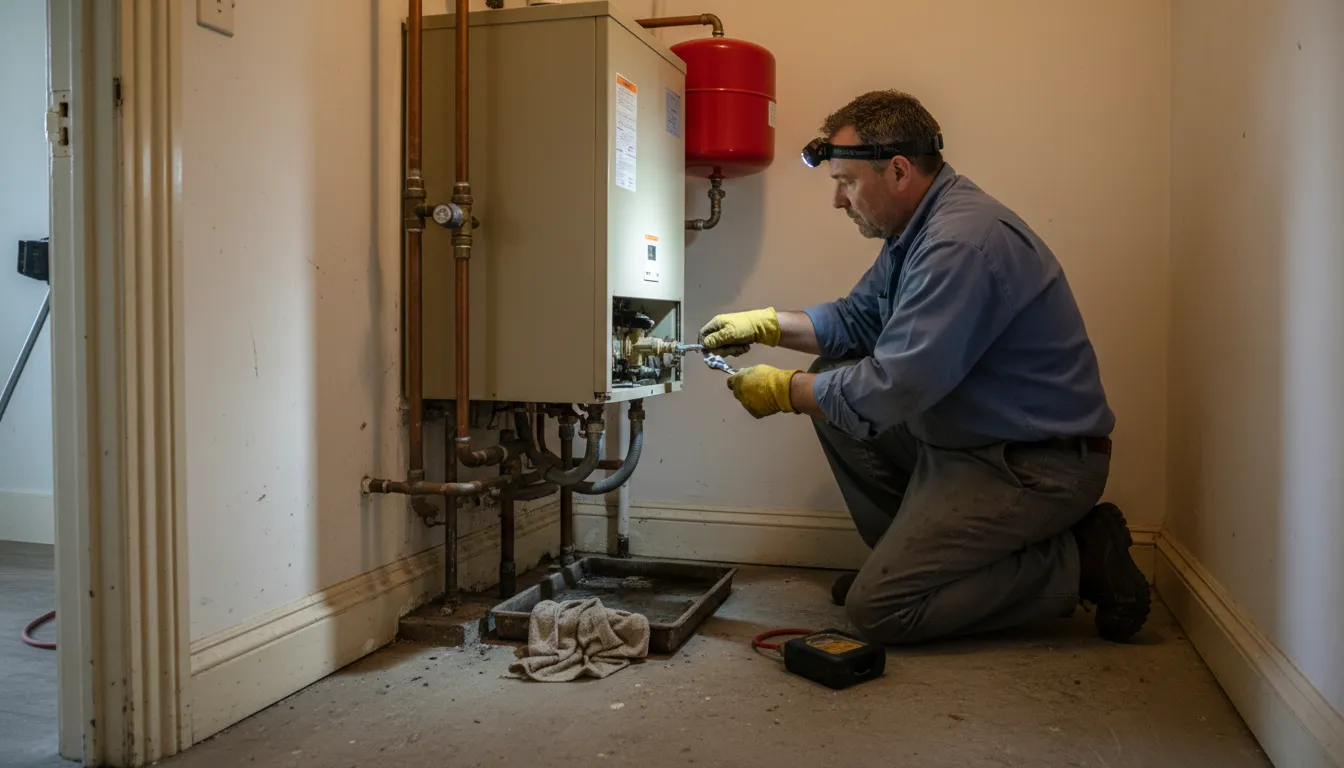
When a licensed technician arrives to service your Delaware boiler, they follow a systematic process to diagnose and resolve issues safely and effectively.
1. Diagnosis & Assessment: The technician will discuss the symptoms with you, examine the unit, and use tools like combustion analyzers and multimeters to pinpoint the fault. They will check for error codes and test critical safety components first.
2. Common Repairs: Frequent fixes include replacing a failed circulator pump, repairing or replacing leaky valves and seals, cleaning soot or scale from the heat exchanger, fixing ignition system components, and recalibrating controls for optimal efficiency.
3. Safety-Critical Repairs: The most serious issue is a cracked heat exchanger. This can allow flue gases, including carbon monoxide, to mix with the circulating air. There is no repair for a cracked heat exchanger; the boiler must be replaced. A technician will always check for this during an inspection.
4. Annual Tune-Up: Even without a repair, an annual maintenance visit is recommended. This typically includes cleaning the burner and heat exchanger, testing safety devices, checking for gas leaks (if applicable), analyzing combustion efficiency, and ensuring all system pressures and temperatures are correct. This proactive service can prevent up to 90% of mid-winter breakdowns.
Understanding Costs for Boiler Service in Delaware
The cost for boiler service in Delaware varies based on the job's complexity, the parts required, and the time of year.
- Annual Inspection/Tune-Up: A standard annual maintenance visit typically ranges from $150 to $300+. This is a preventative investment that can improve efficiency, extend the system's life, and identify small problems before they become expensive repairs. 8
- Common Repairs: Repair costs for components like a circulator pump, pressure relief valve, or gas valve generally fall between $190 and $660, including parts and labor.
- Boiler Replacement: If your boiler is old, inefficient, or has a failed heat exchanger, replacement is necessary. Installing a new, high-efficiency boiler system in Delaware can cost between $3,600 and $8,400 or more, depending on the unit's size, complexity, and required modifications to piping or venting. 9 10
Safety is Paramount: While cost is a factor, never compromise on safety or proper licensing. Always hire a technician who is licensed, insured, and experienced with your specific type of boiler. The risk of carbon monoxide poisoning or fire from an improperly serviced unit is far too great.
Choosing the Right Service Provider
Selecting a qualified professional is the most important step. Look for a company with specific experience in hydronic heating systems. Verify they hold the proper Delaware licenses for plumbing and/or HVAC work and carry liability insurance. Check online reviews and ask for references. A reputable technician will be happy to explain the problem, provide a clear written estimate, and discuss all your options before starting work.
Frequently asked questions
Sources
Footnotes
-
Understanding Boiler Repairs: A Comprehensive Guide - Chambersburg Super Techs - https://chambersburgsupertechs.com/boiler-repair/understanding-boiler-repairs-a-comprehensive-guide/ ↩
-
Troubleshooting Common Issues With Hydronic Heating Systems - https://www.jnrplumbing.com/troubleshooting-common-issues-with-hydronic-heating-systems/ ↩
-
10 Common Boiler Problems & How to Fix Them - EDF Energy - https://www.edfenergy.com/energywise/10-common-boiler-problems ↩
-
How To Know If You Need Your Heater Repaired In Wilmington, DE - https://bouldenbrothers.com/service-areas/wilmington-de/hvac/heating/heater-repair/how-to-know/ ↩
-
Department of Natural Resources and Environmental Control - https://regulations.delaware.gov/register/february2018/proposed/21%20DE%20Reg%20618%2002-01-18.htm ↩
-
Department of Natural Resources and Environmental Control - https://regulations.delaware.gov/register/september2012/proposed/16%20DE%20Reg%20251%2009-01-12.htm ↩
-
Annual Boiler Maintenance Checklist | Cellino Plumbing - https://cellinoplumbing.com/blog/annual-boiler-maintenance-checklist/ ↩
-
Boiler Maintenance Checklist: Heating System Upkeep Guide - https://skaggswalsh.com/boiler-maintenance-checklist-sw/ ↩
-
Boilers and Pressure Vessels - DNREC - Delaware.gov - https://dnrec.delaware.gov/waste-hazardous/boiler-safety/ ↩
-
Boiler Maintenance Guide for Homeowners - Angie's List - https://www.angi.com/articles/boiler-maintenance.htm ↩