
Heat pump repair tips when the system will not heat
When a heat pump suddenly stops heating, it's stressful-and often cold. The good news is many "no heat" problems come down to simple issues you can safely check yourself before calling for a repair. This guide walks through the most common causes: thermostat settings, indoor airflow, outdoor unit problems, and how and when to use Emergency Heat.
This article focuses on basic, safe checks for typical residential air-source heat pumps. Anything involving panels, wiring, or refrigerant is a job for a licensed HVAC technician.
Before you start: safety and how heat pumps heat
A heat pump works by moving heat from outside air into your home, even when it feels cold outdoors. In heating mode, the outdoor unit is the "evaporator" (collects heat) and the indoor coil is the "condenser" (releases heat). A reversing valve and controls switch the system between heating and cooling.
Keep three safety rules in mind:
- Don't open electrical panels or touch wiring. Exposed high-voltage connections are dangerous.
- Don't handle refrigerant lines or gauges. Any work that could release refrigerant must be done by a Section 608-certified technician under EPA regulations.1
- Use the thermostat and breakers as your main tools. If it goes beyond that, it's time to call an HVAC pro.
Also remember: heat pump supply air often feels cooler than air from a gas furnace. If the house is holding temperature and the air feels mildly warm (not hot), your system may be working normally.
Step 1: Check thermostat settings and power
Start with the easiest fix-controls and power:
- Confirm the mode is set to HEAT (not COOL or OFF).
- Raise the setpoint at least 3-4°F above room temperature. Make sure the thermostat "clicks" or shows it's calling for heat.
- Fan setting: For most homes, FAN should be on AUTO, not ON. "ON" will blow air continuously, which can feel like cold drafts if the system isn't actually heating.
- Battery thermostats: If the display is dim, blank, or glitchy, replace the batteries and re-try.
- Programmable and smart thermostats:
- Temporarily bypass schedules using a HOLD or TEMPORARY HOLD.
- Make sure any "Heat Pump" equipment type or outdoor temperature lockout settings haven't been misconfigured.
If the thermostat looks good but the indoor blower never starts, go to your electrical panel:
- Find the breakers labeled Air Handler, Furnace, or Heat Pump.
- If a breaker handle is between ON and OFF, it's tripped-turn it fully OFF, then back ON once.
- If it trips again immediately, stop and call a pro.
Step 2: Check the indoor unit and airflow
If the blower runs but the air is cool or barely warm, check airflow problems that can cripple heat output:
- Air filter:
- Slide the filter out of the return grille or air handler.
- If it's gray, dusty, or visibly clogged, replace it. A heavily clogged filter can cause poor heating and even system shutdown.
- Supply and return vents:
- Make sure supply registers are open and not blocked by furniture, rugs, or curtains.
- Check that return grilles aren't covered or taped shut.
- Unusual sounds or smells:
- A light "dusty" smell when heat first comes on is normal.
- A strong burning, electrical, or melting-plastic smell is not-shut the system off and call a technician.
After changing a dirty filter or opening vents, let the system run 10-15 minutes. If rooms still aren't warming, move outside.
Step 3: Inspect the outdoor unit (the heat pump itself)
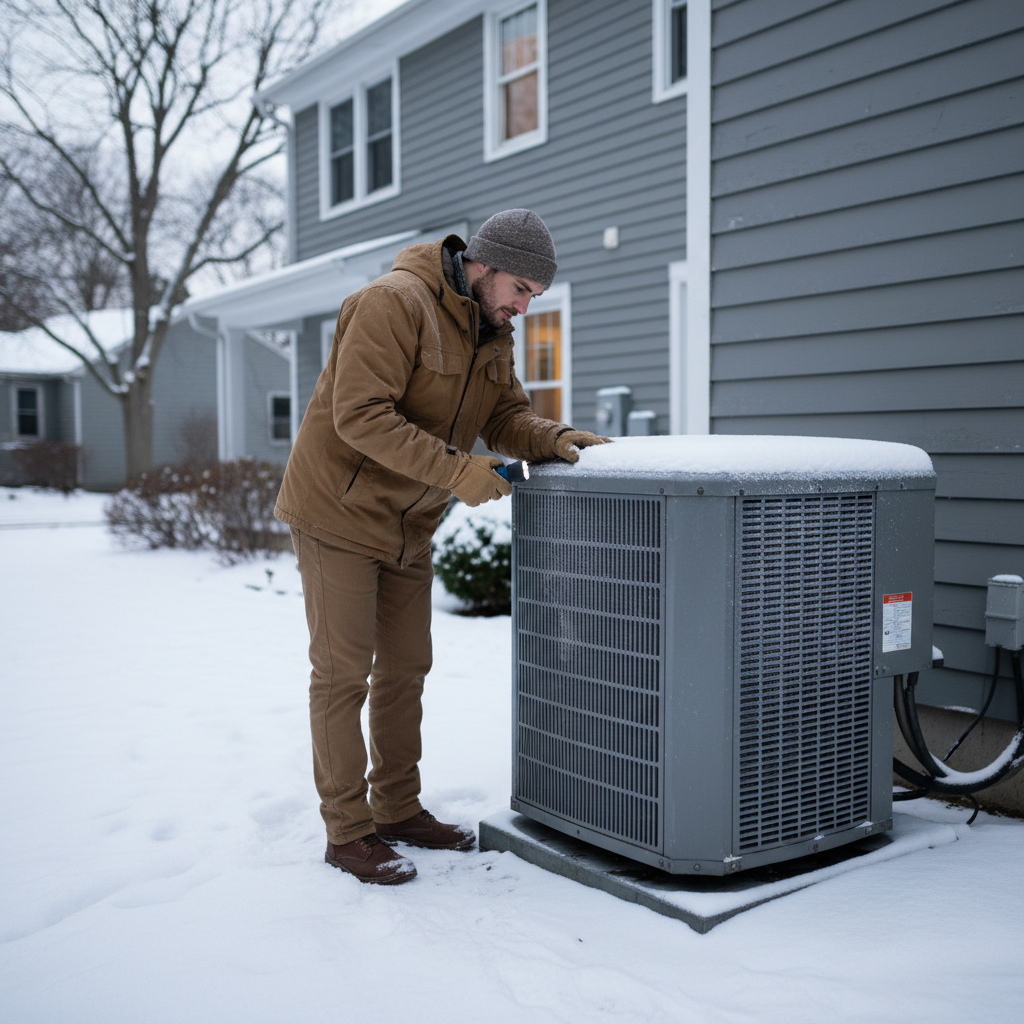
In heating mode, the outdoor unit should be running most of the time in cold weather. Here's what to check-from a safe distance, without opening anything:
- Is the outdoor fan spinning and can you hear the compressor?
- Fan running + compressor sound: the unit is at least trying to heat.
- Totally silent, while the indoor blower blows cool air: you may have a power, control, or outdoor unit fault.
- Snow, leaves, and debris:
- Clear at least 18-24 inches of space around the unit.
- Gently brush off snow on top and sides-don't use sharp tools.
- Frost vs. solid ice:
- A light coating of frost that comes and goes is normal; the unit should enter a defrost cycle periodically to clear it.
- If the whole unit is encased in thick ice, or the fan blades are frozen in place, turn the system OFF and use Emergency Heat at the thermostat to keep warm until a tech can defrost and repair it.
- Steam vs. smoke: During defrost, the unit may briefly blow steam and make a swooshing sound. That's usually normal, not a fire.
- Vibration or grinding: Loud metal-on-metal noises, severe vibration, or a fan that looks loose are immediate stop-and-call-a-pro signs.
Step 4: Simple electrical checks (without opening panels)
If the outdoor unit is dead quiet in heating mode, and you've confirmed the thermostat is calling for heat:
- Outdoor disconnect: Many units have a small box on the wall nearby.
- If it's a pull-out style, make sure the handle is fully inserted.
- If it's a switch type, be sure it's ON.
- Check breakers again: Some systems have separate breakers for indoor and outdoor units-verify that both are ON.
- GFCI outlets nearby: In some installations, a tripped outdoor GFCI (ground-fault circuit interrupter) can indicate moisture problems. If it trips again after reset, leave it off and call a tech.
Do not remove service panels or touch wiring. If all switches and breakers are on and the outdoor unit won't start, the issue may be with the contactor, control board, capacitor, or other parts that require tools and training to diagnose safely.
When and how to use Emergency Heat
Most heat pump thermostats have AUX (auxiliary) or EM HEAT (Emergency Heat) settings:
- Auxiliary heat: Electric resistance heat strips or backup heat that the system automatically brings on when it's very cold or the heat pump can't keep up.
- Emergency Heat: A manual mode that turns the outdoor heat pump off and uses only the backup heat.
Because electric resistance heat uses much more electricity than the heat pump compressor, running on Emergency Heat for long periods can significantly increase your bill.2
Use Emergency Heat when:
- The outdoor unit is frozen in a solid block of ice.
- The outdoor unit is making alarming noises, or you suspect mechanical damage.
- A technician has advised you to run on Emergency Heat until repairs are made.
Avoid using Emergency Heat unnecessarily, such as:
- Mild cold days when the heat pump can keep up.
- Just to "warm up the house faster" after changing the thermostat a few degrees. (Many systems can be wired so the strips don't kick on for large thermostat changes at moderate outdoor temperatures.)2
If you must use Emergency Heat while waiting for service, keep the thermostat as low as comfortably possible to limit energy use.
When to call a heat pump repair company
Call a licensed heat pump repair contractor if you notice any of the following:
- Breakers that trip repeatedly or immediately on reset.
- Outdoor unit frozen solid, not just lightly frosted.
- Loud grinding, buzzing, or metal-on-metal noises.
- Burning, electrical, or chemical smells.
- The system short-cycles (starts and stops every few minutes) or never shuts off yet still can't maintain temperature.
- The thermostat shows error codes, or a newer system flashes fault lights on the indoor or outdoor unit.
A qualified HVAC technician can:
- Test electrical components and safety controls.
- Check refrigerant pressures and temperatures (legally, as required by EPA Section 608 rules).1
- Diagnose problems with the reversing valve, defrost board, compressor, or metering devices.
- Confirm the system is properly sized and configured for your climate, and that auxiliary heat is set up efficiently.2
Bottom line: Work through the simple checks you can do safely, use Emergency Heat only when truly needed, and bring in a certified heat pump pro for anything that involves wiring, refrigerant, or persistent no-heat problems.
Glossary
- Heat pump: An HVAC system that moves heat between indoors and outdoors instead of burning fuel.
- HVAC: Heating, ventilation, and air conditioning.
- Auxiliary heat (AUX): Automatic backup heat (often electric strips) that supplements the heat pump in cold weather.
- Emergency Heat (EM HEAT): Manual mode that turns off the outdoor unit and runs only backup heat.
- Defrost cycle: Automatic mode where the heat pump temporarily reverses to melt frost from the outdoor coil.
- Air handler: The indoor unit that contains the blower and indoor coil, sometimes with electric heat strips.