
Average AC repair costs homeowners should expect for common breakdowns
When your air conditioning (AC) dies on a hot day, the two big questions are: "What's wrong?" and "What is this going to cost me?" This guide focuses on typical 2025-early 2026 price ranges U.S. homeowners see for central air repairs, how service call fees work, and why emergency visits are so much more expensive.
Quick answer: typical AC repair costs at a glance
Most common central AC repairs land between about $200 and $900 total, while major breakdowns like compressor or coil failures can run $1,300 to $3,000+. Lighter fixes-such as capacitor, thermostat, or drain-line problems-often fall in the $150-$400 range, mid-tier repairs like fan motors or basic refrigerant leak fixes often run $400-$900, and big-ticket items like compressors or evaporator coils are often four-figure decisions that make you consider replacing the system instead of repairing it.
How AC repair bills are built (service calls, labor, and timing)
Before we look at specific breakdowns, it helps to understand what you're actually paying for when you hire a heating, ventilation, and air conditioning (HVAC) company.
- Service/diagnostic call fee - Many companies charge a flat fee just to come out and diagnose the problem, commonly in the $75-$250 range for residential jobs.1 This may or may not be credited toward the repair.
- Hourly labor - After diagnosis, standard labor for AC repair is often around $75-$150 per hour, depending on experience and local market.1
- Parts - Capacitors, fan motors, contactors, refrigerant, and larger components (compressors, coils) each have their own price range. Parts for the same repair can be significantly higher for premium brands or hard-to-find components.
- After-hours and emergency rates - Nights, weekends, and holiday calls usually add a surcharge of about 1.5-2× the normal rate, or a separate emergency add-on (often $100+).[^^1]
Bottom line: Your final bill is typically service call + (labor hours × rate) + parts + any emergency surcharge.
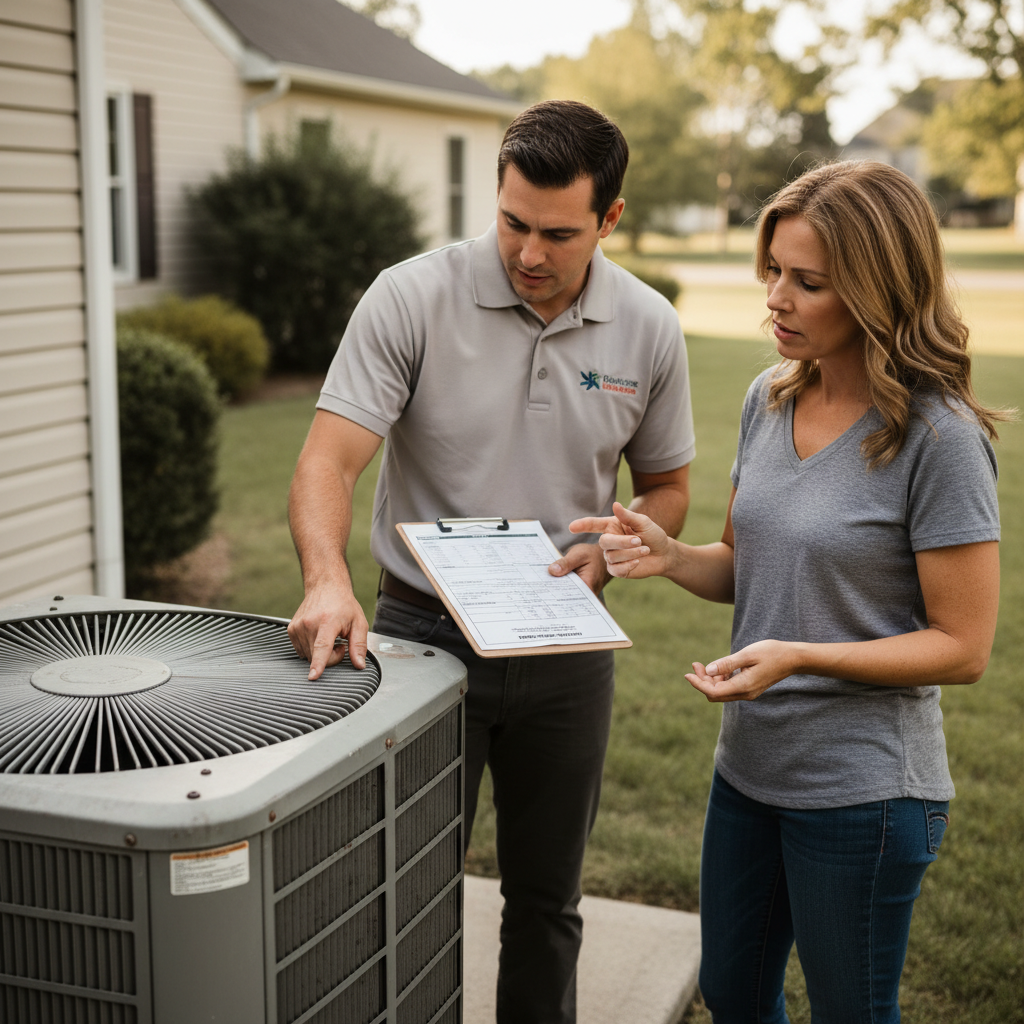
Typical price ranges for common AC breakdowns
These ranges assume a standard residential central air system and include both parts and labor. Actual quotes in your area may be higher or lower, but these numbers should help you sanity-check bids.
1. Capacitor problems
The capacitor helps your compressor and fan motor start and run. When it fails, the unit may hum, struggle to start, or not come on at all.
- Typical cost: About $150-$400 total for diagnosis, part, and installation, depending on type, access, and local labor.2 3
- Often done in a single visit and usually one of the least expensive "no cooling" fixes.
2. Fan motor issues (indoor or outdoor)
Fan motors move air across coils and through your ductwork; when they fail, you may hear grinding, see the fan not spinning, or get little to no airflow.
- Typical repair or replacement: Roughly $300-$900, depending on whether it's a smaller condenser fan motor or a larger indoor blower motor, and how hard it is to access.2
- Higher-end variable-speed motors and specialty parts can push costs toward the top of that range.
3. Refrigerant leak and recharge
If your system has a refrigerant leak, you might notice weak cooling, ice on the lines, or higher bills.
- Leak detection and repair: Commonly somewhere in the $250-$1,550 range, depending on where the leak is (simple fitting vs. coil or line set) and the testing method.3
- Refrigerant recharge (top-off): Often $100-$600, heavily influenced by the refrigerant type and how many pounds your system needs.3
Because older R-22 (Freon) refrigerant is being phased out, topping off those systems is often significantly more expensive than newer R-410A units.3
4. Thermostat, drain, and minor electrical issues
Some "AC not cooling" calls turn out to be smaller control or drainage problems:
- Thermostat repair or replacement: Roughly $125-$450, with basic digital thermostats on the low end and smart thermostats on the high end.2
- Clogged condensate drain / drain line flush: Often $80-$200 total when caught early.2
- Fuses, relays, contactors, small wiring repairs: Commonly $80-$300, depending on what needs to be replaced and how long diagnosis takes.2
These fixes are usually quicker and cheaper than mechanical failures, but you'll still pay the service call and at least some labor.
Big-ticket AC repairs: when costs climb fast
Some failures are expensive enough that your contractor may recommend comparing the repair to the price of a whole new system, especially if your unit is 10-15+ years old.
Compressor replacement
The compressor is the heart of your AC system. When it fails, you may have little or no cooling, and the outdoor unit might buzz or not start at all.
- Typical residential central AC compressor replacement: About $1,350-$2,700 total, including parts and labor for common system sizes.4
- Premium brands, larger 4-5 ton units, or systems using certain refrigerants can push costs closer to or above $3,000.4
Because the compressor is such a major expense, homeowners often:
- Check whether the compressor is still under parts warranty, in which case you might only pay labor (often $650-$1,100).[^^4]
- Compare the quote to a full system replacement, especially if your system is old, inefficient, or has a history of leaks.
Coil and major component replacement
Evaporator and condenser coils, control boards, and other big components can also get pricey:
- National data shows evaporator coil replacements often fall roughly in the $450-$2,500 range for parts and labor, depending on size and complexity.2
- Condenser repairs or replacements can range from a few hundred dollars for small fixes to several thousand when the full outdoor unit is replaced.2
Once a repair enters the high three- or low four-figure range, it's worth asking your contractor to price out "repair vs. replace" options.
Costs and price drivers
Here's a simplified look at how the most common AC repair categories compare, assuming normal business-hours service on a standard central AC system.
| Repair category | Typical range (parts + labor) | What drives cost most |
|---|---|---|
| Capacitor replacement | $150-$400 | Part type/brand, access, labor rate |
| Fan motor repair/replacement | $300-$900 | Motor size/type, access, labor hours |
| Refrigerant leak + recharge | $350-$1,800+ | Leak location, refrigerant type/amount |
| Thermostat or minor controls | $125-$450 | Basic vs. smart thermostat, wiring |
| Drain line / minor electrical | $80-$300 | Time to diagnose and fix |
| Compressor replacement | $1,350-$2,700+ | System size, warranty, refrigerant type |
| Evaporator coil replacement | $450-$2,500+ | Coil size, cabinet access, duct mods |
Key price drivers to keep in mind:
- System type and size - Larger tonnage and higher-efficiency equipment generally use more expensive parts.
- Refrigerant type - Older R-22 systems are usually more expensive to repair and recharge than R-410A systems.3
- Access and installation difficulty - Tight attics, rooftops, or needing to cut and re-seal ductwork increase labor hours.
- Brand and parts availability - OEM (original equipment manufacturer) parts and premium brands usually cost more.
- Warranty status - A valid parts warranty can shave hundreds or even $1,000+ off a compressor or coil repair.4
- Timing and demand - Emergency calls during heat waves often carry higher labor rates and slower scheduling.1
Local factors across the U.S.
Within the USA, labor rates vary a lot by region. Dense coastal metros and high-cost-of-living areas often sit at the higher end of the ranges above, while smaller towns and many Midwestern or Southern markets may land closer to the low or mid points. Climate also matters: in hot regions where AC runs hard most of the year, systems may wear faster, and summer emergency calls are more common.
Because of this, it's smart to:
- Get 2-3 quotes for anything over a few hundred dollars.
- Ask each contractor to clearly list service call, labor rate, parts costs, and any after-hours fees.
How to avoid unpleasant AC repair surprises
You can't prevent every breakdown, but you can make the costs more predictable.
- Schedule annual maintenance. A spring AC tune-up (around $75-$200 in many markets)3 can catch weak capacitors, dirty coils, and small leaks before they become major repairs.
- Change filters regularly. Clogged filters strain blower motors and coils, shortening their lifespan.
- Ask about fees up front. When you call, confirm the diagnostic fee, whether it's credited toward the repair, and what counts as "emergency" or "after-hours."
- Check warranties. Look for both manufacturer parts warranty and any labor warranty from the installing contractor.
- Prioritize repairs strategically. If a technician recommends a major repair on a very old system, ask them to price a properly sized replacement for comparison.
Conclusion
For most U.S. homeowners, expect common AC repairs to fall in the low hundreds and big failures like compressors or coils to push into the thousands-so it pays to understand the line items on your quote before you approve the work.
Glossary
- AC (air conditioning): System that cools and dehumidifies indoor air.
- HVAC: Heating, ventilation, and air conditioning; covers full comfort systems in a building.
- Capacitor: Electrical component that helps AC motors start and run.
- Compressor: Pump in the outdoor unit that moves refrigerant through the system.
- Refrigerant: Chemical fluid that absorbs and releases heat as it circulates through the AC system.
- SEER (Seasonal Energy Efficiency Ratio): Rating that measures an AC system's cooling efficiency over a season.
Sources
Footnotes
-
https://www.hvaccalculatorhub.com/blog/hvac-service-call-costs-2025 ↩ ↩2 ↩3
-
https://www.homr.io/homeexperts/ac-repair-cost-guide-residential ↩ ↩2 ↩3 ↩4 ↩5 ↩6 ↩7
-
https://www.forbes.com/home-improvement/hvac/ac-leak-repair-cost/ ↩ ↩2 ↩3 ↩4 ↩5 ↩6
-
https://www.bluewaterclimatecontrol.com/blog/cost-to-replace-ac-compressor-a-2024-price-breakdown ↩ ↩2 ↩3