
AC repair or replacement how to decide for older systems
Quick answer
In most homes, it makes sense to repair an older central AC when the problem is minor and the system is still under about 10-12 years old, and to replace when it's 12-15+ years old, uses outdated refrigerant, or needs expensive, repeated repairs. A common industry rule is to multiply the repair cost by the system's age: if that number is over 5,000, replacement usually makes more financial sense. If it's under 5,000 and the unit is otherwise reliable, repair is often the better short-term move.1
1. How long central AC systems usually last
Before you decide on repair vs. replacement, you need a realistic idea of how long central air conditioners typically last.
Major manufacturers and HVAC (heating, ventilation, and air conditioning) pros generally put the average life of a central AC around 15-20 years with proper maintenance, though many systems start losing efficiency and reliability in their mid-teens.2 Hot climates, poor maintenance, and bad installation can all shorten that lifespan.
Very old units can still run at 25-30 years, but they're usually:
- Much less efficient than modern units.
- More prone to refrigerant leaks and compressor failures.
- Harder and more expensive to repair because parts are obsolete.
So age alone doesn't force you to replace, but it changes how much risk you're taking when you spend money on another repair.
2. Key questions to ask about your older AC
Use these questions as a simple framework before you authorize a big repair or sign up for a full replacement.
A. How old is the system, and what refrigerant does it use?
- Under ~10 years: Generally worth repairing unless the fix is extremely expensive.
- Around 12-15 years: Gray area-compare the repair cost to replacement and consider efficiency gains.
- 15+ years: You're on borrowed time; think hard before putting big money into it.
If the nameplate or service sticker mentions R-22, that's an older refrigerant that has been phased out; new production and import stopped in 2020, so any remaining R-22 is reclaimed and increasingly expensive.3 Major leaks or recharges on an R-22 system are often a strong reason to redirect that money into a new unit instead.
B. What's the repair history like?
Ask yourself:
- Have you had more than one breakdown in the last 2-3 cooling seasons?
- Are service calls creeping up from "$200 here and $300 there" into major-component territory (compressor, coil, blower motor, control boards)?
Then apply the 5,000 Rule often used in the industry: multiply the quoted repair cost by the system age in years. If the result is over 5,000, replacement is usually the better long-term value; if it's under 5,000, repair is more reasonable.1
C. How are your energy bills and comfort?
Even if it still runs, an older, low-efficiency unit (think pre-SEER2 systems with older Seasonal Energy Efficiency Ratio ratings) can cost a lot more to operate than a modern one. Signs your system is inefficient or undersized include:
- Cooling bills that have climbed noticeably over the last few years without a rate hike.
- Long run times on mild days.
- Some rooms never really cooling down.
D. Are you dealing with comfort or reliability problems?
Red flags that push you toward replacement:
- Frequent cycling on and off.
- Loud or new noises (grinding, buzzing, banging).
- Ice on the refrigerant lines or outdoor unit.
- Uneven temperatures between rooms or floors.
- Musty smells or ongoing moisture issues around the air handler.
Any of these can be repairable-but when they show up on an older system, they're a clue that you may be chasing symptoms on equipment that's nearing the end of its life.
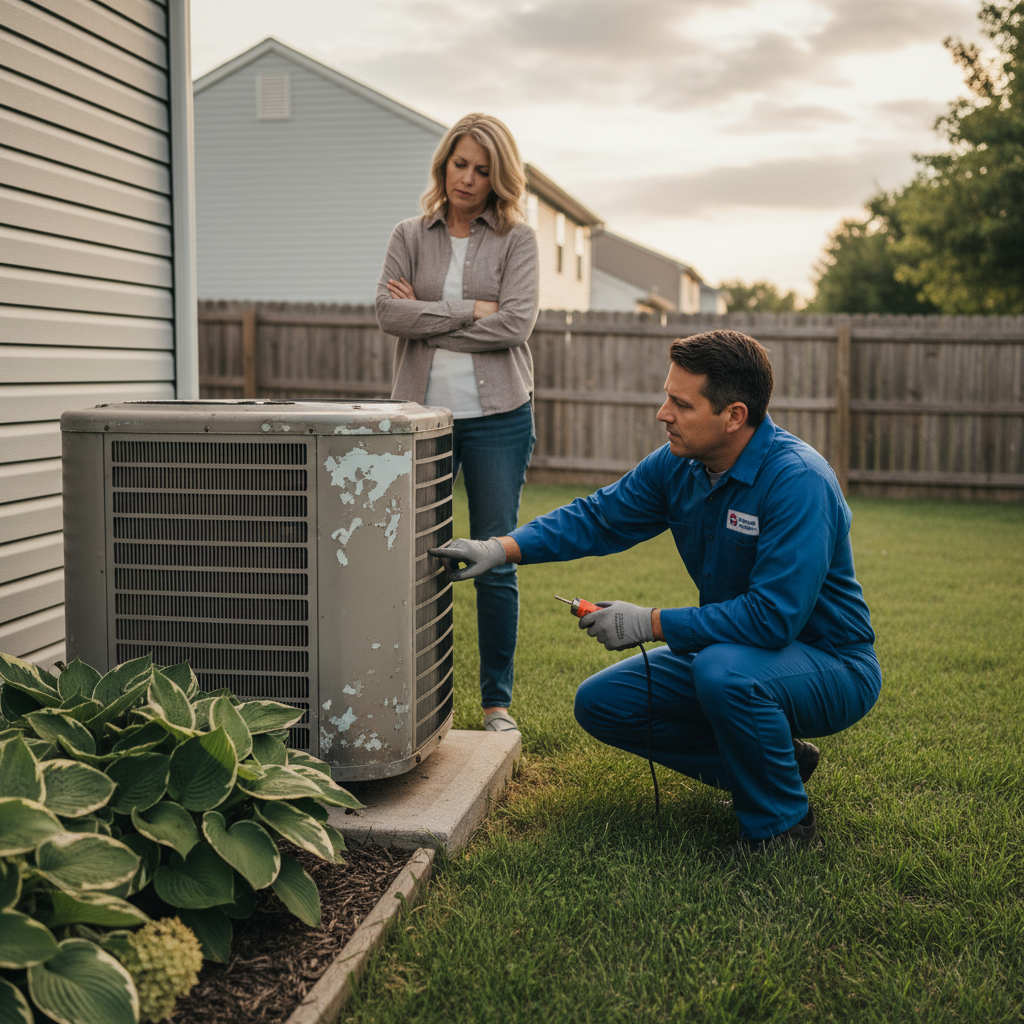
3. When AC repair is usually the smarter move
Lean toward repair if most of these are true:
- System age: Under about 10-12 years, especially if it's the original unit on a fairly new home.
- Limited repair history: This is your first significant breakdown or it's been several years since the last one.
- Relatively low repair cost: The repair is affordable (often a few hundred dollars, not thousands) and the 5,000 Rule number stays under 5,000.1
- No refrigerant phaseout issue: The unit uses a more common, currently supported refrigerant and doesn't have a history of leaks.
- Good comfort: It cools the home evenly, and your energy bills are reasonable for your climate.
- Parts and labor warranty: If the failed part is still under warranty, paying for labor only often makes repair a clear yes.
In these situations, a solid repair can easily buy you several more years of reliable cooling. Just make sure your contractor also does basic maintenance-cleaning coils, checking refrigerant charge, and verifying airflow-so you're not right back in the same spot next summer.
4. When AC replacement is usually the better investment
Replacement starts to look like the smarter long-term move when one or more of these situations applies:
- Age 12-15+ years: You're near or beyond the typical 15-20-year life expectancy.2 A big repair might only buy you a short extension.
- Big ticket repair: The compressor, outdoor coil, or indoor coil has failed, and the estimate is in the $1,500-$3,000+ range.
- R-22 system with leaks or major issues: Paying for large amounts of a phased-out refrigerant plus labor is often close to the cost of a down payment on a new, efficient system.3
- Frequent breakdowns: You're calling for service every summer (or more), and the costs plus inconvenience are adding up.
- Poor comfort or noisy operation: The system struggles on hot days, some rooms never cool, or the unit is loud enough to be a nuisance-even after prior repairs.
- High energy bills: If your AC is 15+ years old, upgrading to a properly sized, high-efficiency unit can significantly cut cooling energy use, reducing your monthly bills and helping repay the upfront cost over time.1
When several of these are true, pouring more money into an old system becomes risky. This is often when homeowners are happiest replacing the entire matched system (indoor and outdoor units together) so everything is correctly sized, efficient, and covered by a new warranty.
5. Costs and price drivers for repair vs. replacement
Prices vary a lot by region, home size, and installation complexity, but it helps to know the general ballpark.
Repair costs
Common repair ranges (very rough, parts + labor):
- Simple electrical or capacitor fixes: often a few hundred dollars.
- Fan motors, contactors, smaller components: several hundred dollars.
- Major repairs (compressor, coil replacement, extensive leak repair): can run into the low thousands, sometimes approaching the cost of a new system.
Replacement costs
Recent national data suggests many homeowners pay roughly $4,000-$8,000 to replace a typical 3-ton central air conditioner, with simpler change-outs on the low end and complex installs or high-efficiency models on the higher end.1
Your price will move up or down based on:
- System size (tonnage) and brand tier.
- Efficiency level (standard vs. high-efficiency SEER2 ratings).
- Ductwork condition (reuse vs. repair/replace).
- Electrical or structural upgrades needed.
- Local labor rates and permit fees.
Because of this variability, it's wise to get at least two or three written quotes for both a repair and a comparable replacement before you decide.
6. How to talk to an AC contractor about your options
To get an honest, apples-to-apples comparison between repair and replacement, ask your AC technician to walk through:
- The specific failure and options. Have them show you the failed part (when possible) and explain whether it's a one-off issue or a symptom of overall wear.
- The cost and expected life of each option. For both repair and replacement, ask: "How long would you reasonably expect this to last in my home?"
- The refrigerant situation. Confirm whether your system uses R-22 or a newer refrigerant and how that affects future repair costs and availability.3
- Efficiency and comfort improvements. With replacement quotes, ask how a new system might affect your energy bills and problem rooms.
- Warranties and maintenance. Compare equipment and labor warranties, and ask what maintenance is recommended to protect your investment.
Then, compare quotes from at least two AC repair companies. If both are telling you the same story-"repair and maintain" or "it's time to replace"-you can feel much more confident in your decision.
Conclusion
For an older central AC, weigh age, refrigerant type, repair history, efficiency, and comfort: repair when issues are minor on a younger, reliable system, and replace when big, repeated problems hit a unit in its mid-teens or beyond.
Glossary
- HVAC: Heating, ventilation, and air conditioning; the overall system that heats and cools your home.
- R-22: An older refrigerant (a hydrochlorofluorocarbon) that has been phased out from new production and import in the U.S., making it expensive and harder to source.3
- SEER (Seasonal Energy Efficiency Ratio): A rating of an AC's cooling efficiency over a typical season; higher numbers mean more efficiency.
- SEER2: An updated efficiency standard and testing procedure that replaced traditional SEER ratings on new equipment.
- 5,000 Rule: A repair-vs-replace guideline where you multiply repair cost by system age; results over 5,000 usually favor replacement.1